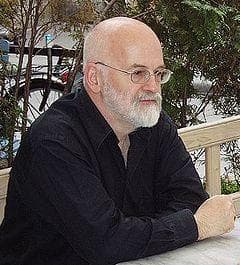
Sir Terence David John Pratchett was an English humorist, satirist, and author of fantasy novels, especially comical works. He is best known for his Discworld series of 41 novels.

Terry Pratchett (1990)
Genre
Fantasy / Science Fiction
Reading Time
12 Minutes
Key Themes
See below
Sign in to track this book
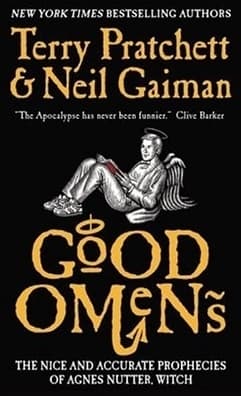
A fussy angel and a fast-living demon, who have grown quite fond of Earth, must race against time and misplaced paperwork to stop the Apocalypse they have accidentally grown to love.
The story begins with Aziraphale, an angel, and Crowley, a demon, who have lived on Earth since the Garden of Eden. Over thousands of years, they have become unlikely friends, often quietly undermining their respective headquarters while keeping up appearances. They have grown to like humanity and Earth's comforts, making them unwilling participants in the coming Apocalypse. The Antichrist's birth nears, and a detailed plan is put into action. The baby Antichrist is meant to be swapped at a hospital with the child of an American diplomat, Mr. Young. However, because of a mistake involving a Satanic nun, Sister Mary Loquacious, the Antichrist baby goes to the Young family, an ordinary English couple, instead of the diplomat's family. The real diplomat's baby goes to another family, and a third baby ends up with the diplomat.
Eleven years later, Adam Young, the Antichrist, grows up in the quiet village of Lower Tadfield, unaware of who he is. He is a mischievous but mostly normal boy, leading a group of friends known as 'The Them' (Pepper, Wensleydale, and Brian). Meanwhile, signs of the Apocalypse appear. The Four Horsemen of the Apocalypse – War, Famine, Pollution (who replaced Pestilence), and Death – start to gather. War appears as a beautiful, red-haired journalist who starts conflicts. Famine is a successful fast-food owner who creates unsatisfying, addictive food. Pollution is a young man who enjoys environmental decay. Death, always present, remains himself. Their gathering signals the start of the final battle, with humanity's future at stake.
Aziraphale and Crowley worry more as the Apocalypse gets closer. They realize the Antichrist, whom they were supposed to subtly guide over the years, is missing. They panic, figuring out the baby swap went wrong. They check Agnes Nutter's 'Nice and Accurate Prophecies,' a precise and often mysterious book by a 17th-century witch. These prophecies, always correct, offer clues but also confuse them more. Their search leads them to investigate various leads, including the Satanic convent where the mix-up happened, and eventually to the area around Lower Tadfield, though they still do not know Adam's true identity.
Anathema Device, Agnes Nutter's last descendant, arrives in Lower Tadfield, aiming to understand her ancestor's prophecies and stop the Apocalypse. She carries the only remaining copy of the 'Nice and Accurate Prophecies' and practices occultism. At the same time, Newton Pulsifer, a descendant of the Witchfinder Thou-Shalt-Not-Commit-Adultery Pulsifer who burned Agnes Nutter, also comes to Tadfield. Newton is a clumsy, somewhat ineffective computer technician who joined the modern Witchfinder Army, a mostly useless group. He is sent to investigate strange events, which leads him to Anathema. Despite their families' past rivalry, they are drawn together by the unfolding events and their shared goal of understanding the prophecies.
As Adam's eleventh birthday approaches, his hidden powers begin to awaken, unconsciously shaped by his surroundings and imagination. He wants a dog, and the universe, responding to the Antichrist's early will, provides one. A large, scary Hound of Hell appears, meant to serve its master and announce the end times. However, Adam, being a normal boy with normal dog expectations, wishes for a 'nice' dog. His innocent, powerful desire accidentally changes the fearsome hellhound into a small, friendly, if somewhat scruffy, terrier. This change further hides Adam's true identity from himself and from Heaven and Hell, who expect a more obviously demonic companion.
With the Apocalypse quickly approaching, forces from Heaven and Hell begin to gather in Lower Tadfield. The angels, led by the Archangel Gabriel, and the demons, led by Hastur and Ligur (at first), prepare for the final battle, each side sure of victory. Aziraphale and Crowley, still trying to find the Antichrist, are caught between their superiors and their growing hesitation to see Earth destroyed. Meanwhile, the Four Horsemen of the Apocalypse are now fully assembled, their powers growing, ready to unleash their destructive influence on the world. The stage is set for a confrontation, though no one, especially the Antichrist himself, fully understands who the players are.
As the world nears collapse, Adam's powers become stronger, though still largely uncontrolled. His thoughts and wishes subtly change reality around him, from creating a new continent in the Atlantic to affecting global news events. He is increasingly influenced by the ideas and talks within 'The Them,' especially their innocent but insightful comments about injustice and the state of the world. These conversations, filtered through Adam's developing omnipotence, start to shape his vision for the future, a vision that is neither completely good nor completely evil, but a child's desire to 'fix' things, often with chaotic results.
Newton Pulsifer and Anathema Device continue to work through Agnes Nutter's prophecies, slowly figuring out the nature of the coming disaster and Adam's key role. Their combined efforts, despite Newton's clumsiness, bring them closer to the Antichrist. At the same time, Aziraphale is briefly removed by his superiors for perceived disobedience, and Crowley is almost destroyed by his, both for failing to deliver the Antichrist and for being 'soft' towards humanity. They escape their punishments, more determined than ever to stop the Apocalypse, realizing their unique understanding of Earth is important.
The story's climax happens at a military airfield, chosen as the site for the final battle. All the main characters converge: Adam and 'The Them,' the Four Horsemen of the Apocalypse, the Witchfinder Army (led by Shadwell), Newton and Anathema, and eventually Aziraphale and Crowley. Heaven and Hell's forces are also there, ready for their grand conflict. Adam, now fully aware of his powers and identity, stands at the center of it all, with the world's fate in his hands. The Horsemen try to lead him towards destruction, while Aziraphale and Crowley try to appeal to his human side, and 'The Them' just want to play.
At the airfield, with all sides gathered, Adam Young makes his choice. Influenced by his human upbringing, his friends, and the quiet requests of Aziraphale and Crowley, he rejects the path of destruction and the predetermined Apocalypse. Using his immense, reality-bending power, Adam takes away the Four Horsemen's abilities, turning War's sword into a plastic toy, Famine's scales into a rusty hanger, and Pollution's sickly green glow into a healthy tan. Death, being absolute, remains, but cannot act without the others. Adam then confronts the representatives of Heaven and Hell, stating his independence and declaring that humanity should be left alone. He reshapes reality, stopping the Apocalypse, and establishing a new, more balanced world order.
With the Apocalypse stopped, Adam returns to his normal life, though now with a deeper understanding of his place in the universe. The forces of Heaven and Hell, confused by the unexpected outcome, try to punish Aziraphale and Crowley for their perceived betrayal. However, having expected this, the angel and demon cleverly swap bodies just before their 'executions.' Aziraphale, in Crowley's body, is bathed in holy water (which would destroy a demon), and Crowley, in Aziraphale's body, is subjected to hellfire (which would destroy an angel). Both survive, proving their innocence to their sides, who cannot understand the body swap. They return to their own bodies, free to continue their comfortable, if unusual, lives on Earth, having saved humanity.
Afterward, life largely returns to normal in Lower Tadfield and across the world, though with subtle changes from Adam's influence. Anathema and Newton start a relationship, continuing their work with the prophecies, now with a new perspective. The Witchfinder Army disbands. Aziraphale and Crowley resume their long-standing arrangement, enjoying earthly pleasures and keeping their unique balance. The book ends with a sense of peace, but also the understanding that while the immediate threat of the Apocalypse has passed, the universe remains a vast and unpredictable place. The characters navigate a world that is largely the same, yet changed by what they saw and did.
The Protagonist
Aziraphale starts as a reluctant participant in the celestial conflict and evolves into a decisive protector of Earth, willing to defy Heaven for the sake of humanity and his friendship with Crowley.
The Protagonist
Crowley transitions from a demon merely going through the motions to a proactive defender of Earth, demonstrating loyalty to his friend Aziraphale and a deep, if grudging, love for human existence.
The Protagonist
Adam begins as an ordinary boy, gradually realizing his extraordinary powers and destiny, ultimately choosing to defy cosmic forces and assert humanity's right to self-determination.
The Supporting
Anathema evolves from a solitary, prophecy-obsessed academic to a key player in averting the Apocalypse, finding unexpected companionship and a renewed purpose beyond her ancestral duty.
The Supporting
Newt transforms from a hapless, aimless individual into a surprisingly effective and brave participant in saving the world, finding love and purpose along the way.
The Supporting
Shadwell remains largely unchanged, a steadfastly eccentric character, but his actions inadvertently contribute to the greater good, and he finds a surprising, albeit platonic, companionship with Madame Tracy.
The Supporting
Madame Tracy's steadfast kindness and practicality remain consistent, but she experiences an unexpected spiritual journey when housing Aziraphale's essence, demonstrating her adaptability and open-mindedness.
The Antagonist
War remains a steadfast force of conflict until Adam disempowers her, reducing her flaming sword to a plastic toy, effectively neutralizing her destructive influence.
The Antagonist
Famine's power is neutralized by Adam, who transforms his scales into a rusty hanger, stripping him of his ability to induce spiritual and physical hunger.
The Antagonist
Pollution's sickly aura is transformed into a healthy tan by Adam, effectively reversing his power to cause environmental harm and making him a benign, if confused, figure.
The Antagonist
Death, being an ultimate force, cannot be 'defeated' by Adam, but his ability to act in the Apocalypse is nullified when the other Horsemen are rendered powerless, leaving him without a function in the averted end times.
The book powerfully reverses traditional ideas of good and evil, showing an angel and a demon who, after thousands of years on Earth, are more complex than their groups. Aziraphale and Crowley show that strict loyalty to 'good' or 'evil' can be less effective than practical cooperation and a real affection for humanity's messy existence. Adam, the Antichrist, ultimately chooses a path that is neither strictly angelic nor demonic, but human, suggesting that true morality comes from individual choice and rejecting set roles. The lines between Heaven and Hell blur, showing them as bureaucratic, often incompetent, and ultimately less concerned with humanity's well-being than the 'fallen' angel and demon.
“The point is, the only reason for doing anything you didn't have to do was to make things better. And the only reason for not doing things you didn't have to do was that there was no point.”
A main theme is the conflict between predetermined fate and the power of individual choice. Adam Young, meant to be the Antichrist and bring about the Apocalypse, ultimately rejects this fate, choosing to save the world based on his human upbringing and friendships. Similarly, Aziraphale and Crowley defy their respective headquarters, using their free will to protect Earth. Agnes Nutter's prophecies, while always accurate, are shown to be open to interpretation and can be fulfilled in unexpected ways, suggesting that even fate can be influenced by free will. The story implies that true power is not in following a script, but in making conscious decisions.
“His father had taught him that you could do anything you wanted to do, if you tried hard enough. Adam had tried hard enough.”
The novel is a deep appreciation for humanity and Earth, seen through Aziraphale and Crowley's eyes. They have grown to value everything from good food and music to human cleverness and unique customs. The coming Apocalypse is not just a cosmic event, but a personal tragedy for them, as it threatens to destroy everything they have come to cherish. The book celebrates the ordinary and extraordinary parts of human life, arguing that it is worth saving, not for any grand religious reason, but simply because it exists and is beautiful in its imperfections. Adam's choice to save the world is ultimately a choice to preserve humanity's varied and flawed existence.
“It may help to understand human affairs to know that the world was made by a benevolent god who had a lot of other things on His mind.”
The unlikely, centuries-long friendship between Aziraphale and Crowley is the emotional center of the novel. Despite being on opposing sides of the cosmic battle, their mutual affection, shared experiences, and practical understanding go beyond their assigned roles. Their loyalty to each other, and their joint loyalty to Earth, drives their actions more than any allegiance to Heaven or Hell. This theme is reflected in Adam's friendship with 'The Them,' which gives him the human values and perspectives that allow him to make his world-saving choice. The book suggests that deep, personal connections are more powerful than any divine or infernal command.
“They had been there since the Beginning. They had seen it all. And they had, in their own curious way, grown rather fond of each other.”
Both Heaven and Hell are shown as large, inefficient bureaucracies, full of petty rivalries, arbitrary rules, and a lack of understanding about human nature. The angels and demons often care more about paperwork and protocol than the actual results of their actions. This bureaucratic incompetence directly leads to the Antichrist mix-up and the chaos that follows. The forces of good and evil are portrayed as equally rigid and out of touch with reality, highlighting the absurdity of their grand plans when faced with the unpredictable nature of Earth and human free will. Their inability to adapt or truly understand the world they want to destroy (or save) is a major source of humor and plot development.
“The universe was a big place, and it was a bit of a miracle that anything worked at all.”
A book of infallible, yet cryptic, prophecies.
This ancient book, written by a 17th-century witch, is the primary source of information regarding the Apocalypse. Its prophecies are always accurate, but their meaning is often obscure, requiring careful interpretation. It serves as a plot driver, guiding characters like Anathema, Aziraphale, and Crowley, and creating suspense as its cryptic verses slowly reveal the unfolding events. The book's infallibility also underpins the theme of destiny, even as the characters work to subvert it, demonstrating that destiny can be fulfilled in unexpected ways.
The accidental swapping of babies at birth.
The central inciting incident of the plot, the Antichrist mix-up, where the baby Antichrist is delivered to the wrong family due to a series of comedic errors involving a Satanic nun. This device is crucial because it allows Adam to grow up as a normal human boy, unaware of his destiny, and thus gives him the free will to choose against the Apocalypse. It also provides the main source of panic and motivation for Aziraphale and Crowley, who spend years searching for the 'lost' Antichrist, completely unaware that he is living a mundane life a few miles away.
God's mysterious and ultimately incomprehensible design.
The 'Ineffable Plan' is a running joke and a philosophical concept throughout the book. It refers to God's grand design, which is supposedly beyond the understanding of angels, demons, or humans. This device serves to explain away any inconsistencies, illogical events, or unexpected outcomes, particularly when characters question why things are happening the way they are. It highlights the bureaucratic and often arbitrary nature of divine intervention, allowing for the narrative's comedic subversion of traditional religious dogma and emphasizing the idea that perhaps even God appreciates a good surprise.
Personifications of destruction who gather to herald the end times.
The Four Horsemen (War, Famine, Pollution, and Death) are classic apocalyptic figures, but they are given modern, often satirical, interpretations. They serve as tangible antagonists and harbingers of the end, their individual powers reflecting contemporary societal ills. Their gathering signals the increasing urgency of the plot. Their eventual defeat by Adam's will underscores the theme of humanity's power to overcome predetermined destruction, and the transformation of Pollution from Pestilence adds a contemporary environmental commentary to the ancient prophecy.
Ready to see how well you understood this book? Take our interactive quiz with 10 questions.
Sir Terence David John Pratchett was an English humorist, satirist, and author of fantasy novels, especially comical works. He is best known for his Discworld series of 41 novels.







