“Once is happenstance. Twice is coincidence. Three times is enemy action.”
— Bond's maxim for identifying patterns of suspicious events.

Ian Fleming (1958)
Genre
Thriller / Mystery
Reading Time
264 min
Key Themes
See below
Sign in to track this book
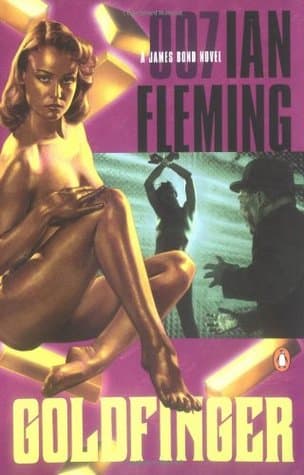
James Bond must outwit the villain Auric Goldfinger and his henchman, Oddjob, to prevent a gold heist that threatens to collapse the global economy and empower SMERSH.
James Bond, on leave in Miami, is asked by millionaire Junius Du Pont to investigate Auric Goldfinger, who Du Pont suspects of cheating at high-stakes canasta. Bond watches Goldfinger and his Korean henchman, Oddjob, and discovers Oddjob uses a hidden radio receiver to give Goldfinger information from a woman watching other players' hands. Bond confronts Goldfinger, forcing him to repay Du Pont and suffer public humiliation. This first encounter shows Goldfinger's ruthlessness and cunning, setting the stage for their future conflict. Bond recognizes Goldfinger as a man to watch.
Back in London, MI6 assigns Bond to investigate Auric Goldfinger, suspected of illegally smuggling large amounts of gold out of England. The Bank of England is concerned about the financial impact. Bond is briefed on Goldfinger's legitimate businesses, including industrial holdings and his love for golf. Bond's mission is to infiltrate Goldfinger's operations and find out how and where the gold is smuggled, leading him to believe Goldfinger is more than a simple smuggler, but a key player in a larger scheme that could affect the global economy.
Bond arranges a golf match with Goldfinger at Royal St. Mark's, where he subtly probes Goldfinger's character and business. During the game, Bond cheats to make Goldfinger lose a large wager, mirroring Goldfinger's own past deceit. More importantly, Bond observes Goldfinger's Rolls-Royce, which he suspects is central to the smuggling. Bond also has his first direct, dangerous encounter with Oddjob, who shows his deadly skill with his steel-rimmed bowler hat. This match confirms Bond's suspicions about Goldfinger's dishonest nature and the extreme danger posed by his bodyguard.
Bond follows Goldfinger's Rolls-Royce to a French port and, with a customs agent's help, uncovers Goldfinger's smuggling method. The car's bodywork is partly pure gold, melted and recast into vehicle components, allowing Goldfinger to transport vast amounts of gold disguised as a legitimate automobile. This discovery reveals the scale and cleverness of Goldfinger's operation, confirming him as a formidable and resourceful adversary. Bond now understands the smuggling mechanism but still needs to uncover the gold's ultimate destination and purpose.
Bond tries to get closer to Goldfinger's inner circle by staging a car accident near Goldfinger's industrial estate in Kent. Goldfinger's security, including Oddjob, then captures him. Bond is brought before Goldfinger, who reveals he knows Bond's true identity and purpose. Bond is tied to a table, and Goldfinger prepares to saw him in half with a circular saw, a chilling display of his cruelty. This scene raises the stakes, putting Bond in immediate mortal danger and emphasizing Goldfinger's lack of remorse.
Bond is spared from the saw, not out of mercy, but because Goldfinger has a use for him. Goldfinger forces Bond to become his secretary, revealing the details of 'Operation Grand Slam,' a plan to rob Fort Knox. Bond learns Goldfinger plans to use nerve gas to incapacitate guards and steal gold bullion. During this time, Bond meets Pussy Galore, the leader of an all-female gang of cat burglars and Goldfinger's personal pilot. Bond begins to plan how to thwart Goldfinger's scheme, realizing the immense threat to the global economy.
Bond, now Goldfinger's prisoner and 'secretary,' travels with Goldfinger's group to America, where preparations for Operation Grand Slam are in full swing. They establish a base near Fort Knox, and Bond observes Pussy Galore's Flying Circus, skilled female pilots who will deploy the nerve gas over the facility. Bond subtly tries to send a warning to the American authorities, using his limited freedom to plant a message, hoping to alert the CIA to the impending attack and give them a chance to prepare a defense against Goldfinger's plan.
Operation Grand Slam begins. Pussy Galore's Flying Circus sprays nerve gas over Fort Knox, seemingly incapacitating all personnel. Goldfinger and his gang, including Oddjob, begin their assault on the vault. However, unknown to Goldfinger, Bond's warning reached the CIA, who replaced the nerve gas with a harmless substitute and staged the guards' incapacitation. As Goldfinger and his men breach the vault, they are met by a prepared military force, leading to a massive shootout and chaos within Fort Knox.
A fierce battle erupts inside Fort Knox. Bond fights Oddjob hand-to-hand, eventually defeating him by using Oddjob's own deadly hat against him, electrocuting him with a live wire. Goldfinger tries to escape with a nuclear device, planning to detonate it and irradiate the gold, making it worthless for decades, thus increasing the value of his own hoard. Bond thwarts this final, desperate act, preventing further global economic destabilization. Pussy Galore, having developed respect for Bond, sides with him against Goldfinger.
Despite Operation Grand Slam's failure, Goldfinger escapes the chaos at Fort Knox. Bond, with Pussy Galore's help, pursues him. Goldfinger commandeers a private jet, intending to flee the country with a small amount of stolen gold. Bond, determined to finish the job, manages to get aboard the same plane, setting the stage for a final, personal confrontation between the two adversaries high above the Atlantic, away from the organized chaos of Fort Knox and the military response.
On board the private jet, Bond confronts Goldfinger. A violent struggle ensues in the confined space. Goldfinger, desperate and cornered, tries to kill Bond, but Bond gains the upper hand. During the fight, Goldfinger's gun discharges, causing cabin decompression. Bond overpowers Goldfinger, eventually pushing him out of the plane's open door to his death. Bond then takes control of the plane, bringing it down safely, ending Goldfinger's reign of terror and bringing the mission to a close.
The Protagonist
Bond begins by investigating a seemingly simple cheating scam, which escalates into preventing a global economic catastrophe, pushing his physical and mental limits.
The Antagonist
Goldfinger's schemes escalate from simple cheating and smuggling to an attempt to destabilize the world economy, ultimately leading to his downfall.
The Supporting
Oddjob remains a consistently deadly and loyal henchman throughout, ultimately dying in a struggle with Bond.
The Supporting
Pussy Galore shifts from Goldfinger's loyal accomplice to Bond's ally, ultimately helping to thwart Goldfinger's plan.
The Supporting
M remains a consistent, authoritative figure, guiding Bond's mission from afar.
The Supporting
Felix Leiter provides key support to Bond in America, demonstrating international cooperation against a global threat.
The Mentioned
Moneypenny's role is static, serving as a point of familiar interaction for Bond at MI6.
The novel's central theme is the destructive nature of unchecked greed, shown by Auric Goldfinger's obsession with gold. His entire life revolves around acquiring and hoarding the metal, leading him to commit increasingly bold and immoral acts. This obsession blinds him to the human cost of his schemes and fuels his desire for power, culminating in a plan that threatens global economic stability. Bond, in contrast, represents order against this chaotic, selfish pursuit.
“He thought of Goldfinger, the monstrous, the fantastic, the utterly evil human being he had been sent to destroy.”
Goldfinger explores the cold, calculating, and amoral nature of evil. Goldfinger is not driven by ideology but by pure self-interest and a complete lack of empathy. He sees people as tools or obstacles, shown by his willingness to saw Bond in half or use nerve gas on thousands of guards. His evil is ordinary yet terrifying, rooted in a twisted rationality that seeks to exploit and dominate. Bond's mission is not just to stop a crime, but to confront and defeat this pervasive, dehumanizing force.
“Goldfinger was a man who lived to break the law, to bend it to his will, to make it serve his own monstrous desires.”
A recurring theme is the deceptive nature of appearances. Goldfinger presents himself as a legitimate, if eccentric, businessman, but beneath this facade is a ruthless criminal mastermind. His Rolls-Royce, seemingly a luxury car, is actually a sophisticated smuggling device. Even Pussy Galore and her 'Flying Circus' appear as harmless entertainers but are key to a major heist. Bond's skill is seeing beyond these superficialities and uncovering the sinister truth, highlighting the constant need for vigilance and keen observation.
“The world was full of men who looked like innocent tourists but whose hearts were full of murder.”
The novel raises the stakes beyond a simple crime, showing Goldfinger's plot as a direct threat to global economic and political stability. Operation Grand Slam, the robbery of Fort Knox, is not just about stealing gold but about devaluing currency, destabilizing Western economies, and potentially empowering hostile forces (implied to be SMERSH, though not explicitly central to the plot). This theme highlights the broader geopolitical implications of Bond's missions, positioning him as a protector of national and international order against chaos.
“The entire economy of the Western world could be thrown into chaos.”
Goldfinger reveals his elaborate plan to Bond.
After capturing Bond, Goldfinger, rather than immediately killing him, takes the time to explain the intricate details of Operation Grand Slam. This device serves multiple purposes: it educates the reader about the villain's motivations and the full scope of the threat, creates dramatic tension as Bond is helpless to stop it, and provides Bond with crucial information he later uses to thwart the plan. It also highlights Goldfinger's arrogance and overconfidence, a common flaw in Bond villains.
Oddjob's deadly, steel-rimmed bowler hat.
Oddjob's bowler hat is a distinctive and memorable plot device. It serves as a visual identifier for the character, a symbol of his lethality, and a recurring threat to Bond. Its unique nature allows for dramatic action sequences and provides a specific challenge for Bond to overcome. Ultimately, the hat is turned against its owner, leading to Oddjob's demise, demonstrating Bond's resourcefulness and the poetic justice often found in Fleming's narratives.
Goldfinger's Rolls-Royce built with gold components.
The method of smuggling gold within the very structure of Goldfinger's Rolls-Royce is a clever and central plot device. It showcases Goldfinger's ingenuity and the lengths to which he will go, while also providing Bond with a tangible clue to investigate. This device highlights the theme of appearance versus reality and requires Bond to use his investigative skills to uncover the hidden truth, driving a significant portion of the early plot and establishing Goldfinger as a formidable adversary.
Pussy Galore, who shifts allegiance from Goldfinger to Bond.
Pussy Galore embodies the classic femme fatale archetype, initially presented as a dangerous, alluring woman allied with the villain. However, her character arc involves a crucial shift in allegiance. Bond's charm and his moral arguments convince her to betray Goldfinger, making her instrumental in the failure of Operation Grand Slam. This device adds complexity to the narrative, introduces a romantic element, and provides Bond with an unexpected and powerful ally at a critical moment.
“Once is happenstance. Twice is coincidence. Three times is enemy action.”
— Bond's maxim for identifying patterns of suspicious events.
“A woman's life is a series of compromises.”
— Pussy Galore reflecting on her life and choices.
“He liked his women to be dangerous, and she certainly was that.”
— Bond's assessment of Pussy Galore.
“There's a saying in the Services: 'If it ain't broke, don't fix it.'”
— Bond's practical approach to certain situations.
“All the great criminals have been men of genius, and men of genius are always eccentric.”
— Bond's observation on the nature of master criminals.
“Bond mistrusted anyone who used too many exclamation marks. It was a sure sign of an underdeveloped mind.”
— Bond's internal thoughts on written communication.
“He had a job to do. He would do it. And then he would forget it.”
— Bond's professional detachment to his missions.
“The world was a dangerous place, and he was one of the few who understood just how dangerous.”
— Bond's perspective on the global threats he faces.
“Goldfinger was a man who lived by his own rules, and those rules were simple: get rich, and get away with it.”
— Bond's summary of Goldfinger's motivations.
“He liked the feel of a gun in his hand. It was a friendly weight, a promise of power.”
— Bond's comfort with his service weapon.
“There was a certain satisfaction in knowing that he was the only man who could stop Goldfinger.”
— Bond's sense of responsibility and unique position.
“A man who thinks he knows everything is always disappointed when he finds out he doesn't.”
— Bond's internal thought about arrogance.
“He had seen too much, done too much, to be easily surprised.”
— Bond's world-weary experience.
“Money, to Goldfinger, was not a means to an end, but the end itself.”
— Bond's insight into Goldfinger's obsession.
Ready to see how well you understood this book? Take our interactive quiz with 10 questions.
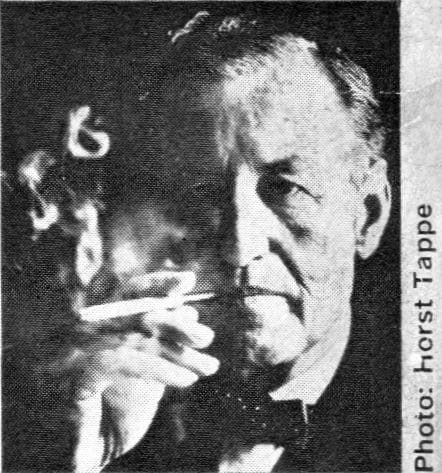
Ian Lancaster Fleming was a British writer, best known for his postwar James Bond series of spy novels. Fleming came from a wealthy family connected to the merchant bank Robert Fleming & Co., and his father was the Member of Parliament (MP) for Henley from 1910 until his death on the Western Front in 1917. Educated at Eton, Sandhurst, and, briefly, the universities of Munich and Geneva, Fleming moved through several jobs before he started writing.







