“All that you see is, to some extent, a product of what you are.”
— Spoken by 'Mo' during a conversation about perception and reality.

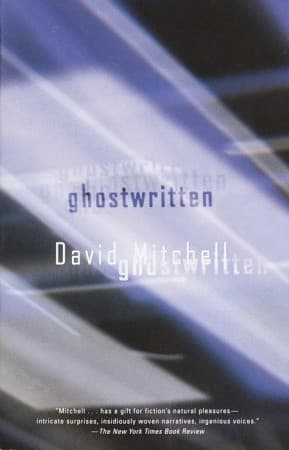
David Mitchell (1999)
Genre
Literary Fiction / Fantasy / Science Fiction
Reading Time
10-12 hours
Key Themes
See below
Sign in to track this book
Nine different lives across the globe, from a museum attendant to a Mongolian spirit, are subtly connected by a shared consciousness, showing the depth of human connection, creation, and destruction.
In St. Petersburg, Russia, Margarita Latunsky, a young gallery attendant, works at the Hermitage Museum. One night, while on duty, she meets a mysterious, older man who seems to know details about her life he shouldn't. He talks about connections and a larger pattern to existence, unsettling Margarita. Later, she finds a strange, almost alien object left behind, which she hides. This meeting leaves her disturbed and intrigued, suggesting a reality beyond her understanding and subtly introducing the idea of unseen forces in ordinary lives. Her unease is clear as she tries to understand the man's cryptic words.
Tokyo, Japan, introduces Quasar, a young man who loves jazz music and works at a record store. He is heavily influenced by a leader, 'The Imperium,' and involved with a cult called 'The Red Army Faction.' Quasar struggles with his identity, his love for jazz, and the cult's increasingly extreme ideas. He feels a growing conflict between his individuality and the group's will, suggesting a fight for self-rule against strong outside pressures. His story explores belonging, manipulation, and the search for meaning in a modern, often lonely, city.
Neal Brose is a cynical, corrupt British lawyer in Hong Kong, deeply involved in illegal activities. He arranges money laundering, drug deals, and other illicit transactions. His life is marked by greed and moral decay. However, his carefully built world begins to fall apart when a deal goes wrong, leading to betrayals and increasing danger. Neal must face the results of his choices, as his past catches up to him. He feels a growing sense of paranoia and isolation, realizing how unstable his position is and how fleeting the wealth he gained illegally is.
Bat Segundo is a late-night radio DJ in Manhattan, hosting a talk show where he thinks about life, music, and current events. He gets a call from a mysterious, philosophical listener who seems to know an unusual amount about him and his show. The caller's insights are unsettlingly deep, making Bat think about reality, coincidence, and the connections between human experiences. Through his talks and monologues, Bat explores the city and the diverse stories of its people, all while an unseen influence seems to subtly guide his thoughts and the direction of his show.
Mo Muntervary is an Irish quantum physicist working on an artificial intelligence project. She finds evidence of a global conspiracy involving a sentient, network-based entity known as 'The Spirit' or 'The Ghost,' which seems to influence events worldwide. Mo becomes a target as she investigates the mystery, realizing the deep impact of this entity's existence on humanity's future. Her story explores scientific ethics, the dangers of unchecked technology, and the fight for truth against powerful, hidden forces that try to control information and manipulate human society.
In rural China, Mrs. Lee, an elderly woman, runs a humble tea shack. She tells about her long and eventful life, marked by historical changes and personal hardships, including the Japanese occupation and the Cultural Revolution. She shares her wisdom and observations about humanity with her customers. One day, she meets a mysterious, seemingly ageless traveler who makes cryptic remarks about existence and connections, echoing themes from earlier in the novel. Mrs. Lee's story emphasizes resilience, the passage of time, and the human spirit amidst historical upheaval.
In Okinawa, Japan, an unnamed cult member, likely from a group similar to Aum Shinrikyo, prepares for a sarin gas attack on a subway system. This character is deeply indoctrinated, having lost their individual identity to the cult's ideas and its leader. Their story is chillingly detached, detailing the careful preparations for mass destruction, driven by a twisted sense of purpose and a belief in an apocalyptic vision. This section shows the dangers of cult manipulation, the loss of self, and the potential for human-made disaster, showing the destructive side of human connection.
Marco is a musician in London, trying to make a living by playing gigs and composing. He is passionate about music but faces constant money and creative problems. He has a creative breakthrough, seemingly inspired by an external, almost otherworldly influence, leading him to compose music that feels divinely inspired. This experience suggests a deeper connection to a universal creative force and the idea that art can be a way to transcendence. Marco's story explores the struggles and successes of artistic creation and the search for meaning through expression.
This section changes perspective to a disembodied, traveling spirit, called 'The Ghost' or 'The Spirit.' It moves across different lives and time periods, watching, and sometimes subtly influencing, the various characters introduced throughout the novel. The spirit's story provides a meta-perspective, showing how all the previous stories are connected and suggesting a larger, cosmic design. It explains its nature as a being that feeds on human consciousness and its cyclical journey of rebirth. This chapter connects the separate stories, offering a look into the overall mechanism that links the characters' fates.
The traveling spirit eventually finds itself in a new host, and through a series of events, the story returns to a familiar figure. It is revealed that the mysterious old man who visited Margarita Latunsky in the Hermitage, and the philosophical caller to Bat Segundo's show, were manifestations of this same traveling consciousness. The novel ends with the spirit thinking about its ongoing existence and its cycle of rebirth and influence, solidifying the idea that all the characters' lives are not just coincidental but part of a larger, connected design orchestrated by this entity. The ending supports the theme of cyclical existence and the subtle, yet deep, ways lives are interwoven.
The Supporting
From an ordinary attendant, she becomes an unwitting recipient of a mysterious object and a glimpse into a larger reality.
The Supporting
He struggles to maintain his individuality against the suffocating influence of a cult.
The Supporting
His life of corruption unravels, leading to paranoia and a reckoning with his past.
The Supporting
His worldview is subtly expanded by an unusual caller, making him ponder interconnectedness.
The Supporting
She uncovers a vast conspiracy and becomes a target, fighting for the truth.
The Supporting
She shares her life's wisdom and experiences a subtle, profound encounter with the supernatural.
The Supporting
Their identity is subsumed by a cult, leading them to participate in a horrific act.
The Supporting
He experiences a profound musical inspiration, hinting at a connection to a larger creative force.
The Protagonist
It continuously transmigrates, observing and subtly influencing human lives, revealing itself as the central, unifying consciousness.
The novel's main theme is the deep connection of all human lives, often appearing as random coincidences that are part of a larger plan. This is clear in how characters from different places and backgrounds are subtly linked, often through the traveling Spirit. For example, the mysterious old man Margarita meets in St. Petersburg and the philosophical caller to Bat Segundo's radio show are revealed to be the same entity, directly linking their seemingly isolated stories. This theme suggests that individual lives are threads in a vast, complex picture, rather than separate events.
““Coincidence is not a thing. It is a word we use when we cannot see the underlying pattern.””
Ghostwritten explores the nature of consciousness and identity. The traveling Spirit, which moves from host to host, directly questions what 'self' means and whether consciousness can exist without a physical body. Characters like Quasar struggle with their identity against a cult's overwhelming force, while the unnamed terrorist shows a complete loss of self. The novel proposes that identity is not fixed but can be influenced, shared, and even taken over, raising questions about free will and the limits of the individual mind.
““I am the sum of all my parts, but my parts are not me.””
The story shows a clear contrast between creation and destruction in human experience. On one hand, there is the creative drive of Marco the musician, inspired by an almost divine force, and Mo Muntervary's intellectual pursuit of knowledge. On the other hand, destructive impulses are shown by Neal Brose's corruption, Quasar's cult's violent ideas, and the sarin gas attack planned by the unnamed terrorist. The novel suggests that the same human desires for meaning and connection can lead to very different results, depending on how they are used.
““For every act of creation, there is an equal and opposite act of destruction.””
By presenting nine different stories across continents and cultures, the novel emphasizes the idea of a 'global village.' It highlights the shared human experiences and emotions that go beyond geography and culture, while also showing the unique details of each setting. From the Hermitage in Russia to a tea shack in China, and the busy streets of Tokyo to the radio waves of Manhattan, the novel paints a rich picture of global life. This theme shows how technology (like Bat Segundo's radio show or Mo's AI research) and even unseen forces can connect seemingly distant lives, creating a sense of shared humanity.
““The world is vast, but also small. It depends on your perspective.””
Independent stories linked by an overarching, unseen presence.
The novel employs a unique nested narrative structure, where each chapter presents a seemingly self-contained story from the perspective of a different character in a distinct location. These individual narratives are not overtly linked until later in the book, creating a sense of mystery and gradually revealing an overarching connection. The ultimate 'frame' is provided by the transmigrating Spirit, which is revealed to be the common thread, subtly influencing or observing each character's life. This device allows Mitchell to explore diverse genres and themes while building towards a unified, cohesive whole.
A disembodied consciousness that links all characters.
The Spirit, or 'The Ghost,' is the central plot device that provides the novel's structural and thematic cohesion. It is a disembodied consciousness that moves from host to host, observing and subtly influencing the characters' lives. This device allows Mitchell to justify the disparate narratives and explore themes of reincarnation, collective consciousness, and the hidden patterns of existence. The Spirit acts as an omnipresent, albeit often unseen, narrator, gradually revealing its nature and its role in connecting all the seemingly random events and individuals across the globe.
Seemingly random events that reveal a deeper, underlying pattern.
Mitchell uses coincidence not as a mere chance occurrence, but as a deliberate narrative tool to hint at a deeper, unseen order in the universe. Initially, the connections between characters appear to be accidental, but as the novel progresses, these 'coincidences' are revealed to be orchestrated by the transmigrating Spirit. This device challenges the reader's perception of randomness, suggesting that what appears to be chance is often a manifestation of a profound, interconnected web of causality. It reinforces the novel's central theme that nothing is truly isolated.
“All that you see is, to some extent, a product of what you are.”
— Spoken by 'Mo' during a conversation about perception and reality.
“There are books that are not books, you know. They're just living things.”
— Discussed by the character Satoru, a fan of books and stories.
“What is the Self? A congeries of memories, habits, beliefs, desires, and neuroses. It's a story you tell yourself.”
— A philosophical reflection on the nature of identity.
“Every life is a story. To live is to write it.”
— A recurring theme about the narrative quality of existence.
“The past is never dead. It's not even past.”
— A character's rumination on the lingering influence of past events.
“Chaos is what we've got. The only way to deal with it is to become a master of it.”
— A character's pragmatic approach to an unpredictable world.
“Every person is a book, and every book a world.”
— A thought expressed about the depth and complexity of individuals.
“We are all connected, you see. Like the threads of a vast, invisible web.”
— A character pondering the interconnectedness of lives and events.
“Stories are not escape. They are nourishment.”
— A discussion about the vital role of narratives in human experience.
“The universe is made of stories, not of atoms.”
— A philosophical statement on the fundamental nature of reality.
“Fear is a powerful force, but hope is stronger.”
— A character facing a difficult situation reflects on human resilience.
“To be truly free, you must first be truly lost.”
— A paradoxical statement about the journey towards self-discovery and freedom.
“History is a ghostwritten document.”
— A meta-fictional reflection on the nature of history and its narrators.
“We are all, in our own way, ghosts, haunting the present with our pasts.”
— A character's melancholic observation about memory and existence.
Ready to see how well you understood this book? Take our interactive quiz with 10 questions.
David or Dave Mitchell may refer to:







