“The wind was a raw hand, grabbing at my skirts and trying to snatch my bonnet.”
— Describing the weather upon arriving at the the house in the country.

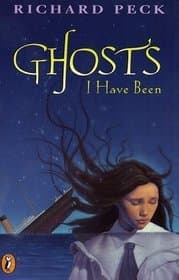
Richard Peck (1987)
Genre
Fantasy / Children's / Historical Fiction / Young Adult
Reading Time
90 min
Key Themes
See below
Sign in to track this book
In 1890s Bluff City, Blossom Culp, known for her made-up ability to see ghosts, faces a terrifying reality when her lie becomes truth, sending her as a spectral passenger onto the ill-fated Titanic.
Blossom Culp is a sharp, independent girl in 1914 Bluff City. She is known for her quick wit and navigating social circles, often clashing with the town's more respected people. To get ahead and avoid being an outcast, Blossom invents a story about having 'second sight' and being able to talk to the 'Unseen.' She uses this made-up ability to her advantage, subtly influencing situations and people. But this playful deception turns serious when Blossom truly starts seeing things others cannot, realizing her lie has become a surprising truth. She struggles to accept her initial fabrication with her unsettling new reality, which no longer feels like a game.
After Blossom's public claims of second sight, a strange invitation arrives from Miss Dabney, the town's quiet and unusual spiritualist. Miss Dabney, who has real psychic abilities, sees a similar spark in Blossom and wants to mentor her. This invitation both confirms Blossom's growing powers and scares her, as it forces her to face the truth of her 'gift.' During their first meeting, Miss Dabney shares specific details about Blossom's past and future that only someone with true second sight could know. This strengthens Blossom's belief in her own abilities and the seriousness of her situation. Miss Dabney becomes Blossom's reluctant mentor, guiding her through the initial confusion and fear.
Blossom's second sight grows stronger, moving beyond quick glimpses to full apparitions. One evening, looking in her mirror, she sees not her reflection but a pale, distressed young boy. This encounter deeply unsettles Blossom, as it is her first clear, undeniable interaction with a spirit. The boy seems trapped and communicates urgency and fear without words. This incident confirms to Blossom that her abilities are real and powerful, but also that they bring responsibilities and potential dangers. She begins to understand that these 'ghosts' are not just imagined but are beings with their own stories and troubles.
Under Miss Dabney's strict and unconventional teaching, Blossom starts to develop her second sight. Miss Dabney teaches her about different types of spirits, how to protect herself, and how to understand the often unclear messages from the 'Unseen.' Their sessions mix practical advice and spiritual guidance, often clashing with Blossom's practical and skeptical nature. Blossom first resists the discipline, preferring to use her abilities on her own terms, but slowly comes to respect Miss Dabney's wisdom and experience. This training helps Blossom understand the ethical aspects of her gift and the importance of using it responsibly, not just for personal gain or mischief.
During one of her more intense psychic experiences, Blossom gets a powerful vision of a grand ship, the R.M.S. Titanic. The vision is fragmented but clear: the ship is huge, luxurious, and full of people, yet there is a strong sense of coming doom and icy cold. This premonition deeply disturbs Blossom, as it suggests a major disaster on a scale she has never imagined. She shares her vision with Miss Dabney, who recognizes its importance and the chance for Blossom to become involved in a historical event. This vision marks a turning point, moving Blossom's ghostly encounters from local spirits to a larger, more impactful historical context.
Blossom's connection to the Titanic grows surprisingly strong. Through a powerful and unintended psychic projection, she finds herself aboard the R.M.S. Titanic, not as a physical passenger, but as a ghost observer. She can see and hear the other passengers, experience the ship's grand atmosphere, and feel the growing tension and excitement. This is a terrifying yet fascinating experience for Blossom, as she is a witness to history unfolding. She moves through the decks, observing the lives of various passengers, from the wealthy in first class to the hopeful immigrants in steerage, all unaware of the approaching disaster. Her presence is unseen by the living, yet she is undeniably 'there.'
As the Titanic crosses the Atlantic, Blossom, still in her spectral form, helplessly watches the ship hit the iceberg. She feels the jolt and hears the grinding sound, followed by initial confusion and disbelief among passengers and crew. She observes the crew's frantic efforts, attempts to keep order, and growing panic as the situation's reality sets in. Blossom sees individual acts of bravery and cowardice, the class divisions that remain even in the face of death, and heartbreaking goodbyes. The sheer scale of the tragedy and the human drama around her deeply affect Blossom, moving her beyond mere observation to a deep emotional connection with the doomed passengers.
Blossom watches in horror as the Titanic slowly sinks into the icy water. She is present for the final, desperate moments, witnessing the ship splitting and its ultimate plunge. As the ship goes down, Blossom is overwhelmed by the sudden appearance of countless new spirits—the souls of those who died. These new ghosts are disoriented, some still clinging to the idea of life, others filled with confusion and despair. Blossom, now surrounded by many fresh spirits, feels a deep sense of responsibility and empathy for their plight. She realizes her abilities are not just for seeing the past, but for helping the newly departed find their way.
In the chaotic aftermath of the sinking, Blossom finds her purpose. Instead of just watching, she begins to interact with the new spirits of the Titanic. She offers comfort, guidance, and understanding to those who are lost and confused. She helps a young mother find her child, reassures a frightened old man, and gently directs others toward peace. Blossom's initial fear of her gift changes into deep compassion and duty. She becomes a source of hope for these tragic souls, using her unique ability to provide some solace in their sudden, untimely deaths. Her interactions are subtle but impactful for the spirits.
After what seems like a long time aboard the doomed ship, Blossom is abruptly pulled back to her own time and body in Bluff City. The experience has left a lasting mark on her. She is no longer just the mischievous, quick-witted girl; she is a young woman who has seen immense tragedy and helped many souls. Her view on life, death, and her own abilities has deeply changed. She carries the weight of the Titanic's ghosts with her, understanding the true power and responsibility of her second sight. While her outward manner might still be lively, an inner maturity and a deeper understanding of the human condition now define her, making her a more empathetic and focused person.
The Protagonist
Blossom transforms from a mischievous, self-serving girl who feigns psychic abilities into a genuinely gifted and compassionate medium, using her powers to help others.
The Supporting
Miss Dabney serves as a catalyst for Blossom's development, sharing her wisdom and experience to help Blossom embrace her true potential.
The Supporting
Mama Culp remains a steadfast, grounding presence, providing a contrast to Blossom's fantastical experiences.
The Mentioned
The boy in the mirror is a static character, serving as an initial manifestation of Blossom's powers.
The Mentioned
These spirits are static, serving as a collective catalyst for Blossom's compassionate growth.
The novel explores accepting what is beyond normal understanding, especially through Blossom Culp's journey. At first, Blossom pretends to have psychic abilities to fit in or gain an advantage in Bluff City, a town that values conformity. But when her lie becomes real, she must face and eventually embrace a world unseen by others. Her friendship with Miss Dabney, an openly unconventional spiritualist, supports this theme, showing that there is wisdom and power in those who take a different path. Blossom's acceptance of her 'second sight' ultimately leads to her deep personal growth and ability to help others.
““It was one thing to tell a lie, and quite another to have the lie come true.””
As Blossom's second sight develops, she learns her gift comes with great responsibility. Her first use of her 'powers' is for mischief or social maneuvering. But her experience on the Titanic forces her to confront immense suffering and loss of life. Seeing the tragedy firsthand, and then interacting with the confused and frightened spirits, changes her. She moves beyond self-interest to deep compassion, using her abilities to comfort and guide the newly departed. This theme shows that true power is not in manipulation, but in empathy and the willingness to help those in need.
““She was no longer just Blossom Culp of Bluff City; she was a witness, a helper, a bridge between two worlds.””
Blossom Culp's journey is a powerful coming-of-age story, sped up and shaped by her supernatural abilities and her encounter with a historical tragedy. She starts as a rebellious and often self-centered teenager, trying to find her place in a small town. Her development of second sight, and especially her spectral journey to the Titanic, exposes her to life's fragility, the depth of human suffering, and the vastness of the unseen world. These experiences force her to mature quickly, building empathy, purpose, and self-awareness she lacked before. She returns to Bluff City a changed person, carrying the weight of profound understanding.
““The girl who had left Bluff City had seen too much to ever be quite the same.””
The novel shows history not as a distant past, but as a living presence that can affect the present. Blossom's ability to 'see' the Titanic is not just a vision; she is transported to the event, becoming an active, though unseen, participant. This allows the reader to experience the historical tragedy through a unique lens, highlighting the human stories behind the headlines. The lingering spirits of the Titanic further show that history's impact goes beyond its immediate moment, and that the past can continue to influence and interact with the present through those who perceive it.
““The past was not merely memory; it was a place where she could go.””
Blossom's ability to see and interact with ghosts, and to project her consciousness across time and space.
This is the central plot device, driving Blossom's entire journey. Initially, it's a fabricated ability, but it quickly becomes real. Blossom's second sight allows her to perceive spirits and communicate with them. More uniquely, it evolves into a form of psychic projection, enabling her to transcend physical boundaries and time, specifically transporting her consciousness to the R.M.S. Titanic. This device is crucial for both her character development and the unfolding of the plot, connecting her personal story to a major historical event and allowing her to act as a bridge between the living and the dead.
An experienced spiritualist who guides Blossom in understanding and controlling her abilities.
Miss Dabney serves as the classic mentor figure, providing Blossom with the knowledge, context, and discipline necessary to harness her erratic powers. Without Miss Dabney, Blossom would likely be overwhelmed or misuse her gift. The mentor-mentee relationship allows for exposition about the rules of the 'Unseen' world and provides a safe space for Blossom to explore her abilities. Miss Dabney's guidance is instrumental in Blossom's transformation from a mischievous girl to a responsible medium, ensuring she understands the ethical implications of her unique talent.
Early visions and feelings that hint at future events, particularly the Titanic disaster.
The novel uses foreshadowing, primarily through Blossom's premonitions, to build suspense and prepare the reader for the major historical event. Blossom's initial, vague glimpses of the Titanic gradually become clearer and more intense, creating a sense of impending doom. This device not only heightens the dramatic tension but also establishes the credibility of Blossom's increasingly powerful second sight. It allows the narrative to slowly draw Blossom (and the reader) into the tragedy, making her eventual 'presence' on the ship feel like an inevitable consequence of her developing powers.
The sinking of the R.M.S. Titanic serves as the pivotal event for Blossom's personal transformation.
The historical event of the Titanic's sinking is not merely a backdrop but a central catalyst for Blossom's character arc. By placing Blossom directly into this immense tragedy through her psychic projection, the story forces her to confront profound themes of life, death, and human suffering on a grand scale. Witnessing the event and interacting with the spirits of the deceased fundamentally changes her perspective, transforming her from a self-absorbed teenager into a compassionate and purposeful individual. The Titanic's sinking provides the ultimate test and proving ground for her nascent abilities and moral development.
“The wind was a raw hand, grabbing at my skirts and trying to snatch my bonnet.”
— Describing the weather upon arriving at the the house in the country.
“Being a ghost, I’ve learned, is more about being forgotten than being dead.”
— Wise observation from Blossom C. Culp about the nature of ghosts.
“There are things in this world that can’t be explained by science, and those are the very things that make life worth living.”
— Blossom's grandmother, a spiritualist, imparting wisdom.
“A good story, like a good haunting, never really leaves you.”
— Blossom reflecting on the power of narratives and experiences.
“Being a brave person doesn't mean you're not scared. It means you do what needs to be done even when you are.”
— Blossom's internal monologue while facing a difficult situation.
“The past isn't dead. It isn't even past. It's just waiting for you to find it.”
— A recurring theme in the book, emphasizing the enduring presence of history.
“You can't outrun your own shadow, and you certainly can't outrun a ghost who wants to be found.”
— Blossom grappling with a persistent spectral presence.
“Every house has its secrets, and some houses have more than their share.”
— Introduction to the mysterious nature of the mansion where Blossom stays.
“It’s a peculiar thing, to be a ghost. You see everything, but nobody sees you.”
— Blossom experiencing the unique perspective of being an unseen entity.
“Sometimes the greatest adventures happen when you least expect them, and in the most unlikely places.”
— Blossom reflecting on her unexpected journey into the supernatural.
“The world is full of wonders, if you only know where to look, and how to see them.”
— A lesson learned by Blossom about opening her mind to the unknown.
“A good fright is like a good laugh; it clears the cobwebs from your mind.”
— Blossom's pragmatic view on experiencing scary events.
“Being a ghost, I discovered, was a lot like being a child: you were often overlooked, but you saw everything.”
— Blossom drawing a parallel between her ghostly state and her youthful observations.
“Some truths are too big for words, and some secrets are too heavy to carry alone.”
— Blossom realizing the profound nature of the mysteries she uncovers.
Ready to see how well you understood this book? Take our interactive quiz with 10 questions.

Biography coming soon.







