“The only thing you have to fear is fear itself... and a couple of other things, maybe.”
— Jessie's internal monologue about fear.

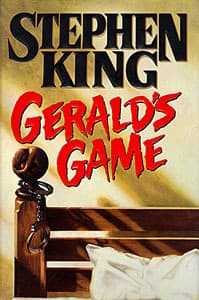
Stephen King (1992)
Genre
Thriller / Fantasy / Mystery
Reading Time
6-8 hours
Key Themes
See below
Sign in to track this book
Trapped and handcuffed to a bed in an isolated house with her dead husband beside her, Jessie must confront her darkest memories and a lurking, unspeakable horror to survive.
Jessie Mahout Burlingame and her husband, Gerald, arrive at their remote summer house on Dark Score Lake, Maine, for a weekend trip to improve their marriage. Gerald suggests a sexual role-playing game where he handcuffs Jessie to the bedposts. Jessie is uncomfortable at first but agrees, having played this game before. However, the game quickly turns sour as Gerald becomes aggressive, making comments about Jessie's past and her perceived frigidity. Jessie kicks him, and in the argument, Gerald has a heart attack and dies on the bed. Jessie is left alone, handcuffed, with her dead husband beside her.
After Gerald's death, Jessie's shock turns to terror as she realizes her situation. The remote location means no one will find her for days. Her attempts to free herself fail, causing her wrists to chafe and bleed. As night falls, her mind, lacking sleep and food, begins to break. She starts hearing voices: 'Goody,' a practical and encouraging alter ego; 'Ruth,' a critical and cynical voice; and the disembodied, mocking voice of Gerald himself. These internal dialogues reflect her rising panic and her struggle to stay sane while facing her grim reality.
As hours pass, a hungry stray dog, drawn by the smell of death, enters the house through an open door and begins to chew on Gerald's body. Jessie, horrified, tries to scare it away, but her efforts are useless. Her terror peaks when, in the middle of the night, she sees a figure in her bedroom doorway. This gaunt, disfigured man, whom she calls the 'Moonlight Man,' has glowing eyes and carries a box of trinkets and a glass of water. Jessie first believes him to be a hallucination, a manifestation of her darkest fears, but his presence is disturbingly real.
The extreme stress and isolation bring back repressed memories from Jessie's childhood, particularly a disturbing event during a total solar eclipse when she was ten. Her father, Tom Mahout, had taken her boating on the lake to watch the eclipse. During the moments of totality, he molested her. This traumatic event, long buried, resurfaces clearly, mixed with her current situation. The memory of the eclipse's darkness and her father's betrayal mirrors her current feeling of entrapment and helplessness, showing the deep psychological scars that have shaped her life and her relationships with men, including Gerald.
Dehydration becomes a serious threat, adding to Jessie's suffering. The Moonlight Man's glass of water taunts her. Driven by intense thirst, Jessie plans a desperate way to reach the glass of water on the bedside table. She realizes she needs to remove her wedding ring to create enough slack in the handcuff chain to extend her reach. Removing the ring becomes a symbolic breaking of her ties to Gerald and their shared life. Her attempts are agonizing, requiring her to dislocate her thumb and tear her flesh, but she eventually removes the ring.
With her wedding ring off, Jessie now has just enough extra slack in the handcuff chain. She focuses all her remaining strength and resolve on dislocating her thumb and wrist to slip her hand out of the cuff. The process is agonizingly painful, tearing skin and muscle, but her will to survive overcomes the physical torment. The voices in her head, especially Goody, urge her on. After a brutal struggle, she manages to free her right hand, leaving her wrist mangled and bleeding but finally unbound. The immediate relief is immense, but her ordeal is not over.
After freeing herself, Jessie collapses on the floor, momentarily overwhelmed by pain and exhaustion. However, the Moonlight Man's presence quickly returns. She sees him clearly this time, a real, terrifying figure with a strong stench, confirming he is not a hallucination. He is a necrophile who collects 'trinkets' from his victims. He approaches her, and in a desperate act of self-preservation, Jessie shatters the glass of water she had finally obtained and uses a shard to slash his face, driving him away. This confrontation confirms the external danger she faces.
Wounded and traumatized, Jessie crawls out of the bedroom, past Gerald's decaying body, and into the living room. She finds Gerald's car keys and, despite her injuries and disorientation, manages to start the car. She drives away from the house, leaving the horror behind, but her journey is full of fear and pain. She eventually reaches a local store, where she collapses and is found by the owner. The physical ordeal is over, but the psychological trauma, especially the resurfacing memory of her father's abuse and the terror of the Moonlight Man, continues to haunt her.
Jessie is hospitalized for her injuries and severe dehydration. While recovering, she gives a partial account of the events to the authorities, carefully leaving out details about the handcuffs and Gerald's games to protect her reputation. The police investigate the lake house, finding Gerald's body and evidence of a struggle, including the dog's scavenging. The incident is initially ruled an accident. Jessie's mental state remains fragile, and she struggles to reconcile the reality of her ordeal with the public narrative and her own repressed memories.
Driven by a need for closure and to understand the reality of the Moonlight Man, Jessie begins her own investigation after her recovery. She searches newspaper archives and police reports, eventually discovering that the 'Moonlight Man' is Raymond Andrew Joubert, a serial killer and necrophile responsible for several unsolved murders and grave desecrations across Maine. He has acromegaly, a condition that explains his disfigured appearance. This discovery confirms her sanity and the reality of her terror, confirming that he was not a hallucination, but a very real and dangerous predator.
Jessie decides to attend Raymond Andrew Joubert's trial, not as a witness, but as an observer seeking a final confrontation with her fear. Seeing him in person, stripped of the terrifying mystique he held in her mind, helps her process the trauma. She realizes that while he was real and dangerous, he was also just a man. During the trial, she makes eye contact with Joubert, and in that moment, she feels a sense of power and closure. Her attendance marks a significant step in her healing process, allowing her to reclaim her agency and move past the victimhood she had experienced.
Having confronted both the external horror of Raymond Andrew Joubert and the internal trauma of her childhood abuse, Jessie begins to rebuild her life. She writes a book, detailing her experiences, not just for herself but to help others who might have suffered similar fates. She acknowledges the lasting scars but also celebrates her resilience and survival. The experience, while horrific, leads her to a deeper understanding of herself and a new strength, allowing her to live authentically and free from the psychological chains that had bound her for so long.
The Protagonist
Jessie transforms from a psychologically repressed and physically trapped victim into a survivor who confronts her childhood trauma and reclaims her agency.
The Antagonist/Catalyst
Gerald's physical arc is brief and ends in death; his psychological arc as a tormentor of Jessie continues as a voice in her head, representing her internalized fear and guilt.
The Antagonist
Joubert appears as a terrifying, seemingly supernatural entity before being exposed as a very real and human monster, demystified by Jessie's investigation.
The Supporting/Inner Voice
Goody remains a consistent source of strength and practical advice for Jessie, helping her navigate the immediate crisis.
The Supporting/Inner Voice
Ruth's role is to challenge Jessie's optimism and force her to confront the direness of her situation, ultimately strengthening Jessie's resolve.
The Mentioned/Flashback Antagonist
Though only appearing in flashbacks, Tom's influence on Jessie's character arc is profound, as confronting his memory is key to her liberation.
The Mentioned/Flashback Character
Sally's character serves to highlight the devastating impact of denial and complicity on a victim's psyche, contributing to Jessie's internal struggles.
The Supporting
The dog's role is primarily to heighten the immediate horror and grim reality of Jessie's situation.
The novel explores the long-lasting effects of childhood trauma and psychological repression. Jessie's horrifying situation forces her childhood sexual abuse by her father during a solar eclipse to resurface. This repressed memory, symbolized by the 'eclipse' in her mind, has shaped her adult life, relationships, and sense of self. The book shows how buried trauma can appear in various forms, from emotional detachment to internal conflict, and how facing it is essential for healing and self-liberation. The voices in Jessie's head—Goody and Ruth—can be seen as fractured aspects of a mind dealing with unprocessed pain, finally brought to light.
“What you don't know can hurt you, what you do know can kill you.”
At its heart, 'Gerald's Game' is a story of survival against overwhelming odds. Jessie faces not only physical threats like dehydration, injury, and the Moonlight Man, but also immense psychological pressure, including isolation, fear, and the resurfacing of deep trauma. Her journey from utter helplessness, handcuffed to a bed, to actively fighting for her life shows extraordinary human resilience. The detailed descriptions of her efforts to free herself, even dislocating her thumb, highlight the primal will to live. Her eventual escape and subsequent investigation into the Moonlight Man show her transformation from victim to an active participant in her own recovery.
“Sometimes you have to go a long, long way out of your way to come back a short way correctly.”
Stephen King effectively uses Jessie's isolation to show the incredible and terrifying power of the human mind. Without external stimuli, Jessie's mind becomes her greatest ally and her worst enemy. Her hallucinations, including the critical 'Ruth' and the encouraging 'Goody,' illustrate the mind's ability to create internal support systems and process overwhelming information. The blurred lines between reality and hallucination—especially regarding the Moonlight Man—show the mind's fragility under extreme stress. Ultimately, Jessie's mental fortitude, her ability to analyze, plan, and endure, allows her to survive, demonstrating that the mind is both a prison and a key to freedom.
“The mind can be a wonderful tool, or it can be a terrible weapon.”
The novel begins with a game of control, with Gerald asserting dominance over Jessie through handcuffs, and this theme runs through the entire narrative. Gerald's desire to control Jessie, and the subsequent loss of that control through his death, sets the stage. Jessie then struggles with her lack of control over her physical situation, her body, and her own mind as repressed memories surface. The Moonlight Man represents an external force of ultimate violation and control. The recurring handcuffs symbolize not just physical restraint but also the psychological chains of past trauma and societal expectations that have bound Jessie. Her journey is about reclaiming control over her body, her past, and her future.
“The only way to beat the game is to stop playing it.”
A literal and symbolic restraint.
The handcuffs are the central physical plot device, directly trapping Jessie and initiating her entire ordeal. Beyond their literal function, they serve as a powerful symbol of Jessie's psychological entrapment: by her marriage, by her repressed trauma, and by her own passivity. Her struggle to free herself from them is not just a physical act of survival but a symbolic breaking of the chains of her past and a reclamation of her autonomy. The pain and effort involved in her escape underscore the difficulty of shedding psychological burdens.
The fragmented voices within Jessie's mind.
Due to her extreme isolation, Jessie's primary interactions are with the voices in her head: 'Goody' and 'Ruth,' along with the imagined voice of Gerald. This internal monologue serves multiple purposes: it provides exposition, reveals Jessie's past and psychological state, drives the plot forward by having her debate survival strategies, and showcases the fracturing of her mind under duress. These alter egos represent different facets of her personality, allowing the author to explore her character depth without external dialogue, while also blurring the lines between sanity and hallucination.
A recurring motif linking past trauma to present horror.
The solar eclipse functions as a powerful, recurring motif that links Jessie's past trauma to her present horror. The original eclipse marked the moment of her childhood sexual abuse by her father, becoming a symbol of a 'darkness' that overshadowed her life. Its resurfacing in her memory during her entrapment connects the past violation with her current vulnerability and feeling of being exposed and consumed. The 'ring of light' during totality also subtly mirrors the wedding ring she must remove, further intertwining the themes of trauma, memory, and liberation.
A manifestation of fear that blurs reality and hallucination.
The Moonlight Man initially appears as a terrifying hallucination, a grotesque figure that embodies Jessie's deepest fears of violation and death. This device effectively ratchets up the psychological horror, making the reader question Jessie's sanity. However, the eventual revelation that he is a real serial killer, Raymond Andrew Joubert, grounds the supernatural dread in a tangible, horrifying reality. This shift from imagined horror to concrete threat reinforces Jessie's resilience and provides a tangible enemy for her to overcome, ultimately validating her experience.
A physiological threat that intensifies desperation and hallucinations.
Dehydration is a critical physiological plot device that adds immense pressure and urgency to Jessie's struggle. The relentless thirst intensifies her physical suffering, making her pursuit of the glass of water a desperate, agonizing quest. Beyond the physical toll, dehydration contributes significantly to her mental deterioration, blurring the lines between reality and hallucination and making her more susceptible to the internal voices and the perceived presence of the Moonlight Man. It underscores the fragility of the human body and mind under extreme duress.
“The only thing you have to fear is fear itself... and a couple of other things, maybe.”
— Jessie's internal monologue about fear.
“The past is a wheel. If you don't learn from it, it will roll over you.”
— Jessie reflecting on her past traumas.
“Sometimes the things that hurt you the most are the things you can't see.”
— Jessie's realization about psychological wounds.
“There are no monsters under the bed, not really. But there are monsters inside us.”
— Jessie confronting her inner demons.
“A man's got to do what a man's got to do. And a woman's got to do what a woman's got to do, especially when no man is around to help.”
— Jessie's determination to survive on her own.
“The silence was the worst. It was a silence that ate at you, gnawed at you, until there was nothing left but the silence itself.”
— Jessie experiencing extreme isolation.
“Sometimes the only way out is through.”
— Jessie's mantra for enduring her ordeal.
“The world is full of things that can hurt you, but the most dangerous things are the ones you carry inside.”
— Jessie's internal struggle with her memories.
“You can never truly escape your past, but you can learn to live with it.”
— Jessie's eventual acceptance of her history.
“That's what fear does. It makes you do things you never thought you'd do.”
— Jessie observing her own extreme actions.
“There are times when the only thing that matters is not giving up.”
— Jessie's core belief during her ordeal.
“The mind is a powerful thing, capable of both creating and destroying.”
— Jessie's experience with her own mental state.
“Sometimes the greatest freedom is found in facing what you fear the most.”
— Jessie's ultimate liberation from her past.
Ready to see how well you understood this book? Take our interactive quiz with 10 questions.

Stephen Edwin King is an American author of horror, supernatural fiction, suspense, crime, science-fiction, and fantasy novels. Described as the "King of Horror", his books have sold more than 350 million copies as of 2006, and many have been adapted into films, television series, miniseries, and comic books. King has published over 65 novels/novellas, including seven under the pen name Richard Bachman, and five non-fiction books. He has also written approximately 200 short stories, most of which have been published in book collections.







