“There are some things you can't outrun. Some things that follow you, no matter how fast you go, or how far.”
— Reflecting on the past and its inescapable grip on the present.

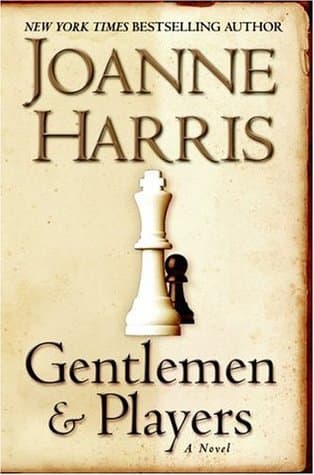
Joanne Harris (2006)
Genre
Thriller / Mystery
Reading Time
500 min
Key Themes
See below
Sign in to track this book
At an old British grammar school, a resentful former student returns as a teacher, carefully planning 'pranks' to destroy the school and get revenge on its traditional faculty.
Roy Straitley, a Classics teacher at St. Oswald's Grammar School for Boys for over thirty years, starts a new school year. He is a strong traditionalist, against the modern changes the new headmaster, Dr. House, is making. Straitley finds comfort in the familiar routines and the Latin language, which he teaches with passion. This term brings five new teachers, including a quiet English teacher named Mr. Wright, and a confident art teacher, Mr. Penny. Straitley, though he acts like he dismisses change, feels his age and the coming need to retire. The mood at St. Oswald's is one of change, with the old ways represented by Straitley, and the new, efficiency-focused approach championed by Dr. House, creating underlying tensions.
As the term continues, small, confusing incidents begin at St. Oswald's. Pens disappear, coffee mugs are moved, and personal items are subtly tampered with. These first events are dismissed as minor annoyances or student pranks. However, how often they happen and their targeted nature suggest a more deliberate hand. For example, Straitley's carefully arranged desk is disturbed, and Mr. Penny's art supplies are interfered with. The staff, especially Straitley, starts to notice a pattern, though they cannot find a cause or person responsible. The incidents are unsettling, creating a low sense of unease under the school's daily operations, and slowly wearing away the feeling of order and security.
The incidents become more serious, moving beyond personal annoyances to affect how the school runs. The school bell, a symbol of St. Oswald's tradition and order, is tampered with, ringing at wrong times and disrupting lessons. This is followed by false fire alarms, causing evacuations and major disruptions to the school schedule. These acts are clearly deliberate and harmful, no longer simple pranks. Dr. House, the headmaster, grows frustrated and calls for investigations, but no clear culprit appears. The increasing disruptions create a mood of suspicion among the staff and fear among the students, showing a more sinister plan at work within the school walls.
The sabotage campaign gets worse, directly targeting individual staff members. The staff room is vandalized, and personal belongings are stolen or damaged. Mr. Penny, the confident art teacher, becomes a main target. His classroom is defaced, and his reputation is slowly ruined through anonymous complaints and false evidence. This leads to a humiliating incident where his art exhibition is ruined, and he is accused of professional misconduct. Under great pressure and facing a formal inquiry, Mr. Penny is forced to resign, leaving the school under a cloud of scandal. His departure sends a chilling message to the other staff: no one is safe from the unseen perpetrator.
Troubled by the increasing events and Mr. Penny's forced resignation, Roy Straitley begins his own quiet investigation. Using his decades of experience at St. Oswald's, he watches the new teachers and studies the patterns of the attacks. He notices inconsistencies and strange behaviors, especially from Mr. Wright, the quiet English teacher. Straitley's suspicions are vague at first, but he senses a malevolent intelligence behind the disruptions, a 'player' in a game with the school as its board. He looks into the school's archives, searching for past events or forgotten grudges, believing the key to the present lies in the past. His investigation comes from a deep loyalty to St. Oswald's and a desire to protect its integrity.
Dr. House, the headmaster, finds himself in a difficult position. The constant disruptions, bad publicity, and low staff morale are getting unwanted attention from the school's board of governors. They demand answers and solutions, threatening Dr. House's career and the school's future. He puts in stricter security measures and starts internal investigations, but the perpetrator remains hidden. The pressure builds, making Dr. House desperate, caught between keeping order and keeping his authority. The board's scrutiny shows the severe impact of the 'game' on the school's public image and money, making the stakes very high for everyone involved.
Through his careful research and sharp observations, Roy Straitley finally identifies the perpetrator: Mr. Wright, the quiet English teacher. Straitley discovers that Mr. Wright is, in fact, Julian Thorogood, a former St. Oswald's student who suffered a traumatic and unfair expulsion decades ago. Julian had been wrongly accused of theft and expelled, his reputation and future destroyed, largely due to the carelessness and class snobbery of certain staff members and students. His return to St. Oswald's is a carefully planned act of revenge, a 'game' designed to systematically dismantle the institution he believes ruined his life. The 'incidents' were all part of his grand strategy to get retribution.
Julian Thorogood's reasons are rooted in a deep desire for revenge. As a scholarship student from a working-class background, he always felt like an outsider at St. Oswald's, a place of privilege and tradition. His expulsion, arranged by a vindictive teacher and a dismissive headmaster, not only ended his school career but also destroyed his self-worth. He spent years carefully planning his return, taking on the persona of Mr. Wright, a quiet and unassuming teacher, to get into the school. His strategy involved slowly ruining the school's reputation, causing disagreements among the staff, and ultimately bringing about its collapse, mirroring the destruction of his own life. His actions are not random but calculated moves in a long-awaited game of revenge.
Roy Straitley confronts Julian Thorogood, revealing that he knows Julian's true identity and his plan for revenge. The confrontation is full of emotion, as Julian, now exposed, confesses his long-held bitterness and the careful planning behind his 'game.' He details how each incident, from the missing pens to Mr. Penny's downfall, was a deliberate step in his strategy to dismantle St. Oswald's. Straitley tries to appeal to Julian's conscience, arguing that the school has changed, but Julian remains firm in his desire for complete destruction. Julian's final move involves exposing a major financial scandal, which he hopes will be the ultimate blow to the school's existence.
Julian's final act of exposing a significant financial problem throws St. Oswald's into a severe crisis. The school faces closure, its reputation in ruins, and its future very uncertain. Dr. House is dismissed, and the board struggles to deal with the consequences. Roy Straitley, despite the devastation, remains firm. He refuses to abandon the school, believing in its core values and the students. He takes on a more active interim role, gathering the remaining staff and students, and working to save what he can of St. Oswald's. The ending suggests a long and difficult road to recovery, but also highlights Straitley's strong dedication and the lasting spirit of the institution, though it is changed forever by Julian's revenge.
The Protagonist
Straitley moves from reluctant observer of change to the school's most ardent defender, ultimately becoming its unlikely savior in its darkest hour.
The Antagonist
Julian's character is revealed through his past, showing his transformation from a hopeful student to a vengeful mastermind.
The Supporting
Dr. House's arc is one of decline, from confident reformer to a desperate, ultimately defeated figure.
The Supporting
Mr. Penny's arc is a swift fall from grace, illustrating the ruthlessness of Julian's plan.
The Supporting
Cromwell mostly remains a static character, serving as a foil and confidante for Straitley.
The Mentioned
The Board's presence drives the plot's external conflict, their increasing pressure leading to Dr. House's downfall.
The main theme is Julian Thorogood's carefully planned revenge for a great injustice he suffered decades ago at St. Oswald's. His 'game' is an elaborate attempt to get retribution, believing that the school must pay for its past mistakes. The story explores the destructive nature of long-held grudges and the fine line between seeking justice and giving in to vengeful destruction. Julian believes his actions are justified, a rebalancing of scales, while Straitley argues for forgiveness and the school's ability to change. The story makes readers question if true justice can ever be achieved through such means.
“Audere, agere, auferre. To dare, to strive, to conquer. It was the school motto, but to me, it was a battle cry.”
This theme is seen in the conflict between Roy Straitley's strong traditionalism and Dr. House's attempts to modernize St. Oswald's. Straitley values the school's old ways, its Latin lessons, and its established routines, seeing them as the core of its identity. Dr. House, conversely, focuses on efficiency, technology, and a more business-like approach to education. Julian's revenge, ironically, targets both the old and the new, using the tensions between them. The story suggests that while tradition can be rigid and exclusive, modern approaches, without soul, can also be vulnerable and easily manipulated. The struggle shows how difficult it is to adapt without losing core values.
“The old ways were dying. And I, Roy Straitley, was a dinosaur, clinging to the last vestiges of a forgotten age.”
The novel subtly but strongly explores the theme of class and privilege within an elite grammar school. Julian Thorogood, a scholarship student from a working-class background, felt like an outsider and was ultimately hurt by the common class snobbery and an institution that favored its privileged students. His expulsion was not just a personal failure but reflected the systemic biases within St. Oswald's. The story contrasts the lives of those born into privilege, who often faced fewer consequences, with Julian's struggle, which was made worse by his social standing. This theme highlights the deep reasons for Julian's bitterness and the lasting impact of social injustice.
“They were gentlemen. I was merely a player, and the rules were never designed for me.”
Julian Thorogood's entire plan relies on a major act of deception, taking on the identity of 'Mr. Wright' to get into St. Oswald's. This highlights the theme of identity, both how it forms and how it can be changed. Julian carefully creates his new persona, hiding his true self and his past grievances for decades. The story explores the psychological cost of such long-term deception and the blurring of lines between the real self and the assumed identity. Straitley, in contrast, is firm in his identity as a traditional teacher, making his unchanging authenticity a contrast to Julian's elaborate disguise. The story questions what truly defines a person and how deeply one's past shapes their present.
“To become someone else, you first have to erase who you were. And then, you have to remember why.”
The past plays a crucial, almost overwhelming role in the novel. Julian's entire motivation comes from a traumatic event from his past at St. Oswald's, and he carefully revisits and reconstructs those memories to fuel his revenge. For Straitley, the past is a source of comfort and identity, but also contains the origins of the current crisis. The school itself is full of history and tradition, which both defines it and makes it vulnerable to past grievances. The story explores how memories, both personal and institutional, shape the present and determine the future, suggesting that unresolved issues from the past can return with devastating consequences.
“The past, they say, is a foreign country. But sometimes, it's just the classroom next door, waiting for you to walk back in.”
The story is told from multiple perspectives, primarily Straitley's, with hidden truths.
The novel employs an unreliable narrator, or rather, multiple narrators whose perspectives are gradually revealed to be incomplete or biased. The primary narrative is from Roy Straitley's point of view, colored by his traditionalism and initial obliviousness to the true nature of the events. Interspersed are chapters from the 'player' (Julian Thorogood), whose identity is concealed until late in the book. This dual narration, with one perspective actively hiding crucial information, creates suspense and allows for a dramatic reveal. The reader is led to make assumptions alongside Straitley, only to have them subverted when Julian's full story and identity are exposed, challenging the perceived reality of the events.
Misleading clues and characters divert attention from the true antagonist.
The author extensively uses red herrings to mislead the reader and Straitley about the identity of the perpetrator. Characters like Mr. Penny, with his ambition and occasional arrogance, are subtly presented in a way that makes them seem like plausible suspects for the minor disruptions, or even the target of a rival. The initial incidents are designed to appear as student pranks or general incompetence, diverting attention from the meticulous, long-term planning of Julian Thorogood. These misdirections build suspense and ensure that the reveal of Mr. Wright's true identity and motive is a genuine surprise, enhancing the mystery aspect of the thriller.
The audience is privy to information that characters are not, creating tension.
Dramatic irony is employed through the interspersed chapters told from the perspective of the 'player' (Julian Thorogood). These chapters, initially anonymous, give the reader insights into the perpetrator's thoughts, motivations, and the meticulous planning behind the 'game' long before Straitley or any other character understands the full scope of what is happening. The audience knows that the incidents are deliberate and part of a larger scheme, while the characters within the story are still dismissing them as isolated events or pranks. This creates a constant sense of tension and foreboding, as the reader watches the characters stumble towards a truth they are unaware of.
The antagonist views his revenge as a meticulously planned 'game' with rules and moves.
Julian Thorogood frames his entire revenge scheme as a 'game,' a meticulously planned series of moves and counter-moves designed to bring about the destruction of St. Oswald's. This plot device emphasizes his calculating nature and the intellectual battle between him and Straitley. The 'game' has 'players' (Julian and, unwittingly, Straitley), 'rules' (the school's vulnerabilities), and a 'board' (St. Oswald's itself). This metaphor elevates the conflict beyond simple sabotage, portraying it as a strategic, intellectual duel, making the antagonist's actions feel more deliberate and psychologically complex. It also highlights the antagonist's detachment and his view of the school and its inhabitants as pawns.
“There are some things you can't outrun. Some things that follow you, no matter how fast you go, or how far.”
— Reflecting on the past and its inescapable grip on the present.
“The past is a foreign country; they do things differently there.”
— A common literary allusion used to describe the changing nature of the school.
“A school is a small, self-contained world, with its own rules, its own hierarchies, its own cruelties.”
— Describing the microcosm of St. Oswald's.
“Revenge, like a good wine, needs time to mature.”
— A character's patient planning of their retribution.
“It's astonishing how quickly people forget, given the right inducements.”
— Referring to the ability to manipulate memories and perceptions.
“Every secret has a shelf life. Eventually, it spoils.”
— The inevitability of secrets being revealed.
“The truth is rarely pure and never simple.”
— Discussing the complex and often convoluted nature of events.
“A good game, like a good story, needs a twist.”
— Referring to the unfolding plot and the enjoyment of suspense.
“We are all, in our way, prisoners of our own making.”
— Reflecting on the choices that lead to one's current circumstances.
“Nostalgia is a powerful drug. It makes you remember things not as they were, but as you wish they had been.”
— Examining the deceptive nature of remembering the past.
“There’s a kind of madness that comes from living too long with a secret.”
— The psychological toll of hiding a profound truth.
“The greatest trick the devil ever pulled was convincing the world he didn't exist.”
— Used to describe the subtle and unseen influence of a manipulative force.
“Sometimes, the best way to hide is in plain sight.”
— A strategic approach to remaining undetected.
“You can change your clothes, your name, your address, but you can never truly escape who you are.”
— The enduring nature of identity despite attempts to change.
“Every game has rules. And every player knows them. Or learns them, one way or another.”
— Highlighting the underlying structure and expected behaviors within the school's social dynamics.
Ready to see how well you understood this book? Take our interactive quiz with 10 questions.

Biography coming soon.







