“Science without conscience is but the ruin of the soul.”
— Gargantua's letter to Pantagruel, urging him to pursue knowledge but also virtue.

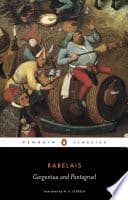
François Rabelais (2006)
Genre
Fantasy / Philosophy
Reading Time
2500 min (approx.)
Key Themes
See below
Sign in to track this book
Rabelais's tale of a giant prince and his philosophical son uses humor and obscenity to critique education, law, and religion, while celebrating human joy and the search for wisdom.
The story begins with a fantastical family tree, tracing giants through mythical figures like the Titans and Cain, to Grandgousier, King of Utopia, and his wife Gargamelle. Rabelais uses a mock-heroic tone, describing their enormous appetites and unusual lives. Gargantua's birth is especially strange: he is born through his mother's ear, a detail that immediately shows the work's absurd and carnivalesque nature. At birth, Gargantua instantly cries for 'Drink!' ('À boire!'), setting up his legendary appetite and the recurring theme of feasting and consumption. This opening establishes the mix of folklore, satire, and the grotesque that defines the series.
As a young giant, Gargantua shows great physical strength and a remarkable, though crude, intelligence. His early education is handled by incompetent and rigid tutors, mainly Master Tubal Holofernes and later Master Jobelin Bridé. These educators represent the strict, outdated scholastic methods of the Middle Ages, focusing on memorization, logical errors, and trivial details over practical knowledge or moral lessons. Gargantua learns little of value, spending his time idly and developing rough manners. His father, Grandgousier, eventually sees how useless this education is, noticing his son's lack of intellectual growth and refinement, leading him to seek a new, more enlightened approach for his son.
Grandgousier, unhappy with Gargantua's scholastic tutors, gives his son's education to the wise humanist scholar Ponocrates. Under Ponocrates in Paris, Gargantua changes greatly. His new curriculum is broad, including classical languages (Greek, Latin, Hebrew), natural sciences, mathematics, music, physical exercise, and moral philosophy. Ponocrates emphasizes practical use, observation, and a balanced development of mind, body, and spirit. Gargantua's daily routine is carefully planned, mixing study with physical activity, good hygiene, and intellectual discussions. This section directly supports Renaissance humanism, contrasting sharply with the earlier critique of scholasticism, and presents Rabelais's ideal for a well-rounded, virtuous prince.
The Picrocholine War begins because of a small fight over Foucace cakes between Grandgousier's shepherds and the people of Lerné, ruled by King Picrochole. Picrochole, driven by ambition and bad advice, uses this as a chance to invade Grandgousier's lands. Grandgousier, a peaceful ruler, tries to solve the conflict with diplomacy, offering payment and seeking peace, but Picrochole remains stubborn. Gargantua is called back from his studies to defend his home. The war satirizes the causes and conduct of war, showing the vanity, cruelty, and irrationality that often drive conflicts, while also allowing Rabelais to show the heroic and just leadership of Grandgousier and Gargantua.
After the Picrocholine War, Gargantua rewards the brave and unusual Friar John des Entommeures for his courageous defense of the abbey vineyard. Instead of giving him a traditional monastic position, Gargantua suggests building a new abbey, Thélème, designed on principles opposite to existing monasteries. Thélème is a utopian place where men and women live together, guided only by the rule 'Do What You Will' (Fay ce que vouldras). It rejects celibacy, strict schedules, walls, and vows, instead promoting freedom, beauty, learning, and noble pursuits. The inhabitants are well-born, intelligent, and attractive, living a life of leisure, intellectual discussion, and refined pleasure, representing Rabelais's humanist ideal of individual freedom and self-governance.
Pantagruel, the son of Gargantua and Badebec, is born in another unusual way, after his mother dies from eating too many tripes. His birth coincides with a great drought, which Pantagruel's huge thirst helps to ease. He grows quickly, showing immense strength and remarkable intelligence from a young age. Gargantua sends Pantagruel to various universities, ending in Paris, to complete his education. During his travels, Pantagruel meets many eccentric characters and gains knowledge, reflecting his father's humanist upbringing but with an even greater focus on intellectual curiosity and a critical view of established institutions.
While studying in Paris, Pantagruel meets Panurge, a quick-witted, poor, and notoriously mischievous character. Panurge is introduced speaking many languages, none of which Pantagruel initially understands, highlighting his worldly and cunning nature. Pantagruel takes Panurge into his service, recognizing his intelligence and resourcefulness, despite his playful and often morally unclear tendencies. Panurge quickly becomes Pantagruel's closest friend and confidant, offering comic relief, cynical comments, and a contrast to Pantagruel's more serious and philosophical manner. Their relationship forms the core of the later books, as Panurge's personal problems drive many of their adventures.
Panurge becomes obsessed with whether he should marry. He fears being cheated on and beaten if he marries and remains unsure about the wisdom of having a wife. This personal problem becomes the central plot for the third book, as Pantagruel and his friends go on a quest to find clear advice for Panurge. They consult many figures, including philosophers, theologians, doctors, judges, a Sibyl, a mute, a poet, and even a jester. Each consultation gives conflicting, unclear, or comically unhelpful advice, satirizing the limits of human wisdom and the pointlessness of seeking absolute certainty in matters of the heart.
Unable to find a clear answer to Panurge's marriage question on land, Pantagruel decides the only solution is to journey to the distant and legendary Oracle of the Dive Bouteille (Holy Bottle). This epic voyage becomes the focus of the fourth and fifth books. The expedition, on Pantagruel's ship, takes them through a series of fantastical islands and encounters with strange inhabitants, each representing a satirical comment on various aspects of society, religion, law, and human nature. This journey gives Rabelais many chances for allegorical storytelling, grotesque humor, and philosophical discussion, as the companions navigate both real and symbolic storms.
During their long voyage, Pantagruel, Panurge, Friar John, and their crew visit many islands, each with peculiar beings and customs. They meet the Cheliens (who live by the law of the strongest), the Gastrolaters (who worship their bellies), the Popegues (who devoutly worship the Pope's image), the Furred Law-cats (representing corrupt legal systems), and the Ringing Island (a satire on the clergy and their idle lives). These episodes are full of allegorical meaning and sharp satire, targeting specific institutions, social classes, and human flaws. Rabelais uses these fantastical encounters to criticize legal abuses, religious hypocrisy, gluttony, and the pursuit of power, keeping the carnivalesque tone while delivering strong social commentary.
Finally, after many trials, the companions reach the island of the Dive Bouteille. Inside a magnificent temple, they go down into an underground cave where the Oracle lives. The Oracle, a sacred bottle, gives its message: a single, echoing word – 'Trinch!' (Drink!). Panurge is at first confused, but Pantagruel, acting as interpreter, explains that 'Trinch' means not just physical drinking but also the pursuit of knowledge, truth, and inspiration, suggesting that the answer to Panurge's problem, and indeed to life's questions, lies in intellectual and spiritual exploration, freedom of thought, and embracing life with enthusiasm. The journey ends with this philosophical interpretation, leaving Panurge to make his own choice.
After the Oracle's pronouncement of 'Trinch!', Pantagruel explains its deeper meaning. He says that 'Trinch!' is a call to drink not just wine, but deeply from knowledge, wisdom, and experience. It encourages intellectual curiosity, open-mindedness, and the search for truth. For Panurge's specific question about marriage, Pantagruel suggests that 'Trinch!' means he should face life's challenges and joys, whatever path he chooses, with courage and a thirst for understanding. The answer's ambiguity reinforces Rabelais's humanist message that individuals must ultimately make their own decisions, guided by reason and a lively spirit, rather than relying on clear external pronouncements. The book ends with Panurge still thinking about his options, but now with a broader philosophical view.
The Protagonist
From an unrefined giant dulled by scholasticism, Gargantua transforms into a wise, cultured, and benevolent humanist king through enlightened education.
The Protagonist
Born into wisdom, Pantagruel further develops his philosophical depth and leadership, becoming a moral compass and interpreter of life's mysteries.
The Supporting
Panurge's character remains largely static in his roguishness and indecision, serving as a catalyst for philosophical discussions and satirical encounters.
The Supporting
Friar John remains consistently courageous and pragmatic, providing a grounded, action-oriented foil to the intellectual pursuits of his companions.
The Supporting
Grandgousier's arc demonstrates a ruler's growth in discerning wise counsel and prioritizing peace over conflict.
The Antagonist
Picrochole's arc is a cautionary tale of unchecked ambition leading to his inevitable defeat and downfall.
The Supporting
Ponocrates consistently embodies the ideal humanist educator, shaping Gargantua's transformation without undergoing significant change himself.
The Supporting
Epistemon maintains his role as the learned intellectual throughout the narrative, providing scholarly commentary and historical perspective.
The Supporting
Gymnast consistently demonstrates his martial skill and bravery, serving as a model of physical prowess and tactical acumen.
Rabelais supports Renaissance humanist ideals, especially through Gargantua's different educational experiences. The criticism of scholastic education (rote learning, trivial debates) strongly contrasts with Ponocrates's broad, balanced humanist curriculum, which focuses on classical languages, sciences, physical training, and moral philosophy. This theme advocates for a complete development of mind, body, and spirit, preparing individuals for active, virtuous lives, as seen in Gargantua's change into a wise ruler and Pantagruel's natural intellectual curiosity. The Abbey of Thélème further shows this, promoting freedom of thought and noble pursuits.
“Science without conscience is but the ruin of the soul.”
Rabelais uses his fantastical story and grotesque humor to offer sharp social and institutional criticism. He satirizes the legal system (the Furred Law-cats, the long and absurd legal cases), monastic life (through Friar John's anti-monasticism and the founding of Thélème), Church abuses (the Popegues, the Ringing Island), and the foolishness of war (the Picrocholine War, driven by minor causes and ambition). The various islands Pantagruel and his crew visit are allegories for human flaws and institutional corruption, revealing the absurdities and hypocrisies of his society.
“How many honest people are there in the world who are ruined, destroyed, and undone by the wickedness of others!”
The novel is deeply rooted in the carnivalesque tradition, marked by inversion, excess, bodily humor, and a celebration of the lower body. This appears in the giants' huge appetites, crude humor, explicit sexual references, and a general mood of joyful transgression. The grotesque body, with its open parts and focus on eating and excreting, is central. Examples include Gargantua's birth through his mother's ear, his use of a goose for wiping, and many descriptions of feasts and bodily functions. This theme challenges common ideas of decency and hierarchy, creating a world where the sacred and profane, high and low, constantly mix, reflecting a popular, earthy worldview.
“I drink to the thirst to come.”
A main theme, especially in the later books, is the search for knowledge and the elusive nature of truth. Panurge's intense quest for marriage advice, leading to the voyage to the Oracle of the Dive Bouteille, symbolizes humanity's search for clear answers. The journey itself, through different cultures and philosophical encounters, suggests that truth is often complex, unclear, and found through experience and open inquiry rather than simple statements. The Oracle's single word, 'Trinch!' (Drink!), interpreted by Pantagruel as a call to drink deeply from the well of knowledge and life, emphasizes that ultimate truth lies in intellectual curiosity, critical thinking, and a joyful engagement with the world.
“The greatest truths are those that are least understood.”
Rabelais explores good governance through the contrasting figures of Grandgousier and Picrochole. Grandgousier embodies the ideal ruler: peaceful, just, willing to negotiate, and concerned with his people's well-being and education. His efforts to avoid war and his generosity in victory highlight the virtues of a benevolent monarch. In contrast, Picrochole's ambition, impulsiveness, and openness to bad advice serve as a warning against tyrannical and self-serving leadership. The creation of Thélème also shows Rabelais's ideas on ideal societal organization, based on freedom and noble principles rather than force.
“It is better to make peace than to make war.”
A physical voyage serving as a framework for philosophical and satirical exploration.
The journey to the Oracle of the Dive Bouteille, undertaken by Pantagruel and his companions, is a central plot device. This physical quest for Panurge's marriage advice becomes a metaphorical journey through various allegorical islands, each representing different aspects of society, human folly, and intellectual debates. It allows Rabelais to introduce a wide range of characters, cultures, and philosophical discussions, providing a flexible framework for his extensive social and religious satire. The destination, the Oracle, is less important than the experiences and insights gained along the way, emphasizing the process of inquiry itself.
Exaggeration and bodily humor used for comic effect and social commentary.
Rabelais extensively employs grotesque humor and hyperbole, particularly in describing the giants' bodies, appetites, and bodily functions. Gargantua's prodigious birth, his immense thirst, his use of a goose for wiping, and the exaggerated descriptions of feasts and battles all serve to create a carnivalesque atmosphere. This device is not merely for crude comedy; it functions to invert social norms, challenge authority, and highlight the absurdities of human behavior and institutions. By presenting the world in an exaggerated, bodily-centric way, Rabelais encourages readers to look at reality with fresh, often critical, eyes.
Characters, places, and events that represent broader societal issues or human types.
Throughout the pentalogy, Rabelais uses satirical allegory to comment on specific institutions, professions, and human vices. The Picrocholine War, for instance, is an allegory for the irrationality and trivial causes of real-world conflicts. The various islands visited on the voyage to the Dive Bouteille (e.g., the Furred Law-cats representing corrupt legal systems, the Popegues representing religious dogma) are thinly veiled allegories for contemporary social and religious issues. This device allows Rabelais to deliver sharp critiques without direct condemnation, often cloaking his commentary in fantastical and humorous scenarios, making it both entertaining and thought-provoking.
Extended discussions and arguments that explore complex ideas.
Rabelais frequently uses philosophical debates and dialogues as a means to explore a wide range of intellectual and moral questions. Panurge's quest for marriage advice, for example, is primarily conducted through a series of consultations with various learned figures, each offering different perspectives (philosophers, theologians, doctors, etc.). These dialogues allow Rabelais to present different viewpoints, critique various schools of thought, and ultimately suggest the limitations of absolute certainty in complex matters. Pantagruel often serves as the arbiter or interpreter in these discussions, guiding the reader towards a more humanist and reasoned conclusion, as with the interpretation of 'Trinch!'
“Science without conscience is but the ruin of the soul.”
— Gargantua's letter to Pantagruel, urging him to pursue knowledge but also virtue.
“Do what thou wilt shall be the whole of the Law.”
— The inscription above the entrance to the Abbey of Thélème, a utopian institution.
“I drink for the thirst to come.”
— A jovial statement often attributed to the characters, reflecting their love of life and drink.
“Appetite comes with eating, and drinking with drinking.”
— A simple observation on the nature of desire and indulgence.
“The greatest gift of God is a good wife.”
— A statement made in discussions about marriage and the ideal partner.
“How can one be happy if he is not free?”
— A question posed during philosophical discussions on liberty and contentment.
“Always remember that time is money.”
— A pragmatic piece of advice given in the context of managing resources.
“To laugh is proper to man.”
— A foundational statement about the unique quality of human beings, often linked to the purpose of the book.
“Eat little, drink much, sleep well.”
— A simple prescription for a healthy and joyful life.
“The devil is not so black as he is painted.”
— A proverb used to suggest that things are often not as bad as they seem.
“I never go to bed without supper.”
— A humorous and characteristic statement reflecting the characters' hearty appetites.
“By the virtue of a thousand devils!”
— A common exclamation used by the characters, showing their boisterous nature.
“One day, when I was a little boy, I was walking along a road and I saw a snail.”
— A seemingly mundane opening to a story or reflection, highlighting the narrative style.
“The world is a comedy to those who think, a tragedy to those who feel.”
— A philosophical observation on different ways of perceiving life.
Ready to see how well you understood this book? Take our interactive quiz with 10 questions.
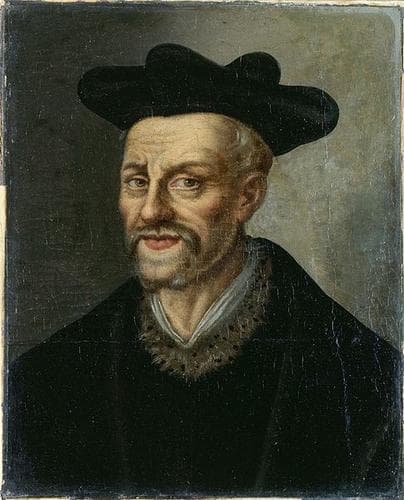
Biography coming soon.







