“The gardens were not just for food; they were for remembering.”
— Indigo reflects on the significance of the traditional gardens cultivated by her people.

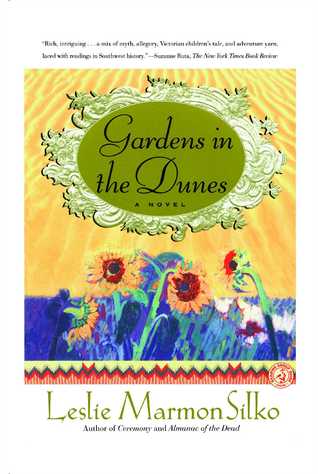
Leslie Marmon Silko (2013)
Genre
Literary Fiction / Historical Fiction
Reading Time
960 min
Key Themes
See below
Sign in to track this book
Orphaned by soldiers and adopted by an East Coast couple, a young Sand Lizard girl navigates the differences between her ancestral traditions and an encroaching white world, finding her identity through a globe-spanning journey and the wisdom of the earth.
The story begins with Indigo, a young girl of the Sand Lizard people, living a traditional life with her family in the dunes of the American Southwest. Her world involves a deep connection to the land, ancient stories, and the cultivation of unique gardens hidden within the desert. This peaceful life is interrupted when white soldiers arrive, destroying their homes, harming their sacred sites, and capturing many of the Sand Lizard people, including Indigo's mother and older sister, Sister Salt. Indigo escapes the initial raid but sees the destruction, which ends her childhood innocence and the traditional life she knows. She is eventually found and taken to a government Indian school, where she is forced to abandon her language and customs.
After a time at the harsh government school, Hattie and Edward Palmer, a well-meaning but somewhat naive white couple, 'rescue' Indigo. Hattie, an advocate for Native American rights and a botanist, sees Indigo as a chance to prove her progressive ideals. Edward is a wealthy scholar interested in ancient cultures and plants. They take Indigo into their home, planning to educate her in white society's ways, believing they are offering her a better life. Indigo struggles to adapt to their Victorian customs, the rigid schedule, and the suppression of her natural instincts, but Hattie's kindness and Edward's intellectual curiosity about her heritage begin to form an unusual bond between them.
Edward's scholarly work leads the couple, with Indigo, on an extensive journey. They first travel to New York, where Indigo experiences urban life, a contrast to the desert. Later, they go on a grand tour of Europe. Indigo, often quiet, observes keenly. She sees the wealth and class structures of European society, visits botanical gardens, and sees ancient artifacts in museums. This exposure to diverse cultures and histories broadens her understanding of the world beyond her desert home and the American frontier, even as she secretly holds onto her Sand Lizard identity and memories.
The journey continues to Brazil, specifically the Amazon rainforest, as Edward looks for rare and ancient plants for his botanical studies. This environment, though different from her desert home, connects with Indigo's deep relationship with nature. She observes indigenous communities and their traditional ways, seeing similarities with her own people's connection to the land. During this time, Edward's interest in 'primitive' cultures also leads him to appreciate Indigo's innate knowledge and resilience, though he still struggles to fully bridge the cultural divide. Indigo, meanwhile, finds a temporary sense of belonging in the lush, untamed wilderness.
While Indigo is traveling, her older sister, Sister Salt, endures the hardships of forced assimilation and abuse at the hands of white captors. Driven by her spirit and the memory of her family's traditions, Sister Salt eventually escapes. She journeys, relying on her knowledge of the land and the kindness of other Native Americans, as well as some sympathetic white individuals. Her path involves survival, resistance, and an effort to reconnect with her people and their ancestral lands, facing constant threats and the erosion of her culture.
Throughout their travels, Hattie, initially confident in her progressive views, gradually confronts the complexities and injustices of colonialism. She sees the exploitation of indigenous peoples in Brazil and the superficiality of European society. Her interactions with Indigo, and her growing awareness of the cultural divide between them, make her question her own assumptions and the effectiveness of her 'civilizing' mission. She begins to understand that 'helping' Indigo might have alienated her from her true heritage, leading to guilt and a reevaluation of her life's purpose and her relationship with Edward.
After years abroad, the Palmers and Indigo return to the American Southwest. Edward still pursues his botanical research, now with a deeper, if still academic, appreciation for indigenous knowledge. Hattie increasingly focuses on finding a way to make amends for her past actions and to genuinely support Native American communities. Indigo, now older and having gained much worldly experience, feels a pull back to her ancestral lands and the hope of finding her family, especially Sister Salt. The desert, once a place of childhood, now represents memory, loss, and potential reunion.
Upon their return to the Southwest, Indigo, with Hattie's support and Edward's resources, begins her search for Sister Salt. She uses her knowledge of the land and the subtle clues of her people's movements, combined with her understanding of the larger world, to navigate the region. This search is not just for her sister, but for her roots, her identity, and the remnants of her culture. She encounters various Native American communities, some displaced, others holding onto their traditions, gathering information that guides her path.
Indigo and Sister Salt finally reunite. Their reunion is a moment of shared grief, resilience, and renewed hope. Sister Salt, having survived years of hardship, has also kept the knowledge of their people's sacred gardens and planting traditions. Together, they begin the task of restoring their ancestral lands and the hidden gardens in the dunes. This act of planting is not just agricultural; it is an act of cultural reclamation, resistance, and shows the spirit of the Sand Lizard people. Hattie, having fully committed to supporting them, provides resources and protection.
With Hattie's assistance and Edward's eventual, if more distant, support, Indigo and Sister Salt establish a new community rooted in their ancestral traditions but also selectively incorporating elements from the outside world. They become guardians of their heritage, teaching the younger generation the importance of their language, stories, and the sacred gardens. The story ends with the sisters, embodying both the ancient wisdom of their people and the broader understanding gained through their experiences, cultivating not only the physical gardens but also a resilient future for the Sand Lizard people, showing the power of cultural endurance and adaptation.
The Protagonist
From a traditional Sand Lizard child, she evolves into a worldly woman who bridges cultural divides, ultimately reclaiming and revitalizing her heritage.
The Supporting
She transforms from a captured victim into a powerful guardian of her people's traditions, leading the effort to restore the ancestral gardens.
The Supporting
From a well-meaning but culturally insensitive 'savior', she evolves into a self-aware and actively supportive ally for Native American self-determination.
The Supporting
His academic interest in 'primitive' cultures gradually deepens into a more respectful, though still somewhat detached, appreciation for indigenous knowledge and resilience.
The Supporting
Her influence remains constant throughout Indigo's journey, serving as an unwavering spiritual and cultural guide, even in absence.
The Supporting
Her role is primarily to demonstrate the harshness of the government schools and the solidarity among the children, providing a brief but impactful connection for Indigo.
The Supporting
Her character remains consistently kind and observant, serving as a subtle bridge of humanity for Indigo within the Palmer household.
The Mentioned
As a mythological figure, he has no personal arc but consistently represents the enduring wisdom and worldview of the Sand Lizard people.
The novel explores Indigo's journey to define her identity amidst conflicting cultural influences. Taken from her Sand Lizard heritage and exposed to European and American societies, Indigo constantly navigates the tension between assimilation and cultural preservation. Her internal struggle is clear in her silent observations, her adherence to her memories, and her ultimate return to her roots. The theme is also reflected in Hattie's self-discovery, as she re-evaluates her own biases and role in the colonial project.
“She had learned to be still and to watch, to collect the details of this new world while holding fast to the memory of her own.”
At its heart, the book shows the resilience of indigenous cultures in the face of destruction and assimilation. The Sand Lizard people's sacred gardens symbolize their deep connection to the land, their spiritual beliefs, and their way of life. Indigo and Sister Salt's efforts to restore these gardens are acts of cultural reclamation, showing that tradition can endure and even flourish despite immense pressures. The oral traditions and stories, particularly those of Grandma Fleet and Old Man Chaos, also help preserve the culture.
“The stories were seeds. They contained everything, all the knowledge and the memory of the land.”
The novel portrays the devastating impact of colonialism on Native American communities, from the initial violence and land dispossession to the forced assimilation of government schools. It also critiques the 'benevolent' colonialism practiced by characters like Hattie, whose good intentions are initially marred by cultural ignorance and a desire to 'civilize.' The global journey highlights the widespread nature of colonial power structures, seen in Brazil and Europe, and the exploitation of indigenous peoples and their resources worldwide.
“They thought they were saving her, but they were only erasing her.”
Nature, particularly the desert and its hidden gardens, is a source of healing, identity, and spiritual connection for the Sand Lizard people. Indigo's memories of the gardens and her eventual return to them are central to her recovery and the revitalization of her culture. Even in the Amazon, the rainforest offers a different, yet powerful, connection to the earth. Hattie, as a botanist, also finds solace and understanding in the natural world, suggesting a human need for this connection, but the Sand Lizard relationship is sacred.
“The desert held the secrets, but it also held the healing.”
The novel explores various forms of family—the traditional Sand Lizard kinship, the adoptive family of Hattie and Edward, and the chosen family Indigo and Sister Salt eventually build. Indigo's longing for her birth family, especially Sister Salt, drives much of her journey. The reunion of the sisters is an affirmation of blood ties and shared heritage. The evolving relationship between Indigo and the Palmers also shows how belonging can be formed across cultural divides, with challenges and lessons learned on all sides.
“Family was not just blood; it was the stories shared, the land remembered, and the hands that planted together.”
Juxtaposes traditional Sand Lizard worldview with Western perspectives.
The narrative frequently shifts between Indigo's internal, often silent, observations and the external, dominant white perspective. This device highlights the stark cultural contrasts and the misunderstandings that arise. Indigo's silent wisdom often serves as a counterpoint to the verbose, often ethnocentric, views of Hattie and Edward, allowing the reader to experience the world through two radically different lenses. This contrast underscores the novel's themes of colonialism and cultural identity.
Represents cultural heritage, resilience, and spiritual connection.
The hidden gardens of the Sand Lizard people are central to the novel's symbolism. They represent not just sustenance, but also cultural identity, spiritual connection to the land, and the deep, ancient knowledge passed down through generations. The specific plants, like corn, are imbued with sacred meaning. Their destruction symbolizes the colonial assault on indigenous culture, and their eventual replanting by Indigo and Sister Salt signifies cultural reclamation, healing, and enduring life. Hattie's botanical interests also connect to this, highlighting a different, scientific appreciation for plants.
Represents a quest for identity, knowledge, and spiritual return.
Indigo's physical journey across continents (America, Europe, Brazil) is a powerful metaphor for her internal journey of self-discovery and cultural negotiation. Each new location exposes her to different facets of the world, broadening her understanding while simultaneously reinforcing her connection to her origins. Her return to the Southwest is not just a homecoming but a spiritual and cultural re-engagement, a completion of her arc from displacement to rootedness. The journey also represents Hattie's evolving understanding of the world and her own biases.
Preserves cultural knowledge and provides a moral framework.
The stories, myths, and oral traditions of the Sand Lizard people, particularly those recounted by Grandma Fleet and featuring figures like Old Man Chaos, are crucial to the narrative. These stories are not merely entertainment; they are repositories of history, spiritual belief, practical knowledge, and moral lessons. They provide Indigo and Sister Salt with a continuous link to their heritage and a framework for understanding the world, even when physically separated from their people. This device emphasizes the enduring power of indigenous knowledge systems.
More than a setting, it is a character reflecting the Sand Lizard people's spirit.
The American Southwest desert is not merely a backdrop; it is presented as a living, breathing entity with its own spirit, wisdom, and challenges. For the Sand Lizard people, the desert is their home, their provider, and an integral part of their spiritual identity. Its harshness mirrors the hardships they face, while its hidden beauty and resilience reflect their own. Indigo's deep connection to the desert grounds her throughout her travels and ultimately calls her home, embodying the profound relationship between indigenous peoples and their ancestral lands.
“The gardens were not just for food; they were for remembering.”
— Indigo reflects on the significance of the traditional gardens cultivated by her people.
“The white people think they own the land, but the land owns them.”
— Sister Salt observes the contrasting relationships to land between Indigenous and settler cultures.
“In the desert, water is life, and life is water.”
— Description of the harsh yet vital environment of the dunes where the characters live.
“We are the sand, the wind, the rain—we are the gardens.”
— A spiritual reflection on the interconnectedness of people and their environment.
“The old stories are like seeds; they must be planted to grow.”
— Grandma Fleet teaches Indigo about the importance of preserving oral traditions.
“Freedom is not given; it is taken, like water from a dry riverbed.”
— Sister Salt's defiant thoughts on autonomy and resistance.
“Every plant has a story, and every story has a root.”
— Indigo learns about the medicinal and cultural knowledge associated with native plants.
“The world is a garden, and we are its keepers.”
— A philosophical moment highlighting human responsibility toward the earth.
“They tried to bury us, but they didn't know we were seeds.”
— A resilient declaration in the face of cultural suppression and displacement.
“In the silence of the dunes, you can hear the voices of the ancestors.”
— A meditative passage describing the spiritual presence in the landscape.
“To forget the gardens is to forget who we are.”
— A warning about the loss of cultural identity through neglect of traditions.
“The wind carries the seeds of change, and we must be ready to plant them.”
— A hopeful reflection on adaptation and the future.
“We do not own the land; we belong to it.”
— A fundamental Indigenous belief contrasted with Western concepts of property.
“The gardens in the dunes are a rebellion against forgetting.”
— Describing the act of maintaining traditional gardens as an act of cultural resistance.
Ready to see how well you understood this book? Take our interactive quiz with 10 questions.

Biography coming soon.







