“I was born into the world with a hunger for more, and it has never left me.”
— Julie's early reflection on her ambition and desire for a life beyond the ordinary.

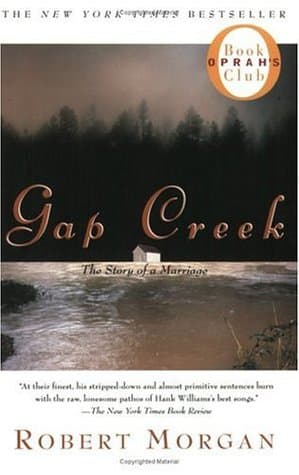
Robert Morgan (1999)
Genre
Literary Fiction / Historical Fiction / Romance
Reading Time
9-10 hours
Key Themes
See below
Sign in to track this book
In the late 19th-century Appalachian mountains, a young bride fights natural disasters, treachery, and a new marriage, hoping love can keep her from falling into madness.
Seventeen-year-old Julie Harmon lives with her family in the mountains, doing tough chores. She handles tasks usually for men, like hog slaughtering and farm work. Her father, a preacher, is often away, leaving Julie and her mother with much of the responsibility. Her sister, Lily, is often sick, and her brother, Billy, is young. Julie's life is defined by constant work and a strong sense of duty, often feeling she has no choice but to keep going, driven by her family's needs and the harsh reality of their lives. She dreams of a different life, one with less hardship and more personal satisfaction.
During a rare trip to town, Julie meets Hank Richards, a charming young man who works at a sawmill in Gap Creek. Their courtship is short but intense, marked by stolen moments and a shared desire for a future together. Hank is drawn to Julie's strength and practical nature. Julie is drawn to his kindness and the promise of a life away from her family's mountain farm. Their connection offers Julie a glimpse of a different existence, where she might be a wife and not just a laborer, and where love could offer a break from her constant work.
Julie and Hank marry and move into a small, rented house near the sawmill where Hank works in Gap Creek. This transition is both exciting and challenging for Julie. She leaves behind her familiar, hard life on the mountain for an uncertain future in the valley. Their new home is simple, and their first days are filled with the joys of new marriage and the challenges of setting up their own household. Julie quickly learns to manage their few resources, adapting her mountain skills to their new environment. But the valley brings its own difficulties, from unfamiliar social dynamics to unpredictable natural forces.
Life in Gap Creek quickly becomes challenging. Julie and Hank face a series of misfortunes that test their strength. A fire destroys their rented home and almost all their belongings, leaving them homeless and deep in debt. This event is a major blow, forcing them to rebuild their lives from nothing. They find temporary shelter and must rely on others' kindness, which often comes with judgment and unwanted advice. Julie's practical nature is pushed to its limits as she deals with despair and the overwhelming task of recovering from such a loss.
After the fire, Julie and Hank are burdened by debt and need new housing. They move into another small, rundown house. Hank works tirelessly at the sawmill to repay what they owe. Julie, despite her own exhaustion, continues to manage the household and find ways to get by, often through bartering or making do with very little. The constant financial strain and physical demands of their lives begin to wear on them, causing moments of tension and disappointment. They realize that their dreams of a simpler, happier life might be harder to achieve than they imagined.
Hank's Aunt Marthie, a demanding and critical woman, arrives and quickly makes herself at home with Julie and Hank, making their strained living situation worse. Aunt Marthie constantly offers unwanted advice and judgment, criticizing Julie's housekeeping and methods. Her presence adds immense emotional and practical pressure to the young couple. Julie, used to independence, finds herself trying to please Aunt Marthie while also trying to keep her own identity and her relationship with Hank, who struggles to mediate between the two women.
Amidst their struggles, Julie becomes pregnant, bringing both hope and worry. However, the pregnancy is difficult, made worse by Julie's constant physical labor and emotional stress. The demands of their life, combined with Aunt Marthie's presence and general hardship, take a toll on Julie's health. Tragically, Julie suffers a miscarriage, a devastating loss that deeply grieves her and further tests her strength and her marriage. This loss highlights the fragility of their dreams and the harsh reality of their lives in Gap Creek.
A heavy rain leads to a flood that covers Gap Creek, destroying homes and livelihoods. Julie and Hank barely escape with their lives, seeing nature's destructive power firsthand. The flood washes away their few remaining possessions and shows their vulnerability. Afterward, they must again pick up the pieces, relying on their inner strength and their bond to survive. This event is a stark reminder of the unpredictable and often cruel world they live in, and the constant fight against forces beyond their control.
Despite the many setbacks—the fire, the debt, Aunt Marthie's interference, the miscarriage, and the flood—Julie and Hank show remarkable strength. They find another place to live, a small cabin they slowly make their own. Julie, though changed by her experiences, continues to work tirelessly, finding comfort in her daily tasks and her commitment to Hank. Their shared suffering and mutual support strengthen their bond, showing that their love can withstand even the toughest challenges. They learn to find small joys and to appreciate simply surviving together.
As seasons pass, Julie and Hank slowly create a more stable life. They continue to work hard, but the immediate crises begin to lessen. Julie plants a garden, finds ways to save food, and makes their small cabin a home. Hank's work at the sawmill becomes more steady, and they slowly start to pay down their debts. Life remains challenging, but their experiences have forged a strong bond between them. They face the future with a deeper understanding of each other and a quiet, hard-won hope, knowing that their love and shared determination are their greatest assets against an unpredictable world.
The Protagonist
Julie evolves from a dutiful, hardworking mountain girl into a resilient and deeply empathetic woman, hardened by loss but strengthened by her enduring love for Hank.
The Supporting
Hank grows from a hopeful newlywed into a more weathered but steadfast partner, learning to lean on Julie's strength and his own commitment.
The Supporting
Aunt Marthie remains largely static, a consistent source of external conflict and a symbol of societal expectations.
The Supporting
Her arc is largely static, representing the foundational values and hardships that shaped Julie.
The Supporting
His arc is largely static, serving as a moral and spiritual touchstone for Julie's upbringing.
The novel explores human strength against hardship. Julie and Hank endure a fire, debt, an intrusive relative, miscarriage, and a flood, yet they repeatedly find the will to rebuild. Julie's thoughts often show her determination to keep going, even when despair is near. Her ability to find purpose in daily tasks, like gardening after losing everything, shows an unyielding spirit. This theme is central, showing how people can survive and even grow despite great suffering.
“You just kept on, whether you felt like it or not. You kept on, because there was nothing else to do.”
Love, specifically the bond between Julie and Hank, is a vital force that helps them through their challenges. Their marriage, tested by outside pressures and personal grief, becomes a refuge and a source of mutual support. Despite their individual struggles and occasional frustrations, their commitment to each other remains firm. Quiet moments of affection, shared understanding, and teamwork to rebuild their lives show how love anchors them against their chaotic world. It is the foundation of their survival.
“His hand found hers under the quilt, and they held on as if they were drowning.”
Nature in 'Gap Creek' is not a calm background but a powerful, often destructive force. The novel details the constant struggle against the elements, from the hard demands of mountain farming to sudden disasters like the fire and the flood. These natural events are not just plot points but fundamental challenges that shape the characters' lives and views. Julie's deep understanding of the land, learned from her mountain upbringing, helps her survive, yet she is constantly reminded of humanity's vulnerability to nature's power.
“The creek rose like a living thing, hungry for everything in its path.”
From Julie's early life on the mountain farm to her married life in Gap Creek, constant physical labor and a deep sense of duty define her existence. She is praised for working 'hard as a man,' and her identity is tied to her ability to toil. This theme explores not just the physical demands but also the psychological toll of endless work, where the body is pushed to its limits and personal desires are often secondary to survival. The story highlights how labor is both a burden and a source of purpose and identity for Julie, especially when survival depended on it.
“I was never so tired in my life, and never so used to it.”
The story is told from Julie Harmon's perspective, looking back on her early married life.
The novel is narrated by Julie Harmon in the first person, reflecting on her experiences as a young wife in Gap Creek. This allows for deep insight into her thoughts, feelings, and resilience. The retrospective nature of the narration lends a sense of wisdom and perspective to her recounting, as she understands the significance of events in hindsight. It also creates an intimate connection between the reader and Julie, making her struggles and triumphs profoundly personal and immediate.
Subtle hints of impending hardship or natural disaster are woven into descriptions of the environment.
Morgan frequently uses descriptions of the weather, seasons, and natural environment to foreshadow upcoming challenges. For instance, unusually heavy rains or a dry spell might subtly hint at an impending flood or fire. This device grounds the narrative in the physical world and emphasizes the characters' vulnerability to external forces. It builds suspense and reinforces the theme of humanity's struggle against nature, making the environment an active, often antagonistic, character in the story.
The various homes Julie and Hank inhabit symbolize their evolving stability and emotional state.
The homes Julie and Hank occupy serve as powerful symbols throughout the novel. Their initial rented house represents the fragile hope of their new marriage, its destruction by fire symbolizing the immediate shattering of their dreams. Subsequent, more dilapidated shelters reflect their ongoing struggles and emotional burdens. The small cabin they eventually make their own, despite its simplicity, comes to symbolize their hard-won resilience, their enduring love, and their ability to create a sanctuary even in the face of adversity, representing a measure of stability and hope.
“I was born into the world with a hunger for more, and it has never left me.”
— Julie's early reflection on her ambition and desire for a life beyond the ordinary.
“The mountains seemed to hold all the secrets, and I felt like I was always on the edge of finding them out.”
— Julie's observations of the Appalachian landscape and its mysterious allure.
“Love ain't always easy, but it's always worth the trouble.”
— A reflection on the challenges and rewards of marriage and commitment.
“There's a strength in women that ain't always seen, but it's there, like a deep well.”
— Julie's internal thoughts on the resilience and hidden power of women.
“You can lose everything but your memories, and they're the heaviest things of all.”
— Julie contemplating the weight of her past experiences and losses.
“Work was a prayer, and sweat was the offering.”
— Describing the demanding physical labor and the spiritual aspect of their daily struggle.
“Sometimes the only way to get through a day is to just keep putting one foot in front of the other.”
— Julie's simple philosophy for enduring difficult times.
“The future was a dark room, and I had no lamp to light it.”
— Julie's feelings of uncertainty and apprehension about what lies ahead.
“A good story can make you forget your troubles, even if just for a little while.”
— The power of storytelling as a form of escape and comfort.
“We were always building, always trying to make something out of nothing.”
— Reflecting on the constant effort to build a life and home despite scarce resources.
“The world was full of wonders, even in the smallest things, if you only knew how to look.”
— Julie's appreciation for the simple beauty and marvels of her surroundings.
“There's a fire in every heart, and it's up to us to keep it burning.”
— A metaphor for maintaining hope, passion, and spirit.
“Grief is a river that never truly dries up, it just flows underground sometimes.”
— Julie's ongoing experience with sorrow and its enduring presence.
“Every sunrise was a promise, and every sunset a memory.”
— A poetic reflection on the passage of time and the daily rhythm of life.
“You can't outrun your past, but you can learn to carry it.”
— Julie's realization about coming to terms with her history and experiences.
Ready to see how well you understood this book? Take our interactive quiz with 10 questions.







