“Furthermore was a place where color was currency. Where the more vibrant a person was, the more important they were.”
— Describing the central premise of the world of Furthermore.

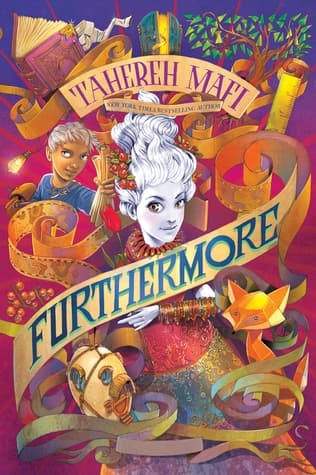
Tahereh Mafi (2016)
Genre
Fantasy / Children's / Young Adult
Reading Time
240 min
Key Themes
See below
Sign in to track this book
A girl without color travels through the strange land of Furthermore with a boy made of lies to find her missing father and reclaim the magic she believes she lost.
Alice Alexis Queensmeadow lives in Ferenwood, where people's magic appears in vibrant colors. Alice, however, has no color, making her unusual and judged by her community, especially her mother. Her father, a famous color maker, disappeared three years ago, leaving Alice feeling alone. On her twelfth birthday, a day when Ferenwood children are expected to show more magic, Alice can do none. This failure confirms her status as an outcast and deepens her wish for her father, the only person who truly understood and loved her despite her lack of color.
After her disappointing birthday, Alice receives an invitation from the Surrender, Ferenwood's ruling council, for the 'Surrender of the Sass'. This annual event is a rite of passage for all twelve-year-olds. As she gets ready, a boy named Oliver comes to her door, saying he is her companion for the journey. Oliver is known for his unusual magic, which involves changing perception and truth, often through lies. Alice is wary of Oliver, but with no other options and hoping the Surrender might offer clues about her father, she agrees to travel with him into the mysterious lands beyond Ferenwood.
Alice and Oliver step through a hidden portal, leaving Ferenwood and entering Furthermore. This new land immediately shows itself to be a place of confusing magic and rules. Their first stop is a village where everything is literally upside down, defying gravity. The people speak in riddles and seem to follow different rules. Alice struggles to adapt to Furthermore's changing reality, while Oliver, with his ability to understand the illogical, navigates it easily. This first meeting sets the tone for their journey, showing the big differences between Ferenwood and Furthermore.
Continuing their journey, Alice and Oliver arrive in a part of Furthermore where paper is alive and thinking. Trees have parchment leaves, and landscapes are made of different kinds of paper, all with their own personalities and rules. They learn that stepping on certain papers can have bad results, while others offer help. This place tests Alice's trust in Oliver, whose understanding of Furthermore's oddities often seems their only guide. The living paper creates both problems and chances, forcing Alice to question her fixed ideas of reality and to rely on her companion's unusual wisdom.
Alice learns she has only twelve hours to complete her quest and find her father, a detail Oliver had not mentioned. This news adds urgency and a feeling of betrayal to her emotions toward him. During this time, a small, mischievous fox-like creature starts to follow them. This creature, later called a 'Wink', communicates with gestures and seems to know Furthermore's hidden paths and dangers. The Wink becomes an unofficial guide, leading them through dangerous places and giving subtle clues, though its reasons remain unclear, further complicating Alice and Oliver's already hard journey.
Their travels lead them to a confusing land where 'left' and 'right' constantly shift and contradict each other. What is left one moment becomes right the next, making simple navigation impossible. This place shows Furthermore's illogical nature, forcing Alice to stop relying on normal understanding. Oliver, with his magic to see and change truth, finds this land surprisingly easy for his skills, using his unique perception to guide them through the bewildering area. Alice, however, struggles greatly, feeling more lost and confused, both physically and emotionally, questioning her own mind.
Eventually, Alice and Oliver reach the Surrender of the Sass, a grand gathering of Furthermore's most powerful beings. Here, the true nature of their journey and Oliver's role begins to become clear. Oliver admits he was sent by the Surrender, not just as a companion, but specifically to test Alice. He reveals his own parents were taken by the Surrender years ago, and he believes helping Alice find her father is his only way to gain favor and possibly reunite with his own family. This confession deepens Alice's complex feelings for Oliver, mixing anger with a new understanding and sympathy for his situation.
Before the Surrender, Alice is put on trial, not for a crime, but as a test of her worth and understanding. She is asked about her lack of color, her purpose, and her journey through Furthermore. During this trial, Alice has a major realization: her lack of color is not an absence of magic, but a different kind of magic. She understands that her unique perspective, her ability to see things clearly without the distraction of bright colors, is her real strength. This understanding empowers her, letting her stand firm against the Surrender's examination and accept her individuality.
Alice finally confronts her father, who has been living in Furthermore, seemingly by choice. He reveals that Furthermore is a magical sanctuary, a place where those who are different or misunderstood in Ferenwood can find a home and purpose. Her father explains he left Ferenwood not because he didn't love her, but to help her accept her unique nature and understand her own colorless magic. He explains that the Surrender's tests help individuals like Alice discover their true selves and their place in the larger magical world, rather than punishing them.
With her father found and the truth known, Alice must choose: stay in Furthermore, where she is finally understood and valued, or return to Ferenwood, where she was an outcast. She realizes her journey was not only about finding her father but also about finding herself. With her new understanding of her unique magic and a deeper connection with Oliver, she chooses to return to Ferenwood. She hopes to bring a new perspective to her home, to challenge its strict views on magic and color, and to perhaps connect the two worlds, carrying the lessons of Furthermore back to her colorless reality.
The Protagonist
Alice transforms from a self-conscious, colorless girl who feels unloved into a confident individual who embraces her unique magic and finds her place in the world.
The Supporting
Oliver learns to trust and open up to Alice, revealing his vulnerabilities and finding a true friend, rather than just a means to an end.
The Supporting
Revealed to have been on his own journey of discovery, he guides Alice to understand her true self.
The Supporting
Her character arc is less pronounced, but her eventual acceptance of Alice hints at a softening of her rigid views.
The Supporting
The Wink remains largely static, serving as a consistent, albeit enigmatic, helper.
The Antagonist/Supporting
Their role shifts from a perceived antagonist to a guiding, benevolent force, revealing their true purpose.
The Mentioned
Serve as a world-building element rather than having an individual arc.
Alice's journey centers on her struggle with her identity as a colorless girl in a world defined by color. Her search for her father becomes a search for self-acceptance. She learns that her 'lack' of color is, in fact, a unique form of magic, a different way of seeing the world. This theme is clear when she faces the Surrender and finally accepts her 'colorless magic' as a strength, not a flaw, realizing her true power is her unique perspective, unlike the Ferenwood standard.
“Perhaps there was something magnificent to be found in the absence of color. Perhaps she was magnificent.”
The book constantly questions common ideas of magic, showing it as fluid, personal, and linked to perception. Ferenwood's magic is about color, but Furthermore's magic is about defying logic, changing truth, and finding wonder in the strange. Oliver's 'lies' are a form of magic, and Alice's 'colorlessness' is a unique magical ability to see clearly without distraction. This theme appears in the 'Land of Left and Right' and the 'Upside-Down Village', where reality itself is shaped by perspective and belief, making Alice expand her understanding of what magic truly is.
“Sometimes, the truth is just a lie that hasn't found its way to you yet.”
Alice's deep love for her father and her wish for his return drive her entire journey. Despite her mother's perceived coldness, Alice's basic desire for family connection moves her. The reveal that her father left to help her, and Oliver's desire to find his own parents, show the strong and lasting nature of family love, even through distance and misunderstandings. The story highlights how love, in its various forms, can be the most powerful magic, able to guide and support people through the hardest times.
“Love was the most powerful magic of all. More powerful than color, more powerful than lies, more powerful than anything.”
While Alice goes on a physical journey to find her father, the real quest is an internal one of self-discovery. Each strange land and difficult encounter in Furthermore makes her drop old ideas, question her beliefs, and grow. Her change from an insecure, colorless girl to a confident person who understands her unique worth is the main story arc. The entire 'Surrender of the Sass' is a mechanism for this purpose, guiding young people to accept their true selves instead of conforming to what society expects, ending in Alice's realization during her trial.
“Sometimes, to find yourself, you have to get a little lost first.”
A magical constraint that adds urgency and pressure to Alice's quest.
Alice is magically bound to a twelve-hour time limit to complete her journey and find her father. This device creates a constant sense of urgency and heightens the stakes of her adventure. It forces Alice and Oliver to make quick decisions, often under pressure, and adds a layer of tension to their encounters in Furthermore. The time limit also serves to highlight Oliver's initial deception, as he withholds this crucial information from Alice, further complicating their relationship and adding to her feelings of betrayal.
The fantastical and often contradictory rules governing the land of Furthermore.
Furthermore operates on a system of 'illogical logic' where common sense is inverted, directions are fluid, and objects possess sentience. This device serves to disorient Alice, forcing her to abandon her rigid, Ferenwood-centric worldview and embrace adaptability. It also highlights Oliver's unique magical aptitude, as he is adept at navigating this bizarre reality. Furthermore's constantly shifting rules challenge both the characters and the reader to think outside conventional boundaries, reinforcing the theme of perception and the subjective nature of reality.
An annual rite of passage that serves as a deceptive framework for Alice's true quest.
The 'Surrender of the Sass' is presented as an annual event for Ferenwood children to demonstrate their magical prowess. However, it is revealed to be a far more complex and benevolent mechanism orchestrated by the Surrender of Furthermore. This device acts as a narrative red herring, initially appearing as a simple competition but ultimately serving as a disguised journey of self-discovery. It is the catalyst that propels Alice into Furthermore, and its true purpose is to guide individuals with unique magic to understand and embrace their abilities, rather than merely judging them.
Alice's unique trait in Ferenwood, initially perceived as a flaw but later revealed as a unique form of magic.
Alice's complete lack of color in the vibrant, magic-infused world of Ferenwood is a central plot device. It immediately establishes her as an outsider and is the source of much of her insecurity and her mother's disappointment. This 'absence' is not merely a characteristic but a fundamental aspect of her being that drives her search for belonging and understanding. The device undergoes a significant transformation, as it is ultimately revealed to be a unique and powerful form of magic itself, allowing Alice to see truths others cannot, thus subverting initial perceptions and reinforcing the theme of self-acceptance.
“Furthermore was a place where color was currency. Where the more vibrant a person was, the more important they were.”
— Describing the central premise of the world of Furthermore.
“Because even the most beautiful things can be dangerous.”
— Alice's observation about the beauty and potential peril of Furthermore.
“She was a smudge in a world of sparkle. A whisper in a world of shouts.”
— Describing Alice's lack of color and how she stands out.
“Sometimes, the only way to find your way is to get lost.”
— A recurring theme about adventure and discovery.
“People always assumed that the quiet ones were weak. They never realized how much strength it took to hold so much inside.”
— Alice reflecting on her own quiet nature and inner strength.
“And the world, she realized, was so much bigger than she had ever imagined.”
— Alice's growing understanding of the world beyond her village.
“A good story, she thought, was like a magic trick. It could transport you to another place, another time.”
— Alice's love for stories and their power.
“It was impossible to be truly happy if you couldn't be truly yourself.”
— A realization about authenticity and happiness.
“But what if the things that made you different were also the things that made you special?”
— Alice questioning her perceived flaws and embracing her uniqueness.
“Courage wasn't the absence of fear, but the triumph over it.”
— Alice facing her fears during her journey.
“And sometimes, the only way to get what you wanted was to ask for it. Even if it was terrifying.”
— Alice learning to advocate for herself.
“The world was full of wonders, if only you knew where to look.”
— A hopeful message about finding magic in the world.
“Color, she realized, wasn't just about vibrancy. It was about feeling. About living.”
— Alice's evolving understanding of what color truly represents.
“Because even the smallest of us can make the biggest difference.”
— A message about the impact of seemingly insignificant individuals.
Ready to see how well you understood this book? Take our interactive quiz with 10 questions.
Biography coming soon.







