“Humankind cannot gain anything without first giving something in return. To obtain, something of equal value must be lost. That is alchemy's First Law of Equivalent Exchange.”
— The fundamental principle of alchemy explained in the series.

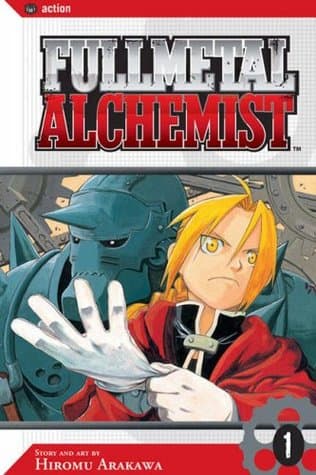
Hiromu Arakawa (2014)
Genre
Fantasy / Science Fiction / Young Adult
Reading Time
90 min
Key Themes
See below
Sign in to track this book
Alchemy comes at a brutal cost in this story of two brothers. One is a living suit of armor, the other an alchemist with prosthetic limbs. They hunt for a mythical stone to restore their bodies, but they uncover a conspiracy more dangerous than their own forbidden experiments.
The story opens with a flashback to the Elric brothers' childhood in Resembool. Their mother, Trisha Elric, dies from an illness. Young Edward and Alphonse Elric, driven by grief and their growing alchemical talent, decide to attempt human transmutation to bring her back. They gather the necessary ingredients and perform the forbidden alchemy. The transmutation goes horribly wrong. Alphonse loses his entire body, and Edward loses his left leg. In a desperate act to save his brother, Edward sacrifices his right arm to bind Alphonse's soul to a suit of armor. This traumatic event sets them on their quest for the Philosopher's Stone, which they believe can restore their original bodies.
Now older, Edward, with automail prosthetics, and Alphonse, still a walking suit of armor, arrive in the desert town of Lior. They are investigating Father Cornello, the leader of the 'Leto' cult, who claims to perform miracles using the power of the Sun God. The brothers suspect Cornello is using a fake Philosopher's Stone to perform alchemy without a transmutation circle. This feat is only possible with a true Stone. Their goal is to expose him and retrieve the Stone, believing it is the genuine article they need for their own bodies.
Edward infiltrates Cornello's temple and confronts him. Cornello demonstrates his 'miracles,' such as bringing a statue to life and healing a sick girl, all without a transmutation circle. Edward quickly realizes that Cornello is using a pseudo-Philosopher's Stone, a weaker imitation of the real thing, to bypass alchemical laws. He exposes Cornello by destroying the 'Stone' and revealing the mechanisms behind the 'miracles,' such as hidden wires and a pre-existing automail arm on the statue. The cult members are disillusioned, and Cornello, enraged, attacks Edward.
During their fight, Cornello reveals his true, grotesque form. He used the pseudo-Philosopher's Stone to enhance his own body. He is a formidable opponent, but Edward, with Alphonse's help, defeats him. As Cornello lies defeated, a shadowy figure, Lust, appears. She reveals that Cornello was merely a pawn and that a mysterious group gave him the pseudo-Philosopher's Stone. Lust then brutally kills Cornello, showing the ruthlessness of the true antagonists and introducing the concept of Homunculi to the brothers. This leaves them with more questions than answers about the Philosopher's Stone.
After the incident in Lior, Edward's automail arm is heavily damaged. The brothers return to their childhood home in Resembool to have his prosthetics repaired by their childhood friend and mechanic, Winry Rockbell, and her grandmother, Pinako Rockbell. This visit provides a brief break from their travels and allows them to reconnect with their surrogate family. During this time, Edward thinks about the dangers of their quest and alchemy's moral ambiguities, especially after encountering the pseudo-Philosopher's Stone and the Homunculi. Winry expresses concern for their safety, showing the emotional toll their journey takes on those around them.
While Edward's automail is being repaired, he researches the Philosopher's Stone. He consults various texts and scholars, trying to understand its true composition and the rumors surrounding it. He learns that the genuine Philosopher's Stone is not merely a highly concentrated alchemical amplifier. It is rumored to be created from human lives, a concept that deeply disturbs him. This revelation presents a moral dilemma for the brothers, as the very object they seek to restore their bodies might require an unthinkable sacrifice. This forces them to re-evaluate the cost of their ambition.
On their next journey, the Elric brothers are on a train hijacked by anti-government terrorists. Edward, using his alchemy, quickly dispatches the hijackers, showing his combat prowess. However, a mysterious man with a large X-shaped scar on his forehead, known as Scar, is also present. Scar is an Ishvalan warrior, a survivor of the Ishvalan Civil War, who despises State Alchemists for their role in the genocide of his people. He confronts the brothers, viewing Edward as a military tool, and articulates his deep hatred for alchemy and its practitioners. This leaves a lasting impression on the brothers.
After the train incident, the brothers travel to Central City. There, they meet Major Maes Hughes, an officer in the Amestrian military and a close friend of Colonel Roy Mustang. Hughes is a jovial and family-oriented man, constantly doting on his wife and young daughter. He offers the Elric brothers hospitality and resources, emphasizing his willingness to help them in their quest, especially given Edward's status as a State Alchemist. Hughes's warm demeanor contrasts with the colder, more bureaucratic aspects of the military and the harsh realities the brothers often face.
Edward receives orders to investigate 'Laboratory 5,' a supposedly abandoned military research facility. He and Alphonse infiltrate the building, encountering two formidable guardians. Slicer, a former death row inmate, has his soul bound to two suits of armor. Barry the Chopper, a serial killer, has his soul bound to a single, imposing suit of armor. During their intense battles, Edward and Alphonse discover that the guardians are homunculi-like beings, similar to Alphonse, whose souls have been transmutated and bound. They realize that Laboratory 5 was a site for horrific human experimentation related to the Philosopher's Stone.
During their confrontation in Laboratory 5, Alphonse begins to remember fragments of their failed human transmutation. He recalls seeing 'The Gate of Truth,' a metaphysical entity that holds all knowledge of the universe. He remembers the immense pain and the horrifying price exacted by the Gate for attempting to defy the natural order. This recollection reinforces the gravity of their past mistake and the sheer power needed to overcome the consequences. The memory serves as a stark reminder of the sacrifices they've already made and the dangers that still lie ahead in their pursuit of the Philosopher's Stone.
The Protagonist
Edward begins as a guilt-ridden boy focused solely on restoring his and Alphonse's bodies, but through his journey, he starts to question the moral implications of alchemy and the Philosopher's Stone.
The Protagonist
Alphonse initially struggles with his identity as a soul in armor, but his steadfast support for Edward and his developing memories of the Gate strengthen his resolve and understanding of their quest.
The Supporting
Winry's arc in this volume primarily revolves around her role as a steadfast support system for the Elric brothers, maintaining their physical well-being and emotional connection to home.
The Supporting
Mustang is introduced as Edward's commanding officer, setting the stage for his complex role as both a superior and a potential ally/rival in the future.
The Supporting
Pinako's role in this volume is primarily to provide a safe haven and essential repairs for Edward, reinforcing the theme of home and family.
The Antagonist
Cornello is introduced as a seemingly powerful religious leader, but his true nature as a deceitful charlatan is exposed, leading to his downfall and revealing the larger conspiracy at play.
The Antagonist
Lust is introduced as a mysterious and dangerous antagonist, revealing the existence of Homunculi and a larger, more sinister plot beyond Cornello.
The Antagonist/Mentioned
Scar is introduced as a vengeful figure, immediately establishing his antagonism towards State Alchemists and foreshadowing future conflicts and moral dilemmas for the Elric brothers.
The Supporting
Hughes is introduced as a loyal friend and supportive military figure, offering a contrast to the more rigid aspects of the military and the dangers the brothers face.
This theme is central to the brothers' backstory. Their attempt at human transmutation, driven by the ambition to defy death, results in devastating physical and emotional loss. The 'Gate of Truth' is a stark reminder that all knowledge comes with a price, and breaking fundamental laws has severe consequences. Father Cornello's misuse of the pseudo-Philosopher's Stone for personal gain shows how ambition, unchecked by morality, leads to deception and violence. The growing realization that the Philosopher's Stone itself might require human sacrifice forces the brothers to confront the ultimate cost of their quest.
“To obtain, something of equal value must be lost. That is the law of Equivalent Exchange.”
Alphonse's existence as a soul bound to armor is the primary example of this theme. He frequently questions his own humanity, wondering if he is truly human or merely a suit of armor with memories. This internal struggle grows when he encounters other transmutated souls in Laboratory 5. Edward, too, grappling with his automail limbs, faces challenges to his physical identity, often feeling less than whole. The quest for the Philosopher's Stone is not just about restoring their bodies, but about reclaiming their sense of self and what it means to be human, free from the consequences of their past mistake.
“I wonder... am I really Alphonse Elric? Or am I just a suit of armor with Alphonse Elric's memories?”
The Elric brothers' entire journey is born from the profound grief over their mother's death. Their desperate act of human transmutation was an attempt to overcome this loss, leading to further, even more tragic losses of their own bodies. The flashback to Trisha's death and the subsequent trauma underpins their motivation. This theme is also subtly explored through Winry's concern for the brothers, reflecting the pain their absence and danger cause those who care for them. Scar's character, driven by the loss of his people in the Ishvalan War, further emphasizes how grief can fuel destructive paths.
“A mother's death is a sorrow that never truly fades.”
Alchemy, a blend of science and art, is a powerful force with immense potential for both good and evil. The series immediately establishes human transmutation as forbidden, highlighting the dangers of scientific hubris. Father Cornello's abuse of alchemy for manipulation, and the revelation of human experimentation in Laboratory 5, show how power, especially scientific power, can be corrupted. The military's use of State Alchemists in warfare, hinted at by Scar's backstory, raises questions about the moral responsibility of those who wield such immense abilities.
“Alchemy is not omnipotence. It is the science of understanding, deconstructing, and reconstructing. It is not a miracle art.”
The fundamental law of alchemy: 'To obtain, something of equal value must be lost.'
Equivalent Exchange is the core principle governing alchemy in the world of Fullmetal Alchemist. It dictates that any alchemical transmutation requires a sacrifice of equal value. This device is immediately established as the immutable law that the Elric brothers violated with human transmutation, resulting in their physical losses. It functions as both a scientific principle and a moral compass, constantly reminding characters of the costs of their actions and the futility of trying to get something for nothing, especially when dealing with life itself.
Advanced prosthetic limbs that replace lost body parts, integrated with the nervous system.
Automail serves as a crucial plot device, symbolizing both the brothers' tragic past and Edward's resilience. These highly advanced, mechanical prosthetics replace lost limbs and are directly connected to the user's nervous system, requiring painful surgery and meticulous maintenance. Winry Rockbell's skill as an automail mechanic is vital to Edward's ability to function as a State Alchemist. Beyond its practical function, automail highlights themes of humanity, artificiality, and the physical toll of the brothers' journey, constantly reminding Edward of his sacrifice.
A legendary alchemical amplifier that bypasses the law of Equivalent Exchange.
The Philosopher's Stone is the ultimate MacGuffin of the story, the object the Elric brothers are desperately seeking to restore their bodies. It is rumored to allow alchemists to perform transmutations without adhering to Equivalent Exchange. Its introduction through Father Cornello's pseudo-Stone immediately establishes its power and desirability. As the brothers learn more about its true, horrific origins (created from human lives), the Stone transforms from a simple solution into a profound moral dilemma, forcing them to confront the ethical implications of their quest and the potential cost of their ambition.
The forbidden act of attempting to create or revive a human life through alchemy.
Human Transmutation is the inciting incident of the entire series. It is the forbidden alchemical act that Edward and Alphonse attempted, leading to their devastating physical losses and the binding of Alphonse's soul to armor. This plot device establishes the central conflict and the brothers' driving motivation. It also sets a clear ethical boundary within the world's alchemy, underscoring the dangers of defying natural laws and the immense, irreversible consequences that follow, serving as a constant reminder of their past trauma and the high stakes of their journey.
“Humankind cannot gain anything without first giving something in return. To obtain, something of equal value must be lost. That is alchemy's First Law of Equivalent Exchange.”
— The fundamental principle of alchemy explained in the series.
“A lesson without pain is meaningless. For you cannot gain anything without sacrificing something else in return. But once you have overcome it and made it your own... you will gain an irreplaceable fullmetal heart.”
— The narrator's reflection on the brothers' journey and the meaning of their struggles.
“Even if you call it a 'human transmutation,' that's not what happened. What we tried to create wasn't human. It was just... something else.”
— Edward reflecting on their failed attempt to bring their mother back to life.
“The world isn't perfect. But it's there for us, doing the best it can. That's what makes it so damn beautiful.”
— Rosé's hopeful outlook despite the hardships in Reole.
“Stand up and walk. Keep moving forward. You've got two good legs. So use them. You're strong enough to make your own way.”
— Edward's encouragement to Rosé after she loses her faith.
“Don't forget 3 October. 11. Am. It's a day we'll never forget.”
— Edward inscribing a message inside his watch after burning down their house.
“If you don't like your destiny, don't accept it. Instead, have the courage to change it the way you want it to be.”
— Edward's internal monologue about taking control of his life.
“A human being is 50 liters of water, 20 kg of carbon, 4 liters of ammonia, 1.5 kg of lime, 800 g of phosphorus, 250 g of salt, 100 g of saltpeter, 80 g of sulfur, 7.5 g of fluorine, 5 g of iron, and 3 g of silicon. Plus, traces of 15 other elements.”
— Alphonse reciting the chemical composition of a human body.
“There's no such thing as a painless lesson. They just don't exist. Sacrifices are necessary. You can't make something out of nothing.”
— Edward reflecting on the cost of knowledge and power.
“You really think you can bring back the dead? You think you can play God?”
— Cornello questioning Rosé's belief in his ability to resurrect her boyfriend.
“You can't just sit around and wait for someone to save you. You have to save yourself.”
— Edward's advice to Rosé, encouraging her to take action.
“We're not devils or gods. We're human. Just tiny, insignificant humans. We can't even save one little girl.”
— Edward's moment of despair after failing to save the people of Reole.
“Alchemy is not a miracle art. It's a science. It's about understanding, deconstruction, and reconstruction.”
— Edward explaining the true nature of alchemy to Rosé.
“I'm not short! I'm just vertically challenged!”
— Edward's recurring outburst whenever his height is mentioned.
Ready to see how well you understood this book? Take our interactive quiz with 10 questions.







