“War is not a game. It's not a test. It's not a story. It's a machine that grinds people up and spits them out.”
— A reflection on the brutal reality of war, often voiced by characters experiencing its horrors.

Michael Grant (2016)
Genre
Historical Fiction / Science Fiction / Young Adult
Reading Time
10-12 hours
Key Themes
See below
Sign in to track this book
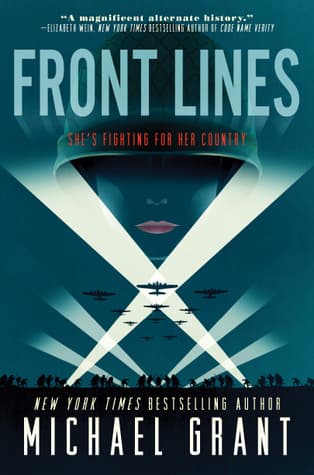
In an alternate 1942, as the world teeters on the brink, three ordinary American girls are thrust onto the brutal front lines of World War II after a landmark court decision drafts women into combat against the Nazi war machine.
In an alternate 1942, a Supreme Court decision, *Richlin v. United States*, makes women eligible for the draft, changing World War II. Rio Richlin, a Californian, is drafted but volunteers for officer training to avoid being a grunt. She wants to prove herself to her father. Frangie Marr, an African American girl from rural Mississippi, enlists as a medic, hoping to escape poverty and make a difference. Rainy Schulterman, a Jewish girl from New York, volunteers for intelligence work, motivated by the atrocities against Jews in Europe and a sense of patriotism. Their initial experiences in basic training are different, showing the social and racial divides of the era even as they prepare for a shared, uncertain future in the war.
Rio does well in officer training at Fort Benning, despite sexism from some male cadets and instructors. She befriends fellow cadet Jenou, and her intelligence and leadership skills are quickly recognized. Frangie, after basic medical training, is assigned to a segregated medical unit. She works under difficult conditions and sees racial discrimination in the military. She struggles with the bureaucracy and emotional toll of her work. Rainy, meanwhile, is sent to a top-secret intelligence school, where her sharp mind and language skills are tested. She learns espionage techniques and code-breaking, preparing for a dangerous role behind enemy lines. Each girl begins to understand the size of the war and her individual role in it.
Rio, now a new lieutenant, is assigned to an infantry platoon in North Africa, part of American forces preparing for Operation Torch. Her platoon, initially skeptical of a female officer, is deployed to Tunisia. Their first combat is a chaotic encounter with German forces, where Rio must make difficult, life-or-death decisions under pressure. She proves her courage and competence, earning the respect of her men, including Sergeant Linc and Private Jo-Jo. The battle is a harsh awakening to the realities of war, with many casualties and the psychological toll of killing. Rio grapples with the responsibility of leadership and the loss of her soldiers. This marks her transition from a trainee to a combat officer.
Frangie is deployed to a field hospital in North Africa, where she is immediately overwhelmed by the number and severity of casualties from the front lines. She works tirelessly, tending to wounded soldiers, both Allied and Axis, and experiences the suffering of war firsthand. Despite her dedication, she continues to face racial prejudice, especially from some white officers and patients. Frangie forms a close bond with fellow medic Leora and struggles with the emotional burden of her work, questioning the justice of a war that still segregates its own soldiers. She sees the death of a young soldier she had tried to save. This deepens her resolve to do more for those suffering.
Rainy, now trained in espionage, is parachuted into occupied France as part of an Office of Strategic Services (OSS) mission. Her objective is to gather intelligence on German troop movements and support the French Resistance. She adopts a cover identity and uses her language skills to navigate the environment. Rainy experiences the constant fear of discovery and the moral ambiguities of working in a clandestine world, where trust is a luxury. She contacts Resistance fighters and sees the occupation firsthand, strengthening her resolve to help the Allied cause. Her mission is dangerous, requiring quick thinking and bravery to avoid capture by the Gestapo.
Rio's platoon is ordered to take Hill 609, a fortified German position in Tunisia. The battle is ferocious, with intense fighting, artillery barrages, and hand-to-hand combat. Rio shows leadership and tactical skill, inspiring her men despite heavy casualties. She personally engages in combat, killing enemy soldiers and facing the psychological toll of close-quarters warfare. The platoon suffers significant losses, including her friend Jenou. This forces Rio to confront the cost of victory. The battle for Hill 609 becomes a moment for Rio and her surviving soldiers, forging them into a hardened unit, but leaving them scarred by the experience.
While working in the field hospital, Frangie encounters a severely wounded German soldier who is being neglected by some American medical personnel due to his nationality. Despite the risks and disapproval of others, Frangie, following her Hippocratic oath and her sense of humanity, provides him with care. This act of compassion puts her at odds with her superiors and exposes her to potential disciplinary action, especially given the racial tensions within the unit. Frangie's actions show her moral compass and her refusal to let the hatred of war dictate her medical ethics, even as she continues to face injustice within her own army.
During her mission in France, Rainy is captured by the Gestapo. She is subjected to interrogation, resisting their attempts to get information about the Resistance and Allied plans. Rainy endures physical and psychological torture, showing her strength and training. However, she manages to exploit a moment of carelessness by her captors and, with the help of a sympathetic Resistance contact, stages a daring escape. Her ordeal leaves her physically and emotionally scarred, but it also reinforces her determination to fight against the Nazi regime. Her escape shows her courage and quick thinking under extreme pressure.
Following the fighting in North Africa, Rio and her surviving platoon members get a brief break. Rio grapples with the trauma of combat and the deaths of her friends, but also feels a sense of accomplishment and purpose. Frangie, after her act of defiance, faces an investigation but is allowed to continue her work, her reputation as a compassionate medic growing. Rainy, having escaped the Gestapo, is debriefed and given time to recover, her resolve to continue her intelligence work stronger than ever. As the North African campaign concludes, all three receive new orders, preparing them for the next, even more difficult phase of the war: the invasion of Europe.
As the Allied focus shifts to the invasion of Italy, the three protagonists find themselves moving towards new, more dangerous assignments. Rio, now a seasoned combat officer, prepares her depleted but hardened platoon for amphibious landings. She has earned the respect of her men and developed an understanding of battlefield leadership. Frangie, recognized for her skill and compassion, is assigned to a medical unit preparing for the invasion, anticipating even greater casualties. Rainy, having recovered from her ordeal, is assigned to a new intelligence mission, likely involving the Italian campaign. Their individual journeys, though separate, are now all directed towards the heart of the European conflict, promising more challenges and deeper involvement in the war.
The Protagonist
From a sheltered girl seeking validation, Rio evolves into a hardened, compassionate, and effective combat leader who earns the respect of her soldiers.
The Protagonist
Frangie grows from an idealistic enlistee into a resilient and morally steadfast medic, challenging injustice even amidst the chaos of war.
The Protagonist
From a sharp-minded volunteer, Rainy transforms into a hardened and resourceful intelligence operative, surviving extreme danger through her intellect and bravery.
The Supporting
Linc evolves from a skeptical subordinate to a loyal and respectful supporter of Rio's leadership.
The Supporting
Jenou serves as a supportive friend and fellow soldier whose death profoundly impacts Rio.
The Supporting
Leora serves as a loyal friend and fellow medic, providing crucial emotional support to Frangie.
The Supporting
Jo-Jo remains a steadfast and loyal soldier in Rio's platoon, serving as a testament to her leadership.
The Antagonist
The interrogator serves as a direct antagonist, representing the oppressive force Rainy fights against.
The central theme of *Front Lines* explores the alteration of gender roles in World War II, specifically how women are integrated into combat and support roles. The book directly challenges traditional ideas of female capabilities and male dominance in the military. Rio faces skepticism and sexism from male soldiers and officers but consistently proves her competence and courage in battle, earning respect through her actions rather than her gender. Frangie and Rainy, in their roles, also navigate and overcome gender-based expectations. They show that skill, bravery, and dedication are not exclusive to one sex. This theme highlights the potential for societal change under extreme circumstances and the equality of individuals in the face of shared peril.
“"The war didn't care if you had breasts or a penis. It just cared if you could fight, if you could heal, if you could think."”
Despite the unifying cause of fighting fascism, *Front Lines* portrays the racial prejudice and segregation within the American military during the 1940s. Frangie Marr, as an African American medic, constantly confronts systemic racism, from segregated units to differential treatment of patients based on race. Her experiences highlight the hypocrisy of fighting for freedom abroad while denying it to citizens at home. The theme explores the internal conflict of fighting for a country that does not fully value all its citizens, and Frangie's moral struggles against this backdrop. It shows how even in a global conflict, ingrained societal prejudices can persist and inflict their own kind of suffering.
“"They wanted us to die for freedom, but they didn't want us to sit at the same table."”
The novel depicts the realities of combat and its psychological impact on soldiers. Rio's experiences on the front lines, particularly the battle for Hill 609, include violence, death, and moral ambiguity. Frangie sees the aftermath of battles in the field hospital, dealing with mass casualties and suffering. Rainy endures physical and mental torture during her capture. The book explores the trauma, grief, and emotional scarring that accompany participation in war. It shows how soldiers are changed by their experiences. It emphasizes that war is not glorious but a devastating force that leaves deep and lasting wounds.
“"The dead were a lesson. The living were a curse. And the war just kept on taking."”
Amidst the violence and hatred of war, the theme of moral courage and compassion is clear in the actions of the protagonists. Frangie, in particular, shows this by defying orders and risking her career to treat a wounded German soldier. She follows her humanitarian principles above military protocol or nationalistic hatred. Rio shows moral courage in leading her men through difficult situations and making ethical decisions under fire. Rainy's strength during interrogation also shows a deep moral conviction. This theme highlights the human capacity for empathy and the strength required to uphold one's values even in the most dehumanizing circumstances. It suggests that true heroism often lies in acts of humanity.
“"Saving a life wasn't about uniforms or flags. It was about breath, and blood, and beating hearts."”
Each protagonist goes through a journey of self-discovery as they navigate the challenges of war. Rio, initially seeking her father's approval, finds her true identity as a capable and respected leader. Frangie, aspiring for a better life, discovers her moral strength and commitment to humanity. Rainy, driven by a sense of duty to her heritage, uncovers her strength and intellectual prowess in the face of danger. The experience of war forces them to confront their deepest fears, strengths, and values, ultimately shaping who they become. Their experiences strip away preconceived notions and reveal their true characters, forging new identities in fire.
“"She wasn't just Rio anymore. She was Lieutenant Richlin, a soldier forged in the fires of war."”
The foundational premise of a gender-integrated World War II.
The most significant plot device is the alternate history premise: the Supreme Court ruling in *Richlin v. United States* that makes women subject to the draft and eligible for combat. This single change fundamentally alters the historical narrative of World War II, allowing for the inclusion of female protagonists in roles traditionally held by men. This device allows the author to explore themes of gender equality, military service, and societal change from a fresh perspective, while still grounding the story in the recognizable historical context of the war. It creates a 'what if' scenario that drives the entire plot and character arcs.
Following three distinct protagonists whose paths occasionally intersect.
The novel employs a multiple perspective narrative structure, following the individual journeys of Rio, Frangie, and Rainy. Each girl's story is told in separate chapters, allowing the reader to experience different facets of the war—infantry combat, field medicine, and intelligence work. This device provides a comprehensive view of the war's impact across various roles and social strata. While their paths are largely separate in this first volume, the occasional mention of shared events or locations subtly connects their experiences, hinting at future convergences and demonstrating the vastness yet interconnectedness of the conflict.
The protagonists' rapid maturation amidst extreme circumstances.
This device focuses on the protagonists' transformation from young, relatively inexperienced individuals into hardened, mature soldiers and women. The extreme pressures of war force Rio, Frangie, and Rainy to shed their youthful naiveté and confront brutal realities, make life-or-death decisions, and develop resilience far beyond their years. Their 'coming-of-age' is accelerated and intensified by their military service, highlighting how extraordinary circumstances can forge character and accelerate personal growth. This device is central to their individual character arcs and the emotional impact of their stories.
How military attire and assigned roles reflect and challenge identity.
The military uniforms and the specific roles assigned to each girl (infantry officer, medic, intelligence operative) serve as powerful symbols. For Rio, the uniform represents a challenge to traditional gender roles and a symbol of her hard-won authority. For Frangie, her medic uniform symbolizes her humanitarian calling, often clashing with the racial segregation she experiences. For Rainy, her civilian disguise and covert attire highlight the secrecy and duplicity of her intelligence work. These symbols underscore the characters' evolving identities and the societal expectations they either fulfill or defy within the context of the war.
“War is not a game. It's not a test. It's not a story. It's a machine that grinds people up and spits them out.”
— A reflection on the brutal reality of war, often voiced by characters experiencing its horrors.
“You don't get to choose when you're brave. Bravery chooses you.”
— A character grappling with fear and courage in the face of combat.
“In this war, we're all just pieces on a board, and someone else is moving us.”
— A sentiment about the lack of control and agency soldiers feel.
“Sometimes the only way to survive is to become someone else.”
— A character adapting to the harsh demands of military life and identity.
“They told us we could be heroes. They didn't tell us what it would cost.”
— A critique of the romanticized ideals of war versus its grim realities.
“Fear is a constant companion, but so is the determination to not let it win.”
— A personal mantra for soldiers pushing through daily terror.
“We fight not for glory, but for the person next to us.”
— Emphasizing camaraderie and loyalty over abstract causes.
“In the silence between bullets, you find out who you really are.”
— A moment of introspection during the lulls in battle.
“History will remember the battles, but we remember the faces.”
— Highlighting the personal, human cost often overlooked in historical accounts.
“There's no such thing as a small victory when every life matters.”
— A perspective on valuing each success in the midst of loss.
“We wear uniforms to look alike, but underneath, we're all fighting different wars.”
— Acknowledging the individual struggles and backgrounds of soldiers.
“The front lines aren't just a place on a map; they're a state of mind.”
— Describing the psychological impact of being in constant danger.
“You can't unsee what war shows you, but you can choose what to do with it.”
— A reflection on trauma and the path to coping or growth.
Ready to see how well you understood this book? Take our interactive quiz with 10 questions.

Biography coming soon.