“I believe that what we cannot do in the present century will be done in the next.”
— Barbicane expresses optimism about human progress and space exploration.


Jules Verne (2021)
Genre
Fantasy / Science Fiction
Reading Time
180 min
Key Themes
See below
Sign in to track this book
Before humans flew, Jules Verne wrote about three Americans launching from a Florida cannon to the Moon and back, predicting space travel with surprising accuracy.
After the American Civil War, the Baltimore Gun Club, a group of artillery lovers, has no worthy project. Their president, Impey Barbicane, calls a meeting to suggest a new plan: firing a projectile to the Moon. The idea brings shock and excitement. Barbicane shows his calculations and a detailed plan, inspiring his audience and bringing back their passion for big scientific goals. The club members, mostly former military men, quickly support the seemingly impossible project. They are eager to use their wartime skills for a peaceful, but groundbreaking, goal.
Barbicane's idea quickly becomes famous worldwide, capturing the public's imagination in America and Europe. Donations arrive from various countries, all wanting to be part of such a big scientific achievement. But not everyone supports it. J. T. Maston, a strong-willed Philadelphia armor plate maker and Barbicane's former rival, publicly questions if the project can be done, especially the choice of aluminum for the projectile. Maston, known for being direct and confrontational, sends Barbicane a series of critical telegrams. This starts a long-distance argument that adds personal drama to the scientific effort and keeps the public interested.
The Gun Club must choose the best place to build their giant cannon, the 'Columbiad.' After looking at things like latitude, weather, and ground stability, Barbicane and his team narrow down the choices. People debate between Texas and Florida. Florida is chosen, specifically near the 27th parallel. This decision is based on needing a location close to the equator to use the Earth's spin to help the projectile's path to the Moon. This choice prepares for the huge building project, turning a quiet Florida area into a busy industrial site.
With the launch site picked, the huge job of building the Columbiad begins. Thousands of engineers, workers, and experts arrive in Florida. The project is enormous: a huge pit is dug, and the giant cannon is cast right into the earth using a new vertical casting method. Barbicane carefully watches every detail, making sure the precision and strength needed for such a powerful tool are there. The building site becomes very busy, a sign of human cleverness and resolve, as the Gun Club works fast to solve engineering problems and make their Moon dream happen.
As the Columbiad is almost finished, a surprising telegram arrives from Michel Ardan, a showy and brave French adventurer, sportsman, and artist. Ardan, known for his bold stunts and optimism, says he wants to travel *inside* the projectile to the Moon. This idea excites the public and at first shocks the Gun Club. Barbicane and his colleagues are hesitant because of the great risks, but Ardan's charm and his good reasons for a manned mission eventually convince them. His involvement changes the project from just a science experiment into an exciting human adventure, adding new danger and thrill.
After Ardan's announcement, J. T. Maston, the Gun Club's biggest critic, makes a sudden and unexpected appearance in Florida. Despite his past arguments, Maston is fascinated by Ardan's bravery. He publicly makes up with Barbicane, saying he admires the project. To everyone's surprise, he volunteers to join Ardan and Barbicane on the Moon trip. His inclusion completes the three-man crew. He adds a practical, but odd, balance to Ardan's romance and Barbicane's scientific focus. The once-skeptical Maston now fully commits to the mission, showing how the project can bring together even very different people.
With the three adventurers ready, the focus shifts to preparing the aluminum projectile, now a small space capsule. Barbicane, Ardan, and Maston carefully supervise the installation of what they need: air-recycling equipment, food, water, scientific tools, and even a small library. The inside is designed to handle the huge G-forces of launch and provide a place to live for the journey. Engineers work hard to make sure every part is perfect, knowing the three men's lives depend on their accuracy and foresight. The projectile becomes an engineering wonder, a self-contained world for space travel.
On the chosen day, a huge crowd, estimated to be hundreds of thousands, gathers in Florida to see the historic launch. The atmosphere is full of excitement. Reporters, scientists, and regular people from around the world watch as the three brave travelers, Barbicane, Ardan, and Maston, enter the projectile. The last preparations are made, the huge pyroxylin charge is lit, and with a loud roar and big recoil, the Columbiad fires its human cargo toward the sky. The projectile, a tiny spot against the big sky, begins its dangerous journey, leaving behind a stunned world.
Inside the projectile, Barbicane, Ardan, and Maston survive the huge G-forces of launch, though they are uncomfortable. Once stable, they get used to being weightless. They watch Earth move away below them and are amazed by space, with its many stars. Using the projectile's windows, they make scientific observations, talk about the cosmos, and have lively discussions. The journey has challenges, like managing their air supply and keeping their scientific tools working, but the crew stays positive, driven by their shared goal of reaching the Moon.
As the projectile nears the Moon, the travelers feel excited and worried. They make detailed observations of the Moon's surface, finding features and discussing where they might land. But because of a small change in their path, maybe from an earlier encounter with a small meteoroid or unexpected gravity, the projectile does not land on the Moon. Instead, it goes into an oval orbit around the Moon, becoming a satellite itself. The crew realizes their problem: they are now stuck in orbit, unable to land or go back to Earth directly, leaving their future unknown.
Stuck in Moon orbit, the three adventurers face a bad situation with less and less supplies. But the Moon's gravity, combined with Earth's, eventually changes their path. To their surprise and relief, the projectile slowly starts to fall back toward Earth. The trip back is full of worry as they get ready for impact. They figure out where they will likely land and prepare for the splashdown, hoping their clever design and cushioning will be enough to keep them alive when they re-enter Earth's atmosphere.
The projectile splashes down in the Pacific Ocean. Observers on Earth, especially from the Gun Club, watched its descent anxiously. After a long search, the American warship 'Susquehanna' finds the floating capsule. A rescue operation quickly starts, and the three travelers — Impey Barbicane, Michel Ardan, and J. T. Maston — are brought safely aboard. Even though they did not land on the Moon, their journey is called a huge scientific success. They are celebrated as heroes. They pushed the limits of human exploration and showed that space travel is possible, inspiring future generations to aim high.
The Protagonist
From a brilliant engineer seeking a new challenge, Barbicane becomes the leader of humanity's first space mission, demonstrating courage and adaptability in the face of the unknown.
The Protagonist
Ardan's character remains consistently adventurous and optimistic, serving as the emotional heart of the crew and inspiring others with his courage.
The Protagonist
Maston transforms from a vocal critic and rival into a dedicated participant and friend, demonstrating the power of shared adventure to overcome past animosities.
The Supporting
His character arc is largely static within the narrative, serving primarily as a historical rival to Barbicane.
The Supporting
The Secretary remains a consistent, professional figure, embodying the administrative side of the scientific endeavor.
The Supporting
General Morgan consistently supports the Gun Club's endeavors.
The Mentioned
Their collective sentiment shifts from curiosity to global enthusiasm and then to anxious anticipation.
The Plot Device
The Columbiad is conceived, constructed, and successfully fired, fulfilling its singular purpose.
A main theme of the novel is humanity's constant effort to push the limits of science and engineering. Barbicane's project, which comes from a wish to use wartime skill for peaceful goals, shows this. The careful calculations, the new way of casting the Columbiad, and the projectile's design all show the power of human intelligence and teamwork. The global response, with countries giving money, shows a shared human desire for progress and exploration. This suggests that science can bring people together for a common, inspiring goal. The journey itself, despite its result, shows the pursuit of knowledge.
“What had been impossible for the ancestors became easy for their descendants.”
Michel Ardan shows the theme of adventure, adding a human element to Barbicane's purely scientific project. His bold offer to travel inside the projectile turns the mission from an experiment into a grand journey. The novel celebrates the human desire to explore the unknown, to face danger for discovery, and to experience wonder. Ardan's optimism and love for life inspire even the practical Barbicane and the skeptical Maston. This shows that real progress often needs both scientific rigor and an adventurous spirit.
“The Moon! What a prodigious leap for humanity!”
Verne explores the two sides of international relations. While the initial rivalry between Barbicane and Maston (and the implied rivalry with Nicholl) shows competition, the project eventually leads to global cooperation. Countries from around the world give money, showing a shared investment in human progress. This theme suggests that big scientific projects can go beyond national borders and political differences, uniting humanity for common exploration. The global celebration of the launch and the rescue further emphasize this sense of shared achievement and destiny.
“A universal subscription was opened for the purpose of aiding the enterprise.”
The huge size of the Columbiad's construction, the projectile's complex design, and the detailed calculations for the Moon trip all show the theme of human cleverness. The Gun Club members, especially Barbicane, show strong determination to overcome what seem like impossible problems. From choosing materials to the casting process, every problem is met with new solutions and hard work. This theme celebrates human ability to solve problems, to keep trying, and to turn big dreams into real, though amazing, things through sheer will and intelligence.
“To conquer the unknown, to penetrate the impenetrable, to reach the unapproachable—that was the problem.”
Scientific details and character motivations are revealed through discussions.
Verne frequently uses detailed conversations and debates among the characters, particularly within the Gun Club meetings and between Barbicane, Ardan, and Maston, to convey complex scientific principles, engineering challenges, and the various arguments for and against the project. This allows for natural exposition of technical information without resorting to lengthy narrative summaries. It also serves to develop character by showcasing their personalities, expertise, and points of view through their interactions, such as Maston's initial skepticism or Ardan's boundless enthusiasm.
Verne's narrative often predicts future scientific and technological realities.
A hallmark of Verne's writing, this device sees the author incorporating detailed scientific and technological forecasts that, in many cases, remarkably align with future actualities. From the launch site in Florida, the three-person crew, the use of aluminum, to the splashdown in the ocean, Verne's story often reads like a blueprint for future space exploration. This device not only adds a layer of realism and prescience to the fantasy but also encourages readers to consider the future potential of science and engineering, blurring the lines between fiction and plausible scientific advancement.
A minor plot deviation that prevents a direct lunar landing.
Instead of a direct landing on the Moon, the projectile enters an orbit around it, a subtle but significant plot twist. This 'unreliable trajectory' serves as a device to heighten suspense and introduce an unexpected challenge for the crew, testing their resourcefulness and resilience in space. It also allows Verne to describe the Moon's far side, which was unknown at the time, and provides a plausible reason for their return to Earth, avoiding the complexities of a lunar landing and takeoff for the scope of this particular novel. It adds an element of scientific realism to the unpredictable nature of space travel.
The ultimate destination that drives the entire plot.
While the Moon is a tangible celestial body, within the narrative of 'From the Earth to the Moon,' it functions as a classic MacGuffin. It is the ultimate goal, the object of desire that motivates Barbicane, unites the Gun Club, and inspires Ardan's audacious journey. The specific characteristics of the Moon are less important than its role as the catalyst for the grand endeavor. It drives the plot forward, justifies the immense scientific and financial effort, and provides the narrative's central conflict and resolution, even if the characters don't physically reach its surface in the way they intended.
“I believe that what we cannot do in the present century will be done in the next.”
— Barbicane expresses optimism about human progress and space exploration.
“There is no such thing as an impossible obstacle; there are only insufficient means.”
— Barbicane argues for overcoming challenges in the moon project.
“The gun will be the agent of our departure; the projectile will be our vehicle.”
— Describing the plan to launch a spacecraft using a giant cannon.
“We shall be the Columbus of this unknown world.”
— Comparing the moon mission to historical exploration.
“Science, my dear sir, is made up of mistakes, but they are mistakes which it is useful to make, because they lead little by little to the truth.”
— Barbicane discusses the iterative nature of scientific progress.
“The moon is a world like our own, and it must be studied as such.”
— Emphasizing the scientific importance of lunar exploration.
“Imagination is the eye of the soul.”
— Reflecting on the role of creativity in envisioning the mission.
“We are about to become the ambassadors of the human race to another world.”
— Highlighting the symbolic significance of the journey.
“The cost is nothing; the glory is everything.”
— Justifying the expense of the project for its historic impact.
“Let us calculate everything, foresee everything, and then act.”
— Stressing the importance of meticulous planning for the mission.
“The stars are not beyond our reach if we dare to dream.”
— Inspiring the team to aim for ambitious goals.
“Every great achievement requires a touch of madness.”
— Acknowledging the audacity of the moon project.
“We shall write our names in the annals of the sky.”
— Expressing the desire for lasting fame through the mission.
“The silence of space will be our companion on this journey.”
— Describing the anticipated experience of traveling to the moon.
Ready to see how well you understood this book? Take our interactive quiz with 10 questions.
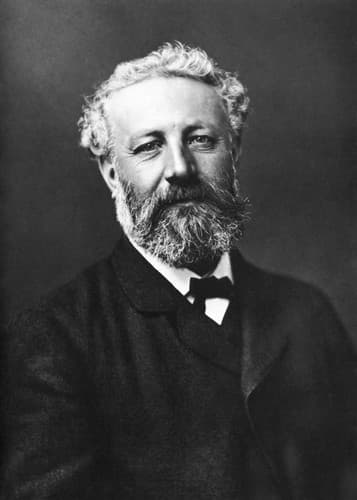
Jules Gabriel Verne was a French novelist, poet, and playwright. His collaboration with the publisher Pierre-Jules Hetzel led to the creation of the Voyages extraordinaires, a series of bestselling adventure novels including Journey to the Center of the Earth (1864), Twenty Thousand Leagues Under the Seas (1870), and Around the World in Eighty Days (1872). His novels, always well documented, are generally set in the second half of the 19th century, taking into account the technological advances of the time.







