“Your father is a hero, but you are not. You are a frog. You can only croak.”
— Wan Zu speaks to Tadpole, criticizing his lack of agency compared to his father.

Sign in to track this book
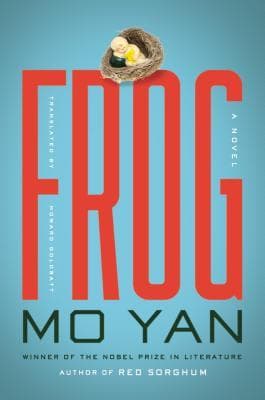
A respected midwife's brutal dedication to China's one-child policy is the focus of Mo Yan's epic, which examines the human and national costs of extreme ideology.
The story begins with the main character, a playwright named Tadpole, writing letters to his friend, a Japanese writer. Tadpole explains he plans to write a play about his aunt, Gugu, a well-known midwife in their hometown of Gaomi. He thinks about Gugu's strong influence on many women and families in the area, especially with China's changing population control policies. Tadpole's first letters are full of fond memories and respect for his aunt, hinting at a complicated and perhaps controversial past he wants to explore in his play. He starts collecting information and memories, preparing to tell Gugu's life story and the history of family planning in Gaomi.
The story then covers Gugu's early life, showing her as the smart and driven daughter of a famous communist doctor in Gaomi. From a young age, Gugu shows a strong interest and skill in medicine, especially helping her father with births. She quickly becomes his apprentice, learning the details of midwifery and understanding the human body and birth process. Her early experiences are marked by kindness and dedication, earning her a reputation as a skilled and gentle caregiver in the village. This time establishes Gugu's first identity as a healer, someone committed to bringing life into the world, which is very different from her later role.
A key event in Gugu's life happens when her lover, a military officer, leaves the Communist Party. This betrayal deeply hurts Gugu's personal life and, more importantly, casts doubt on her political standing. Despite her father being a strong communist and her own dedication, Gugu's loyalty to the Party is seriously questioned. She faces strong criticism, threatening her career and social position. This event is a turning point, making Gugu face the hard truths of political loyalty and personal sacrifice in revolutionary China. To clear her name and show her loyalty, she feels she must prove her commitment to the Party's rules, even if it means making hard choices.
After the political trouble from her lover's defection, Gugu commits herself to strictly enforcing the new one-child policy in Gaomi. Driven by a desire to show strong loyalty to the Communist Party, she changes from a gentle midwife to a powerful and often feared family planning official. Gugu carefully tracks the number of children in each home, doing regular checks and pressuring women who break the policy. Her duties include performing abortions, sometimes on women eight months pregnant. She does this with firm resolve, despite the great emotional and ethical cost to the community and, indirectly, to herself. This period defines her as 'Gugu the Frog,' a symbol of the state's strict control over reproduction.
The story shows the sad case of Wang Xiaotian, a young woman who gets pregnant with a second child and tries hard to avoid Gugu's enforcement of the one-child policy. Xiaotian, afraid of a forced abortion, hides her pregnancy and tries to give birth secretly. However, Gugu, with her wide network and strong will, eventually finds her. The confrontation leads to a terrible chase and a poorly done, forced abortion in difficult conditions, causing serious problems for Xiaotian and the loss of her baby. This event highlights the policy's devastating human cost and the intense pressure Gugu is under. It strengthens her reputation as a harsh enforcer among the villagers, even as she believes she is working for the greater good.
Tadpole mixes his adult thoughts with clear childhood memories of Gugu. He remembers her as a complex person: a loving aunt who told him stories and comforted him, but also a strict and powerful authority figure, especially about family planning. He recalls seeing some of her more forceful actions, which made him feel both awe and fear. These memories show Gugu's two sides through a child's eyes, a woman capable of great kindness and deep severity. Tadpole's personal connection to Gugu lets him explore the details of her actions, dealing with the moral questions of her role while still feeling a deep, though complicated, affection for her.
As the one-child policy continues for decades, the story moves to its later stages, where Gugu sees its changing effect on the community. She encounters 'black children,' unregistered second or third children born against the policy, often hidden from authorities. This time also sees the rise of secret groups helping with illegal births and adoptions. Gugu, still an enforcer, begins to see the strong human desire for more children and how far families will go to continue their family line. These encounters subtly challenge her strict adherence to the policy, making her face the unexpected results and the moral compromises made by both the state and the people.
After retiring, Gugu must deal with the heavy burden of her past actions. The years of enforcing the one-child policy, especially the forced abortions, start to haunt her. She has vivid nightmares and a deep sense of guilt, feeling the presence of the unborn children she ended. This period marks a big inner struggle for Gugu, as she faces the moral meaning of her strong dedication to the Party's rules. Her once firm resolve gives way to regret, and she begins to seek some form of atonement, though the exact way she finds redemption is not immediately clear. This phase shows a more sensitive and thoughtful Gugu, weighed down by her past.
In her later years, as China's economy changes and social views shift, Gugu finds a new purpose that subtly reflects her past while offering a path to redemption. She starts helping couples who cannot have children, especially those who want a child but cannot conceive naturally. This often involves arranging surrogacy, a controversial but growing practice. Gugu uses her extensive knowledge of reproductive health and her community connections, though in a different way, to bring life into the world. This new role allows her to use her skills for a positive outcome, helping families achieve their dreams of parenthood, and offering a strong contrast to her earlier life as an abortionist.
As Tadpole continues writing letters, his play about Gugu slowly takes shape. The writing process forces him to confront the complex and often painful truths of his aunt's life and the lasting impact of the one-child policy on his community. The play is not just a simple criticism but an attempt to understand the reasons and pressures that shaped Gugu's choices. His artistic work becomes a public reckoning with the past, inviting Gugu and the community to think about the moral questions and human costs of an era. Tadpole hopes his play will offer a form of shared healing and understanding, even if it brings up old pains.
In the final parts, Gugu, now an old woman, shares her last thoughts on her unusual and often harsh life. She admits the pain she caused and the hard choices she made, but also puts them in the context of the historical and political pressures of her time. While never fully forgiving herself, she comes to a deeper understanding of her own reasons and the part she played in her community. Her story is not one of simple evil or heroism, but of a person caught in the machinery of state policy. Gugu finds some peace through her later acts of helping couples who cannot have children, believing she has balanced things, leaving a complex and memorable legacy.
The Protagonist/Central Figure
Gugu transforms from a dedicated healer to a feared enforcer, then ultimately seeks redemption and finds peace by facilitating life rather than ending it.
The Narrator/Protagonist
Tadpole moves from a somewhat detached observer to a deeply engaged chronicler, ultimately finding a nuanced understanding of his aunt and the historical context.
The Supporting/Victim
Xiaotian's arc is tragic, moving from hopeful defiance to a devastating loss that profoundly impacts Gugu.
The Mentioned/Confidante
Not applicable, as the character is a narrative device.
The Supporting/Mentor
Not explicitly detailed, but his influence sets Gugu's early path.
The Supporting/Collective
Their collective presence highlights the evolution of the policy's impact and societal resistance.
The Supporting
Little Lion evolves from an underground operator to a facilitator of legal (though controversial) reproductive services.
The novel carefully examines the damaging personal and social effects of China's one-child policy. Through Gugu's actions and the stories of characters like Wang Xiaotian, it shows how political orders, no matter their stated goals, can cause great suffering, moral compromises, and the loss of individual freedom. The forced abortions, the 'black children,' and the psychological scars on both those who enforced and those who were forced show the deep and often tragic results when the state tries to control the most private parts of human life. The story always highlights the individual tales of loss, fear, and desperation against the background of national policy.
“A frog's life is a life of struggle, a life of endless croaking. And a human life, even more so.”
Gugu's journey is deeply tied to themes of guilt and the search for forgiveness. Her strong enforcement of the one-child policy, especially the forced abortions, leaves her with deep psychological scars and recurring nightmares in her later years. The novel explores how she deals with these 'ghosts' and seeks some form of redemption through her later work helping infertile couples with surrogacy. This change from ending life to helping create it is her attempt to balance the moral scales, showing a common human need to make peace with one's past actions and find calm, even if full forgiveness is not possible. Tadpole's play itself is an act of shared reckoning and possible forgiveness for the community.
“I can hear the frogs croaking in the pond, the souls of the children I killed.”
The novel shows a complex and often contradictory view of motherhood and creating life. Gugu, as a midwife, is first a symbol of giving life, but she becomes a tool of ending life through forced abortions. This creates a clear duality in her character and the broader story. The desire for children is shown as a basic human instinct, often clashing with state policies. Even with strong restrictions, life finds a way to assert itself through 'black children' and later, through the surrogacy industry. The theme explores the sacredness of life, the pain of its termination, and the lasting human drive to have children and care for them.
“A woman's belly is like a field; if you don't plant seeds, it will lie fallow.”
A main conflict in the novel is the tension between loyalty to the state and individual moral conscience. Gugu's initial change to strong enforcement of the one-child policy is largely driven by a need to prove her loyalty to the Communist Party after her lover left. Her actions raise deep questions about whether obeying authority can ever justify morally wrong acts. The novel explores the great pressure people face to follow political ideas, and the inner struggles that happen when personal ethics clash with state demands. It examines the gray areas where survival, loyalty, and morality meet in a controlling society.
“My conscience was clear. I was just doing my job, serving the Party.”
The novel itself explores memory and how history is made through storytelling. Tadpole's letter-based story, his attempts to write a play about Gugu, and his use of personal memories and interviews highlight how subjective and often broken memory is. It questions how history is recorded, understood, and presented, especially when dealing with painful and controversial events like the one-child policy. The act of writing becomes a way to confront the past, to speak about what was unsaid, and to bring together different views on a shared history, showing the power of stories to shape understanding and legacy.
“History is a messy business, full of forgotten details and inconvenient truths.”
The story is told through a series of letters from Tadpole to his Japanese friend.
The novel's primary plot device is its epistolary format, presented as a series of letters written by Tadpole, the playwright, to his unnamed Japanese friend. This structure allows for an intimate, subjective, and reflective narrative voice. It provides a direct window into Tadpole's thoughts, research, and emotional struggles as he constructs his play about Gugu. The letters also enable the author to weave together different timelines – Tadpole's present-day writing, his childhood memories, and Gugu's historical narrative – creating a layered and complex understanding of the events and characters. It also mimics a confessional style, inviting the reader into a private dialogue.
Frogs symbolize fertility, the cycle of life, and the overwhelming presence of children.
The metaphor of the 'frog' is central to the novel, appearing in its title and throughout the narrative. Frogs, known for their prolific breeding, symbolize fertility and the powerful, almost uncontrollable, urge to procreate. They are also associated with water and the cycle of life. For Gugu, the croaking of frogs often becomes a haunting reminder of the unborn children whose lives she terminated. The metaphor extends to the overwhelming presence of children in Chinese society, both desired and, under the one-child policy, suppressed. It imbues the story with an almost mythological quality, connecting human reproductive struggles to the natural world's primal forces.
Tadpole's ongoing creation of a play about Gugu serves as a meta-narrative device.
Tadpole's project of writing a play about his aunt, Gugu, functions as a significant meta-narrative device. This 'play-within-a-novel' allows for a deeper exploration of the creative process, the challenges of historical interpretation, and the subjective nature of truth. As Tadpole researches and drafts scenes, the reader gains insight into how stories are constructed and how different perspectives shape understanding. It also provides a structural framework for presenting various aspects of Gugu's life and the one-child policy, offering a layered commentary on storytelling itself and the act of confronting a controversial past through art.
The narrative moves between Tadpole's present, his childhood, and Gugu's past.
The novel employs shifting timelines, constantly moving between Tadpole's present-day act of writing his letters, his vivid childhood memories, and the historical recounting of Gugu's life from her youth through old age. This non-linear structure allows for a comprehensive and multi-faceted exploration of the characters and themes. It builds suspense, reveals information gradually, and highlights the long-term impacts of historical events. The interweaving of past and present emphasizes how personal and national histories are deeply interconnected and how the past continues to resonate in the present, shaping individual identities and collective memory.
“Your father is a hero, but you are not. You are a frog. You can only croak.”
— Wan Zu speaks to Tadpole, criticizing his lack of agency compared to his father.
“History is like a mirror, but it's a cracked mirror. You can see your reflection, but it's distorted.”
— The narrator reflects on the subjective nature of historical memory and truth.
“A woman's belly is like a field. If you don't plant anything in it, weeds will grow.”
— Gugu often uses this metaphor to justify the imperative of childbirth and the one-child policy.
“The world is full of frogs, and each frog has its own croak. Some are loud, some are soft, but they all sing of life.”
— Tadpole's philosophical musings on the diversity of human experience and resilience.
“You can escape the village, but you can never escape your past.”
— A recurring theme as characters grapple with the consequences of past actions and decisions.
“Every child is a poem, but some poems are harder to write than others.”
— A poignant reflection on the value of children, especially in the context of the one-child policy and forced abortions.
“We were all just trying to survive, to make sense of a world that made no sense.”
— The characters' shared experience of living through turbulent political and social changes.
“The smell of blood, the smell of formaldehyde, the smell of new life – they were all intertwined.”
— Tadpole's sensory description of the hospital environment and the cycle of life and death.
“To be a frog is to live in the mud, but also to sing in the rain.”
— A metaphor for enduring hardship while still finding moments of joy and expression.
“The government is like the sky – sometimes clear, sometimes cloudy, but always above us.”
— A character's resigned view of the pervasive and immutable power of the state.
“Sometimes, the greatest kindness is also the greatest cruelty.”
— Reflecting on the complex moral dilemmas faced by Gugu and others implementing the policy.
“Even a small frog can dream of becoming a dragon.”
— A hopeful sentiment about ambition and overcoming humble beginnings.
“The silence after a baby is born is different from any other silence. It's a silence full of possibilities.”
— A description of the profound moment of childbirth, contrasting with the novel's themes of forced abortion.
“We carry our burdens like frogs carry their tadpoles – on our backs, through the water.”
— A metaphorical depiction of enduring personal and collective hardships.
Ready to see how well you understood this book? Take our interactive quiz with 10 questions.
Biography coming soon.







