“Let's play!”
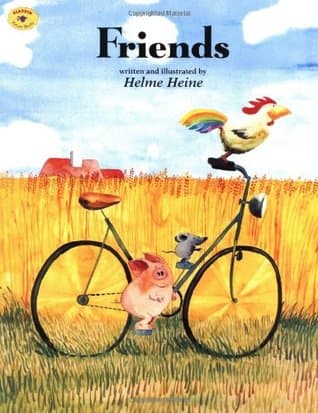
— Charlie Rooster, Johnny Mouse, and Percy Pig meet.

Sign in to track this book
Three inseparable farm animal friends discover that while adventures are best shared, true companionship transcends even the necessity of saying goodnight.
The story begins by introducing Charlie Rooster, Johnny Mouse, and Percy the Pig, three inseparable friends who live in a small, peaceful house. Their day starts with shared activities, highlighting their bond. They ride a bicycle together, with Percy pedaling, Johnny steering, and Charlie balancing on top. This shows their teamwork and the joy they find in each other's company, setting the mood for their strong friendship. The pictures show them in a bright, natural setting, emphasizing the simple happiness of their lives.
As the day continues, the three friends keep having shared adventures. They play hide-and-seek, with Percy's large size making him a funny but obvious hiding spot for the smaller Johnny Mouse. They also play pretend, sailing a boat together, which is likely a toy in a small pond or puddle. Their games always include everyone, showing how they adjust to each other's strengths and weaknesses, making sure everyone plays and has fun. This part reinforces their strong connection and how well they understand each other.
Their friendship goes beyond playtime into everyday tasks. When it's time for chores, Charlie Rooster, Johnny Mouse, and Percy the Pig do them as a team. They are shown washing clothes together, with Charlie hanging them, Johnny helping to wring them out, and Percy assisting with the heavy lifting. This scene illustrates that their bond is not just about fun, but also about helping each other and sharing duties, making even everyday tasks enjoyable when done together. It highlights the practical side of their friendship.
After their chores, the friends gather for a meal, sharing a single apple. This simple act of sharing further emphasizes their communal spirit and lack of selfishness. They sit close together, happy in each other's presence, reinforcing the idea that their happiness comes from their companionship rather than material things. The apple, a universal symbol of sharing, becomes a focus of their unity and contentment. This quiet moment shows the comfort and familiarity they find in their shared routine.
As evening approaches, the friends watch the sunset together, their shapes against the colorful sky. They are still close, enjoying the peaceful end of the day. This moment marks the passing of time and the natural shift from daytime activities to the quiet of night. Their continued togetherness highlights their wish to spend every possible moment in each other's company, hinting at the upcoming challenge of separation as bedtime nears. The beauty of the sunset reflects the beauty of their bond.
When it's time for bed, Charlie Rooster, Johnny Mouse, and Percy the Pig, used to doing everything together, try to sleep in the same bed. However, Percy's large size, along with Charlie's and Johnny's, makes it an impossible and uncomfortable fit. They try different positions, but the bed is simply too small for all three of them. This is the first practical challenge to their constant togetherness, introducing the idea that some activities might require them to be apart for practical reasons.
Not giving up, the friends move to another bed, hoping for more space. Yet, the result is the same: the bed is still too small for the three of them to sleep comfortably. This repeated attempt highlights their strong desire to stay together, even in sleep, and their initial reluctance to accept separation. The humor in their struggle emphasizes the innocence of their belief that true friendship means constant physical closeness, setting up the lesson they are about to learn about what friendship truly means.
After their failed attempts to share a bed, Charlie, Johnny, and Percy finally realize they must sleep in their own individual beds. They each go to their own sleeping places in the house. This moment marks a turning point, as they begin to understand that while they do everything together during the day, nighttime needs a different approach. It is a subtle introduction to the idea of individual space and the practical limits of constant togetherness, even for the best of friends.
Despite being hesitant to separate for sleep at first, each friend eventually settles comfortably into their own bed. Charlie Rooster finds his perch, Johnny Mouse snuggles into his small bed, and Percy the Pig stretches out in his larger one. The pictures show them looking content and peaceful in their individual spaces. This scene shows that while physical separation for sleep is necessary, it does not lessen their friendship. They are still connected, even when not physically touching.
The story ends with a heartwarming image of Charlie Rooster, Johnny Mouse, and Percy the Pig reunited in their dreams. They are shown together in a dream world, continuing their adventures, suggesting that their bond lasts beyond physical presence. This final scene beautifully captures the main message of the book: true friends may need to be apart sometimes, but their connection remains strong, even showing up in their dreams. It reinforces how their friendship lasts, even when they are physically separated.
The Protagonist
Charlie learns that friendship is not solely about constant physical proximity, but also about a deeper, enduring connection that can bridge temporary separation.
The Protagonist
Johnny discovers that true friendship persists beyond physical presence, extending even into the realm of dreams and shared memories.
The Protagonist
Percy learns to accept the practical necessity of individual space while understanding that it does not diminish the emotional closeness of his friendships.
The main theme explores what it truly means to be friends. At first, friendship is shown as constant togetherness, sharing every activity from bike rides to chores. However, as the story moves to bedtime, the characters learn that true friendship is not just about being physically close. It is about a deep, lasting bond that can handle temporary separation and even appear in shared dreams, showing that emotional connection is most important.
“Because that's what good friends do.”
This theme is clear in every shared activity the friends do. They ride a bike together, play games, do chores, and even share an apple. Their ability to work as a team, adjusting to each other's sizes and strengths, highlights how important cooperation and selflessness are in a friendship. This collaborative spirit makes every task enjoyable and strengthens their collective identity, showing that shared effort makes their bond stronger.
“They do everything together.”
While the friends love doing everything together, the challenge of bedtime introduces the need for individual space. They learn that despite their strong bond, there are times when being apart is practical and even necessary. This theme suggests that true friendship allows for individual needs and boundaries without making the overall connection weaker, teaching that embracing individuality can exist with deep companionship.
“But that's okay, because true friends always find each other, even if it's just in their dreams.”
Throughout the story, the characters find great comfort and joy in each other's presence. Whether it is the laughter during playtime or the peaceful shared moments watching the sunset, their happiness is closely tied to their companionship. Even when physically separated for sleep, the idea of being reunited in dreams provides a deep sense of comfort, showing that the emotional connection between friends is a strong source of security and well-being.
“When night falls, though, and it's time to go to bed, they learn that sometimes friends have to be apart.”
The recurring phrase 'Because that's what good friends do' reinforces the core message.
The phrase 'Because that's what good friends do' is repeated throughout the early parts of the story, emphasizing the characters' understanding of friendship as constant togetherness and shared activities. This repetition establishes their initial belief about friendship, which then contrasts with the later realization that friendship can also involve temporary separation. It serves to drive home the evolving definition of friendship to the young reader.
The small bed serves as a physical barrier representing the limits of constant togetherness.
The bed, specifically its inadequate size for all three friends, acts as a crucial symbolic obstacle. It's the first thing that forces the friends to consider being apart, challenging their established routine of constant togetherness. This physical limitation metaphorically represents the practical boundaries and individual needs that exist even within the strongest friendships, leading to the story's central lesson about the nature of true connection.
The final dream sequence provides a resolution that transcends physical separation.
The dream sequence at the end of the book is a powerful plot device that offers a comforting resolution to the problem of separation. By showing the friends reunited in their dreams, it visually reinforces the idea that their bond is so strong it extends beyond waking hours and physical presence. This device reassures the reader that temporary goodbyes do not diminish true friendship, providing a hopeful and heartwarming conclusion.
“Let's play!”
— Charlie Rooster, Johnny Mouse, and Percy Pig meet.
“Friends play together.”
— The three friends decide to play.
“Friends share.”
— They share a swing.
“Friends help each other.”
— When one friend falls, the others help.
“Friends have fun.”
— They are all laughing while playing.
“Friends are always there for you.”
— They stay together through different activities.
“Friends can be different.”
— A rooster, a mouse, and a pig are unlikely friends.
“Friends can nap together.”
— They all fall asleep side-by-side.
“Friends wake up together.”
— They stir awake at the same time.
“Friends eat together.”
— They share a meal after waking up.
“Friends are the best!”
— The overall sentiment of the book.
“It's good to have friends.”
— The simple joy of their companionship.
“Even when it's time to go home, friends are still friends.”
— They part ways at the end of the day.
“See you tomorrow!”
— They say goodbye, promising to meet again.
Ready to see how well you understood this book? Take our interactive quiz with 10 questions.

Biography coming soon.

Dan Gemeinhart
4.5

Kate O'Hearn
4.4

Jeanne Birdsall
4.4

Jen Wang
4.4

Wendelin Van Draanen
4.3

John Marsden
4.3

Chris Van Allsburg
4.3
Jennifer A. Nielsen
4.2