“Violence is the last refuge of the incompetent.”
— Salvor Hardin reflecting on the actions of the Four Kingdoms.

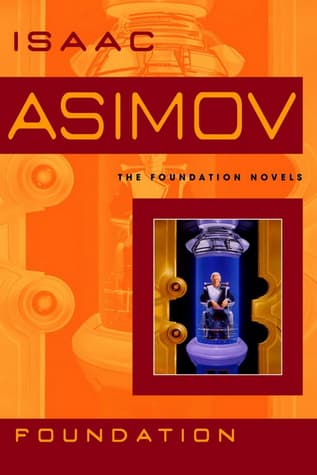
Isaac Asimov (1951)
Genre
Fantasy / Young Adult
Reading Time
360 min
Key Themes
See below
Sign in to track this book
As a dying Galactic Empire crumbles, a lone visionary uses the science of psychohistory to establish a remote outpost of knowledge, hoping to shorten humanity's inevitable dark age amidst rising warlords and the threat of annihilation.
On the planet Trantor, the capital of the Galactic Empire, Dr. Hari Seldon, a psychohistorian, is arrested for sedition. He predicts the Empire's imminent collapse, followed by a 30,000-year dark age. During his trial before the Commission of Public Safety, Seldon explains his science of psychohistory, which uses statistical analysis of large populations to predict future events. To reduce the coming dark age to only 1,000 years, he proposes two Foundations: one of physical scientists to compile an *Encyclopedia Galactica*, and a secret Second Foundation of mental scientists. The Commission, unable to grasp the full implications but wary of his influence, exiles Seldon and his followers to Terminus, a desolate planet at the galaxy's edge, where they establish the First Foundation.
Fifty years after its founding, the First Foundation on Terminus is no longer directly overseen by Hari Seldon, who has long since died. The current Board of Trustees, composed of encyclopedists, focuses solely on the *Encyclopedia Galactica*. However, Dr. Salvor Hardin, the Mayor of Terminus City, recognizes that the four surrounding prefectures — Anacreon, Smyrno, Konom, and Locris — are breaking away from the weakening Empire and becoming independent kingdoms. These kingdoms, technologically superior due to their proximity to the old Empire, threaten the Foundation, which possesses advanced nuclear technology. Hardin, dismissed by the Board as a mere politician, foresees a crisis the encyclopedists are ill-equipped to handle.
The first Seldon Crisis arrives when Anacreon, under its ambitious King Lepold I, threatens to annex Terminus and seize its nuclear power plant. The Foundation's Board of Trustees, led by Chief Encyclopedist Lewis Pirenne, believes the Empire will intervene, but Salvor Hardin, now Mayor, understands the Empire is too weak. Hardin, through clever diplomacy and an understanding of the kingdoms' reliance on Foundation technology, reveals his plan. He uses the religious reverence the barbarian kingdoms have developed for Foundation scientists and their technology, which has been presented as 'holy' by missionaries. By threatening to cut off essential nuclear power and technology, Hardin forces Anacreon to back down, establishing the Foundation's dominance through technological dependency rather than military might.
Eighty years later, the Foundation has established a theocratic hierarchy, exporting its advanced nuclear technology disguised as 'holy' gifts to the four surrounding kingdoms. Foundation-trained priests, who alone can operate the technology, serve as a powerful political tool, making the kingdoms dependent. Salvor Hardin, still Mayor, faces another Seldon Crisis. Prince Wienis of Anacreon, regent for the young King Leopold II, plans to build his own nuclear battleship and declare war on the Foundation. Hardin understands Wienis is attempting to break the Foundation's technological and religious hold. Hardin's strategy involves inciting a popular uprising among the Anacreonian populace, who are devout followers of the Foundation's 'religion' and fear the loss of their technology.
Prince Wienis, attempting to assert Anacreon's independence, orders the launch of his new nuclear battleship, crewed by his loyalists. However, the Foundation has subtly infiltrated the ship's control systems and the Anacreonian priesthood. As Wienis prepares for war, the Foundation's priests, acting on Hardin's orders, initiate a general strike and broadcast a message of divine wrath, causing widespread panic and dissent among the populace. The people, fearing the loss of their technology and divine favor, revolt against Wienis. Ultimately, Wienis is assassinated by his own men, and the young King Leopold II is forced to sign a treaty that formally places the four kingdoms under the Foundation's economic and political control, cementing the Foundation's role as the dominant power in the region.
After another Seldon Crisis, the Foundation's expansion continues, moving beyond the initial four kingdoms. Independent traders, like Limmar Ponyets, become the new vanguard of Foundation influence. These traders bring Foundation technology and goods to increasingly distant, less developed planets, often dealing with local despots and warlords. Ponyets, a skilled and cynical trader, finds himself on Askone, a backward planet ruled by an anti-technology council. He is arrested for selling Foundation goods, specifically a nuclear generator, which is considered heresy. The Foundation, now led by the merchant class, sends him to negotiate his release and open trade routes.
On Askone, Limmar Ponyets is imprisoned, while the Foundation sends a warship to pressure Askone for his release. Ponyets, however, prefers a more subtle approach. He befriends the young, ambitious merchant councilor, Pherl, who is frustrated by Askone's stagnant, anti-technological policies. Ponyets subtly introduces Pherl to advanced Foundation gadgets and the concept of profit, bypassing the rigid council's rules. He engineers a situation where Pherl can gain wealth and power by trading with the Foundation, effectively bribing him with advanced technology that can be reverse-engineered and sold. This allows Ponyets to secure his release and establish a foothold for Foundation trade on Askone, demonstrating the power of economic influence over military might.
Fifty years later, the Foundation's power is challenged by the independent trading world of Korell, led by its aggressive Commdor, Asper Argo. Korell has obtained advanced weapon technology, not from the Foundation, but from the decaying Galactic Empire itself, creating a new threat. Hober Mallow, a renowned and pragmatic Master Trader, is sent by the Foundation to investigate the disappearance of Foundation ships and to negotiate with Korell. The Foundation council, still divided between the old religious-technological approach and Mallow's purely economic one, is hesitant to trust him. Mallow, however, believes in free trade and self-sufficiency, rather than the old religious manipulation.
Hober Mallow arrives on Korell and quickly discerns that Commdor Asper Argo is receiving advanced weaponry from the remnants of the Empire. Mallow is framed for the murder of an Imperial agent, but through his shrewdness and the help of a local woman, Onum Barr, he exposes the setup. He realizes that Korell, despite its military build-up, is utterly dependent on Foundation goods and services for its infrastructure and daily life. Mallow refuses to engage in direct military conflict, instead opting for an economic blockade. He cuts off all trade with Korell, plunging the planet into a severe economic depression. The people, suffering from the lack of essential Foundation products, rise up against Commdor Argo, forcing Korell to submit and accept Foundation trade terms, further expanding its economic empire.
Two centuries after its founding, the Foundation faces its greatest threat yet: the rising power of the Galactic Empire, specifically through the ambitious and capable General Bel Riose. Riose, a brilliant military strategist, has successfully re-conquered several systems and is now turning his attention to the Foundation, which he perceives as a vulnerable, technologically advanced but militarily weak entity. Riose sees the Foundation as a potential rival to the Empire's resurgence. He captures Foundation traders, including Lathan Devers, and begins to probe the Foundation's defenses, aiming for a decisive military victory and the re-absorption of the 'barbarian' peripheral systems into the Empire.
Bel Riose, with his powerful Imperial fleet, engages in a prolonged war with the Foundation. The Foundation, led by figures like the politician Ducem Barr and the trader Lathan Devers, attempts to fight back, but their military is no match for the Empire's might. However, the Foundation's true strength lies in psychohistory. The Seldon Plan dictates that the Empire is inherently unstable and will not tolerate a successful general like Riose for long. Emperor Cleon II, despite Riose's loyalty and success, eventually fears his general's growing power and popularity. He recalls Riose to Trantor, where both Riose and his patron, Duce Barr, are executed. The Imperial threat collapses from within, once again proving the Seldon Plan's predictive power and securing the Foundation's continued existence.
The Protagonist (indirect)
Seldon's arc is completed before the main narrative; his legacy is the unfolding of his meticulously planned future.
The Protagonist
Hardin evolves from an overlooked politician to the indispensable leader who secures the Foundation's initial survival and political dominance.
The Supporting
Pirenne's arc is one of failure to adapt, representing the obsolescence of pure academic pursuits in times of crisis.
The Protagonist
Ponyets demonstrates the shift from political/religious control to economic hegemony as the Foundation evolves.
The Protagonist
Mallow solidifies the Foundation's economic power, proving that the Seldon Plan can adapt to new threats through non-military means.
The Antagonist
Riose's arc is a tragic one, as his success and loyalty ultimately lead to his downfall due to the Empire's internal politics.
The Supporting
Dornick's arc is brief, serving primarily to establish the context of the Foundation's creation.
The Supporting
Pherl's arc shows how individual greed can be harnessed for the Foundation's larger goals.
The Antagonist
Argo's downfall illustrates the Foundation's shift from religious to economic dominance.
The central theme of 'Foundation' is the tension between the predetermined course of history, as predicted by psychohistory, and the apparent agency of individual characters. Hari Seldon's plan dictates the overarching trajectory, making historical events seem inevitable. However, within these broad strokes, characters like Salvor Hardin, Limmar Ponyets, and Hober Mallow make important decisions that appear to save the Foundation. The narrative suggests that while the large-scale outcome is fixed, the specific methods and the 'how' of achieving it are left to the ingenuity of individuals operating within the Plan's parameters. This creates a fascinating interplay where characters believe they are acting freely, yet are unwittingly fulfilling a grand design.
“Individuals are statistics, too, you know. But the laws of statistics apply only to large groups. You can't predict what a single human being is going to do.”
Knowledge and technology are the ultimate sources of power in 'Foundation.' The Foundation itself is built on the preservation and advancement of scientific knowledge. Its initial survival against barbarian kingdoms is due to its superior nuclear technology, which is then used as a religious weapon. Later, advanced trade goods and economic principles become the Foundation's tools for expansion. The book consistently shows that control over information, scientific understanding, and technological innovation is more potent than brute military force, allowing the Foundation to overcome physically stronger adversaries. The *Encyclopedia Galactica* symbolizes this foundational belief in the enduring power of accumulated wisdom.
“Violence is the last refuge of the incompetent.”
The novel explores the rise and fall of civilizations, mirroring historical patterns of empires. The Galactic Empire is in its twilight, decaying from within, unable to maintain its vast reach. The Foundation is designed to shorten the interregnum of barbarism and eventually give rise to a new, stronger galactic order. Each crisis faced by the Foundation, from the barbarian kingdoms to the resurgent Imperial general, is a small example of this larger cycle. The Foundation's success lies in understanding and exploiting the weaknesses inherent in declining powers, and in adapting its own strategies to avoid succumbing to the same fate.
“The Galactic Empire has lasted for twelve thousand years. It has been a magnificent structure, but it is rotting at the core.”
A recurring conflict in the novel is between pragmatic, often cynical, leaders and idealistic, sometimes naive, academics or traditionalists. Salvor Hardin, Limmar Ponyets, and Hober Mallow are all figures who prioritize practical solutions, often involving manipulation or economic leverage, over rigid adherence to scientific purity or moral codes. The encyclopedists, and later some of the Foundation's councilors, represent the idealistic counterpoint, believing in the power of knowledge for its own sake or adhering to outdated strategies. The narrative consistently champions the pragmatic approach as essential for survival, demonstrating that adaptability and a willingness to compromise on ideals are necessary to navigate crises.
“To succeed, planning alone is not enough. One must also have a certain amount of luck.”
A meticulously calculated roadmap for humanity's future.
The Seldon Plan is a master strategy devised by Hari Seldon using psychohistory. It predicts the collapse of the Galactic Empire and outlines a path to reduce the ensuing dark age from 30,000 years to 1,000 years by establishing two Foundations. The Plan is an overarching narrative device, guiding the plot and ensuring the Foundation's survival through various 'Seldon Crises.' Characters are often unaware they are fulfilling the Plan, only understanding its purpose retrospectively through Seldon's holographic messages, which are revealed at critical junctures.
A fictional science capable of predicting societal trends.
Psychohistory is a revolutionary science developed by Hari Seldon, combining mathematics, sociology, and statistics to predict the future behavior of large populations. It operates on the principle that while individual actions are unpredictable, the collective actions of billions can be statistically modeled. This device provides the scientific justification for the Seldon Plan and allows for the 'inevitability' of historical events. It elevates the conflict beyond mere political machinations to a cosmic chess game, where the Foundation's success is a validation of scientific foresight.
A time-locked chamber revealing Hari Seldon's pre-recorded messages.
The Vault is a sealed chamber on Terminus that opens automatically at specific intervals, revealing pre-recorded holographic messages from Hari Seldon. These messages explain the nature of the current 'Seldon Crisis' and the true purpose of the Foundation, which often differs from what the Foundation's leaders believed. This device serves as a crucial plot point, providing exposition, validating the Seldon Plan, and re-directing the Foundation's strategy whenever it strays from its intended path. It reinforces Seldon's omniscient presence long after his death.
Foundation's advanced technology used as a tool for control.
The Foundation maintains a significant technological advantage over its less developed neighbors. This superiority, particularly in nuclear energy, is often disguised as a 'sacred' or 'divine' power by Foundation-trained priests. This plot device allows the Foundation to exert political and economic control over the barbarian kingdoms without direct military conquest. The 'religion' creates a crucial dependency, as only Foundation personnel can maintain and operate the advanced technology, making their withdrawal a devastating threat.
“Violence is the last refuge of the incompetent.”
— Salvor Hardin reflecting on the actions of the Four Kingdoms.
“It is the chief characteristic of the human mind, that it can never forsee its own development.”
— Hari Seldon explaining the limitations of psychohistory.
“A good politician is as nearly an omniscient god as can be found on this planet.”
— Salvor Hardin musing on the necessary qualities of a leader.
“The fall of a civilization, my dear, is a phenomenon that is by no means a new one.”
— Hari Seldon addressing the Committee of Public Safety about the decline of the Galactic Empire.
“Never let your sense of morals prevent you from doing what is right!”
— Salvor Hardin's advice to his subordinates regarding practical governance.
“All men are not created equal. There are some men who are just naturally smarter than others.”
— An argument presented by one of the scientists on Terminus regarding the 'Encyclopedists'.
“The human mind works differently from the non-human. The non-human mind is a logical machine, the human mind is a mass of contradictions.”
— Hari Seldon discussing the complexities of human behavior versus predictable systems.
“An atom-blaster is a good weapon, but it can point both ways.”
— Salvor Hardin cautioning against the sole reliance on military might.
“The psychohistorical equations are, of course, statistical in nature, and deal with probabilities.”
— Hari Seldon explaining the core principle of psychohistory.
“To succeed, planning alone is insufficient. One must improvise as well.”
— Salvor Hardin reflecting on the dynamic nature of political strategy.
“Only a great genius can lead the world. Only a great genius can save the world.”
— Part of the rhetoric used by the Foundation to elevate its status among the barbarized worlds.
“The greatest weapon in the world is the ability to make men believe in you.”
— Salvor Hardin explaining the power of influence and persuasion.
“There are no nations, only parts of nations, and the people in them.”
— An observation about the breakdown of larger political entities.
“The future is not a gift. It is an achievement.”
— A general philosophical statement reflecting the Foundation's proactive approach to the Seldon Plan.
Ready to see how well you understood this book? Take our interactive quiz with 10 questions.
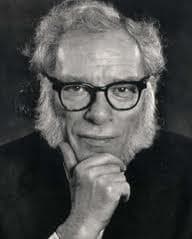
Isaac Asimov was an American writer and professor of biochemistry at Boston University. During his lifetime, Asimov was considered one of the "Big Three" science fiction writers, along with Robert A. Heinlein and Arthur C. Clarke. A prolific writer, he wrote or edited more than 500 books. He also wrote an estimated 90,000 letters and postcards. Best known for his hard science fiction, Asimov also wrote mysteries and fantasy, as well as much non-fiction.







