“Violence is the last refuge of the competence.”
— General observation on the nature of power and conflict.

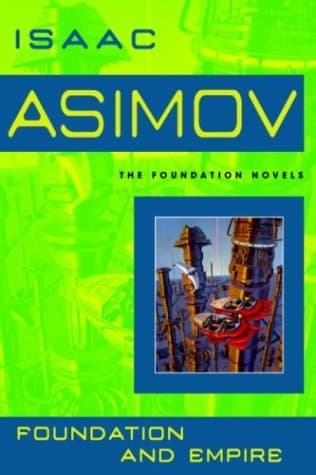
Isaac Asimov (1945)
Genre
Fantasy / Science Fiction
Reading Time
300 min
Key Themes
See below
Sign in to track this book
As the First Galactic Empire crumbles, the Foundation, guided by psychohistory, confronts the unexpected emergence of the Mule, a mutant capable of shattering Seldon's plan for humanity's future.
General Bel Riose, a military leader of the decaying First Galactic Empire, begins a campaign to conquer the independent Foundation. Despite the Empire's overall decline and technological stagnation, Riose has a formidable fleet and strategic skill. He views the Foundation's growing influence and technology as a direct threat to Imperial authority. Riose establishes a base on Siwenna, gathering intelligence and resources, while the Foundation, guided by the Seldon Plan, believes itself safe from attack. Riose's initial successes, including the capture of several Foundation outposts, surprise the Foundation's leadership, forcing them to reconsider the Seldon Plan's predictions about the Empire's weakness.
Believing direct military confrontation is not possible against Riose's forces, the Foundation sends two agents: Ducem Barr, a former Imperial aristocrat from Siwenna, and Lathan Devers, a Foundation trader. Their mission is not to fight, but to subtly manipulate Imperial politics and Riose's ambition. They deduce that Riose, despite his military skill, is a pawn in the larger game of Imperial power. Their strategy involves planting suspicion within the Imperial court against Riose, hoping to trigger the Empire's paranoia and political instability. They believe that if Riose becomes too successful, the Emperor will see him as a threat, leading to his downfall.
Devers and Barr's efforts work. Emperor Cleon II, a strong but suspicious ruler, becomes wary of General Riose's triumphs. The Emperor's advisors, fueled by fear and jealousy, subtly exaggerate Riose's ambition and independent actions. Despite Riose's loyalty, Cleon II's paranoia overwhelms him. He recalls Riose to Trantor, the Imperial capital, under the guise of celebration. Upon his arrival, Riose is arrested, charged with treason, and executed. His campaign against the Foundation collapses instantly, and the Imperial fleet disperses. The Foundation celebrates this outcome as another triumph of the Seldon Plan, confirming the Empire's inevitable decline and its inability to successfully challenge the Foundation.
Eighty years after Riose's downfall, the galaxy faces a new, unprecedented threat: the Mule. A mysterious individual with the ability to telepathically manipulate emotions, the Mule rapidly conquers independent systems and then sets his sights on the Foundation. His powers allow him to turn entire populations and fleets into loyal followers, making traditional military resistance impossible. The Foundation, complacent in its belief in the Seldon Plan's infallibility, is caught off guard. The Mule's abilities are a 'wild card' – a factor that Hari Seldon, the creator of psychohistory, could not have predicted or accounted for, representing a catastrophic deviation from the Plan. This is the beginning of the Foundation's most severe crisis.
The Mule's advance is relentless. He uses his emotional manipulation to turn Foundation fleets against each other and to convert key Foundation figures, including the Mayor of Terminus, Indbur III, into his loyal servants. Terminus, the capital of the Foundation, falls with minimal resistance. The Seldon Plan, which predicted a series of predictable crises and the Foundation's eventual triumph, is shattered. The Mule establishes his new capital on Kalgan and begins to build a new, personal empire, changing the trajectory of galactic history. The Foundation's citizens are left in despair, their faith in psychohistory and the future undermined.
Amidst the chaos and despair following the Foundation's fall, a young woman named Bayta Darell, along with her husband Toran and the Mule's jester, Magnifico Giganticus (who is secretly the Mule himself), begins a search for the Second Foundation. According to Seldon's prophecies, the Second Foundation was established at 'the other end of the galaxy' and comprised mental scientists capable of guiding humanity's future. Bayta believes that only the Second Foundation has the mental powers to counter the Mule. Their journey takes them through various star systems, including the remnants of the old Empire and the Mule's newly conquered territories, as they try to evade the Mule's agents and uncover clues.
Bayta, Toran, and Magnifico travel to the ruins of Trantor, the former capital of the Galactic Empire, now a desolate planet stripped of its metal and resources. They seek the Imperial Library, hoping to find any records or clues about the Second Foundation's location. They encounter Jord Fara, a scholar living among the ruins, who guides them through the vast, decaying library. While they find no direct mention of the Second Foundation, they learn more about Hari Seldon's life and his foresight, reinforcing Bayta's conviction that the Second Foundation must exist. Their time on Trantor shows the devastation caused by the Empire's fall and the lingering knowledge hidden within its remnants.
The trio eventually travels to Kalgan, the Mule's new capital. During their stay, Bayta Darell begins to piece together subtle clues and inconsistencies in Magnifico's behavior and knowledge. She realizes that the seemingly harmless jester is, in fact, the powerful, emotion-manipulating Mule himself, who has been traveling with them, observing and manipulating their quest. This revelation is a shocking climax, as Bayta confronts the Mule directly. The Mule, having grown fond of Bayta, reveals his true nature and the extent of his powers, admitting that he kept her close out of a strange affection and a desire to understand those who defied him.
In a tense confrontation on Kalgan, Bayta, with her knowledge of the Mule's identity, manages to briefly resist his mental influence through sheer force of will, fueled by her love for Toran. This act, while not defeating him, disturbs the Mule. He realizes that a strong emotional force, particularly love, can partially shield against his powers. More importantly, he recognizes that the Second Foundation, if it truly exists, would be his only true threat, as they would have mental abilities potentially equal or superior to his own. He declares his intention to find and destroy the Second Foundation, shifting his focus from galactic conquest to this new, personal crusade.
Unbeknownst to the Mule, the Second Foundation has been subtly working against him all along. While their direct intervention is not explicitly shown in this book, the ending implies that they have been guiding events and planting the idea of a 'search for the Second Foundation' in the minds of key individuals like Bayta. Their ultimate goal is to neutralize the Mule without revealing their existence or directly confronting him, thus preserving the Seldon Plan. The Mule's shift in focus to finding the Second Foundation is, in itself, a manipulation by the Second Foundation, diverting him from further consolidating his empire and setting him on a path where they can eventually counter him.
The Antagonist
From a triumphant conqueror, Riose falls victim to Imperial politics, demonstrating the Empire's inherent self-destructive nature.
The Supporting
From a disillusioned Imperial citizen, Barr becomes a crucial agent in the Foundation's political warfare.
The Supporting
Devers develops from a relatively inexperienced trader into a capable and courageous agent for the Foundation.
The Mentioned
His reign marks the final, albeit temporary, resurgence of Imperial power before its ultimate decay.
The Antagonist
From a hidden conqueror, he is unmasked and then shifts his focus from galactic dominance to finding the Second Foundation.
The Protagonist
Bayta evolves from a fearful survivor into a determined leader, whose actions inadvertently help the Second Foundation.
The Supporting
From a pragmatic trader, Toran becomes a loyal companion, demonstrating the power of love and loyalty in a crisis.
The Supporting
He serves as a conduit of historical knowledge, aiding the protagonists in their quest.
The Supporting
From a driven scholar, he becomes a victim of mental manipulation, highlighting the vulnerability of even the most intelligent minds.
The novel shows the decline and collapse of the First Galactic Empire, with political paranoia, technological stagnation, and internal decay, as seen in the fate of General Riose. At the same time, it shows the Foundation's emergence as a new galactic power, first through its technology and economy, and later through its struggle against unforeseen challenges. The Mule's conquest represents another, unexpected, shift in galactic order, showing how power cycles and civilization constantly changes. The story contrasts the old, decaying power with the new, evolving one, and then introduces an entirely new, unpredictable force.
“The Galactic Empire was a thing of the past. The Foundation was a thing of the future. The two could not exist together.”
Psychohistory, Hari Seldon's science of predicting mass human behavior, is central to the Foundation's existence. The first part of the book, 'The General', shows psychohistory's accuracy in predicting the Empire's self-destructive tendencies. However, the second part, 'The Mule', explores the limits of this prediction. The Mule, a unique individual with unprecedented mental powers, represents a 'wild card' that psychohistory could not account for, shattering the Seldon Plan and plunging the Foundation into chaos. This theme asks whether even the most advanced scientific models can truly predict and control all aspects of human destiny, especially when confronted with unpredictable genius or mutation.
“Psychohistory dealt with the reactions of human masses to socioeconomic stimuli. It was a science of statistics, not of individuals.”
This theme comes from the conflict between the Seldon Plan and the Mule. The Plan suggests a deterministic future for humanity, guided by statistical probabilities. Characters like Bel Riose try to act against this tide, but ultimately fall victim to larger historical forces. The Mule, however, represents a powerful individual who can change the course of history through personal will and unique abilities, defying deterministic predictions. Bayta Darell's desperate search and her love for Toran also show the human desire to act and make choices, even when faced with overwhelming, seemingly predetermined, events. The story explores the tension between humanity's collective destiny and the impact of extraordinary individuals.
“The Seldon Plan was broken. It was not merely bent, or twisted, or temporarily dislocated. It was broken. And I broke it.”
The novel looks at different forms of power: the decaying political power of the Empire (Cleon II's paranoia), the military power of a capable general (Riose), the technological and economic power of the early Foundation, and the mental power of the Mule. It contrasts traditional forms of leadership with the Mule's ability to subjugate minds, raising questions about control and consent. The Foundation's reliance on the Seldon Plan also represents a form of power – the power of knowledge and long-term planning. The themes explore how power is acquired, maintained, and how it can corrupt or be subverted, and what is legitimate leadership in a changing galaxy.
“There was a time when the mere name of the Emperor was enough to send shivers down a man's spine. Now, it's just a word.”
After the fall of the Foundation to the Mule, a deep sense of despair affects the galaxy. The loss of the Seldon Plan, which had provided a clear path to a better future, leaves many feeling lost and hopeless. Bayta Darell's quest for the Second Foundation is a symbol of this search for renewed hope and meaning. Her determination to find a solution, even when faced with great odds, shows the human spirit's need for purpose and a belief in a brighter tomorrow. The 'myth' of the Second Foundation is a psychological anchor for those who refuse to surrender to the Mule's conquest and the apparent end of the Seldon Plan.
“We're looking for the Second Foundation. We need to find them. They're our only hope.”
A fictional science used to predict the future of large populations.
Psychohistory is the central plot device and philosophical backbone of the 'Foundation' series. Developed by Hari Seldon, it is a mathematical science that can predict the general course of future events for large human populations, though not for individuals. In 'Foundation and Empire', it initially provides the Foundation with a sense of security against the Empire, accurately predicting Riose's downfall. However, its failure to predict the Mule's emergence becomes the primary conflict, highlighting its limitations and creating a crisis that drives the second half of the narrative. It serves as both a guiding prophecy and a challenge to human free will.
An unpredictable element that disrupts the established order or plan.
The Mule is the ultimate 'wild card' anomaly in 'Foundation and Empire'. He represents an individual whose unique mental abilities and singular impact on history could not be accounted for by psychohistory. His emergence shatters the Seldon Plan, plunging the Foundation into an existential crisis. This device introduces unpredictability and raises the stakes, demonstrating that even a robust scientific prediction model like psychohistory has limits when confronted with truly exceptional, unforeseen factors. It forces the characters and the narrative to adapt to a reality beyond their understanding.
A legendary, secretly existing group of mental scientists.
The Second Foundation is a legendary, almost mythical, organization whose existence is hinted at throughout the series. It's described as being located at 'the other end of the galaxy' and composed of mental scientists who work to subtly guide humanity's development according to the Seldon Plan. In 'Foundation and Empire', it serves as Bayta Darell's desperate objective and the ultimate hope against the Mule. Its hidden nature and mental powers make it an invisible hand, subtly influencing events and ultimately neutralizing the Mule without direct confrontation, thus preserving the Seldon Plan and its own secrecy.
A setting representing the decline of a once-great civilization.
The First Galactic Empire serves as a powerful backdrop and a primary antagonist in the first part of the novel. Its decay is not just a setting but a plot device that enables the Foundation's rise. Characterized by political paranoia (Emperor Cleon II), technological stagnation, and internal corruption, the Empire's inherent weaknesses are exploited by the Foundation. Its inability to sustain a prolonged, effective campaign against the Foundation, despite the brilliance of General Riose, underscores its inevitable collapse predicted by Seldon. The ruins of Trantor later symbolize this profound decline.
A unique telepathic ability to control and alter the emotions of others.
The Mule's power of emotional manipulation is a critical plot device that fundamentally alters the nature of conflict in the 'Foundation' universe. Unlike conventional warfare, which relies on technology and strategy, the Mule's ability to turn enemies into loyal followers by 'tweaking' their emotions renders traditional defenses useless. This power allows him to conquer the Foundation swiftly and without significant resistance, creating a crisis that psychohistory could not foresee. It also highlights the vulnerability of the human mind and introduces a new dimension of psychological warfare.
“Violence is the last refuge of the competence.”
— General observation on the nature of power and conflict.
“Never let your sense of morals prevent you from doing what is right!”
— Mule's philosophy on pragmatic action, even if it seems amoral.
“To succeed, you must have the courage to fail.”
— Often attributed to various characters discussing strategy and risk.
“The greatest enemy of knowledge is not ignorance, it is the illusion of knowledge.”
— A reflection on the dangers of overconfidence and incomplete understanding.
“An atom-blaster is a good weapon, but it can point both ways.”
— Discussion about the dangers of powerful technology and its potential for self-destruction.
“It is the chief characteristic of the human mind, that it can never be at rest.”
— A philosophical musing on human nature and the constant drive for progress or change.
“The only sure weapon against the Mule is freedom.”
— General understanding of how to resist the Mule's mind control and influence.
“The test of a first-rate intelligence is the ability to hold two opposed ideas in mind at the same time and still retain the ability to function.”
— A quote on intellectual flexibility and the capacity for complex thought.
“History is a wheel, for the nature of man is a wheel.”
— A cyclical view of history and human behavior, suggesting patterns repeat.
“There are no such things as facts, only interpretations.”
— A relativistic view of truth and knowledge, often expressed in debates.
“The future is not a path to be walked, but a labyrinth to be explored.”
— A perspective on the unpredictable and complex nature of the future.
“The highest activity a human being can attain is learning for understanding, because to understand is to be free.”
— A deep thought on the liberating power of true comprehension.
“Against logic there is no armor like ignorance.”
— A comment on the futility of arguing with those who refuse to acknowledge reason.
“The only way to solve a problem is to prevent it.”
— A proactive approach to problem-solving, emphasizing foresight.
Ready to see how well you understood this book? Take our interactive quiz with 10 questions.
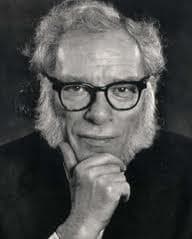
Isaac Asimov was an American writer and professor of biochemistry at Boston University. During his lifetime, Asimov was considered one of the "Big Three" science fiction writers, along with Robert A. Heinlein and Arthur C. Clarke. A prolific writer, he wrote or edited more than 500 books. He also wrote an estimated 90,000 letters and postcards. Best known for his hard science fiction, Asimov also wrote mysteries and fantasy, as well as much non-fiction.







