“Sometimes the hardest thing to find is the thing you never knew you were looking for.”
— Reflection on the journey of the characters discovering their true identities.

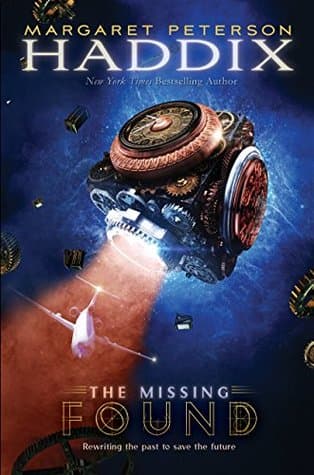
Margaret Peterson Haddix (1908)
Genre
Fantasy / Young Adult / Romance
Reading Time
320 min
Key Themes
See below
Sign in to track this book
When mysterious letters reveal their adoption is a cover for a millennia-old time-traveling conspiracy, two teenagers find themselves at the heart of a cosmic battle for their very existence.
Thirteen-year-old Jonah has always known he was adopted, but it has never been a big issue until he receives a cryptic letter simply stating, 'You are one of the missing.' Soon after, another adopted boy named Chip, new to their school, receives an identical letter. Jonah’s younger sister, Katherine, a detective in the making, becomes interested and helps them investigate. Their first attempts to understand the letters lead them to a support group for adopted children, where they meet many other kids who have also received the same strange message. The mystery grows when a second, more urgent letter arrives, warning them, 'Beware! They're coming back to get you.' This increasing threat creates unease and urgency, pushing the trio to look deeper into the puzzle of their adoptions.
The FBI gets involved after many adopted children report receiving the mysterious letters. Special Agent James Reardon, a benevolent but evasive agent, takes a particular interest in Jonah, Chip, and Katherine. He explains that all the children were adopted through the same agency, the 'Interdimensional Bureau of Chronology,' a fantastical name. Reardon reveals that a plane full of babies, including Jonah and Chip, appeared out of nowhere years ago, defying logic. These 'found' children were then placed for adoption. The FBI investigates this impossible event and the reappearance of the letters, suggesting a larger, more bizarre conspiracy than the kids could have imagined.
While at an FBI-organized meeting for the 'found' children, chaos erupts. Two mysterious figures, a man and a woman later identified as Gary and Hodge, burst in and abduct Jonah and Chip. They are taken to a secluded location where Gary and Hodge reveal an astonishing truth: they are from the future. They explain that Jonah, Chip, and the other 'found' children were not just adopted but were snatched from different points in time and illegally brought to the present by a time traveler. This revelation shatters the boys' understanding of their identities and places them in the center of a temporal conflict, far beyond any ordinary adoption mystery.
Gary and Hodge explain their story, saying that time travel is a regulated and dangerous technology in their future. They are agents of the Time Authority, tasked with correcting temporal anomalies. They reveal that a time traveler, known as JB, was illegally bringing children from various historical periods into the 21st century and placing them for adoption. Jonah and Chip were among these 'time-displaced' children. The letters were a warning from the Time Authority, meant to gather the children and prepare them for their return to their original times. The agents say it is important to return the children to prevent disruptions to the timeline, painting a dire picture of the consequences if they fail.
Katherine continues her own investigation after Jonah and Chip's abduction. She teams up with Alex, another 'found' child who escaped the FBI meeting. Together, they use Katherine's detective skills and Alex's street smarts to track down clues. They find inconsistencies in Gary and Hodge's story and begin to suspect that the Time Authority might not be as benevolent as they claim. Katherine's digging leads them to a hidden facility, where they see the Time Authority's methods firsthand, realizing that the situation is more morally ambiguous than simply good versus evil.
Gary and Hodge present Jonah and Chip with their options: return to their original times and places, which for many means facing certain death or hardship, or remain in the present, creating dangerous paradoxes and potentially altering history. The agents say that staying could erase their families and friends in the present, while returning might mean sacrificing the lives they know. This choice weighs heavily on the children, forcing them to confront their identities and the value of their current lives against the demands of historical integrity. Chip, in particular, struggles with leaving his adoptive family and the only life he has ever known.
Through discussions and confrontations, Jonah, Chip, and Katherine begin to understand JB's true motives. They learn that JB, the time traveler who brought them to the present, was not malicious but a compassionate individual trying to save these children from terrible fates in their original timelines. Many of the children were destined for early deaths, severe illness, or lives of hardship. JB believed he was giving them a second chance at life in a safer, more advanced future. This revelation complicates the moral dilemma, making the Time Authority's mission seem less noble and JB's actions more understandable, blurring the lines between right and wrong.
Katherine, still investigating with Alex, infiltrates the Time Authority's temporary base. She confronts Gary and Hodge, demanding answers and questioning their methods. During this encounter, Katherine inadvertently reveals details about her own adoption and her desire to find her birth family. In a shocking turn of events, the Time Authority agents realize that Katherine is also one of the 'found' children, adopted through the same mysterious agency. She is immediately apprehended and taken into custody, now facing the same choices as Jonah and Chip, increasing the personal stakes for Jonah.
Distraught by Katherine's capture and the Time Authority's stance, Jonah realizes he cannot simply stand by. He begins to formulate a desperate plan to rescue his sister and prevent the other 'found' children from being forcibly returned to their often-dangerous pasts. Jonah, along with Chip and Alex, starts to gather information and strategize, using their limited knowledge of time travel and the agents' vulnerabilities. He understands that direct confrontation is impossible, so he focuses on finding a way to disrupt the Time Authority's operations from within, or at least buy enough time to consider other options for the children.
In a struggle, Jonah, Chip, and Katherine, aided by a few other 'found' children, manage to escape the Time Authority's clutches. They use quick thinking, strategic diversions, and a bit of luck to evade Gary and Hodge. Although they are now on the run, their escape provides a brief reprieve and a chance to regroup. The experience strengthens their bond and their determination to find a third option—a way for all the 'found' children to live safely without disrupting history or sacrificing their lives. The ending leaves them with a fragile sense of hope, but also the realization that they are now fugitives in a complex temporal war, with their future, and the future of many others, hanging in the balance.
The Protagonist
Jonah transforms from a somewhat passive recipient of information into an active, determined leader seeking to protect his friends and family.
The Protagonist
Chip moves from fearful denial to a gradual acceptance of his situation, finding strength in his bond with Jonah and Katherine.
The Supporting
Katherine's role evolves from an inquisitive bystander to a central figure in the mystery, discovering her own time-displaced origin.
The Supporting
Reardon shifts from a seemingly helpful FBI agent to an agent of the Time Authority, revealing his deceptive nature.
The Antagonist
Gary remains consistently focused on his mission, serving as a steadfast antagonist representing the Time Authority's strict principles.
The Antagonist
Hodge maintains her commitment to the Time Authority's mission but reveals glimpses of empathy and internal conflict.
The Supporting
Alex develops from an independent, cautious 'found' child into a loyal and resourceful ally for Katherine.
The Mentioned
JB's character is developed through the revelations of his past actions and motivations, shaping the children's understanding of their origins.
The novel explores identity, especially for adopted children. Jonah and Chip deal with the revelation that their existence in the present is an anomaly, forcing them to question who they are and where they belong. Is their identity defined by their adoptive families and the lives they have known, or by their true historical origins? This theme is heightened by the choice they face: return to a past where they might die or remain in a present where they do not historically belong. Katherine's discovery of her own 'found' status further complicates these questions, as she must reconcile her established identity with a newly revealed, time-displaced one.
“You are one of the missing.”
A central ethical problem in the book is the morality of intervening in history, even for benevolent reasons. JB's actions of 'saving' children from harsh pasts are seen as criminal by the Time Authority, who prioritize the integrity of the timeline above individual lives. Conversely, the children question the Time Authority's morality in forcibly returning them to potentially horrific fates. This theme asks whether it is ever right to sacrifice individual happiness and safety for the sake of a 'greater good' or historical accuracy. The characters weigh the consequences of compassion against the demands of temporal law, blurring the lines between hero and villain.
“You can't change history. There are consequences.”
Despite the fantastical premise of time travel, the story is anchored in the power of family bonds, both biological and adoptive. Jonah's loyalty to Katherine, even before her own 'found' status is revealed, is a driving force. Chip's love for his adoptive parents makes the idea of returning to his original time unbearable. The book shows that family is not just about blood, but about the love, care, and connections formed. The Time Authority's cold, logical approach to returning children clashes with the emotional reality of these established family units, showing the impact of love on identity and belonging.
“They were my parents. They are my parents.”
The story is built on layers of deception and the struggle to uncover the truth. From the mysterious letters to Agent Reardon's hidden agenda and the Time Authority's selective revelations, the characters constantly face misinformation. Jonah, Katherine, and Chip must figure out who to trust and what information is accurate. This theme shows the dangers of blind obedience to authority and the importance of critical thinking. The 'truth' about their origins is not a simple fact but a complex, morally ambiguous story that requires careful piecing together, challenging their perceptions of reality and justice.
“Everything you think you know about your past... it's a lie.”
Catalyst for the plot and initial source of suspense.
The anonymous, cryptic letters ('You are one of the missing,' 'Beware! They're coming back to get you') serve as the initial inciting incident. They immediately establish a sense of mystery and urgency, drawing Jonah, Chip, and Katherine into the unfolding plot. The letters act as a direct call to adventure, forcing the characters to question their reality and embark on a quest for answers. They also function as a narrative hook, compelling the reader to uncover the meaning behind the ominous messages and the identity of their sender, creating early suspense and intrigue.
A collective of time-displaced individuals forming a shared identity and threat.
The concept of the 'found' children, a group of adopted kids who all mysteriously appeared from different historical periods, is a central plot device. This collective identity creates a shared bond and a common threat for Jonah and Chip, emphasizing that their experience is not isolated. It allows for the introduction of other characters like Alex, expanding the scope of the problem. The sheer number of 'found' children underscores the scale of JB's operation and the Time Authority's mission, making the stakes feel larger than just a few individuals.
The primary antagonistic force, representing order and historical preservation.
The Time Authority functions as the primary antagonistic force, representing the rigid rules of time travel and the imperative to maintain historical integrity. They are not inherently evil but are driven by a cold, logical adherence to universal laws, making them a formidable and morally complex opponent. Their existence introduces the rules and consequences of time travel into the narrative, providing the framework for the plot's conflicts. Their pursuit of the 'found' children creates constant tension and drives the characters' desperate search for a solution.
The inexplicable event that brought the children to the present, a central mystery.
The story of an airplane full of babies appearing out of nowhere, years ago, is a crucial plot point and a powerful symbol of the inexplicable. This 'plane of babies' serves as the concrete, tangible evidence of the time displacement, grounding the fantastical elements in a specific, historical event within the narrative. It's the puzzle piece that the FBI and later the children try to understand, eventually leading to the revelation of time travel. The image of the plane underscores the miraculous and perplexing nature of the children's arrival, making their origins even more extraordinary.
“Sometimes the hardest thing to find is the thing you never knew you were looking for.”
— Reflection on the journey of the characters discovering their true identities.
“You can't change the past, but you can change the future.”
— A character discussing the implications of time travel and their origins.
“Family isn't always about blood. It's about who is willing to hold your hand when you need it the most.”
— A moment of bonding between characters who form unexpected connections.
“The truth is like a puzzle. Sometimes you have to look at all the pieces before you can see the whole picture.”
— Characters piecing together clues about their mysterious pasts.
“Fear is just a shadow. It can't hurt you unless you let it.”
— Encouragement during a tense escape or confrontation.
“Every choice we make ripples through time, affecting more than we can ever know.”
— Philosophical discussion on the consequences of actions in a time-travel context.
“Home isn't a place. It's the people who make you feel like you belong.”
— A character realizing where they truly feel at peace.
“The past is a ghost that haunts us, but the future is a blank page waiting to be written.”
— Reflection on moving forward despite unresolved mysteries.
“Love isn't about finding someone perfect. It's about seeing someone imperfect perfectly.”
— A romantic moment between characters amidst the chaos.
“Sometimes the bravest thing you can do is trust someone else.”
— A character learning to rely on allies in a dangerous situation.
“We are all stories in the end. Make yours a good one.”
— Inspiring words about shaping one's destiny.
“The world is full of secrets, but the biggest secret is often the one we keep from ourselves.”
— A revelation about self-discovery and hidden truths.
“Courage isn't the absence of fear. It's moving forward even when you're scared.”
— Motivational advice during a perilous journey.
“In the end, it's not about where you came from, but who you choose to be.”
— A character defining their identity beyond their origins.
Ready to see how well you understood this book? Take our interactive quiz with 10 questions.

Biography coming soon.







