“The past is a ghost that haunts you, even when you try to bury it deep.”
— Main character reflects on her forgotten past and the unease it causes.

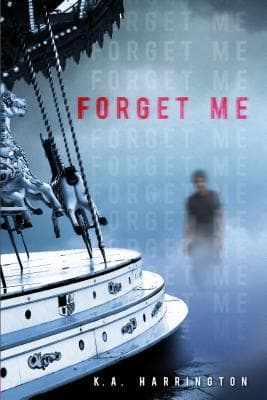
K.A. Harrington (2014)
Genre
Thriller / Mystery / Young Adult / Romance
Reading Time
360 min
Key Themes
See below
Sign in to track this book
Haunted by her deceased boyfriend's digital ghost, a grieving teen finds a chilling doppelgänger and a town-wide conspiracy that makes her question everything she knew about the boy she loved.
Three months after her boyfriend Flynn's death in a car accident, Morgan creates a memorial page for him on FriendShare. She uploads his photo, a cherished memory. To her shock, the facial recognition software suggests 'Evan Murphy,' a name she doesn't know. Evan Murphy lives in a nearby town and looks exactly like Flynn. This discovery shatters Morgan's peace, raising questions about Flynn's identity, his death, and the circumstances. The image of Evan Murphy, alive, contradicts everything she thought she knew about her lost love.
Driven by a need for answers, Morgan finds Evan Murphy and confronts him. She shows him Flynn's photo and explains her connection, but Evan reacts with confusion. He insists he's never met her, has no memory of being Flynn, and dismisses her claims as mistaken identity or grief-induced delusion. His genuine bewilderment, combined with the striking resemblance, leaves Morgan stunned. She is torn between the evidence of her eyes and Evan's firm denial. This first meeting only deepens the mystery and strengthens Morgan's resolve to find the truth.
Evan's denial does not stop Morgan. She learns Evan was in a car accident around the same time Flynn died and has amnesia, unable to recall anything before the crash. This detail immediately feels too coincidental. As she investigates, she finds small, odd details that seem to link Flynn's life to Evan's, like shared interests or subtle habits. Her friends, Clara and Lexa, initially skeptical, also notice the similarities, supporting Morgan's increasingly strange theory. Pieces of a disturbing puzzle start to form.
Morgan asks her parents for help, hoping they can explain Flynn's past or his resemblance to Evan. Their reactions are unexpectedly defensive and evasive. Her mother, usually open, becomes quiet and dismissive, urging Morgan to move on from Flynn's death. Her father offers vague answers and discourages her investigation. This sudden secrecy from her usually supportive parents is a red flag. Their reluctance to discuss Flynn or Evan makes Morgan suspect they know more, perhaps even involved in a deception. The trust in her family begins to crack.
While searching her house for Flynn's mementos, Morgan finds a hidden photo album in her parents' closet. The album contains childhood pictures of Flynn, clearly taken in a different town, one she recognizes as Evan Murphy's hometown. The photos show Flynn with a different family, living a life separate from the one he shared with Morgan. This discovery is a major breakthrough, confirming Flynn had a past she knew nothing about and had lived under another identity. The realization that Flynn led a double life is devastating and unsettling.
As Morgan spends more time with Evan, trying to trigger his memory, he starts to have fragmented flashbacks and vivid dreams. These memories, though disjointed, increasingly match events and details from Flynn's life that Morgan describes. He recalls places, feelings, and specific conversations only Flynn would know. These moments of recognition, however brief, distress Evan, as they conflict with the identity he has known since his accident. For Morgan, they confirm her instinct was right, and Evan is Flynn, struggling to reclaim his true self.
With the photo album and Evan's emerging memories, Morgan confronts her parents. Under pressure, they confess a shocking truth: Flynn was not their biological son. He was abducted as a child, and they, desperate for a child after miscarriages, took him in and raised him as their own, naming him Flynn. They reveal the car accident that supposedly killed Flynn was staged to protect him from his biological family, who had recently found him. This revelation completely changes Morgan's understanding of her family and her relationship with Flynn, exposing years of lies.
Her parents explain that Flynn's biological family, the Murphys, are wealthy and influential and had searched for him for years. The original abduction, they claim, was not by them but by a desperate relative of the Murphys who then abandoned him, leading to Morgan's parents finding him. They explain their fear of losing him and the drastic steps they took to keep him safe and happy, including creating a new identity and faking his death. Morgan grapples with the ethical implications of her parents' actions, understanding their love but also the deep deception involved.
With the full truth revealed, Evan (now understanding he is Flynn) struggles to combine his two identities. He spends time with both Morgan and his biological family, the Murphys, slowly piecing together his past. Memories return in waves, bringing both joy and confusion. He feels a deep connection to Morgan and their shared life, but also a growing sense of belonging with the Murphys. He is torn between the love he knows and the family he was stolen from, facing a difficult decision about which life, which name, and which family truly represent who he is.
After much thought and emotional struggle, Flynn/Evan decides to integrate both parts of his identity. He acknowledges his past as Flynn and his love for Morgan, but also embraces his biological family and his birth name, Evan Murphy. He chooses to build a future where he can have relationships with both Morgan and the Murphys, recognizing that both have shaped him. The ending suggests a hopeful but complex path forward, where he is no longer defined by a single identity but by all his experiences, with Morgan by his side as they navigate this new reality together. The mystery is resolved, but the journey of healing and acceptance has just begun.
The Protagonist
Morgan evolves from a heartbroken girlfriend to a tenacious truth-seeker, ultimately accepting a complex reality about love and identity.
The Love Interest / Central Mystery
From a seemingly deceased boyfriend, he re-emerges as an amnesiac, gradually regaining his true identity and facing the challenge of reconciling his past and present.
The Supporting
Clara remains a constant and supportive friend, adapting her understanding as the mystery unfolds.
The Supporting
Lexa moves from skepticism to belief and support as the truth becomes undeniable.
The Supporting / Antagonist (initially)
Revealed as a participant in a long-term deception, she eventually confesses her role and the complex reasons behind it.
The Supporting / Antagonist (initially)
Revealed as a participant in a long-term deception, he eventually confesses his role and the complex reasons behind it.
The Mentioned / Supporting
They represent the lost past that Evan/Flynn must integrate into his present and future.
The novel explores identity through Flynn/Evan's journey. He deals with two distinct lives and names, questioning who he is when his memories are fragmented and his past is made up. Morgan also undergoes self-discovery, not about her own identity, but about her understanding of love, trust, and truth, forcing her to redefine her perceptions of those closest to her. The story suggests that identity is not just about memory or name, but about the connections and choices one makes, as seen when Evan chooses to integrate both his pasts.
““How can you know who you are if you don’t even know your own name?””
Truth and deception are central to the plot, as Morgan uncovers layers of lies about Flynn's past and her parents' involvement. The story looks at the complexities of deception, showing that lies can be told with good intentions, driven by love and a desire to protect. However, it also highlights the consequences of such secrets, causing betrayal and emotional turmoil. Morgan's pursuit of the truth, despite the pain it brings, shows the importance of honesty, even when it's difficult. The story questions whether a 'good lie' can ever be justified.
““Sometimes the truth hurts more than any lie could.””
The novel explores the many sides of love – romantic love between Morgan and Flynn, and parental love from Morgan's adoptive parents. This love, however, is mixed with deep betrayal. Morgan feels betrayed by Flynn's hidden past and, more painfully, by her parents' decades-long deception. The parents' actions, though driven by a desperate love for their adopted son, are a major betrayal of trust to Morgan. The story examines how love can lead to extreme actions and how the pain of betrayal can challenge even the strongest bonds, ultimately asking if love can survive such deep deceit.
““How could the people you trusted most be the ones who lied the most?””
Memory, especially its absence and return, plays a crucial role. Evan's amnesia is the catalyst for the mystery, and his fragmented memories are key to finding the truth. The trauma of abduction and the creation of a new identity have deeply affected him, showing in his inability to recall his past. For Morgan, her memories of Flynn are cherished, but also become distorted as she learns the truth, forcing her to re-evaluate every shared moment. The novel shows how memory shapes identity and how trauma can disrupt or erase it, making recovery a painful but necessary journey.
““It was like trying to put together a puzzle with half the pieces missing, and the other half from a different box.””
The catalyst for the entire mystery.
The FriendShare facial recognition software serves as the inciting incident for the entire plot. By identifying Flynn as 'Evan Murphy,' it provides Morgan with the first, undeniable piece of evidence that her deceased boyfriend might be alive under another name. This modern technological tool immediately pulls Morgan into the mystery, overriding human assumption and grief with cold, hard data. It's a plausible and relatable device for a young adult thriller, grounding the extraordinary premise in a contemporary context and setting the stage for all subsequent investigations.
A convenient plot device that explains Evan's lack of memory and prolongs the mystery.
Evan Murphy's amnesia, resulting from his car accident, is a crucial plot device. It explains why he cannot immediately confirm Morgan's claims, thereby prolonging the central mystery and allowing for Morgan's investigation to unfold gradually. This device creates suspense as readers, alongside Morgan, wait for Evan's memories to return. It also adds a layer of pathos to Evan's character, as he is genuinely lost, and makes his eventual recognition of Flynn's life more impactful, as it's a battle against a neurological barrier rather than simple denial.
A tangible piece of evidence that confirms the deception.
The hidden photo album discovered by Morgan is a classic and effective plot device. It provides undeniable, physical proof of Flynn's past life in another town and his connection to the Murphy family, confirming her suspicions and exposing her parents' deception. This tangible evidence serves as a turning point in the narrative, moving the story from speculation to confirmed truth. Its discovery provides the momentum for Morgan to confront her parents and forces them to reveal the full story, accelerating the plot towards its resolution.
The extreme measure taken to protect a secret, driving the thriller aspect.
The staged death of Flynn is the ultimate deceptive act in the novel, serving as a high-stakes plot device that elevates the thriller aspect. It demonstrates the extreme lengths Morgan's parents were willing to go to protect their secret and 'their son.' This fabrication creates immense emotional conflict for Morgan, not only with her parents but also with the very concept of her relationship with Flynn. It's a shocking revelation that underscores the depth of the deception and the moral complexities at the heart of the story, making the stakes incredibly personal and intense.
“The past is a ghost that haunts you, even when you try to bury it deep.”
— Main character reflects on her forgotten past and the unease it causes.
“Sometimes, the truth isn't what you want it to be. Sometimes, it's a monster.”
— As the protagonist uncovers more about her past, she grapples with disturbing revelations.
“He looked at me like I was the only thing that mattered, and for a moment, I almost believed him.”
— A moment of intense connection between the protagonist and a love interest, tinged with doubt.
“Every secret has a shelf life, and mine was about to expire.”
— The protagonist feels the pressure of her hidden past catching up to her.
“I was a blank canvas, waiting for someone to paint my story, but I was terrified of what colors they might choose.”
— Describing the protagonist's feeling of having no past and the fear of what she might learn.
“The town held its breath, waiting for the past to resurface, just like I was.”
— The small town setting plays a role in the mystery, with everyone seemingly knowing more than the protagonist.
“Love can be a weapon, sharp and precise, especially when wielded by someone you trust.”
— A reflection on betrayal and the destructive power of misplaced affection.
“My own memories were a foreign country, and I was an unwelcome tourist.”
— The protagonist's struggle with amnesia and the feeling of disconnect from her own history.
“There's a difference between forgetting and being forced to forget. One is a tragedy, the other is a crime.”
— A key realization about the nature of the protagonist's memory loss.
“He had eyes that promised both protection and danger, and I was drawn to both.”
— Describing the enigmatic allure of a character who plays a complex role in the protagonist's life.
“The more I learned, the less I knew, and the more dangerous it all became.”
— The protagonist's journey of discovery leads to more questions and heightened stakes.
“Sometimes, the only way to find yourself is to get lost in someone else's secrets.”
— The protagonist's quest for her own identity becomes intertwined with uncovering the secrets of others.
“The silence was louder than any scream, filled with all the things no one dared to say.”
— Reflecting on the unspoken truths and hidden tensions within the community.
“I wasn't just solving a mystery; I was rebuilding a life, piece by terrifying piece.”
— The protagonist's personal stakes in solving the mystery are profoundly high.
Ready to see how well you understood this book? Take our interactive quiz with 10 questions.

Biography coming soon.







