“There was a reason they called him a force of nature. He was relentless, unstoppable, and he didn’t play by anyone else’s rules.”
— Describing protagonist Joe Pickett's reputation and approach.

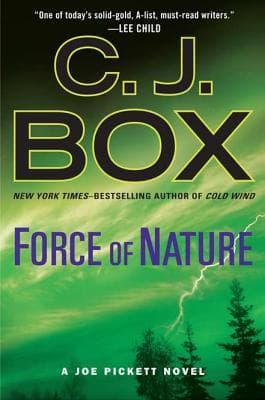
C.J. Box (2012)
Genre
Thriller / Mystery
Reading Time
770 min
Key Themes
See below
Sign in to track this book
A former Special Forces operative, haunted by a dark secret and targeted by a ruthless government official, must draw his straight-arrow game warden friend into a lawless fight to protect their families in the unforgiving Wyoming wilderness.
Nate Romanowski, a former Special Forces operative, lives an isolated life in a remote cabin in Wyoming's Bighorn Mountains, raising falcons. His peace is shattered when he receives a coded message from a former military associate, warning him that John Nemecek, a high-ranking government official and former commander, is eliminating members of their old unit. Nemecek is trying to cover up a horrific incident from their 1995 deployment in Bosnia. Nate understands that his friends, particularly game warden Joe Pickett and his family, are now in danger as Nemecek will use them as leverage to draw Nate out. He begins preparing for an inevitable confrontation, knowing he must protect his chosen family.
Game Warden Joe Pickett is called to investigate the disappearance of a wealthy out-of-state bird hunter, Kirk Hadden, in the vast wilderness of the Bighorn Mountains. Hadden's vehicle is found abandoned, and the circumstances are suspicious. As Joe begins his search, he encounters Nate Romanowski, who appears to be on his own hunting trip. Nate, knowing the true nature of the threat but unable to fully disclose it to Joe for fear of putting him in more danger, subtly tries to steer Joe's investigation. He recognizes that Hadden's disappearance is likely connected to Nemecek's scheme. Joe, ever the diligent lawman, remains focused on the missing person case, slowly realizing the deeper, more sinister currents at play.
As Joe continues his search for Kirk Hadden, his wife, Marybeth, and their daughters, Sheridan and Lucy, become direct targets of Nemecek's operatives. Strange vehicles are seen near their home, and unsettling incidents occur. A particularly unnerving event involves Lucy being followed and nearly abducted, shaking the family. Joe realizes that the threat is no longer abstract; it's personal and aimed squarely at his loved ones. Nate, observing from the shadows, is desperate to protect the Picketts without revealing the full extent of Nemecek's power, knowing that direct involvement might put them in even greater peril.
Through intense flashbacks, the horrifying incident in Bosnia in 1995 is revealed. Nate Romanowski, then a member of a Special Forces unit, witnessed his commander, John Nemecek, commit an unspeakable act of war brutality against innocent civilians. Nemecek, a sociopath, executed unarmed individuals and then orchestrated a cover-up, threatening anyone who spoke out. Nate and a few others were forced to comply, carrying the burden of this secret for years. These memories fuel Nate's determination to stop Nemecek, not just for his own survival, but to prevent Nemecek from continuing his reign of terror and to finally bring justice, however unconventional, to his past.
With the threat against his family escalating, Joe Pickett is forced to confront the truth about Nate's past and the danger Nemecek represents. Nate, realizing he can no longer protect the Picketts from a distance, finally reveals more details about Nemecek's ruthlessness and his network of corrupt operatives. Despite their differing moral codes—Joe's commitment to the law versus Nate's willingness to operate outside it—they forge an uneasy alliance. Joe, though uncomfortable with Nate's methods, understands that the legal system may be powerless against Nemecek, and that extraordinary measures are required to save his family.
Using Nate's tracking skills and knowledge of the Bighorn Mountains, combined with Joe's experience as a game warden, they begin to hunt Nemecek's operatives. The rugged terrain is both an advantage and a challenge. They uncover evidence linking Nemecek's men to Kirk Hadden's disappearance and realize Hadden was likely a pawn in Nemecek's larger scheme to draw Nate out. The pursuit is dangerous, leading to several tense encounters and skirmishes in the wilderness, as Joe struggles to reconcile his duties as a lawman with the brutal realities of their situation.
Nemecek's network is more extensive and ruthless than anticipated. They abduct a crucial witness or a member of Nate's old unit, escalating the stakes. This act confirms Nemecek's determination to silence anyone connected to the Bosnia incident and puts immense pressure on Joe and Nate. Realizing time is running out, Nate devises a daring, unconventional plan to confront Nemecek directly, knowing it will be dangerous and likely involve breaking numerous laws. Joe, caught between his moral compass and the need to protect his family, reluctantly agrees to Nate's desperate strategy, understanding it may be their only chance.
Joe and Nate, utilizing their distinct skill sets, infiltrate a remote, heavily guarded compound where Nemecek is believed to be orchestrating his operations. The compound is a fortress, filled with Nemecek's loyal, ruthless operatives. The infiltration is tense and dangerous, testing their resolve and teamwork. They encounter booby traps and armed guards, forcing them to use stealth, evasion, and calculated force. Joe, while trying to minimize casualties, finds himself in situations that push his boundaries, while Nate operates with an efficiency honed by years of covert operations.
The climax unfolds as Nate and Joe confront John Nemecek himself. Nemecek, a cunning and manipulative adversary, reveals his psychopathic nature, taunting them with the certainty of his impunity. The confrontation is brutal, both physically and psychologically. Nate, driven by years of suppressed rage and a desire for justice, engages Nemecek in a fierce battle. Joe, though out of his element in such a violent encounter, uses his instincts and knowledge of the environment to support Nate, ensuring Nemecek cannot escape justice. The resolution is violent and definitive, leaving no doubt about Nemecek's fate.
In the immediate aftermath, Nemecek is dead, and his network dismantled, but the cost is high. Joe Pickett is left grappling with the moral compromises he made, the lines he crossed, and the violence he witnessed. He must navigate the legal and ethical ramifications of their actions, knowing that the official story will likely be a sanitized version of the truth. Nate Romanowski, having achieved his grim justice, retreats back into the shadows, his past finally avenged but his future still uncertain. The Pickett family is safe, but forever changed by the terrifying ordeal, leaving questions about justice, loyalty, and the nature of good and evil.
The Protagonist
Nate moves from isolated self-preservation to actively seeking justice for past wrongs and protecting his found family, ultimately finding a measure of peace but remaining an outsider.
The Protagonist
Joe is forced to confront the limits of the law and embrace unconventional, morally ambiguous methods to protect his family, challenging his core beliefs about justice.
The Antagonist
Nemecek's arc is one of escalating ruthlessness and desperation to silence his past, leading to his ultimate downfall.
The Supporting
Marybeth confronts the fragility of her family's safety and strengthens her resolve to protect them, adapting to the extreme circumstances.
The Supporting
Sheridan is forced to confront the harsh realities of the adult world and the dangers facing her family, growing in resilience.
The Supporting
Lucy experiences the terror of being targeted, which fuels the protective instincts of her family.
The Mentioned
Hadden's disappearance serves as a plot device to initiate the main conflict, revealing the extent of Nemecek's reach.
The Supporting
Livius acts as a physical embodiment of Nemecek's threat, ultimately being overcome by Nate and Joe.
The novel explores the conflict between seeking justice and adhering to the law. Joe Pickett, a staunch upholder of the law, confronts its limitations when faced with a powerful, corrupt antagonist like Nemecek who operates above it. Nate Romanowski, on the other hand, embodies a more primal, extra-legal form of justice. Their alliance forces Joe to question his moral boundaries, demonstrating that sometimes, true justice is achieved by operating outside the established legal system, as seen when they take down Nemecek in a remote, unregulated confrontation.
““Some men are too powerful for the law, Joe. And some crimes are too dark for a jury.””
The past, specifically the traumatic Bosnia incident, casts a long, dark shadow over the present, driving the entire narrative. Nate Romanowski's life is defined by the war crime he witnessed and Nemecek's subsequent cover-up. The past is an active force that threatens to destroy Nate's present and the lives of those he cares about. Nemecek's relentless pursuit of those who know his secret demonstrates how deeply he is bound by his past actions, unable to escape their consequences, leading him to desperate measures to erase all evidence and witnesses.
““The past isn't dead. It's not even past.””
At its core, the novel is a story about fierce loyalty to family, both blood and chosen. Joe Pickett's primary motivation for engaging in such a dangerous undertaking is the unwavering need to protect his wife, Marybeth, and their daughters, Sheridan and Lucy, from Nemecek's threat. Nate Romanowski, despite his solitary nature, views the Picketts as his chosen family, and their safety becomes his driving force for confronting his past. This theme highlights the lengths individuals will go to safeguard their loved ones, even if it means risking their own lives and moral standing, as seen in Joe's willingness to ally with Nate.
““You threaten my family, you threaten me. And that's a mistake you won't live to regret.””
The novel exposes the insidious nature of corruption and the abuse of power within high levels of government. John Nemecek, a high-ranking official, uses his position, resources, and influence to commit heinous acts, cover them up, and eliminate witnesses. His ability to operate with impunity, commanding a network of loyal operatives and manipulating the system, highlights the terrifying reality of unchecked power. This theme shows the vulnerability of ordinary citizens and the difficulty of finding justice when the perpetrator is embedded within the structures designed to uphold the law.
““He's not just a man, Joe. He's a system. He's got friends in high places, and they protect their own.””
A seemingly unrelated event that draws the protagonist into the main conflict.
Kirk Hadden's disappearance serves as a classic MacGuffin, initially presenting Joe Pickett with a seemingly routine missing person case. This event acts as the initial hook, drawing Joe into the Bighorn Mountains and, inadvertently, into the orbit of Nate Romanowski and Nemecek's wider conspiracy. While Hadden's fate is eventually revealed to be tied to Nemecek's machinations, his specific identity or importance is less significant than his role in setting the main plot in motion and escalating the tension, allowing Nate to subtly guide Joe towards the true threat.
Scenes from the past that reveal crucial backstory and character motivation.
Flashbacks are strategically employed throughout the novel to gradually unveil the horrific Bosnia incident of 1995. These glimpses into Nate Romanowski's past are vital for understanding his deep-seated trauma, his motivations for seeking solitude, and the true nature of John Nemecek's depravity. The staggered release of this information builds suspense and allows the reader to piece together the full scope of Nemecek's crimes and Nate's burden, justifying Nate's extreme methods and Joe's eventual, reluctant acceptance of them. They contextualize the present conflict with a powerful, dark history.
A more experienced or knowledgeable character who guides the protagonist.
While Nate Romanowski is a protagonist in his own right, he also functions as a mentor figure to Joe Pickett in the context of confronting Nemecek. Nate possesses specialized knowledge of military tactics, survival skills, and the ruthlessness required to fight outside the law, areas where Joe, the law-abiding game warden, is inexperienced. Nate reluctantly guides Joe through the morally ambiguous and dangerous world of covert operations, teaching him how to track, evade, and fight in ways that are alien to Joe's normal life, effectively expanding Joe's capabilities and challenging his worldview.
A narrative device that creates urgency by imposing a deadline.
The ticking clock device is employed through Nemecek's systematic elimination of witnesses and his direct targeting of the Pickett family. Each step Nemecek takes, from the initial warning to the abduction attempts on Lucy, intensifies the urgency for Joe and Nate. The escalating threat to Joe's loved ones imposes a clear, unspoken deadline: they must stop Nemecek before he succeeds in harming or killing the Picketts. This constant pressure forces Joe and Nate to accelerate their plans and take increasingly desperate measures, propelling the plot forward with a sense of immediate danger and high stakes.
“There was a reason they called him a force of nature. He was relentless, unstoppable, and he didn’t play by anyone else’s rules.”
— Describing protagonist Joe Pickett's reputation and approach.
“The wilderness had its own justice, and sometimes, it was far more brutal than anything a court could deliver.”
— Reflecting on the harsh realities of nature and crime.
“You can run, but you can’t hide forever, especially not in a place where everyone eventually leaves a trail.”
— A thought about the inevitability of being tracked in the vast landscape.
“Fear was a powerful motivator, but it could also blind you to the obvious.”
— Considering the psychological impact of fear on characters.
“Some secrets were meant to stay buried, but the earth had a funny way of giving them up.”
— Hinting at the discovery of hidden truths.
“The deeper you went into the woods, the more the rules of civilization seemed to fray.”
— Observations on the diminishing influence of societal norms in remote areas.
“He knew the land not just as a map, but as a living, breathing entity with its own memory.”
— Highlighting Joe Pickett's deep connection and understanding of his environment.
“Sometimes, the most dangerous people weren't the ones you saw coming, but the ones hiding in plain sight.”
— A realization about the true nature of the antagonists.
“The wind carried whispers, and in the mountains, those whispers often told tales of the past.”
— Evoking the sense of history and unseen events in the setting.
“There was a difference between surviving and truly living, and he was fighting for the latter.”
— Joe Pickett's internal struggle and motivation.
“Every decision had a ripple effect, and in the wilderness, those ripples could become tidal waves.”
— Reflecting on the far-reaching consequences of actions.
“He didn't need a badge to know right from wrong, just his own internal compass.”
— Joe Pickett's moral code and independence from formal authority.
“The scent of pine and impending danger was a familiar perfume in his world.”
— Sensory detail combining the natural environment with the thriller element.
Ready to see how well you understood this book? Take our interactive quiz with 10 questions.

C.J. Box is a New York Times bestselling author of crime fiction, particularly known for his Joe Pickett series. His novels, such as 'Out of Range' and 'Force of Nature,' are celebrated for their gripping plots and vivid portrayals of the American West. Box's work often explores themes of conservation, law enforcement, and the rugged landscape he calls home.







