“When you're dying, the only thing you regret is not having spent more time with your loved ones.”
— Spoken by Charley 'Chick' Benetto, reflecting on his life and the impending end.

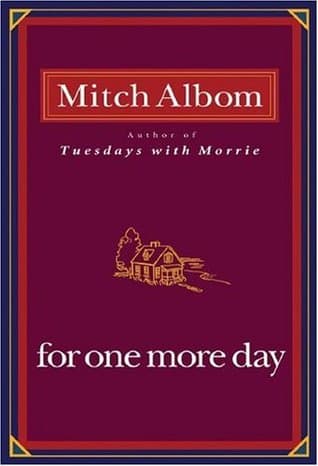
Mitch Albom (2006)
Genre
Fantasy
Reading Time
180 min
Key Themes
See below
Sign in to track this book
A broken man, near suicide, gets one miraculous day to reconnect with his deceased mother, learning about her untold sacrifices and mending his life.
Charley 'Chick' Benetto, once a promising baseball pitcher, finds his life in ruins. He is fired from his sales job due to alcoholism and unreliability, a pattern that has pushed his family away. His wife, Lenore, has left him, and his daughter, Maria, is getting married but tells him he is not welcome. Devastated and full of regret, Charley decides to end his life. He drives back to his childhood home of Pepperville, planning to commit suicide by carbon monoxide poisoning in his car. However, he messes up the attempt and crashes, leading him to walk back towards his old, seemingly empty house.
After his failed suicide attempt and car crash, Charley walks through the dark streets of Pepperville. He goes to his run-down childhood home, expecting it to be empty. To his surprise, the lights are on, and his mother, Posey Benetto, who died eight years ago, is inside. She greets him warmly, as if he had just been out for a walk, unaware of her own death or the years that have passed. Charley is confused, thinking he might be dreaming or hallucinating, but her presence feels real, offering him a strange yet comforting break from his despair.
Charley spends the day with his mother, Posey, reliving moments he once took for granted. They share breakfast, run errands in town, and visit familiar places. Posey goes about her daily routine, seemingly unaware that she has been dead for years. For Charley, this is a chance to watch her, listen to her stories, and feel her unwavering love again. He struggles to understand her living presence with his memory of her death, constantly questioning the reality, yet he cherishes every second of this impossible reunion.
During their day together, Charley and Posey talk about his father, Leonard Benetto, and their family history. Posey reveals details about Leonard's struggles with alcoholism and his gambling, which caused financial hardship for the family. She explains the sacrifices she made to keep the family going, often working multiple jobs and putting up with Leonard's unpredictable behavior. Charley begins to understand his mother's strength and the burdens she carried, realizing that his childhood idea of his father's 'coolness' often came at his mother's expense.
Posey recounts how she gave up her dreams of becoming an artist and her love for painting to support her family. After Leonard left, she worked tirelessly, cleaning houses and taking any job to ensure Charley and his sister, Roberta, had what they needed. She describes how she gave up her own happiness and personal fulfillment to be a stable presence for her children, especially after their father left. Charley is deeply moved by these revelations, understanding for the first time the true measure of her love and the quiet strength that defined her life.
Throughout their day, Posey never criticizes Charley's past mistakes, his alcoholism, or his distance from his family. Instead, she offers him gentle guidance and steady affection. She listens to his regrets and fears without judgment, reminding him of his worth and encouraging him to find his way back to himself. Her presence comforts his wounded soul, showing the lasting power of a mother's love, which goes beyond time and circumstance, and offering him the deep sense of acceptance he needs.
Posey takes Charley to the old dance hall where she and Leonard first met. She shares memories of their early romance, revealing that despite Leonard's failures, she truly loved him. She speaks of his charm and the joy he brought her, acknowledging their complex relationship without bitterness. She tells Charley that she always wanted him to be happy, even if it meant choosing his father over her, showing her understanding and acceptance of his childhood choices.
As the day goes on, Charley remembers various times from his childhood when his mother quietly supported him, even when he thought she was absent or disapproving. He recalls her presence at his baseball games, her encouragement, and her efforts to protect him from his father's instability. He understands that her love was not always obvious but was a constant, underlying force in his life, an 'invisible thread' that connected them, regardless of his awareness or appreciation at the time.
As the sun sets, Charley feels an urgency and a sad understanding that his miraculous day with Posey is ending. He knows he cannot stay in this impossible reality. Posey, still seemingly unaware of her own death, gives him a final, comforting hug. He realizes that this experience was a gift, a chance to heal, understand, and find forgiveness, not just for others, but for himself. He prepares to return to his own time, changed by his mother's lasting love.
Charley wakes up in a hospital bed, recovering from his suicide attempt and the car crash. The events of the 'one more day' with his mother feel like a vivid dream, yet the lessons and emotional impact are real. He is filled with purpose and a desire to make amends. He starts attending AA meetings, reaches out to his wife, Lenore, and his daughter, Maria, expressing his regret and his commitment to change. With a deeper understanding of his past and his mother's sacrifices, Charley begins the difficult but hopeful journey of rebuilding his life.
The Protagonist
Charley transforms from a despairing, self-pitying man to one with a renewed sense of purpose, understanding, and a commitment to making amends and living a better life.
The Supporting (Apparition/Memory)
Though already deceased, Posey's character arc is revealed through Charley's new understanding of her life, transforming from a figure he took for granted to one he deeply reveres for her sacrifices and love.
The Supporting (Memory)
His character's arc is seen through Charley's changing perception, moving from an idealized figure to a more realistic, flawed individual.
The Supporting
Her arc is tied to Charley's; she moves from being a disillusioned wife to a potential partner in his recovery.
The Supporting
Her arc is tied to Charley's; she moves from a position of hurt and exclusion to a cautious openness for reconciliation.
The Mentioned
Her role is static, primarily serving to illustrate the broader family impact of the parents' choices.
The main theme of the novel is the deep, unconditional, and often unseen love of a mother. Posey's character shows this completely; she gives up her own dreams, works tirelessly, and endures hardship without bitterness, all for her children. Even in her 'return,' her love is non-judgmental and accepting, giving Charley the healing he needs. This theme is clear when Charley realizes his mother's support was always there, an 'invisible thread,' even when he didn't see it, and her ultimate wish was always his happiness, regardless of his choices.
“A mother’s love is like a circle. It has no beginning and no ending.”
Charley's journey is full of regret over his life choices, especially his neglect of his mother and the pain he caused his family. His 'one more day' directly confronts these regrets, offering him a chance to understand, if not directly apologize, to his mother. The experience allows him to begin forgiving himself and seeking forgiveness from his estranged wife and daughter. The novel suggests that true forgiveness starts with understanding the past and taking responsibility for one's actions, making way for a hopeful future.
“Don’t be so hard on yourself, honey. We all make mistakes. The trick is to learn from them.”
The book explores the complex dynamics within a family, especially the sacrifices parents make for their children. Posey's story reveals the hidden burdens and dreams she gave up to ensure her children's well-being, contrasting with Leonard's more selfish path. It looks at the idea that family bonds, while sometimes strained or broken, are essential to identity and personal growth. Charley's realization of his mother's sacrifices changes his understanding of his family history and his place in it, showing that love often appears through quiet, lasting acts of selflessness.
“You can be a mama’s boy or a daddy’s boy, but you can’t be both.”
The entire idea of 'For One More Day' centers on a second chance – a miraculous opportunity for Charley to revisit his past and gain a new perspective. This 'second chance' is not just about seeing his mother again, but about redeeming his own life. It lets him face his problems, understand the source of his pain, and choose a different path forward. The novel argues that even at the lowest point, redemption is possible through understanding, self-awareness, and a renewed commitment to love and responsibility.
“Sometimes, the thing you want most is the one thing you can’t have. And sometimes, the thing you can’t have is the only thing that will make you happy.”
Charley experiences a day with his deceased mother, blurring the lines between life and death, reality and illusion.
The central plot device is Charley's seemingly miraculous encounter with his deceased mother, Posey. This supernatural event serves as a catalyst for his emotional and psychological journey. It's presented with a soft magical realism, where the impossibility of the situation is acknowledged but not overly explained, allowing the focus to remain on the emotional impact and the lessons learned. This device provides Charley with a unique 'second chance' to gain perspective and heal, which would be impossible in a purely realistic narrative.
Charley's memories and his mother's stories bring the past into the present, revealing hidden truths and shaping his understanding.
Throughout his day with Posey, Charley frequently delves into his memories of childhood, contrasting his initial perceptions with the new information his mother provides. Posey's anecdotes also function as flashbacks, recounting events from her past and her marriage to Leonard. This constant interplay between present experience and past recollection allows for a deeper exploration of family history, character motivations, and the complex layers of regret and love that define Charley's life. It's how the reader, and Charley, piece together the full story.
The narrative structure is built around a single, finite period of time with a lost loved one.
The entire story is framed around the titular 'one more day' that Charley spends with his mother. This finite time limit creates a sense of urgency and poignancy, emphasizing the preciousness of every moment. It forces Charley to confront his deepest regrets and absorb as much as he can from his mother's presence. This device highlights the universal human yearning for a chance to reconnect with lost loved ones and make amends, giving the narrative a powerful emotional core and a clear structural purpose.
“When you're dying, the only thing you regret is not having spent more time with your loved ones.”
— Spoken by Charley 'Chick' Benetto, reflecting on his life and the impending end.
“A child is a person who is going to carry on what you have started.”
— Charley's mother, Pauline, imparts this wisdom to him about the importance of children.
“You can't go through life wanting to be someone else.”
— Pauline advises Charley against comparing himself to others, particularly his father.
“The greatest gift you can give someone is your time. Because when you give your time, you are giving a portion of your life that you will never get back.”
— Charley reflects on the value of his mother's time spent with him.
“There are no ordinary moments.”
— A recurring theme, emphasizing the preciousness of every moment, especially with loved ones.
“You see, a lot of people just go through life, not really connecting with anybody.”
— Pauline observes the isolation many people experience.
“Love is how you stay alive, even after you are gone.”
— Charley realizes the enduring power of his mother's love.
“Every parent is at some point a child. And every child is at some point a parent.”
— Charley muses on the cyclical nature of family roles and responsibilities.
“We all have a few 'if onlys' in our lives.”
— Charley acknowledges the common human tendency to dwell on past regrets.
“It's never too late to make things right.”
— A hopeful message conveyed through Charley's journey to reconcile with his past.
“The things you regret most in life are the risks you didn't take.”
— Charley reflects on his own missed opportunities and the comfort of his mother's presence.
“Sometimes you have to step back to see things clearly.”
— Charley gains perspective on his life and family dynamics during his extraordinary day.
“No one is truly gone as long as they are remembered.”
— The underlying message about the power of memory and love to keep people alive.
“We are all tied to our past, and we can only be free when we understand it.”
— Charley's journey is about confronting and understanding his past to find peace.
Ready to see how well you understood this book? Take our interactive quiz with 10 questions.

Biography coming soon.







