“The Earth had been a good home, for so long. Now it was just a memory, a blue marble receding into the black.”
— Reflecting on the planet's fate as humanity leaves.

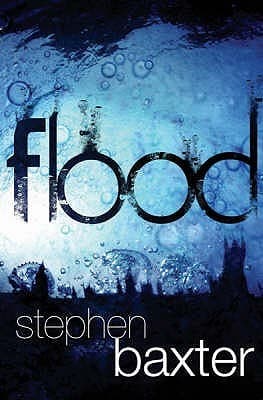
Stephen Baxter (2008)
Genre
Thriller / Fantasy / Science Fiction
Reading Time
536 min
Key Themes
See below
Sign in to track this book
A global flood consumes continents, forcing former hostages to navigate a drowning world, searching for answers beyond climate change as humanity struggles for survival on shrinking high ground.
In 2016, a severe storm surge breaches the Thames Barrier, flooding central London. At the same time, Lily McLeish, Helen Gosling, Gary Boyle, and Piers Torday are rescued from a cave in Spain after five years of captivity by Christian extremists. The former hostages, especially Lily, struggle to re-enter a rapidly changing world. News reports begin to mention unusual flooding globally, but most people attribute them to extreme weather. The initial London flood recedes, allowing a semblance of normalcy to return, though an underlying unease persists.
Over the next two years, global sea level rise becomes undeniable and catastrophic. Major cities like London, New York, and Venice are permanently submerged. The Pope delivers his final address from the Vatican before it is swallowed by the Mediterranean. Mecca also succumbs to the rising waters, erasing ancient landmarks and displacing billions. Scientists struggle to explain the speed and scale of the inundation. They initially point to accelerated climate change, but the rate of rise defies known models. Panic sets in as governments and populations realize the world is drowning.
As the waters continue to rise, humanity begins a mass exodus to higher ground. Coastal regions are abandoned, and billions become environmental refugees, straining resources and infrastructure. The remaining landmasses, primarily mountain ranges and high plateaus, become battlegrounds for survival. Lily, Helen, Gary, and Piers, along with their families and new acquaintances, join millions fleeing the encroaching ocean. Social order unravels, with governments struggling to maintain control, leading to widespread chaos and desperation.
While public opinion largely blames climate change, Dr. Kate Morris, a geologist, proposes a radical alternative. The water is not from melting ice caps but from a vast, unknown reservoir beneath Earth's crust. She theorizes that a massive geological event opened fissures, allowing trapped water to escape to the surface. Her theory is initially met with skepticism but gains traction as traditional climate models fail to explain the phenomenon. Her work offers hope for understanding the catastrophe.
With much of Europe and Asia submerged, the Tibetan plateau becomes one of the last significant landmasses. Millions of survivors, including Lily, Helen, and their families, make the perilous journey to the Himalayas. Amid dwindling resources and escalating conflicts, a global initiative, the 'Ark Project,' begins. The goal is to construct massive, self-sustaining vessels capable of housing a significant portion of humanity, preserving knowledge, and ensuring the species' survival on an ocean world. The project faces political and logistical challenges.
Lily, Helen, Gary, and Piers continue to struggle with the psychological scars of their five-year captivity. Their past ordeal, while seemingly unrelated to the global flood, prepared them for extreme hardship and uncertainty. Lily forms a close bond with Piers, both finding solace in their shared trauma and an unexpected connection amidst the apocalypse. Helen, more pragmatic, focuses on practical survival, while Gary struggles with despair. Their coping mechanisms and evolving relationships are tested by the flood and the unraveling of civilization.
As land becomes scarcer, international cooperation crumbles, replaced by competition and warfare. Nations with remaining high ground, like China and the United States, become fortresses, often refusing entry to refugees. Resource wars erupt over food, fresh water, and building materials for the Ark Project. The global political landscape shifts dramatically, with powerful factions emerging and traditional alliances dissolving. The struggle for survival breeds both altruism and brutality.
Driven by Dr. Morris's theory, a desperate international effort sends a submersible deep into the Pacific Ocean, where seismic activity and unusual geological formations suggest the flood's source. Lily McLeish, with her geology background and resilience, is recruited for this mission. The expedition aims to gather definitive proof of the deep-ocean water reservoir and understand its release mechanism. The journey is dangerous, facing immense pressures, unknown geological phenomena, and the psychological toll of humanity's last hope resting on their shoulders.
The deep-ocean expedition, led by Lily, locates a colossal chasm, an unprecedented geological feature stretching thousands of kilometers. Within this abyss, they discover a massive subterranean ocean and an enigmatic, artificial structure - a 'Seed.' This alien artifact is the true cause of the flood, a mechanism designed to terraform Earth into an ocean world. The discovery alters humanity's understanding of its place in the cosmos. It reveals the catastrophe is not natural but a deliberate, extraterrestrial intervention.
Despite the discovery and the Ark Project, the flood continues. Earth becomes an almost entirely aquatic planet, with only the highest mountain peaks remaining as scattered islands. Billions have perished, and survivors are confined to massive arks or isolated, precarious settlements on the few remaining landmasses. The atmosphere becomes heavy with moisture. The once-familiar blue-green planet is now a vast, deep blue. Humanity faces the challenge of adapting to an entirely new world, forever changed by the 'Seed' and the deluge it unleashed.
The Ark Project, though scaled down, launches several massive vessels. Lily, Helen, Gary, and Piers are among the survivors aboard these arks. Life on the arks is a stark contrast to their previous existence, marked by tight living quarters, resource management, and the constant hum of machinery. They grapple with the psychological impact of losing their home world. Humanity's future involves navigating a water planet, exploring its depths, and perhaps, one day, understanding the full purpose of the 'Seed' and their place in the universe. The novel concludes with humanity's uncertain but determined survival.
The Protagonist
From a traumatized survivor, Lily evolves into a pivotal figure in humanity's quest for answers, leading the deep-ocean expedition and ultimately confronting the alien truth.
The Supporting
Helen navigates the flood with a steadfast focus on her family's survival, demonstrating resilience and adaptability in the face of unimaginable loss.
The Supporting
Gary's arc is one of decline, grappling with his past trauma and succumbing to despair as the world drowns.
The Supporting
Piers finds love and purpose with Lily amidst the apocalypse, using his journalistic skills to document humanity's plight.
The Supporting
Kate's relentless pursuit of scientific truth leads to the groundbreaking discovery of the flood's true, non-climatic origin.
The Supporting
Ma Jian spearheads the Ark Project, making difficult ethical choices to ensure a remnant of humanity survives.
The Antagonists/Mentioned
Their influence remains through the trauma they inflict, shaping the characters' responses to the global flood.
The Antagonist
The 'Seed' is revealed as the ultimate cause of the flood, transforming Earth and challenging humanity's understanding of its place in the universe.
The most prominent theme is humanity's struggle for survival against an overwhelming, existential threat. Characters like Lily and Helen, already hardened by captivity, show incredible resilience. The global response, from mass migrations to the Ark Project, shows humanity's capacity for both cooperation and conflict in the face of annihilation. The theme explores not just physical survival but also the adaptation of human society, politics, and psychology to a new, water-dominated world, as seen in the transition to ark life and the scramble for high ground.
“We are survivors. It's what we do. We find a way, even when there isn't one.”
Initially, the flood is widely seen as a consequence of climate change. This aligns with common societal anxieties about environmental degradation. However, Dr. Kate Morris's theory and the deep-ocean expedition reveal a different truth: the flood is not natural but the result of an alien 'Seed' deliberately terraforming Earth. This shift forces humanity to confront not just an environmental disaster but an unknown, possibly hostile, cosmic intelligence. This changes their worldview and sense of agency.
“It wasn't Gaia's wrath. It was... something else. Something far older, far colder.”
The novel explores the psychological impact of trauma, both individual and collective. The former hostages (Lily, Helen, Gary, Piers) carry the scars of their five-year captivity, which prepares them for the global catastrophe. Their coping mechanisms, from Lily's drive for understanding to Gary's despair, highlight human responses to extreme stress. On a larger scale, humanity grapples with the collective trauma of losing its home world, forcing a re-evaluation of what it means to be human and what truly matters.
“We lost five years in that cave. Now we're losing the world. But we're still here.”
A driving force in the narrative is humanity's quest to understand the flood. From initial scientific debates about climate change to Dr. Morris's deep-ocean theory, the pursuit of knowledge is important. Lily's involvement in the deep-ocean expedition exemplifies this theme. Characters risk everything to uncover the truth, even if it is terrifying. The 'Seed' discovery represents the ultimate scientific revelation, challenging all previous assumptions and forcing humanity to confront a reality beyond its comprehension.
“We can't fight what we don't understand. Knowledge is our only weapon.”
The novel details the breakdown of societal structures, governments, and international cooperation as the flood progresses. Resource wars, mass migrations, and the abandonment of traditional cities show the fragility of civilization. However, amidst the collapse, there is also the theme of rebirth and the forging of new communities, particularly on the arks and remaining high ground. This duality highlights humanity's capacity for both destruction and creation, showing that even in the face of ultimate loss, the drive to build, adapt, and continue exists.
“The old world is gone. We must build a new one, or we are truly lost.”
A scientific theory that challenges conventional explanations for the flood.
This theory, proposed by Dr. Kate Morris, serves as a crucial plot device, shifting the narrative's focus from a climate change disaster to a more enigmatic, potentially extraterrestrial event. It provides a scientific mystery that drives the deep-ocean expedition and ultimately leads to the discovery of the 'Seed.' Without this alternative explanation, humanity would remain trapped in a misdiagnosis, unable to comprehend the true nature of their predicament. It adds a layer of scientific intrigue and foreshadows the larger cosmic implications.
The protagonists' shared trauma and unique resilience from five years of captivity.
The five-year captivity of Lily, Helen, Gary, and Piers by Christian extremists functions as a powerful character-building device. It provides them with an unusual baseline for extreme hardship, trauma, and survival, making them uniquely resilient (or vulnerable, in Gary's case) to the global flood. This shared past forges deep bonds and conflicts among them, influencing their decisions and reactions to the apocalypse. It also highlights the contrast between human-made cruelty and an impersonal, overwhelming natural (or alien) force.
Humanity's desperate, last-ditch effort to preserve life and knowledge on massive vessels.
The Ark Project is a monumental plot device representing humanity's collective will to survive and preserve its legacy. It provides a tangible goal for many characters and a framework for the societal and political struggles as resources dwindle. The construction, launch, and eventual life aboard the arks illustrate the practical and ethical challenges of building a new civilization from scratch, while also offering a glimmer of hope for humanity's future on a water world. It symbolizes both the failure of the old world and the potential for a new beginning.
An alien artifact responsible for terraforming Earth into an ocean world.
The 'Seed' is the ultimate plot twist and a central plot device. Its discovery fundamentally recontextualizes the entire narrative, transforming the flood from an environmental catastrophe into a deliberate act of alien terraforming. It introduces a cosmic horror element and raises profound questions about humanity's place in the universe, the nature of intelligence, and the purpose of existence. The 'Seed' acts as a catalyst for humanity's final understanding of its demise and the beginning of its adaptation to a new reality.
“The Earth had been a good home, for so long. Now it was just a memory, a blue marble receding into the black.”
— Reflecting on the planet's fate as humanity leaves.
“It wasn't just water. It was the end of everything they knew, a slow, inexorable drowning of the world.”
— Describing the initial realization of the global flood's scale.
“Hope was a dangerous thing, a flickering candle in a hurricane. But without it, there was nothing.”
— Characters clinging to hope amidst overwhelming odds.
“The ocean was no longer a boundary; it was a conqueror. And it was still rising.”
— Emphasizing the relentless nature of the rising sea levels.
“They were not just escaping a flood; they were escaping a future that no longer existed.”
— Understanding the permanent change brought by the disaster.
“Every drop of water was a tear for what was lost, and a promise of what was to come.”
— A poetic reflection on the emotional impact of the flood.
“The stars were indifferent, as always. But tonight, they seemed to mock their struggle.”
— Looking up at the night sky from a world being submerged.
“Humanity's greatest achievement, its most enduring monument, had become its tomb.”
— Pondering the fate of human civilization and structures.
“Survival wasn't about being strong; it was about being adaptable, even when adaptation meant losing everything.”
— A character's realization about the true nature of survival.
“The world was a blank canvas, washed clean by the sea. What would they paint on it next?”
— Considering the possibility of a new beginning after the flood.
“There was no going back. Only forward, into the endless, watery unknown.”
— Acknowledging the irreversible nature of their situation.
“The silence was broken only by the lapping of water, a constant, mocking reminder of their predicament.”
— Experiencing the pervasive sound of the flood.
“They were the last remnants, the seeds of a new world, adrift on the ruins of the old.”
— Reflecting on the small group of survivors as a new genesis.
Ready to see how well you understood this book? Take our interactive quiz with 10 questions.

Biography coming soon.







