“Books speak to us, not like people, but like the dead.”
— Geoffrey Braithwaite reflecting on the nature of literary engagement.

Julian Barnes (2010)
Genre
Literary Fiction / Historical Fiction
Reading Time
240 min
Key Themes
See below
Sign in to track this book
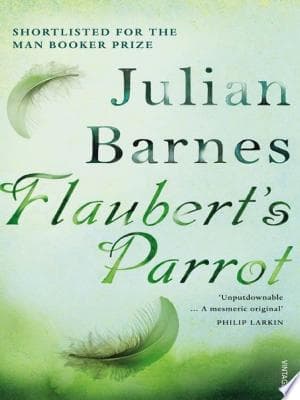
A retired English doctor embarks on a whimsical, obsessive quest to uncover the true parrot that inspired Flaubert, unraveling his own life's mysteries amidst a labyrinth of literary detective work and personal reflection.
The story begins with Geoffrey Braithwaite, a retired English doctor, in Rouen, France, on a trip for Gustave Flaubert. He first wants to find a specific stuffed parrot that Flaubert kept on his desk while writing 'Un Coeur Simple'. Braithwaite visits various Flaubert museums, including Flaubert's former home in Croisset. He finds two different stuffed parrots, both said to be the real one, which immediately introduces the main idea of uncertainty and how hard it is to find historical truth. This initial confusion sets the tone for Braithwaite's careful, often frustrating, look into Flaubert's life and legacy, showing the difficulties of historical reconstruction.
Braithwaite uses an unusual biographical approach, presenting three different timelines of Flaubert's life. The first is a standard, factual account of dates and events. The second is a romantic, idealized version, showing Flaubert as a tragic hero. The third is a cynical, critical portrayal, highlighting Flaubert's flaws and failures. These conflicting stories show that it is impossible to find one 'truth' about a historical figure. Braithwaite uses this to explore how biographers project their own biases onto their subjects, questioning the possibility of objective historical understanding and showing how identity is subjectively built.
The narrator explores Flaubert's interest in animals, especially his metaphorical 'bear' – a symbol of his solitary, difficult writing process and his struggles with art. Braithwaite tells stories and quotes from Flaubert's letters, where the author often calls himself a bear, isolated and working hard. This section also mentions other animals in Flaubert's life and work, such as the lion he saw at the Jardin des Plantes, which influenced his writing. These animal metaphors humanize Flaubert, showing his inner conflicts and the immense effort he put into his craft, portraying him as both a worker and an artist.
Braithwaite focuses on the two most important women in Flaubert's life: Louise Colet, his passionate mistress, and George Sand, his intellectual friend and fellow writer. He explores the different natures of these relationships – Colet representing romantic involvement and artistic debate, Sand representing deep friendship and mutual respect. Through parts of their letters, Braithwaite shows the intellectual and emotional currents that shaped Flaubert's personal life and indirectly influenced his work. This exploration shows Flaubert's complex feelings about women, love, and the demands of an artist's life, showing how these relationships both inspired and challenged him.
Braithwaite recounts Flaubert's significant money problems, especially the bad investments made by his niece's husband, which left the author deeply in debt in his later years. This personal hardship is set against the larger historical background of the Franco-Prussian War (1870-1871), which deeply affected Flaubert, bringing conflict and occupation to his home in Croisset. The war's destruction and his money troubles contributed to Flaubert's growing disappointment and despair, influencing the tone and themes of his later works. This section emphasizes how personal tragedy and historical events shape an artist's life and views.
As Braithwaite learns more about Flaubert's life, his own grief slowly appears. He makes more frequent, but at first indirect, references to his deceased wife, Ellen. These hints suggest a deep personal sorrow that supports his obsessive pursuit of Flaubert. The reader starts to understand that Braithwaite's scholarly detachment is a coping mechanism, a way to channel his grief and find meaning in another's life story. This gradual revelation of his emotional vulnerability changes the story's focus, showing the narrator's own reasons and the parallel themes of loss and the search for understanding.
Braithwaite returns to the main puzzle of the stuffed parrot, thinking about what it means. He considers the two parrots he saw earlier and how impossible it is to find the 'real' one. This leads him to broader thoughts on authenticity, the value of relics, and the human desire to connect with the past through objects. He questions whether the physical object truly matters, or if its symbolic power and the stories connected to it are more important. This section reinforces the idea that historical truth is often subjective and created, rather than a single, verifiable fact.
Braithwaite tells a strange, seemingly unrelated story about a sea-lion that escaped from a zoo and was eventually caught on a train. This whimsical story is a metaphorical break, reflecting on the unexpected, the absurd, and life's unpredictable nature. It also touches on themes of confinement and freedom, and how different things can connect in surprising ways. While seemingly unrelated to Flaubert, the story offers a moment of lightness and further shows Braithwaite's associative and unconventional storytelling style, allowing him to explore broader philosophical questions about existence and meaning.
In a personal confession, Braithwaite finally reveals the full extent of his grief: his wife, Ellen, committed suicide. This devastating truth explains the sorrow that has filled his story and his intense focus on Flaubert's life and struggles. His search for understanding in Flaubert's biography becomes a parallel search for understanding his own loss and the inexplicable nature of human suffering. This revelation changes how the reader sees Braithwaite, shifting him from a detached scholar to a deeply wounded person dealing with profound personal tragedy.
After Ellen's suicide is revealed, Braithwaite thinks deeply about grief, memory, and loss. He deals with the pain of remembering and the impossibility of truly forgetting. He discusses how memory can be unreliable, fragmented, and often shaped by desire or trauma. His thoughts on memory extend to Flaubert, considering how the author shaped his own past and how biographers filter and interpret the lives they study. This section emphasizes the book's main theme of the subjective creation of reality, both personal and historical, and the lasting power of sorrow.
Braithwaite ends his exploration by thinking about Flaubert's lasting literary legacy and what he has learned from his study. He acknowledges the complexity and contradictions of Flaubert's character, accepting that a complete, definitive understanding is impossible. Through his obsessive focus on Flaubert, Braithwaite has, in a way, processed his own grief and come to terms with life's and death's ambiguities. He finds a quiet acceptance, not necessarily of closure, but of the ongoing nature of both historical inquiry and personal suffering. The journey, rather than a definitive answer, has given him a way to understand.
The Protagonist
Braithwaite's journey begins as an academic quest but slowly transforms into a personal exploration of grief and memory, culminating in the revelation of his wife's suicide and a measure of acceptance.
The Central Subject/Historical Figure
As a historical figure, Flaubert's 'arc' is presented through various interpretations, from his early literary aspirations to his later disillusionment and financial ruin, highlighting the subjective nature of biographical construction.
The Supporting/Mentioned
Ellen's story is revealed retrospectively, her death serving as the catalyst for Braithwaite's introspective journey and eventual, partial acceptance of his grief.
The Supporting
Her story is presented historically, showcasing her role in Flaubert's life and the turbulent nature of their affair.
The Supporting
Her role is presented historically, emphasizing her supportive and intellectual friendship with Flaubert.
The Supporting/Mentioned
Her story contributes to the tragic elements of Flaubert's later life, highlighting his personal sacrifices.
The Mentioned
A static, historical figure who provides context for Flaubert's life.
The Mentioned
A static, historical figure, serving as a point of reference for Flaubert's early life and travels.
The novel constantly questions whether objective truth is possible, especially in historical and biographical contexts. Braithwaite finds conflicting accounts of Flaubert's life, from the two identical parrots both claiming to be real to the three different timelines he presents. This theme is central to his struggle to truly 'know' Flaubert, suggesting that history is always an interpretation, a story built from fragmented evidence and personal biases. The past is not fixed but changes, shaped by those who tell it, making a definitive understanding always out of reach.
“History is a commentary on the past, not the past itself.”
At its heart, the book is a deep exploration of grief and how people cope with loss. Braithwaite's careful, almost obsessive, study of Flaubert's life is shown to be a way to deal with his own devastating sorrow over his wife Ellen's suicide. His scholarly pursuit becomes a form of therapy, a way to channel his pain and find meaning in another's struggles. The novel explores how unreliable and selective memory can be, both personal and collective, highlighting how grief can distort or enhance recollections, and how the past, both Flaubert's and his own, is constantly reshaped by the present.
“The past is a foreign country; they do things differently there. But the present is even more foreign; we do things differently here.”
Barnes uses Braithwaite's story to critique and take apart the conventions of biography. By presenting multiple, contradictory versions of Flaubert's life and constantly adding his own subjective opinions and personal stories, Braithwaite challenges the idea of a definitive, authoritative life story. The novel explores the biases of biographers, how they select evidence, and how an author's own life shapes their interpretation of another's. It emphasizes that a biography reflects the biographer as much as the subject, blurring the lines between objective reporting and creative storytelling.
“A biographer is a novelist under oath.”
The novel explores the relationship between an artist's life and their work, especially through Flaubert's dedication to his craft. Flaubert's artistic struggles, his money problems, and his personal relationships are all part of his creative output. Braithwaite wonders if suffering is necessary for great art, drawing parallels between Flaubert's 'bear-like' work and his own emotional pain. The book suggests that pursuing art is often a solitary, difficult journey, deeply connected to personal sacrifice and dealing with life's difficulties. Art is not separate from life, but deeply embedded in its joys and sorrows.
“The artist is a monster. He is not human.”
Geoffrey Braithwaite's personal grief subtly influences his recounting of Flaubert's life.
Braithwaite, while presenting himself as a scholarly and objective observer, gradually reveals himself to be an unreliable narrator. His obsessive focus on Flaubert is a coping mechanism for his own profound grief, and his interpretations of Flaubert's life are inevitably colored by his personal experiences and sorrows. This unreliability is not deceitful but deeply human, as his subjective lens shapes the 'facts' he presents, making the reader question the possibility of true objectivity in any biographical account. His personal story slowly bleeds into his scholarly one, demonstrating how individual experience always filters perception.
The novel frequently references other texts and comments on its own narrative construction.
The book is rich in intertextuality, constantly referencing Flaubert's works, letters, and various biographical accounts. It also employs metafiction by openly discussing the process of writing a biography and the challenges of historical reconstruction. Braithwaite frequently comments on his own narrative choices, the limitations of his sources, and the inherent subjectivity of his project. This device blurs the line between fiction and non-fiction, highlighting the constructed nature of all narratives and inviting the reader to critically engage with the act of storytelling itself, both within the novel and beyond.
The stuffed parrot represents the elusive nature of truth and the human desire for tangible connection to the past.
The stuffed parrot is the central and most potent symbol in the novel. Initially, it represents Braithwaite's quest for an authentic historical artifact and a definitive truth about Flaubert. However, the existence of multiple 'authentic' parrots quickly transforms it into a symbol of the elusiveness of truth, the subjective nature of history, and the futility of seeking single, verifiable facts. It also embodies the human desire to connect with the past through relics, even as those relics prove to be ambiguous. The parrot, both real and imagined, becomes a metaphor for the constructed nature of memory and identity.
The story jumps between Flaubert's life, Braithwaite's reflections, and seemingly tangential anecdotes.
The novel employs a highly fragmented and non-linear structure, eschewing a conventional chronological narrative. Braithwaite jumps between detailed accounts of Flaubert's life, personal anecdotes, philosophical digressions, lists, and even fictionalized scenarios. This disjointedness mirrors the fragmented nature of memory and historical evidence. It also reflects Braithwaite's own associative thought process, driven by grief and obsession rather than strict academic rigor. The structure reinforces the idea that life and history are not neat, linear progressions but complex, interconnected webs of events and interpretations.
“Books speak to us, not like people, but like the dead.”
— Geoffrey Braithwaite reflecting on the nature of literary engagement.
“How can you tell the difference between a real parrot and a stuffed parrot? For that matter, how can you tell the difference between a real love and a stuffed love?”
— Braithwaite's central conundrum regarding the two parrots and the nature of authenticity.
“The past is a foreign country; they do things differently there.”
— A direct quote from L.P. Hartley's 'The Go-Between,' used by Braithwaite to discuss historical understanding.
“History is that certainty produced at the point where the imperfections of memory meet the inadequacies of documentation.”
— Braithwaite's philosophical musing on the elusive nature of historical truth.
“What is the good of reading if you don't even try to understand what the author means?”
— Braithwaite's frustration with superficial engagement with literature.
“Perhaps the only way to make sense of life is to tell a story about it.”
— A reflection on narrative and its role in human understanding.
“Love is a trick, a game, a lie, a betrayal, a seduction, an illusion, a dream.”
— Braithwaite's cynical view of love, likely influenced by his personal experiences.
“The novelist is a god, and his characters are his creatures.”
— A statement on the power and role of the author in creating fictional worlds.
“We are all in the process of becoming, and we never quite arrive.”
— A general observation on the human condition of continuous change and development.
“There are some things you can't get over, and some things you can't live with.”
— A poignant reflection on grief and the enduring impact of loss.
“Facts are like fish. They are not to be caught in nets, but to be found in the deep.”
— Braithwaite's metaphor for the difficulty of uncovering genuine historical facts.
“Why do we bother to live, if all we do is remember?”
— A question posed by Braithwaite, highlighting the burden and nature of memory.
“The purpose of art is to make us feel.”
— A straightforward statement on the primary function and impact of artistic creation.
“Perhaps there are no facts, only interpretations.”
— A postmodernist leaning in Braithwaite's questioning of objective truth.
“To be a writer is to be a professional failure.”
— A self-deprecating but insightful remark on the challenges and constant striving of the writing profession.
Ready to see how well you understood this book? Take our interactive quiz with 10 questions.

Julian Patrick Barnes is an English writer. He won the Man Booker Prize in 2011 with The Sense of an Ending, having been shortlisted three times previously with Flaubert's Parrot, England, England, and Arthur & George. Barnes has also written crime fiction under the pseudonym Dan Kavanagh. In addition to novels, Barnes has published collections of essays and short stories.







