“All of humanity got a glimpse of the future. The future. Not a future, but the future.”
— The immediate aftermath of the worldwide flashforward event.

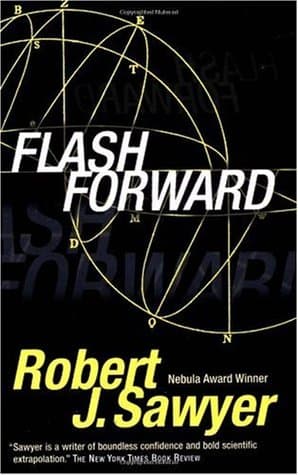
Robert J. Sawyer (1999)
Genre
Thriller / Fantasy / Science Fiction
Reading Time
320 min
Key Themes
See below
Sign in to track this book
Seven billion people glimpse their future in a two-minute global blackout, unraveling the present as they grapple with the terrifying, interconnected mosaic of their destinies.
On October 21, 2009, at 11:18 a.m. Eastern Time, a global event happens: every human on Earth loses consciousness for two minutes and seventeen seconds. The world falls into chaos as planes crash, cars collide, and many lives are lost. Dr. Lloyd Simcoe, a physicist at CERN, and his fiancée, Dr. Michiko Maruyama, are among the survivors. During the blackout, everyone experiences a 'flashforward' – a vivid, personal vision of their life about 21 years in the future. The aftermath is a mix of terror, confusion, and dread as humanity deals with this shared, involuntary peek into their destinies.
Dr. Lloyd Simcoe, head of the ATLAS experiment at CERN, quickly thinks the flashforward event is linked to the Large Hadron Collider (LHC). His team, including Michiko Maruyama, begins an intense investigation into the LHC's data from the blackout. They discover unusual energy readings and a peculiar quantum fluctuation that coincided with the global unconsciousness. The scientific community is initially skeptical, but the evidence Lloyd's team uncovers gradually points to a deliberate or accidental experiment with exotic particles as the trigger, suggesting the flashforward might be a side effect of a fundamental physics event.
Lloyd Simcoe's flashforward shows him a future in 2030 where he lives with a different woman, not Michiko. This vision deeply disturbs him and creates immediate tension in his relationship with Michiko, who also saw her own future but is reluctant to share details. Lloyd struggles with the implications of this predetermined future, questioning free will and the stability of his current life. The vision introduces a personal dilemma, forcing him to confront the potential end of his engagement and the existence of a future he neither anticipated nor desired, despite its apparent clarity.
Michiko Maruyama's flashforward is far more disturbing than Lloyd's. She sees herself committing suicide in 2030, a vision that fills her with dread and a desperate desire to prevent it. She keeps this vision a secret from Lloyd, fearing that revealing it might inadvertently make it come true. This secrecy creates a growing rift between them. Meanwhile, the CERN team, led by Lloyd, continues to analyze the blackout data, eventually concluding that the event was caused by a quantum entanglement phenomenon, possibly involving exotic matter, which momentarily linked all human consciousnesses to a point in the future.
A shadowy figure named D. Gibbons begins to communicate with various media outlets and scientific institutions, claiming to have predicted the flashforward event long before it happened. He presents himself as an expert on quantum mechanics and the nature of time, offering cryptic clues and theories that align with some of the CERN team's findings, yet his motives remain unclear. Gibbons's sudden appearance adds another layer of mystery to the global phenomenon, suggesting a deeper, possibly conspiratorial, aspect to the blackout. His pronouncements further fuel public anxiety and debate about fate versus free will.
The global flashforward event plunges society into unprecedented chaos. Governments struggle to maintain order as people react in extreme ways to their visions. Some, seeing happy futures, become complacent; others, seeing tragic or non-existent futures, fall into despair or nihilism. Suicides increase, marriages dissolve, and the economy falters as people abandon their current lives based on their future knowledge. The very fabric of society is threatened by the loss of the unknown and the perceived inevitability of destiny, leading to widespread moral and ethical dilemmas across all cultures.
Convinced that D. Gibbons holds vital information about the flashforward, Lloyd and Michiko decide to track him down independently. Their investigation leads them through a maze of online forums, academic papers, and obscure scientific communities. They suspect Gibbons might be more than just a theorist, possibly someone directly involved in the event or possessing a deeper, more personal understanding of its mechanics. Their pursuit is driven by a desperate hope that Gibbons can provide a way to understand, or even alter, their foretold futures, especially Michiko's grim vision.
As the CERN team delves deeper, they hypothesize that the flashforward was not merely a vision but a momentary, collective quantum entanglement with the future. This implies a universe where time is not strictly linear, and future events might exist in a probabilistic state. This scientific explanation challenges traditional notions of free will, suggesting that while the future might be 'seen,' it is not necessarily immutable. The debate rages among the scientists: is the future fixed, or can conscious choices in the present alter the trajectory glimpsed during the blackout?
Lloyd and Michiko eventually locate D. Gibbons, who is a brilliant but reclusive physicist named Dimitri Gibbons. He reveals that he was working on a radical theory of time and quantum entanglement, and that the flashforward was not an accident but a deliberate, though uncontrolled, consequence of his experimental work with the LHC. Gibbons explains that he was attempting to prove the existence of a 'future state' accessible through quantum means, but the global blackout was an unforeseen, large-scale side effect. He believes the visions are real but not necessarily deterministic.
As the story progresses, a second, much shorter flashforward event occurs, lasting only a few seconds. This time, it is a ripple effect from the original event, and it provides Michiko with a crucial update to her future vision. Instead of seeing her suicide, she now sees herself making a different choice, influenced by her present actions and her conversations with Lloyd and Gibbons. This second vision gives her hope and reinforces the idea that free will can indeed triumph over predetermined destiny. She makes a decision that directly counters her initial, tragic flashforward.
In the wake of the second flashforward and the revelations from Dimitri Gibbons, humanity slowly begins to heal and redefine its understanding of destiny. The scientific community, now with a clearer understanding of the event's mechanics, explains that while the future can be glimpsed, it is not fixed. People start to realize that their choices in the present hold power. Lloyd and Michiko, having navigated their personal challenges, find a renewed sense of purpose and hope, believing that love and agency can alter even the most seemingly inevitable futures. The world, though scarred, looks towards a future where awareness of possibility empowers rather than paralyzes.
The Protagonist
Lloyd evolves from a scientist grappling with a personal shock to a leader who helps humanity understand the nature of time and the power of choice, ultimately finding peace with his own future.
The Protagonist
Michiko transforms from a woman paralyzed by a terrifying future vision to someone who actively fights for her right to choose her own destiny, ultimately finding a way to alter her fate.
The Antagonist/Supporting
Gibbons evolves from a mysterious, almost villainous catalyst to a figure who provides crucial scientific insights, helping humanity comprehend and adapt to the flashforward's implications.
The Supporting
Theo remains a consistent and reliable scientific presence, supporting the investigation and adapting to the profound implications of the flashforward.
The Mentioned
Samantha's role is static, representing the 'other' future for Lloyd, a fixed point in his vision that drives his personal dilemma.
The central philosophical debate of the novel is whether the future glimpsed in the flashforward is fixed and unchangeable, or if individuals retain the ability to alter their destinies. Michiko's struggle with her suicide vision and Lloyd's unsettling vision of a future without her show this conflict. The scientific explanation of the flashforward as a quantum entanglement, rather than an absolute prophecy, allows for the possibility of modifying one's future through present choices, as Michiko ultimately attempts to do. The book explores the psychological and societal impact of believing one's future is already written.
““Perhaps the future isn't something we're hurtling towards, but something we're creating with every decision we make.””
The flashforward event forces humanity, particularly the scientists at CERN, to reconsider their understanding of time. The idea that all consciousnesses could simultaneously glimpse a specific point in the future suggests a non-linear, perhaps even block-universe, model of time. The novel explores complex quantum physics concepts, like entanglement and the many-worlds interpretation, to explain how such an event might be possible. This theme challenges conventional perceptions of cause and effect, suggesting that reality is far more complex and interconnected than previously imagined, with future possibilities existing concurrently with the present.
““Time isn't a river, flowing in one direction. It's more like an ocean, with currents and eddies, and sometimes, a glimpse of the distant shore.””
The knowledge gained from the flashforward has profound and often destructive effects. Michiko's decision to keep her suicide vision secret from Lloyd shows how fear of a predetermined future can lead to isolation and strain relationships. Conversely, the public revelation of individual futures causes widespread societal chaos, as people react impulsively to their visions, leading to despair, recklessness, and the breakdown of institutions. The novel explores the ethical implications of possessing such foreknowledge, questioning whether some truths are better left unknown, or if knowledge, even if painful, ultimately leads to greater understanding and adaptation.
““Knowing your future isn't a gift. It's a burden, a weight that can crush the present.””
The novel examines the ethical boundaries of scientific research, particularly through the actions of Dimitri Gibbons. His ambitious experiments with the Large Hadron Collider, driven by a desire to understand time, inadvertently trigger a global catastrophe. This raises questions about the responsibility of scientists when their pursuit of knowledge has unforeseen and far-reaching consequences for all of humanity. Lloyd Simcoe and his team represent a more cautious, reactive approach to scientific discovery, attempting to understand and mitigate the effects of Gibbons's actions, highlighting the tension between radical innovation and ethical oversight in scientific endeavors.
““The pursuit of knowledge is noble, but the consequences of that pursuit are often beyond our control.””
The inciting incident that triggers the entire plot and its philosophical questions.
The global blackout is the central plot device, a catastrophic event where all seven billion people on Earth simultaneously lose consciousness for two minutes and seventeen seconds. This event serves as the catalyst for every subsequent plot point, from the scientific investigation at CERN to the personal and societal crises that unfold. It's not just a physical event but a mechanism for delivering the 'flashforwards,' providing each character and the audience with a concrete, yet mysterious, glimpse into a potential future, thereby launching the core themes of free will versus determinism.
Personal glimpses into the future, driving character arcs and societal conflict.
The flashforward visions are the direct result of the global blackout. Each person experiences a unique, personal vision of their life approximately 21 years in the future. These visions are the primary source of conflict and character development. They directly impact relationships, career choices, and mental states, forcing characters like Lloyd and Michiko to confront deeply personal dilemmas. On a societal level, the collective knowledge of these futures creates widespread panic, despair, and a re-evaluation of human agency, serving as a powerful engine for the novel's philosophical exploration.
The scientific instrument at the heart of the flashforward's cause.
The LHC at CERN functions as the scientific explanation and origin point for the flashforward event. It is the setting where Lloyd and Michiko work and where the anomalous quantum fluctuations responsible for the blackout are detected. The LHC grounds the fantastical premise in a plausible (within the sci-fi genre) scientific context, linking the global event to cutting-edge physics experiments. It represents both the pinnacle of human scientific achievement and the potential for unintended, world-altering consequences, embodying the theme of science and ethics.
The scientific framework that explains the flashforward and its implications.
Dimitri Gibbons's theories on quantum mechanics, time, and consciousness provide the scientific underpinning for the flashforward event. Initially presented as cryptic pronouncements, his explanations of quantum entanglement and the accessibility of future states are crucial for the characters and the reader to understand how such an event could occur. These theories move the narrative beyond mere science fiction into a deeper exploration of theoretical physics, offering a potential mechanism for free will to operate even within a seemingly predetermined future, thereby resolving the central philosophical conflict.
“All of humanity got a glimpse of the future. The future. Not a future, but the future.”
— The immediate aftermath of the worldwide flashforward event.
“If you knew your exact future, would you live your present differently?”
— Dr. Lloyd Simcoe ponders the implications of the flashforward.
“The universe is a strange and beautiful place, and we are only just beginning to understand its secrets.”
— A character reflecting on scientific discovery and the unknown.
“Love, it turns out, is a more powerful motivator than the certainty of death.”
— Individuals making choices based on their flashforward glimpses involving loved ones.
“The irony was that in seeing their future, many people had lost their present.”
— Observation of how people reacted to their flashforwards, often negatively.
“There are no accidents, only events whose causes are still unknown.”
— A scientific perspective on seemingly random occurrences.
“Even a glimpse of tomorrow can shatter the foundations of today.”
— Describing the profound societal and personal impact of the flashforward.
“The greatest fear isn't of the unknown, but of the known, if that known is terrible.”
— Characters grappling with unpleasant or tragic flashforwards.
“Humanity's greatest strength is its adaptability, its capacity to find meaning even in chaos.”
— A hopeful reflection on human resilience amidst the global disruption.
“What if free will isn't about changing the future, but about how you react to the one you've seen?”
— A philosophical debate among characters about the nature of free will.
“The universe doesn't care about our plans. It has its own.”
— A character's realization about the indifference of the cosmos.
“Sometimes, the only way to save the world is to risk everything.”
— Lloyd Simcoe's determination to understand and potentially alter the flashforward's implications.
“The future is not a wall, but a window. We can look through it, but we can also choose what we do on this side.”
— A more optimistic view on the implications of seeing the future.
“Knowledge is power, but sometimes, ignorance is bliss, especially when the knowledge is of your own demise.”
— Characters discussing the double-edged sword of knowing one's future.
Ready to see how well you understood this book? Take our interactive quiz with 10 questions.

Biography coming soon.







