
Biography coming soon.

Joanne Harris (2001)
Genre
Historical Fiction / Mystery
Reading Time
12 Minutes
Key Themes
See below
Sign in to track this book
Framboise Simon, in her late fifties, returns to Les Laveuses, a small Loire village, using the name Françoise Dartigen. She inherits a run-down farm, La Lanterne, where she plans to open a crêperie. She wants to live anonymously, escaping the shadow of her mother, Mirabelle Dartigen, who was blamed for a fire during the German Occupation. Framboise remembers her mother as a complex woman, good at cooking but often cruel and distant. The villagers, still holding old resentments, don't recognize her, letting her observe them and remember parts of her childhood.
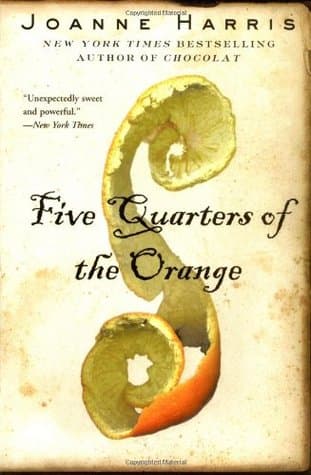
Among her mother's things, Framboise finds a worn scrapbook with recipes, household tips, and Mirabelle's notes. This book, 'Five Quarters of the Orange,' is her main link to her mother. As she starts making the recipes for her crêperie, she realizes the entries are more than just cooking instructions. They contain coded messages, observations, and a hidden story of her mother's life during the war, especially the summer Framboise was nine. The scrapbook is like an orange, with each quarter showing a different side of Mirabelle and the past's hidden truths.
Through Framboise's memories, the story often shifts to 1943, during the German Occupation. Nine-year-old Framboise, with her younger siblings Cassis and Reinette, lives under their mother Mirabelle's strict and often unfair rules. Food is scarce, and Mirabelle uses her cooking skills to trade and survive, often with a German officer named Diehl. The children are often left alone, creating their own secret world and code. Framboise remembers her mother's changing moods, her strong protectiveness, and her acts of kindness and cruelty, all while the village struggles under occupation.
A key part of Framboise's childhood memories involves Diehl, a German officer who often visits their farm. Mirabelle's dealings with him are complicated; she trades food and favors, seemingly for the family's survival, but there's more to it. The children, especially Framboise, are both drawn to and repelled by Diehl, seeing him as a symbol of the occupation. Mirabelle's relationship with Diehl causes village gossip and suspicion, leading to her later bad reputation. Framboise tries to make sense of her mother as a collaborator and her memories of Mirabelle's strong love for her children.
Framboise, Cassis, and Reinette invent games and a secret language to cope with their isolated and often ignored lives. They use the farm as their play area, watching the adults and forming their own ideas about events. Their games, especially one involving 'presents' in a hollow tree, become part of a secret resistance effort. The children, innocent but observant, unknowingly see and take part in small acts of defiance against the German occupiers, adding to the family's story and Mirabelle's real role during the war.
As Françoise Dartigen, Framboise sees how much the villagers still dislike Mirabelle. They tell stories of her mother's coldness, her supposed work with the Germans, and her alleged part in the fire that killed several villagers, including the Mercier family's son. Framboise listens, gathering parts of the story, but finds the villagers' accounts often conflicting and based on rumor and bias. This anger makes her want to find the truth, to understand why her mother was so hated, and to compare the public view with her own memories.
Framboise works to understand her mother's scrapbook. The recipes, in Mirabelle's writing, are mixed with symbols, coded messages, and seemingly random notes. Framboise realizes that the food itself often communicated things or served as a distraction. For example, a cake recipe might hide a meeting, or a specific ingredient might mean a hidden message. Slowly, Framboise starts to understand that her mother was not just a collaborator but was, in her own way, part of the resistance, using her skills to help people and protect her family.
The main point of Framboise's search is the fire. Through her own memories, the scrapbook's coded messages, and village gossip, Framboise puts together what happened. She discovers the fire was not Mirabelle's fault. Instead, it was an accident, or perhaps sabotage gone wrong, linked to the resistance. Mirabelle had tried to protect the children and others involved, taking the blame to shield them. The scrapbook shows Mirabelle's desperate attempts to warn people and her ultimate sacrifice of her reputation to save lives.
With the truth known, Framboise's view of her mother changes completely. The image of a cruel, distant woman is replaced by a resourceful, brave person who made huge sacrifices in impossible times. She understands Mirabelle's 'cruelty' as a way to protect them and her distance as a necessary shield. Framboise finds peace with her mother's memory, forgiving her for past wrongs and seeing the depth of her love. This new understanding allows Framboise to drop her assumed name and be herself.
Having found the truth, Framboise drops her disguise and reclaims her identity. She reconnects with her estranged siblings, Cassis and Reinette, sharing what she learned from their mother's scrapbook. Their shared understanding of Mirabelle's past helps them heal old wounds and form a new bond. Framboise's crêperie, now openly run by Framboise Simon, becomes a place where the past is honored, and the community can begin to see Mirabelle's legacy differently. The book ends with Framboise finding peace, having accepted her heritage and finally understood the 'five quarters of the orange' that made up her mother's complex life.
The Protagonist
Framboise transforms from a woman hiding from her past and resenting her mother into one who understands, forgives, and embraces her heritage, finding peace and a renewed connection with her siblings.
The Central Figure (Antagonist/Supporting)
Mirabelle's character arc is revealed posthumously, transforming from a villainous figure in the eyes of the village and her daughter to a heroic, self-sacrificing woman who made impossible choices.
The Supporting
Cassis moves from an estranged, resentful sibling to one who reconnects with her sister and comes to a more complete understanding of their mother.
The Supporting
Reinette, like Cassis, moves from an estranged sibling to one who reconnects with her sister and gains a deeper understanding of their mother.
The Supporting (Antagonist in childhood perception)
Diehl's character arc is revealed through Framboise's changing perspective, transforming from a feared enemy to a more complex figure whose actions, though ambiguous, were not entirely malicious.
The Supporting (Antagonist)
Mercier remains largely unchanged, serving as a static representation of the village's unyielding judgment and the enduring power of rumor and grief.
The Supporting
Madame Dubois's character serves to reveal information and opinions about Mirabelle, largely remaining a static representation of village memory.
The novel shows how truth depends on individual memory, perspective, and time. Framboise tries to reconcile the public story of her mother as a villain with her own fragmented childhood memories. The scrapbook helps reveal a deeper, more complex truth, showing that what a community remembers or believes may not be what happened. The story highlights how trauma, guilt, and self-preservation can twist or hide memories, making the past a changing thing.
“Memory is a mischievous creature, fickle and unreliable, but stories, once told, take on a life of their own, becoming truer than truth itself.”
A main theme is the complex relationship between mothers and daughters. Framboise's life has been shaped by her mother, Mirabelle, whom she resents, fears, and tries to understand. The novel explores the unspoken sacrifices, misunderstandings, and deep love that can exist in these bonds. It shows how daughters often inherit not just physical traits but also their mothers' burdens and legacies, and how understanding a mother's past can be key to a daughter's self-acceptance and healing.
“Mothers and daughters are linked. What one cannot do, the other must. What one fails to understand, the other will try to unravel.”
The novel clearly shows the harsh realities of life in occupied France, focusing on what people do to survive and protect their families. Mirabelle's actions, first seen as collaboration, are shown to be acts of great sacrifice and resourcefulness in a desperate situation. The theme explores the moral gray areas of war, where choices are rarely simple, and heroism can look like villainy. It highlights the quiet acts of resistance, subtle defiance, and the personal cost of keeping dignity and protecting loved ones under oppression.
“Sometimes, the hardest choices are made not for glory, but for survival. And sometimes, survival looks a lot like betrayal.”
Food is more than just nourishment in this novel; it is a strong metaphor, a way to communicate, and a link to memory and heritage. Mirabelle's recipes are not just instructions but coded messages, reflections of her feelings, and a hidden story of her life. For Framboise, making these dishes is a way to literally taste and understand her mother's past, bridging the gap between them. Food symbolizes love, comfort, survival, and a secret language that goes beyond words, showing life's richness and complexity.
“Food is a language, you see. It speaks of culture, of family, of love and sometimes, of secrets.”
A tattered recipe book holding coded secrets and the truth of the past.
Mirabelle's inherited scrapbook is the central plot device, serving as a literal and metaphorical key to unlocking the novel's mysteries. Filled with recipes, household tips, and cryptic notes, it functions as a coded diary, revealing Mirabelle's true actions and intentions during the war. For Framboise, deciphering its entries is a quest that drives the narrative, connecting her to her mother and the past. The 'five quarters of the orange' title itself is symbolic, representing the multifaceted, often hidden, aspects of Mirabelle's personality and life, which Framboise must uncover piece by piece.
Alternating timelines reveal the story through Framboise's present-day investigation and childhood memories.
The novel employs a dual narrative structure, alternating between Framboise's present-day experiences in Les Laveuses and her vivid flashbacks to her childhood during the German Occupation in 1943. This device allows the reader to experience the mystery alongside Framboise, piecing together information from both timelines. The present-day interactions with villagers inform her interpretation of the past, while the childhood memories provide crucial context and reveal the subjective nature of truth. This structure builds suspense and gradually unveils the complex layers of Mirabelle's story.
The protagonist's childhood memories are filtered through a child's understanding, requiring reinterpretation.
Framboise's memories of her childhood are presented from the perspective of a nine-year-old, making her an initially unreliable narrator regarding the deeper complexities of her mother's actions. As an adult, she re-evaluates these memories, realizing that her child's understanding of events, such as her mother's 'cruelty' or 'collaboration,' was incomplete or mistaken. This device highlights the theme of truth and memory, showing how adult understanding can recontextualize childhood perceptions and reveal hidden motivations behind seemingly harsh actions, adding layers of psychological depth to Mirabelle's character.
Ready to see how well you understood this book? Take our interactive quiz with 10 questions.
Biography coming soon.







