“The world was a dry, hard, unfeeling place. He had done his best to make it so.”
— Reflecting on Captain Hollister's character and the Shop's coldness.

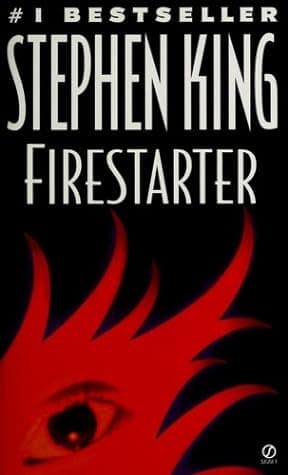
Stephen King (1980)
Genre
Thriller / Fantasy / Science Fiction
Reading Time
900 min
Key Themes
See below
Sign in to track this book
With the government after her, a young girl with fire powers must control her gift and escape those who would turn her into a weapon.
The story begins with Andy McGee and his eight-year-old daughter, Charlie, running from 'The Shop,' a secret government group. They are tired, hungry, and always looking out for danger. Andy has a mild form of mind control, a 'push,' while Charlie has strong fire abilities, which she tries to control, especially when stressed or angry. They are hunted because of experiments Andy and his late wife, Vicky, took part in during college, where The Shop gave them a hallucinogenic drug called 'Lot Six.' This drug gave them psychic powers, which were then passed to and made stronger in Charlie. After Vicky was killed by Shop agents and their home destroyed, Andy and Charlie have been running, trying to stay ahead of the agents who want to capture Charlie and use her powers as a weapon.
Through flashbacks, the story shows how Andy and Vicky got their powers during a college experiment with 'Lot Six.' Andy's 'push' lets him subtly influence minds, while Vicky developed telekinesis, though she rarely used it. Their daughter, Charlie, was born with uncontrolled fire abilities, first showing up as bedwetting incidents that set her sheets on fire. The Shop, which had watched the Lot Six subjects, found the McGees. One night, agents, led by Captain Hollister, raided their home. Vicky was killed, and Andy, using his 'push,' escaped with Charlie. Charlie, in fear and anger, accidentally unleashed a wave of fire, destroying their home and killing several agents. This event, called the 'Kindertrauma,' started their life as fugitives.
Andy and Charlie, after weeks of running, find a secluded farm owned by Irv Manders, a kind elderly man, and his wife, Norma. They offer the tired pair shelter and food, not knowing who they really are or the danger they carry. Charlie, at first careful, starts to relax, experiencing some normalcy. But the rest does not last long. The Shop, using advanced tracking and a nationwide search, finds the Manders' farm. Agents, led by Captain Hollister, surround the property, forcing Andy and Charlie to run again. The Manders, realizing the danger their guests were in, try to cover for them, but their efforts fail against The Shop's force.
Despite trying to escape, Andy and Charlie are eventually cornered by The Shop's agents. Andy, weakened from using his 'push' and constant stress, cannot fight effectively. Charlie, trying to protect her father, unleashes a burst of fire, burning several agents, but she is ultimately subdued by tranquilizer darts. They are both taken to The Shop's secret facility, 'The Farm,' a fortified compound for containing and studying people with special abilities. They are separated when they arrive; Andy is put in an interrogation room, and Charlie in a fireproof cell, immediately becoming the focus of the organization's research.
At The Farm, Charlie goes through painful tests to understand and control her fire abilities. Dr. Wanless, the lead scientist, is fascinated by Charlie's power, seeing her as a potential weapon. Meanwhile, Andy is questioned by Captain Hollister, who tries to get information about his and Vicky's powers and how they passed to Charlie. During this time, the intelligent and psychopathic assassin, John Rainbird, becomes interested in Charlie. He pretends to be a kind orderly, befriending Charlie and gaining her trust, while secretly planning to use her powers for his own ends and eventually kill her, believing it is the ultimate act of friendship.
Andy, isolated and questioned, finds his 'push' ability weakening. Each use drains him, causing headaches and nosebleeds, a side effect he calls the 'bleed.' He tries to stay mentally strong, knowing he must find a way to reach Charlie. Charlie, however, finds her fire powers growing stronger and more unpredictable, especially under stress or during painful experiments. She sometimes loses control, causing spontaneous fires. Rainbird, watching this, subtly encourages her to use her powers, manipulating her emotions to cause these outbursts, making her see him as a confidant who understands her burden.
Despite being separated and The Shop's security, Andy and Charlie make telepathic contact. Andy, using the last of his 'push,' puts suggestions in the minds of some Shop staff, creating chances for them to meet. They have a brief, emotional reunion, where Andy tells her his escape plan. He will use his 'push' to create chaos and stop guards, while Charlie will use her fire for distractions and to clear a path. They agree on a signal and a time, knowing this is their only chance to escape The Shop and Rainbird's manipulations.
The escape plan begins. Andy, pushing himself to his limits, stops several guards and creates diversions, causing chaos in The Farm. Charlie, responding to his mental cues, uses controlled bursts of fire, melting locks and setting off alarms. During the escape, they meet Rainbird. Charlie, still trusting him, believes he is helping them. However, Rainbird, having set up a plan with Hollister, shows his true, psychopathic nature. He shoots Andy, badly wounding him, and tries to kill Charlie, aiming to 'finish' her, seeing it as a twisted act of connection. Charlie is devastated by the betrayal and her father's injury.
Seeing her father shot and Rainbird's deception, Charlie's grief and anger overwhelm her. She loses all control, her fire powers erupting in an uncontrolled, devastating fire. She burns Rainbird, killing him in a display of vengeance. The entire facility becomes a fire as she unleashes her full abilities. Walls melt, metal twists, and agents are consumed by flames. She is no longer just a girl with a power; she is a force of nature, driven by fury and a need to protect her dying father and avenge her mother.
Charlie, a living firestorm, destroys The Shop. She burns through every level, every laboratory, every file, making sure the organization that tormented her family can no longer exist. Captain Hollister, along with many agents and scientists, dies in the fire. Andy, bleeding heavily, uses his last moments to give Charlie a message: she must tell her story, expose The Shop, and make sure no one else suffers their fate. He dies in her arms, his last act one of love and defiance. Charlie, heartbroken but determined, escapes the burning ruins of The Shop, carrying her father's wish as her new purpose.
After escaping the destruction of The Shop, Charlie, alone but driven by her father's last words, goes to a remote cabin. She spends time there, grieving her parents and accepting her power. She understands that her powers, though terrifying, can also be used for justice. Charlie then goes on a journey, determined to tell the world about The Shop and its actions. She finds a reporter at Rolling Stone magazine, telling her entire story. The book ends with Charlie's testimony being prepared for publication, a warning to the world about unchecked government power and the dangers of using human potential as a weapon, making sure The Shop's secrets will be known.
The Protagonist
Charlie transforms from a frightened, dependent child into a powerful, self-aware individual who embraces her abilities to seek justice and expose the truth.
The Protagonist/Supporting
Andy steadily declines physically and mentally from the strain of his powers, sacrificing himself to ensure Charlie's survival and mission.
The Supporting/Mentioned
Her brief life and tragic death serve as the catalyst for the entire plot, representing the initial victim of The Shop's cruelty.
The Antagonist
Rainbird's arc is one of escalating psychological manipulation and physical threat, culminating in his violent demise at Charlie's hands.
The Antagonist
Hollister remains a steadfast antagonist, representing the unyielding institutional threat, until his ultimate destruction.
The Supporting
Wanless remains a detached scientific observer, furthering The Shop's agenda through his research until his end.
The Supporting
Irv's arc is brief but impactful, serving as a beacon of humanity in a desperate situation.
The Supporting
Norma, like Irv, represents a brief, compassionate interlude in Charlie's harrowing journey.
The Antagonist
The Shop is the constant, overarching antagonist, ultimately destroyed by Charlie's unleashed power.
This theme is central to 'Firestarter,' showing the bad results when government groups act without ethics. The Shop, wanting national security and psychic weapons, does inhumane experiments ('Lot Six') and hunts Charlie, a child, to use her. The story shows how seeking power corrupts, leading to murder (Vicky McGee), torture (Charlie's experiments), and ignoring human rights. The Shop's destruction by Charlie's power warns against trying to control and weaponize forces beyond moral limits.
“They had wanted to use her, just as they had used her parents. And they had done it, hadn't they? Used them all up.”
The deep love between Andy and Charlie is the emotional center of the novel. Andy's life is about protecting his daughter, enduring physical and psychological pain ('the bleed') from using his 'push' to keep them safe. He always puts Charlie's well-being first, finally giving his life to ensure her escape and to give her a purpose: to expose The Shop. This theme explores how far a parent will go to protect their child from harm, even against overwhelming odds, showing the power of family bonds against institutional cruelty.
“He would die for her. He knew that. He would die without even thinking about it.”
Charlie McGee's story shows how childhood innocence is broken by trauma. From seeing her mother killed to living on the run and enduring painful experiments, Charlie faces terrible things. Her fire powers, at first scary and causing accidents, become a direct sign of her hidden anger and fear. The story looks at how trauma can change a child's development, forcing them to grow up too fast and deal with scary responsibilities. Charlie's eventual use of her destructive power, though needed for survival, means she permanently loses the carefree childhood she never had.
“She was a child of fire, and the fire had burned away her childhood.”
Charlie's struggle with her fire abilities is a way to show dealing with a unique and potentially dangerous identity. She first sees her powers as a curse, a source of fear and guilt over accidental fires. The Shop's attempts to control and weaponize her further complicate how she sees herself, making her feel like an object. But as the story goes on, especially after her father's death and Rainbird's betrayal, Charlie begins to accept her power as part of who she is. This acceptance lets her unleash her full abilities, not just for destruction, but for justice, creating a new identity as a force for truth.
“She was Firestarter. She was the one who could make it burn.”
The novel shows a clear conflict between Andy and Charlie (representing humanity and individual freedom) and The Shop (representing cold, institutional power). But it also looks at unclear moral areas. Andy's 'push' is a form of mind control, though used for protection. Charlie's power, while used against evil, is destructive and causes many deaths. Rainbird, though a psychopath, offers a twisted view that questions common morality. This theme explores the blurry lines between necessary actions and moral compromises, and how even 'good' characters might use violent means when pushed to extremes.
“Sometimes you had to burn the house down to save the people inside.”
A form of mind control used by Andy to influence others.
Andy McGee's psionic ability, 'the push,' allows him to implant suggestions, subtly influence thoughts, or even compel people to perform actions. It functions as a crucial survival tool, enabling him to evade capture, gather information, and create diversions. However, its use comes at a great cost: severe physical pain, including debilitating headaches and nosebleeds ('the bleed'), which progressively weaken him. This device highlights the personal sacrifice involved in fighting a powerful antagonist and serves as a ticking clock for Andy's diminishing strength, forcing Charlie to ultimately rely on her own powers.
The central supernatural power of the protagonist, both a curse and a weapon.
Charlie McGee's pyrokinetic ability is the primary plot device, driving the entire narrative. It is a terrifying, uncontrollable force that manifests as fire, ranging from small sparks to devastating infernos. This power is both her greatest vulnerability (making her a target for The Shop) and her ultimate weapon. Its unpredictable nature, especially when tied to her emotional state, creates constant tension. The gradual development and eventual unleashing of her full power provide the climax, allowing her to destroy The Shop and fulfill her father's dying wish, transforming her from victim to avenger.
The experimental hallucinogen that granted psychic abilities to Andy and Vicky.
'Lot Six' is the catalyst for all the events in the novel. It is a low-grade hallucinogenic drug administered by The Shop during a college experiment, designed to test its effects on human perception. Unbeknownst to the researchers, it also had a rare side effect of unlocking latent psionic abilities in a small percentage of subjects, including Andy and Vicky McGee. This device establishes the origin of Charlie's powers and provides The Shop with a motive for hunting her – to understand and replicate the effects of the drug and the resulting abilities. It represents the unethical scientific experimentation that underpins the entire conflict.
The overarching antagonist, a clandestine government agency.
The Shop (Department of Scientific Intelligence) serves as the primary antagonist and a powerful plot device representing unchecked governmental power and scientific hubris. It is a vast, shadowy organization with unlimited resources, dedicated to capturing and weaponizing psychic individuals. Its omnipresent threat drives Andy and Charlie's flight, their eventual capture, and the subsequent torture and experimentation. The Shop's ruthlessness and ethical void are the driving force behind the conflict, creating a formidable and relentless enemy that appears insurmountable until Charlie's final, destructive act. It symbolizes the dangers of state control over individual liberty.
Narrative technique used to reveal backstory and character motivations.
The novel frequently employs flashbacks, particularly in the early chapters, to reveal crucial backstory. These flashbacks detail Andy and Vicky's experiences with 'Lot Six,' the first manifestations of Charlie's powers, and the brutal raid on their home that resulted in Vicky's death and the beginning of their life as fugitives. This device provides essential context for the present-day pursuit, explains the origins of Charlie's powers, and deepens the emotional impact of the family's tragedy, allowing the reader to understand the stakes and the characters' motivations more fully without disrupting the immediate tension of their escape.
“The world was a dry, hard, unfeeling place. He had done his best to make it so.”
— Reflecting on Captain Hollister's character and the Shop's coldness.
“You can't kill the spirit, Charlie. It's inside you. It's part of you.”
— Andy trying to comfort and empower Charlie about her abilities.
“The world, Charlie thought, was a place where people did terrible things, but also where people tried to make things right.”
— Charlie's internal monologue about the duality of humanity.
“She was a weapon, and she knew it. The only question was who would point her.”
— Charlie's self-awareness of her dangerous abilities.
“There was no such thing as a free lunch, especially not when the lunch was a little girl with the power to burn down the world.”
— Reflecting on the cost and danger associated with Charlie's abilities.
“Fear was a great motivator, and it was a great teacher.”
— Andy considering how fear drives both the Shop and his own actions.
“He knew, with a sudden, sickening certainty, that he had traded one prison for another.”
— Andy's realization about his situation after escaping the Shop.
“The truth was a fire, and it would burn anyone who stood too close.”
— Andy contemplating the destructive nature of revealing the Shop's secrets.
“Sometimes, the only way to fight fire was with more fire.”
— Charlie's internal justification for using her powers destructively.
“They were all just pieces on a chessboard, and the Shop was playing a very long game.”
— Andy's perception of the Shop's manipulative tactics.
“It was amazing how quickly a little girl could become a monster when she was pushed hard enough.”
— Observing Charlie's transformation under extreme duress.
“The greatest trick the devil ever pulled was convincing the world he didn't exist.”
— Reflecting on the Shop's hidden influence and secrecy.
“Home was not a place, but a feeling. And she had lost it.”
— Charlie's sense of displacement and loss after her parents' deaths.
“He understood then that sometimes, the only way to truly protect someone was to let them fight their own battles.”
— Andy's evolving understanding of Charlie's independence and power.
Ready to see how well you understood this book? Take our interactive quiz with 10 questions.

Stephen Edwin King is an American author of horror, supernatural fiction, suspense, crime, science-fiction, and fantasy novels. Described as the "King of Horror", his books have sold more than 350 million copies as of 2006, and many have been adapted into films, television series, miniseries, and comic books. King has published over 65 novels/novellas, including seven under the pen name Richard Bachman, and five non-fiction books. He has also written approximately 200 short stories, most of which have been published in book collections.







