“Books were his friends, and he had always treated his friends well.”
— Morris Bellamy's reverence for books, especially Rothstein's.

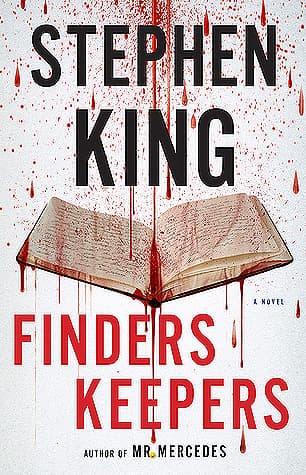
Stephen King (2015)
Genre
Fantasy / Children's / Young Adult
Reading Time
600 min
Key Themes
See below
Sign in to track this book
A super-fan's obsession with a reclusive author's unpublished manuscripts leads to a decades-long game of cat and mouse after a young boy finds the hidden literary treasure.
In 1978, Morris Bellamy, a disgruntled and obsessive fan, breaks into the isolated home of author John Rothstein. Bellamy is furious that Rothstein, creator of the character Jimmy Gold, has stopped publishing and, in Bellamy's view, allowed Gold to 'sell out' in advertising. After a heated confrontation, Bellamy murders Rothstein. He ransacks the house, stealing a significant amount of cash and, more importantly, a collection of notebooks containing Rothstein's unpublished work, including at least one complete Jimmy Gold novel. Bellamy buries the treasure, the money and the notebooks, behind his mother's house before being arrested for an unrelated crime and sentenced to life imprisonment.
In 2009, twelve-year-old Pete Saubers and his younger sister, Tina, struggle after their father is severely injured during the Mercedes Killer massacre, leaving him with permanent brain damage and the family in financial ruin. Desperate to help, Pete decides to bury his prized baseball glove and bat for safekeeping but finds a rusted, buried trunk in the woods behind his house. Inside, he discovers a large sum of money and a trove of handwritten notebooks. Unaware of their origin or value, Pete secretly begins using the cash to alleviate his family's financial burdens, anonymously sending them money.
As Pete continues to use the found money to help his family, he also starts reading the notebooks. He quickly becomes captivated by John Rothstein's unpublished works, particularly the new Jimmy Gold novel, 'The Runner.' Pete, a bright and sensitive boy, finds solace and inspiration in Rothstein's writing, which contrasts with his family's difficult reality. He keeps the notebooks a secret, cherishing them as his personal literary treasure, unaware of the dangerous history and the original owner's violent obsession.
After serving thirty-five years in prison for his original crime, Morris Bellamy, now elderly but still fiercely obsessive, is paroled. His first thought upon release is to retrieve the buried trunk containing Rothstein's money and the invaluable notebooks. He returns to his old family home, only to discover the house has been sold and the land developed. The exact spot where he buried the trunk is now part of the Saubers' property, near where Pete had his hidden spot. Bellamy's desperate search begins, fueled by his lifelong obsession.
Pete's anonymous financial contributions improve his family's situation, allowing them to pay off debts and avoid foreclosure. However, his parents, especially his mother, become suspicious of the mysterious cash. They press Pete, who eventually confesses to finding the money and the notebooks. While relieved by the financial help, they worry about the unknown origin of the items and the potential dangers. Pete's father, Tom, still recovering from his injuries, struggles to grasp the full implications, while his mother fears for their safety.
Morris Bellamy, unable to find the trunk at its original burial site, investigates the new residents of his old property. Through observation and deduction, he realizes the Saubers family must have found his treasure. He learns about their sudden financial improvement and the son, Pete. Bellamy's obsession intensifies, and he begins to stalk Pete and his family, planning how to recover his 'property,' specifically the Rothstein notebooks, at any cost. His long-dormant rage and possessiveness resurface with alarming intensity.
Pete Saubers, now a teenager, has been receiving increasingly menacing letters and threats from an anonymous sender, demanding the return of 'the notebooks.' Recognizing the danger, and remembering the story of the Mercedes Killer, Pete writes a letter to retired Detective Bill Hodges, who, along with Holly Gibney and Jerome Robinson, runs the private investigation agency Finders Keepers. Pete explains his discovery, the anonymous threats, and his fear for his family's safety, hoping Hodges can protect them from the unknown stalker.
Bill Hodges, Holly Gibney, and Jerome Robinson are intrigued and concerned by Pete's letter. They quickly connect the dots between the discovered money and notebooks, the murder of John Rothstein, and the recently paroled Morris Bellamy. Hodges realizes Bellamy's obsession with Rothstein's work drives the threats. The team gathers information on Bellamy, his past crimes, and his current whereabouts, understanding they are dealing with a dangerous and disturbed individual who will stop at nothing to reclaim his literary prize.
Morris Bellamy, having planned his move, ambushes Pete and his family at their remote lake house. He takes them hostage, demanding the immediate return of the notebooks. The situation is tense, with Bellamy's unstable mental state and violent history creating extreme danger. He threatens Pete's family, particularly his younger sister Tina, to coerce Pete into revealing where he has hidden the remaining notebooks. Bellamy's true objective is the literary treasure, not the money, and he is prepared to be ruthless to get it back.
Having tracked Bellamy to the lake house, Bill Hodges, Holly Gibney, and Jerome Robinson arrive just as the situation reaches its boiling point. A violent confrontation ensues between the investigators and Bellamy. Hodges, using his experience and quick thinking, creates a diversion, allowing Holly and Jerome to help the Saubers family to safety. In the struggle, Bellamy is subdued, but not without significant danger to all involved. The Saubers family is rescued, physically unharmed but deeply traumatized by the ordeal.
Morris Bellamy is recaptured and returned to prison, facing new charges for kidnapping and assault. The Saubers family, while safe, grapples with the psychological aftermath of their ordeal. The fate of John Rothstein's notebooks becomes a central issue. After much discussion and with input from Hodges and Pete, a decision is made to publish 'The Runner' and other select works from the notebooks, ensuring Rothstein's legacy lives on and the world can finally read the stories Bellamy coveted so fiercely. Pete, having grown through the experience, finds a new appreciation for literature and his own resilience.
The Protagonist
Pete transforms from a financially burdened child seeking to help his family into a brave young man who stands up against a dangerous threat, coming to terms with the power and peril of found treasures.
The Antagonist
Bellamy's arc is one of unyielding obsession and escalating violence, beginning with murder and culminating in a desperate attempt to reclaim his 'treasure,' ultimately leading to his re-imprisonment.
The Supporting
Hodges continues his work as a private investigator, using his experience to protect the vulnerable and bring criminals to justice, further solidifying his role as a compassionate hero.
The Supporting
Holly continues to develop her confidence and investigative skills, proving herself an indispensable member of the Finders Keepers team and a courageous ally.
The Supporting
Jerome continues to hone his investigative skills and technological expertise, becoming a more integral and reliable member of the Finders Keepers team.
The Mentioned
Though deceased, Rothstein's literary legacy is finally revealed to the world, completing his artistic journey.
The Supporting
Tina endures a traumatic experience but is ultimately rescued, highlighting the resilience of children in the face of terror.
The Supporting
Tom's arc is one of enduring the aftermath of a traumatic injury and trying to protect his family amidst new dangers.
The Supporting
Linda endures significant hardship and fear, ultimately demonstrating her strength and protective instincts as a mother.
The novel explores how literature impacts individuals, from inspiring young Pete Saubers to driving Morris Bellamy to murder. Rothstein's works, especially the Jimmy Gold series, are objects of intense emotional connection. Bellamy's obsession shows the dangerous potential when fandom crosses into entitlement and delusion. Pete's experience shows how literature can offer solace, escape, and even a path to self-discovery, as he reads 'The Runner' and connects to its themes amid his family's struggles.
“A good book is a good book is a good book. It doesn't matter if it's a best-seller or a forgotten classic.”
The entire plot is a direct consequence of past actions. Morris Bellamy's murder of John Rothstein and the subsequent burial of the notebooks in 1978 sets in motion a chain of events that unfolds decades later. Similarly, the Mercedes Killer attack, committed by Brady Hartsfield in the previous novel, directly impacts the Saubers family, creating the circumstances that lead Pete to discover the treasure. The novel emphasizes how unresolved crimes and buried secrets can resurface with devastating effects, impacting innocent lives many years later. The past is never truly buried.
“The past is never dead. It's not even past.”
A central theme is the contrasting values placed on art and money. Morris Bellamy values the Rothstein notebooks far above the stolen cash, seeing them as a sacred treasure. For Pete Saubers, the money initially provides crucial relief for his family, but he quickly becomes captivated by the literary value of the notebooks, finding them inspiring. The conflict arises from Bellamy's belief that he is the rightful heir to Rothstein's literary genius, contrasting with the Saubers family's practical need for the money and Pete's genuine appreciation for the stories. The novel suggests that true value often lies beyond monetary gain.
“The books were his. The money was just a bonus, a way to make sure he had a comfortable place to read them.”
The novel shows heroism not just in the actions of the experienced investigators Bill Hodges and his team, but also in the courage and resilience of ordinary people like Pete Saubers and his family. Pete's initial drive to help his family, his decision to confess his secret, and his bravery in facing Bellamy demonstrate a quiet heroism. The Saubers family, despite their trauma and vulnerability, show remarkable strength in enduring their hardships and standing up to a dangerous threat. This theme emphasizes that bravery can emerge from unexpected places and in extraordinary circumstances.
“He was just a kid, but he knew what he had to do. And he was scared, but he did it anyway.”
The unpublished notebooks of John Rothstein.
The unpublished notebooks containing John Rothstein's final Jimmy Gold novel, 'The Runner,' serve as the primary MacGuffin. While their literary content is explored, their main function is to drive the plot, creating conflict and motivation for both Morris Bellamy (who obsessively covets them) and Pete Saubers (who discovers them). The notebooks' existence, discovery, and subsequent pursuit by Bellamy propel the narrative forward and unite the disparate timelines and characters.
Pete's anonymous money saving his family.
Pete Saubers' discovery of Morris Bellamy's buried cash initially functions as a benevolent Deus ex Machina for the Saubers family, miraculously solving their financial woes. However, this device is quickly subverted, as the 'solution' itself becomes the source of an even greater and more personal danger. The sudden relief is temporary and comes with a severe cost, transforming the lucky break into a catalyst for the main conflict rather than a true resolution, highlighting that easy solutions often have hidden complexities.
Pete's letter to Bill Hodges and Bellamy's threatening notes.
The use of letters plays a crucial role in advancing the plot and character development. Pete Saubers' desperate letter to Bill Hodges is the catalyst that brings the Finders Keepers team into the narrative, bridging the gap between the Saubers family's plight and the investigative arm of the story. Conversely, Morris Bellamy's anonymous, increasingly menacing notes to Pete serve to escalate the tension, reveal Bellamy's growing desperation, and instill fear, directly leading Pete to seek help. These written communications are vital for conveying information and driving the conflict.
The clash between Morris Bellamy and Pete Saubers.
The central conflict between Morris Bellamy and Pete Saubers represents a stark intergenerational clash. Bellamy, an older man consumed by a decades-old obsession, represents a past crime and a fixed, violent worldview. Pete, a young boy coming of age, represents the future and a more innocent, appreciative perspective on the stolen literary works. Their struggle highlights not just a battle over physical property, but a collision of different eras, values, and understandings of what truly matters, with the older generation's unresolved issues directly threatening the younger's future.
“Books were his friends, and he had always treated his friends well.”
— Morris Bellamy's reverence for books, especially Rothstein's.
“The past is a stubborn thing.”
— The lingering impact of Rothstein's unfinished work and Bellamy's crime.
“You can kill a writer, but you can't kill his words.”
— The enduring power of John Rothstein's writing, even after his death.
“Sometimes the things you lose find their way back to you.”
— A recurring theme, particularly with the lost notebooks and their eventual discovery.
“There's no such thing as an innocent bystander in this world.”
— The idea that everyone is affected by the actions of others, directly or indirectly.
“The world had moved on, but some people never did.”
— Morris Bellamy's inability to adapt or let go of his obsessions.
“A book is a loaded gun in the house next door.”
— A reference to the power of ideas and stories, echoing Bradbury.
“Life can be a real bitch, can't it? Especially when you're just trying to get by.”
— Tom Saubers reflecting on the struggles of his family after the accident.
“Some things are better left buried.”
— The danger of unearthing secrets and the consequences that follow.
“The greatest treasure is often hidden in plain sight.”
— The hidden value of Rothstein's final notebooks, overlooked for years.
“Reading was a kind of magic, a way to travel without moving.”
— Holly Gibney's perspective on the transformative power of literature.
“He understood that sometimes, you had to fight for what you loved.”
— Pete Saubers' determination to protect his family and the notebooks.
“Revenge is a dish best served cold, and Bellamy had been marinating for a long time.”
— Morris Bellamy's long-held grudge and his desire for vengeance.
“Every story has an ending, but not every ending is happy.”
— The often harsh realities faced by the characters in the novel.
Ready to see how well you understood this book? Take our interactive quiz with 10 questions.

Stephen Edwin King is an American author of horror, supernatural fiction, suspense, crime, science-fiction, and fantasy novels. Described as the "King of Horror", his books have sold more than 350 million copies as of 2006, and many have been adapted into films, television series, miniseries, and comic books. King has published over 65 novels/novellas, including seven under the pen name Richard Bachman, and five non-fiction books. He has also written approximately 200 short stories, most of which have been published in book collections.







