“The same rules apply.”
— Bruce Robertson's cynical mantra about life and corruption.

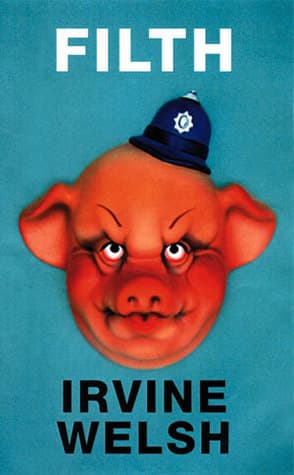
Irvine Welsh (1996)
Genre
Thriller / Mystery
Reading Time
525 min
Key Themes
See below
Sign in to track this book
A depraved, drug-addled Scottish detective's pursuit of a promotion unravels into a grotesque psychological nightmare, battling an intestinal parasite and his own spiraling corruption amidst a racially charged murder investigation.
Detective Sergeant Bruce Robertson, a corrupt Edinburgh policeman, starts his story with a drug-fueled trip to Amsterdam. He uses a lot of cocaine, has casual sex with prostitutes, and engages in general bad behavior, all while wanting a promotion to Detective Inspector. Bruce thinks he will get the promotion, seeing it as a way to fix his failing personal life. His wife, Carole, has left him, and he rarely sees his daughter, Stacy. He constantly manipulates and belittles his coworkers, especially Ray Lennox and Amanda Drummond, believing them to be weaker competition. Unknown to Bruce, a tapeworm in his gut has become sentient and watches his every move, offering increasingly critical comments on his actions and mental state.
Bruce returns to Edinburgh just as a murder happens: Mikey Paterson, a Japanese exchange student, is found dead. Bruce, despite his hangover and withdrawal, takes charge of the investigation, seeing it as his way to get the promotion. He immediately manipulates evidence and witnesses, framing an innocent Black man named Mahmoud instead of looking for real leads. His main goal is to close the case quickly, without caring about justice. He uses the investigation to harass and abuse his coworkers, especially Amanda Drummond, whom he constantly objectifies and tries to exploit sexually. The tapeworm continues its observations, noting Bruce's worsening mental and physical health.
Bruce's drug addiction gets worse, leading to more erratic behavior and vivid hallucinations. He uses cocaine, drinks a lot, and has disturbing sexual encounters, often involving his coworkers' wives or other vulnerable women. His attempts to contact Carole are ignored, and he becomes obsessed with getting her back, believing the promotion will help. He continues to harass his coworkers, making up evidence and intimidating witnesses to fit his story for the Paterson murder. The tapeworm's internal monologue becomes more frequent, showing deeper insights into Bruce's mind and the traumatic events that shaped him, hinting at a past Bruce actively hides.
The annual police Christmas party shows Bruce's increasing bad behavior. He plans a series of cruel pranks and manipulations, including humiliating his coworkers and trying to seduce Amanda Drummond. His behavior alienates almost everyone, and his desire for the promotion becomes clear. He sabotages other officers' chances, especially Ray Lennox, who is genuinely investigating the Paterson case and getting closer to the truth. Bruce's internal monologues, often from the tapeworm, show his deep misogyny, racism, and self-loathing. He starts to have strong physical symptoms, including severe eczema and internal pain, which he blames on stress but are also linked to his drug use and the tapeworm.
Bruce's attempts to get back with Carole are always rejected. He gets a letter from her lawyer, saying she wants a divorce and has moved on. The worst news is that Carole had a miscarriage, losing their child, a fact Bruce had either forgotten or refused to acknowledge. This news, with his failing professional life and the pressure of the murder investigation, pushes him further into a psychological abyss. His hallucinations become more frequent and vivid, blurring the lines between reality and his drug-addled mind. The tapeworm's narrative voice becomes more firm, starting to expose the lies of Bruce's life.
While Bruce continues his fabricated investigation, Ray Lennox, a more ethical detective, follows real leads in the Mikey Paterson murder. Ray's findings start to go against Bruce's story, putting pressure on Bruce and his made-up evidence. Bruce's mental state becomes more fragile. He experiences intense paranoia, believing his coworkers are plotting against him, and his hallucinations become real. The tapeworm's insights become more critical and direct, showing that it is not just a parasite but a manifestation of Bruce's repressed conscience and memories. The story begins to hint at a deeper, more traumatic past Bruce has tried to bury.
The tapeworm's narrative becomes central, showing its true identity as Bruce's suppressed guilt and trauma. It tells of Bruce's horrible childhood, including physical and sexual abuse by his father, and the tragic death of his younger brother, David, for which Bruce feels responsible. It is revealed that Bruce's adult persona—his misogyny, racism, aggression, and drug abuse—is a defense mechanism to cope with this trauma. The tapeworm, in essence, is Bruce's conscience, trying to break through his delusions and make him face the truth. The promotion, Carole, and the murder investigation are all secondary to this internal battle.
Bruce's deceptions about the Paterson case completely unravel, thanks to Ray Lennox's work. His coworkers, who have suspected his corruption, start to openly challenge him. More importantly, his psychological defenses collapse. The tapeworm's revelations about his past become undeniable, forcing Bruce to face the horrifying truth of his childhood abuse and his part in his brother's death. The difference between his hallucinations and reality disappears, and he has a complete mental breakdown. He loses his authority, his respect, and his self-delusions, leaving him exposed and vulnerable to his unacknowledged pain.
With his career ruined, his personal life in tatters, and his mind consumed by the truths of his past, Bruce is alone and without hope. The tapeworm, having made him confront reality, stops narrating, leaving Bruce to face the consequences of his actions and unaddressed trauma. Overwhelmed by guilt, self-loathing, and the weight of his memories, Bruce makes a final, desperate decision. He commits suicide, hanging himself in his home, ending his tormented life. His death is a culmination of his unchecked bad behavior and the effects of his unhealed psychological wounds.
The Protagonist/Antagonist
Bruce descends further into depravity and delusion, only to have his carefully constructed reality shattered by the revelation of his past trauma, leading to his eventual suicide.
The Narrator/Internal Monologue
Evolves from a parasitic observer to a sentient conscience, ultimately revealing Bruce's repressed trauma and serving as the catalyst for his self-confrontation.
The Supporting
Moves from a distant, hoped-for figure to a symbol of Bruce's irredeemable past and lost future.
The Supporting
Perseveres in his investigation, indirectly leading to Bruce's exposure and the collapse of his lies.
The Supporting
Endures Bruce's harassment while maintaining her professionalism, representing a victim of his systemic abuse.
The Supporting
Remains largely oblivious to Bruce's true nature, serving as a pawn in his schemes.
The Supporting
Serves as a recurring victim of Bruce's manipulation and general unpleasantness.
The Mentioned/Flashback
His story is revealed retrospectively, providing the crucial context for Bruce's psychological breakdown.
The novel shows the corruption in the police force, personified by Bruce Robertson. His abuse of power, manipulation of evidence, and exploitation of colleagues and the public show a moral decay. This theme goes beyond institutional corruption to Bruce's personal life, where his drug addiction, sexual perversions, and disregard for others show a breakdown of ethical boundaries. The murder investigation itself becomes a way for Bruce's self-serving agenda, rather than a pursuit of justice, showing how deeply corruption has affected his life.
“I'm a copper. I'm allowed to do anything I want.”
A central theme in 'Filth' is repressed trauma and its psychological effects. Bruce's behavior is revealed to be a defense mechanism against buried childhood abuse and the guilt about his brother David's death. The Tapeworm's narrative gradually uncovers these memories, making Bruce confront the truth he has denied. This theme shows how unprocessed trauma can appear as self-loathing, aggression, and an inability to form healthy relationships, leading to a mental breakdown.
“You don't want to know about your brother, do you, Bruce? You don't want to know about your father.”
Bruce's identity is a facade built on self-delusion. He creates a story where he is a competent detective, a desirable husband, and a deserving candidate for promotion, while his reality falls apart. The novel explores how people cling to these delusions to avoid facing painful truths about themselves and their past. The Tapeworm challenges Bruce's self-perception, slowly taking apart his false identity until he must confront his true self. This theme highlights how fragile identity is when built on lies and repression.
“I was a good boy, a good boy, a good boy.”
Misogyny and abuse are common throughout the novel. Bruce's treatment of women, from his estranged wife Carole to his coworker Amanda Drummond and many prostitutes, is demeaning, objectifying, and violent. His internal monologues are full of sexist slurs and fantasies of sexual exploitation. This theme is not just a character trait but a core part of Bruce's pathology, coming from his own experiences of abuse. The novel shows the effects of misogyny and the cycle of abuse, where victims often become abusers, continuing a culture of violence and disrespect.
“Women. Can't live with 'em, can't live without 'em. Can't trust 'em, can't stand 'em.”
Addiction, especially to cocaine and alcohol, drives Bruce's self-destructive behavior. His drug use is not just recreational but a coping mechanism for his internal pain, fueling his paranoia, hallucinations, and erratic conduct. The novel shows the physical and psychological toll of addiction, how it worsens his mental health issues and speeds up his downfall. Bruce's inability to control his addictions reflects his inability to confront his past, showing how self-destruction repeats when underlying trauma is not addressed.
“Just one more line, just one more line and then I'll sort things out.”
An internal, critical narrator that reveals Bruce's true psyche.
The sentient tapeworm residing in Bruce's gut is the most distinctive and crucial plot device. Initially presented as a literal parasite, it gradually evolves into a metaphorical representation of Bruce's conscience, repressed memories, and the 'filth' within him. It acts as an unreliable, yet ultimately truthful, internal narrator, offering sardonic commentary on Bruce's actions and slowly revealing his traumatic past. This device allows for an intimate, unfiltered look into Bruce's fragmented mind, blurring the lines between physical ailment and psychological torment, and serving as the primary vehicle for the novel's shocking revelations.
Bruce's perspective is heavily skewed by his delusions, drugs, and trauma.
Bruce Robertson himself functions as a highly unreliable narrator. His perspective is consistently distorted by his cocaine addiction, severe psychological issues, and deep-seated self-delusions. He misinterprets events, fabricates realities, and represses traumatic memories, leading the reader to question the veracity of his every thought and action. This device creates a sense of disorientation and tension, forcing the reader to piece together the truth from fragmented and contradictory information, often provided by the Tapeworm. It effectively immerses the reader in Bruce's deteriorating mental state and highlights the theme of self-delusion.
Letters from Bruce's estranged wife that challenge his self-perception.
The sporadic inclusion of letters from Bruce's estranged wife, Carole, serves as an epistolary device. These letters, often read by Bruce, offer glimpses into his failing marriage and Carole's perspective, which starkly contrasts with Bruce's delusional hopes of reconciliation. They provide external, objective information that directly challenges Bruce's self-serving narrative, particularly regarding the state of their relationship and the devastating news of their miscarriage. These elements act as painful intrusions of reality into Bruce's fantasy world, gradually chipping away at his self-delusions and highlighting his isolation.
Vivid, drug-induced and trauma-driven experiences that blur reality.
Throughout the novel, Bruce experiences frequent and increasingly vivid hallucinations and delusions, often fueled by his cocaine addiction and underlying psychological trauma. These range from distorted perceptions of his colleagues to conversations with inanimate objects and projections of his inner turmoil. This device effectively blurs the line between reality and Bruce's internal world, immersing the reader in his deteriorating mental state. The hallucinations become a visual manifestation of his repressed guilt and trauma, eventually culminating in a complete breakdown of his perception of reality, signaling his final descent.
“The same rules apply.”
— Bruce Robertson's cynical mantra about life and corruption.
“People like us, we don't get the breaks.”
— Robertson reflecting on his own misfortunes and self-pity.
“The only way to deal with an unfree world is to become so absolutely free that your very existence is an act of rebellion.”
— A philosophical musing on freedom and defiance.
“I am a man. I am a pig. I am a worm.”
— Robertson's self-loathing and degradation.
“The world is a toilet and we're all just waiting to be flushed.”
— Robertson's bleak view of existence.
“You have to laugh, otherwise you'd cry.”
— Robertson's dark humor in the face of despair.
“The filth is not just on the streets, it's inside us.”
— A reflection on internal and external corruption.
“We're all animals, just some of us wear suits.”
— Robertson's view on human savagery and civility.
“The truth is a shifting, slippery thing.”
— Commentary on the elusive nature of truth in the investigation.
“In the end, we all get what we deserve.”
— Robertson's fatalistic outlook on justice and karma.
“Love is just another word for manipulation.”
— Robertson's cynical take on relationships.
“The only thing worse than being talked about is not being talked about.”
— Robertson's twisted view on notoriety and attention.
“We're all monsters in our own way.”
— Acknowledgment of the darkness within everyone.
“The past is a ghost that haunts us all.”
— Reflection on how past actions and trauma affect the present.
Ready to see how well you understood this book? Take our interactive quiz with 10 questions.

Irvine Welsh is a Scottish novelist, playwright and short story writer. His 1993 novel Trainspotting was made into a film of the same name. He has also written plays and screenplays, and directed several short films.







