“The wind was cold and carried the smell of the sea, and the sky was grey and promised rain.”
— Opening description of Stockton, setting a bleak tone.

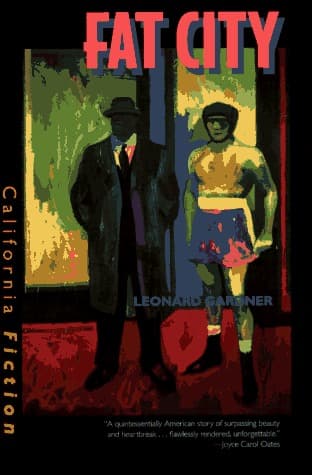
Leonard Gardner (1969)
Genre
Literary Fiction
Reading Time
245 min
Key Themes
See below
Sign in to track this book
In 1960s Stockton, California, two boxers, one a veteran and one new, face their dreams and realities, finding fleeting hope and inevitable despair with every punch.
Billy Tully, a thirty-year-old former boxer struggling with alcoholism and aimlessness, enters a Stockton gymnasium. There, he watches Ernie Munger, a nineteen-year-old aspiring fighter, spar. Impressed by Ernie's talent, Tully offers him advice and encouragement. This meeting starts a brief mentorship, with Tully seeing a reflection of his own past potential in Ernie, while Ernie, despite his youth, already faces the harsh realities of boxing and his limited opportunities in Stockton.
Following Tully's encouragement, Ernie Munger gets his first professional fight in a small, dusty arena. He trains hard, fueled by a new hope for a better life. The fight is grueling, with Ernie taking heavy blows but showing resilience. Despite his efforts, the bout ends in a draw, a result that leaves him feeling a mix of exhaustion, disappointment, and a bit of pride. The experience shows Ernie the grim, unglamorous side of professional boxing, far from any romantic ideas.
Billy Tully's life remains a cycle of odd jobs, cheap wine, and short relationships. He works as a field hand, picking tomatoes under the scorching sun, his body aching and his spirit tired. His attempts to restart his boxing career are half-hearted and unsuccessful. He often visits the local Skid Row bar, the Longhorn, where he reconnects with his on-again, off-again girlfriend, Oma. Their relationship is unstable and codependent, marked by mutual blame and brief moments of affection, often fueled by alcohol.
After his first fight, Ernie Munger continues to train sometimes, but his focus shifts. He marries his girlfriend, Faye, who is Ruben's sister, and they soon have a child. Ernie tries to embrace a more stable, domestic life, working various manual labor jobs to support his young family. However, the responsibilities weigh heavily on him. The demands of fatherhood and marriage, combined with low wages and physical work, begin to chip away at his boxing aspirations, pulling him further into the cycle of everyday survival.
Despite his age and years of neglect, Billy Tully feels a renewed spark of hope. He decides to seriously train for a comeback fight, hoping to earn much-needed money and regain a sense of purpose. He pushes himself through painful workouts, trying to get back his former conditioning. His trainer, Ruben, is skeptical but agrees to work with him. This training period offers Tully a temporary break from his usual despair, providing a fragile structure to his otherwise chaotic life.
Billy Tully's comeback fight shows his fading glory and lasting grit. He enters the ring, older and less agile, against a younger, stronger opponent. The fight is a brutal, one-sided affair, with Tully taking a severe beating. He is knocked down multiple times, his body absorbing punishment that his mind can barely process. Despite his effort, he is defeated, a painful confirmation of his diminished abilities and the harsh realities of a boxer's life. The loss extinguishes the last embers of his professional boxing dreams.
Ernie Munger finds himself increasingly trapped by his circumstances. His boxing career has stalled, and he drifts between demanding, low-paying jobs—picking walnuts, working in a cannery—to support Faye and their child. The physical toll of labor, combined with the emotional strain of his domestic responsibilities, leaves him exhausted and unfulfilled. He occasionally spars, but the drive and hope he once had are slowly eroding from the relentless grind of poverty and the weight of his obligations. His future seems to stretch out, a monotonous continuation of his present.
Billy Tully's relationship with Oma continues its unstable course. Following his devastating loss, his drinking intensifies, and their arguments become more frequent and bitter. Oma, also struggling with her own problems and frustrations, eventually decides to leave him, seeking a fresh start in another city. Her departure leaves Tully even more isolated and adrift, plunging him deeper into despair and reinforcing his sense of failure. He is left alone to confront the emptiness of his life, with no one to share his brief moments of joy or his long stretches of misery.
Desperate for work, Billy Tully and Ernie Munger unexpectedly find themselves on a bus together, heading to Reno, Nevada, for temporary farm labor. The journey is long and uncomfortable, filled with other down-and-out workers. This shared experience brings the two boxers together once more, though under circumstances far from the boxing ring. They work side-by-side, picking crops, their bodies aching under the sun, their conversations sparse but with a shared understanding of their difficult lives. The camaraderie is short-lived, a temporary bond formed in shared hardship.
After a day of grueling labor in Reno, Billy Tully and Ernie Munger stop at a diner for a meal. The scene is quiet and understated, but important. They eat silently, two men brought together by chance and circumstance, both worn down by life but still holding onto a faint spark of something. There's an unspoken understanding between them, a recognition of their shared struggles and the bleakness of their futures. It's a moment of quiet connection, without grand statements, simply two men existing, side-by-side, in an indifferent world.
Upon returning to Stockton, Billy Tully completely succumbs to his alcoholism. He drifts aimlessly, spending his meager earnings on cheap wine, haunting the same bars, and sleeping in flophouses. His physical and mental decline is clear, and he becomes a familiar, tragic figure on Skid Row. The hope that had briefly flickered during his training and the Reno trip is now entirely gone, replaced by a dull, relentless despair. He is trapped in a cycle of self-destruction, unable to break free from his addiction.
Ernie Munger, though younger, finds himself on a similar path to Tully. His boxing dreams are effectively over, and he continues to work menial jobs to support his family. The novel ends with Ernie still in Stockton, facing an uncertain future, caught in the same cycle of poverty and limited opportunity that has defined Tully's life. He is seen working, his youth slowly being consumed by the demands of survival. The brief encounter with Tully and the glimpse of the boxing world have left him with little more than a resigned understanding of his place in 'Fat City'.
The Protagonist
Tully's arc is largely one of cyclical decline, marked by brief, futile attempts at redemption that ultimately lead him back to his original state of despair and alcoholism.
The Protagonist
Ernie's arc shows a gradual disillusionment, as his youthful optimism and boxing dreams are slowly replaced by the resignation and responsibilities of an ordinary, difficult life.
The Supporting
Oma's arc is one of attempting to escape her circumstances, though her success is uncertain, highlighting the difficulty of breaking free from the cycle of poverty and toxic relationships.
The Supporting
Ruben's arc is relatively static, representing the enduring, unchanging nature of the system within which the boxers operate.
The Supporting
Faye's arc is one of adapting to and being defined by early motherhood and the practical demands of supporting a family, representing the domestic toll on the boxers' aspirations.
The Supporting
Babe's arc is largely static, serving as a representation of the enduring, often invisible, working class.
The Supporting
Earl's arc is static, serving as a background figure who facilitates the boxing world for others.
The novel shows how hope and dreams, especially in boxing, are fragile and often crushed by reality. Both Billy Tully and Ernie Munger hope for a better life through boxing, but their circumstances, lack of sustained discipline, and the brutal nature of the sport consistently undermine these hopes. Tully's comeback attempts (Index 5, 6) are always short-lived, ending in painful defeat and a return to his desolate life. Ernie's initial promise (Index 2) slowly erodes from the demands of marriage, fatherhood, and low-wage labor (Index 4, 7). The 'glittering dreams' of boxing contrast with the 'drab realities' of their lives, highlighting how difficult it is to escape the pull of poverty and limited opportunity. The novel suggests that hope, while always present, rarely leads to success for these characters.
“It was a fight, and it was over. He had dreamed, and he was awake.”
A main theme is the inescapable cycle of poverty, alcoholism, and despair that traps the characters in Stockton and its surrounding areas. Both Tully and Ernie are caught in a relentless grind of physically demanding, low-paying jobs—picking tomatoes, walnuts, working in canneries—just to survive (Index 3, 7, 9). This constant struggle for money often leads to destructive coping mechanisms, especially alcoholism for Tully, which further entrenches him in his situation (Index 3, 8, 11). The environment itself, shown as dusty, hot, and lacking real opportunity, contributes to the characters' sense of hopelessness. The novel illustrates that for many, 'Fat City' is not a place of plenty, but a place where dreams die, and escape is nearly impossible, perpetuating a generational struggle.
“He knew he was going to get drunk, and he was tired of it.”
Gardner removes any romantic ideas of boxing, showing it as a harsh, unforgiving sport that often leads to physical and emotional ruin. The fights themselves are depicted with vivid detail, emphasizing the pain, exhaustion, and toll on the fighters' bodies (Index 2, 6). Boxing is not a path to glory for these characters but another form of labor, a desperate attempt to earn a meager living, often at great personal cost. The trainers and promoters like Ruben are practical, understanding that most fighters will not achieve greatness. The sport is a small world for their lives: brutal, often unfair, and ultimately leading to little reward beyond temporary survival, highlighting the exploitation in the system.
“It was his job to get hit, and he did it.”
Despite the presence of other characters, a deep sense of loneliness fills the novel. Billy Tully is often shown alone, whether drinking or drifting between temporary jobs. His relationship with Oma is more a shared misery than a deep connection, marked by arguments and an inability to truly support each other (Index 8). Even when Tully and Ernie are together, such as during their work trip to Reno or in the diner (Index 9, 10), their connection is often unspoken, a shared understanding of their suffering rather than a source of real comfort. The characters live close to each other but remain fundamentally alone, each dealing with their own struggles, highlighting the difficulty of forming lasting bonds in such a fragmented and desperate world.
“He had no one, and he needed no one. He was alone, and he would always be alone.”
The novel explores themes of masculinity, especially in the context of failure and the inability to provide or succeed. Both Tully and Ernie grapple with traditional expectations of manhood—to be strong, to be a provider, to achieve. Tully's repeated failures in boxing and his inability to hold a stable job or maintain a healthy relationship challenge his sense of self-worth. Ernie, though young, quickly feels pressure to provide for his wife and child, which often means sacrificing his own aspirations for grueling, unfulfilling labor. The characters' struggles with poverty and their diminished boxing careers directly affect their identity as men, often leading to feelings of inadequacy, frustration, and a quiet acceptance of their fate. The boxing ring becomes a stark stage for these men to confront their limitations.
“He knew he was a bum, and he felt it. But he was a fighter, too.”
The novel follows two main characters, Billy Tully and Ernie Munger, whose lives intersect.
The novel uses a dual protagonist structure, alternating between the perspectives and experiences of Billy Tully and Ernie Munger. This allows for a comparative study of two men at different stages of their lives but on similar trajectories. Tully, the older, broken man, foreshadows Ernie's potential future, while Ernie's youthful optimism highlights what Tully once had. This structure emphasizes the cyclical nature of their struggles and the difficulty of escaping the 'Fat City' environment. Their occasional meetings underscore the shared fate of men in their world.
The detailed depiction of Stockton, California, and its surrounding agricultural areas.
Gardner employs a naturalistic setting, meticulously detailing the dusty, hot, and often bleak landscapes of Stockton, California, and its agricultural fields. This environment is not merely a backdrop but an active force shaping the characters' lives. The oppressive heat, the endless rows of crops, the dilapidated gyms, and the Skid Row bars all contribute to the sense of entrapment and limited opportunity. The setting underscores the characters' lack of agency and the grinding reality that defines their existence, making their struggles feel visceral and inescapable.
Sparse, realistic dialogue combined with internal monologues revealing character thoughts.
The novel uses understated, realistic dialogue that often reflects the characters' limited vocabulary and resignation. Conversations are rarely grand or philosophical, focusing instead on immediate needs, complaints, or practicalities. This is balanced by brief but potent glimpses into the characters' interior monologues, revealing their unspoken fears, hopes, and weariness. This combination creates a sense of authenticity and allows the reader to understand the characters' inner lives without resorting to overt melodrama, emphasizing their quiet despair and the often unarticulated nature of their suffering.
Tully's life acts as a continuous foreshadowing for Ernie's potential future.
The parallel lives of Billy Tully and Ernie Munger serve as a powerful form of foreshadowing. Tully, the older, defeated boxer, embodies the likely trajectory for Ernie, who is just starting his journey. Tully's alcoholism, his transient jobs, and his failed comebacks paint a grim picture of the future that awaits Ernie if he cannot escape the cycle. This device creates a sense of inevitability and tragedy, as the reader watches Ernie slowly but surely move towards a similar fate, highlighting the crushing power of their environment and circumstances.
“The wind was cold and carried the smell of the sea, and the sky was grey and promised rain.”
— Opening description of Stockton, setting a bleak tone.
“He didn't know what he was doing, or why, or where it would lead, but he was doing it.”
— Reflecting on Billy Tully's aimless existence and his return to boxing.
“It was a cheap life, but it was all he had.”
— Describing the meager circumstances of the characters, particularly Ruben.
“There was a silence in the room, the kind of silence that comes when people have nothing left to say.”
— During a tense, quiet moment between characters, perhaps after an argument or shared defeat.
“Every man has to have something to look forward to, even if it's just getting drunk.”
— One character's cynical view on life's small pleasures and escapism.
“The past was always there, a weight on his shoulders, a ghost in his mind.”
— Billy Tully's inability to escape his past failures and memories.
“They were all in the same boat, going nowhere fast.”
— A realization about the shared stagnation and lack of progress among the characters.
“He saw the future stretching out before him, flat and empty, like a desert.”
— A character contemplating their bleak prospects and lack of future opportunities.
“The world was full of promises, and none of them were for him.”
— A character's feeling of being overlooked and excluded from life's opportunities.
“He fought because it was all he knew, and because he had nothing else to lose.”
— Describing Billy Tully's motivation for continuing to box despite his declining abilities.
“The smell of cheap wine and stale cigarettes hung in the air, a permanent fixture.”
— Sensory detail describing the pervasive atmosphere of the bars and transient hotels.
“Life had a way of wearing you down, grinding you into dust.”
— A reflection on the relentless hardship and toll of their existence.
“He was a fighter, but the fight was never over, and he was always losing.”
— The ultimate tragic reality of Billy Tully's life as a boxer and as a man.
“Sometimes you just had to keep moving, even if you didn't know where you were going.”
— A character's philosophy of enduring and surviving by sheer momentum.
Ready to see how well you understood this book? Take our interactive quiz with 10 questions.







