“The wind was a living thing, and it was screaming.”
— Describing the weather in Slovakia as the war approaches.

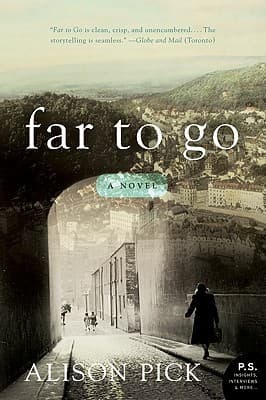
Alison Pick (2010)
Genre
Historical Fiction / Spirituality
Reading Time
7-8 hours
Key Themes
See below
Sign in to track this book
As Nazi propaganda consumes Czechoslovakia, a Jewish family's fight for survival hinges on the loyalty of their governess, whose own secret affair with a betrayer threatens to unravel their last hope.
In 1938, Pavel Bauer, a successful Jewish factory owner in Hradec Králové, Czechoslovakia, lives a comfortable life with his wife Anneliese, and their young son, Pepik. Their beloved governess, Marta, a non-Jewish woman, is an important part of their household. As Hitler annexes the Sudetenland, the mood in Czechoslovakia changes. Pavel, a secular Jew who sees himself as Czech, first dismisses the antisemitism as a temporary madness, believing his wealth and standing will protect his family. However, subtle changes begin: former business partners become distant, and the local community's attitude towards the Bauer family cools, signaling a growing danger Pavel struggles to fully acknowledge.
Marta, the Bauer family's devoted governess, finds herself increasingly involved in a secret relationship with Ernst, Pavel's long-time friend and business partner. Ernst, a seemingly loyal and kind man, begins to show signs of adopting Nazi ideology, subtly aligning himself with the new political order. Marta, deeply fond of the Bauers, is torn between her affection for them and her passionate, forbidden affair with Ernst. This secret relationship becomes a source of inner conflict for her, as she starts to notice Ernst's changing views and what they might mean for the family she cares for, creating a moral dilemma that will test her loyalty.
As the political situation worsens, Pavel's business, which he co-owns with Ernst, faces increasing pressure. Ernst, driven by self-preservation and opportunism fueled by the Nazi regime, secretly betrays Pavel, taking control of their joint enterprise. Marta, through her relationship with Ernst, accidentally learns of his treachery and the immediate danger the Bauers face. This revelation shatters her view of Ernst and forces her to confront the grim reality. The Bauers are now not only isolated but actively targeted, making their comfortable life in Hradec Králové impossible and forcing them to consider desperate measures for survival.
Recognizing the serious threat, Pavel and Anneliese begin to plan their escape from Czechoslovakia. They rely heavily on Marta, whose non-Jewish status allows her to move more freely and gather information. The family decides to try to cross the border into Poland, hoping to eventually reach a safer country. The planning is dangerous and uncertain, requiring secrecy and quick decisions. Marta's loyalty is most important during this time, as she navigates the increasingly hostile environment to get resources and help their escape, risking her own safety for the family she considers her own.
The Bauer family, with Marta, begins their dangerous journey. They travel under the cover of darkness, using a network of contacts and their own cleverness to avoid detection by Nazi patrols and collaborators. The journey is physically and emotionally hard, marked by constant fear, hunger, and uncertainty. Pepik, their young son, struggles to understand the seriousness of their situation, often asking innocent questions that highlight the loss of his childhood. Marta's presence is a source of comfort and practical help, as she shields Pepik and supports Anneliese, while Pavel deals with the huge responsibility of keeping his family safe.
As they approach the Polish border, their escape plan meets a critical obstacle. The details of their separation are sudden and harsh. Pavel, Anneliese, and Pepik are separated from Marta, who is left behind. The circumstances of this separation are unclear at the time, leaving Marta in shock and despair, unsure of the family's fate. This key moment marks a devastating turning point, as the family's unity is broken, and each member is left to face an uncertain and terrifying future alone, with Marta dealing with the guilt and heartbreak of being unable to protect them.
After the separation, Marta is left to survive alone in war-torn Czechoslovakia, now under full Nazi control. She is filled with guilt and grief over the loss of the Bauers, constantly searching for any news of them. Her life becomes a struggle for survival, marked by hunger, fear, and the constant threat of discovery. She makes difficult choices to endure, seeing the atrocities of the war firsthand. Her love for Pepik, especially, becomes a driving force, as she holds onto the hope that he, at least, might have survived, fueling her determination to live and, perhaps, find him someday.
The novel weaves the historical story with a present-day storyline focusing on David, a man living in Canada. David is haunted by fragmented memories and a deep sense of an unspoken past related to his family's origins in Czechoslovakia during WWII. He has a small, cherished wooden bird, a relic from his childhood, which links him to his mysterious past. David begins a quest to uncover the truth about his family, particularly his mother's early life and how they escaped from Europe, driven by a strong need to understand his identity and heritage.
David travels to the Czech Republic, specifically to Hradec Králové, the former home of the Bauer family, to research his family history. He visits archives, speaks with elderly residents, and explores the places his family once knew. Through these investigations, he begins to uncover pieces of information about the Bauer family, the factory, and the devastating impact of the war on Jewish families in the region. Each discovery brings him closer to understanding the trauma and sacrifices his family endured, but also reveals the painful silences and unresolved questions that have shadowed his life.
As David continues his research, the story slowly comes together, revealing the deep connection between his present-day quest and the historical story of the Bauer family and Marta. Through discoveries, including old documents and testimonies, David begins to understand that he is directly linked to the past events. The wooden bird, a recurring symbol, is a crucial piece of the puzzle, connecting him to Pepik and the harrowing journey. The truth about his lineage and the fate of the Bauers, particularly Pepik's survival, starts to emerge, bringing both clarity and immense emotional weight.
The present-day story eventually reveals that Marta played a critical, life-saving role in Pepik Bauer's survival. After the traumatic separation at the border, Marta, against all odds, managed to ensure Pepik's safety. The details of how she did this, enduring great hardship and making profound sacrifices, are gradually brought to light through David's discoveries. Her unwavering love and dedication to the child she cared for are highlighted as the ultimate act of loyalty and courage, showing her lasting impact as a protector and survivor in the face of unimaginable adversity.
By the end of his journey, David has put together the full, tragic, yet ultimately redemptive story of his family. He learns about the fates of Pavel and Anneliese, and Marta's incredible strength and sacrifice. The wooden bird, which he carried throughout his life, becomes a powerful symbol of memory, survival, and the lasting bonds of family and love. David finds closure and a deeper understanding of his identity, allowing him to accept his past and honor the memory of those who came before him. The story ends with a poignant reflection on the importance of remembrance and history's impact on individual lives.
The Protagonist
Pavel transforms from an optimistic, somewhat naive businessman into a man desperately fighting for his family's survival, confronting the brutal reality of his Jewish identity in a hostile world.
The Supporting
Anneliese evolves from a protected wife to a strong, resilient mother facing unimaginable loss and uncertainty with quiet determination.
The Supporting
Pepik's arc is largely implied through the present-day narrative, showing his survival and the profound impact of his early experiences on his later life, even if unremembered.
The Protagonist
Marta's arc is one of profound loyalty and sacrifice, evolving from a conflicted lover to a courageous protector, ultimately ensuring the survival of a Bauer family member.
The Antagonist
Ernst's arc details his transformation from a trusted friend to a treacherous collaborator, embodying the moral compromises made during the war.
The Protagonist
David's arc is one of discovery and reconciliation, as he uncovers his family's tragic past and finds a sense of identity and belonging through understanding.
The novel shows how totalitarian ideologies like Nazism can corrupt individuals and break personal bonds. Ernst's change from Pavel's best friend and business partner into a betrayer is a main example, driven by self-preservation and opportunism under the Nazi regime. This theme is further explored through the gradual alienation of the Bauer family by their neighbors and society, showing how propaganda and fear can turn communities against each other. The betrayal is not just political but deeply personal, leaving lasting scars on those affected, especially Marta who sees Ernst's moral decay firsthand.
““The air was thick with it now, a new kind of air, heavy and sweet and rotten all at once.””
The theme of identity is central, especially for Pavel who, as a secular Jew, identifies strongly as Czech and first believes his patriotism will protect him. The Nazi regime strips him of this identity, forcing him to confront his Jewishness as a target. Marta, a non-Jewish Czech, deals with her own identity as she balances her loyalty to the Bauers against the demands of a nationalist state. In the present, David's search for his family's history is a search for his own identity, trying to understand where he belongs by connecting to his fragmented past and the legacy of his ancestors.
““He was Czech. He had always been Czech. This was his country.””
Despite the pervasive darkness, the novel highlights the profound strength of love, especially Marta's unwavering devotion to the Bauer family, particularly Pepik. Her decision to risk her life for them, even after their separation, shows the enduring power of her affection. Anneliese's love for Pepik also drives her resilience in the face of great hardship. These acts of love and sacrifice contrast sharply with the betrayal and hatred depicted, offering glimmers of humanity and hope amid the atrocities of war. Marta's ultimate role in Pepik's survival is the most powerful example of this theme.
““Love, she thought, was not a choice. It was a current, pulling you where it wanted, whether you fought it or not.””
The dual narrative structure explores how historical events, especially the Holocaust, affect generations. David's present-day quest is driven by a subconscious need to understand the 'unspoken' trauma within his family, showing how unresolved pasts can affect future lives. The fragmented memories, the cherished wooden bird, and the silences about his mother's history are all examples of intergenerational trauma. Uncovering and acknowledging this history becomes a process of healing and remembrance, allowing David to find peace and understand his place within a larger, often painful, narrative.
““The past was not a country he could visit; it was a ghost that lived inside him.””
Interweaving historical and contemporary storylines.
The novel employs a dual narrative, alternating between the Bauer family's experiences in 1930s Czechoslovakia and David's present-day search for his family history. This structure builds suspense as the reader gradually pieces together the connection between the two timelines. It also highlights the long-lasting impact of historical events on subsequent generations, effectively demonstrating intergenerational trauma and the process of uncovering hidden truths. The past informs the present, and the present's questions drive the exploration of the past.
A recurring symbolic object connecting past and present.
The small, carved wooden bird serves as a powerful symbol and a tangible link between the historical narrative of Pepik Bauer and David's present-day quest. It represents innocence, childhood, and the fragile hope of survival amidst devastation. As a physical object that endures through time, it acts as a silent witness to the family's ordeal and ultimately becomes a key piece of evidence in David's discovery of his lineage, embodying memory and the enduring legacy of love and loss.
Hints of future events and the reader's awareness of impending doom.
The novel frequently uses foreshadowing, particularly in the early chapters, as Pavel dismisses the growing threat while the reader, aware of historical events, knows the true horror that awaits. This creates a strong sense of dramatic irony, intensifying the tension and tragedy of the Bauer family's situation. Subtle shifts in societal attitudes, the increasing isolation, and the changing demeanor of characters like Ernst all hint at the devastating trajectory of their lives, making their eventual fate even more poignant.
“The wind was a living thing, and it was screaming.”
— Describing the weather in Slovakia as the war approaches.
“Some things, once broken, can never truly be put back together. You can glue the pieces, but the cracks will always show.”
— Reflecting on the impact of past events and loss.
“History is not a line, but a circle. We keep returning to the same places, the same mistakes.”
— A character's philosophical observation on human nature and conflict.
“To forget is to betray. To remember is to suffer.”
— Exploring the dilemma of memory and the past for survivors.
“There are secrets that burn holes in the soul, and others that are like a comforting blanket.”
— Contemplating the nature and impact of keeping secrets.
“Faith is not about knowing, but about believing even when you don't know.”
— A discussion about religious belief amidst uncertainty and fear.
“The world had shrunk to the size of their small apartment, and even that felt too vast, too exposed.”
— Describing the feeling of confinement and fear during wartime.
“Sometimes the greatest courage is simply to keep breathing.”
— Reflecting on the quiet endurance of individuals facing immense hardship.
“Silence can be a weapon, or a shield, or simply the sound of the world holding its breath.”
— Exploring the multiple meanings and effects of silence in tense situations.
“The past is never truly past; it lives within us, a ghost in the machine of our present.”
— A character grappling with the lasting influence of historical events on their life.
“Hope is a dangerous thing, but more dangerous still is to live without it.”
— Considering the role of hope in times of despair and oppression.
“Love is not a choice; it is a recognition, a remembering of something you always knew.”
— A romantic or familial bond is described with a sense of destiny.
“Even in the darkest night, there are stars. You just have to remember to look up.”
— An optimistic thought amidst bleak circumstances.
“The weight of unspoken words can be heavier than any physical burden.”
— Exploring the psychological toll of keeping secrets or unexpressed thoughts.
Ready to see how well you understood this book? Take our interactive quiz with 10 questions.

Alison Pick is a Canadian novelist and poet. Her first novel, 'Far to Go,' was shortlisted for the prestigious Man Booker Prize and has been translated into several languages. Pick's work often explores themes of identity, family, and belonging, characterized by lyrical prose and compelling character-driven narratives.







