“The world was a book, and those who did not travel read only one page.”
— The narrator reflecting on the limited worldview of some villagers.

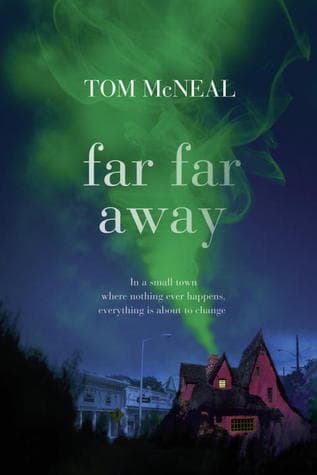
Tom McNeal (2013)
Genre
Fantasy / Mystery / Young Adult
Reading Time
7-8 hours
Key Themes
See below
Sign in to track this book
In the isolated town of Never Better, a young outcast, Jeremy Johnson Johnson, finds his only friend and protector in the mischievous ghost of Jacob Grimm. Jacob warns him of a growing evil, just as a curious local girl threatens to expose their secret, putting their otherworldly bond and the town at risk.
Jeremy Johnson Johnson lives in the isolated town of Never Better, an outcast because he hears voices—specifically, the ghost of Jacob Grimm. Since his mother left and his father became a recluse, Jeremy has been responsible for their meager existence, often taking odd jobs. Jacob Grimm is his constant companion and protector, offering advice and warnings about a looming darkness. The townspeople's suspicion and Jeremy's quiet acceptance of his unique circumstances mark his life. He often visits the town library, finding comfort in books and trying to understand the fairy tales Jacob often mentions, believing they hold clues to his own reality.
Jeremy's quiet life changes with the arrival of Ginger Boultinghouse, a new girl in Never Better known for her beauty and bold manner. Ginger, unlike others, seems interested in Jeremy's quirks rather than repelled. She approaches him, curious about his reputation for hearing voices. Initially wary, Jeremy is drawn to her charm and directness, a stark contrast to Never Better's reserved residents. Jacob Grimm, however, immediately distrusts Ginger and warns against her, sensing a sinister aura that Jeremy, wanting connection, struggles to understand or heed.
Soon after Ginger arrives and interacts with Jeremy, a young boy from Never Better goes missing. The disappearance sends fear through the small community. Jeremy, already an outsider, faces increased scrutiny, with whispers linking him to the event due to his 'strange' abilities. Jacob Grimm's warnings intensify, urging Jeremy to be careful and to recognize the pattern of darkness that seems to follow Ginger. The town's fear becomes a tangible threat, and Jeremy feels the weight of both the community's suspicion and Jacob's urgent, often cryptic, advice.
Ginger, seemingly unfazed by the growing unease in town, gives Jeremy a beautiful, antique locket. She says it is a token of their growing friendship, but Jacob Grimm immediately recognizes it as an object with dark magic, warning Jeremy not to accept or wear it. Despite Jacob's urgent pleas, Jeremy, longing for acceptance and connection, takes the locket. Its presence seems to amplify his connection to the unseen world, and he begins to have strange dreams and heightened sensitivity to the supernatural forces in Never Better. The locket becomes a symbol of Ginger's hold over him and the deeper, darker enchantment she wields.
As more children from Never Better vanish, panic grips the town. The disappearances follow a chilling pattern, and the townsfolk, desperate for answers, become hostile towards Jeremy. Jacob Grimm reveals more about the ancient evil he believes is at work, linking it to dark fairy tales and predatory mythical creatures. Jeremy, while trying to stay calm, feels an undeniable, almost hypnotic pull towards the forest and the places where the children were last seen. The locket seems to throb with a strange energy, guiding him, even as Jacob warns him against following its insidious call.
Under intense pressure, Jacob Grimm finally reveals the full extent of the danger. He explains that Ginger Boultinghouse is not just a girl, but a manifestation of a powerful, ancient evil, a 'witch' in the truest fairy tale sense, who feeds on innocence and seeks to trap Jeremy. He clarifies that his spectral presence is tied to a historical pact or curse, and his purpose is to protect a lineage or specific individuals from this recurring darkness. Jacob reveals that the locket is a binding charm, slowly draining Jeremy's will and making him more susceptible to Ginger's influence, intending to use him as a conduit or sacrifice.
Armed with Jacob Grimm's knowledge and new resolve, Jeremy confronts Ginger in the eerie, enchanted woods surrounding Never Better—the place where the children disappeared. Ginger, revealing her true, malevolent nature, tries to ensnare Jeremy completely, using her charming facade and the locket's power. Jacob guides Jeremy, urging him to resist her magic and to use his unique connection to the unseen world against her. The confrontation is a battle of wills and magical forces, with the fate of the missing children and Jeremy's own soul at stake, unfolding like a dark fairy tale.
During the confrontation, Jeremy, with Jacob's spectral help, resists Ginger's powerful enchantment. He uses his ability to hear and interact with the unseen, not just Jacob, but the faint echoes of the missing children, to counter her magic. He realizes that the locket, while Ginger's tool, also focuses her power. In a desperate act, Jeremy removes or disrupts the locket's power, weakening Ginger's hold. This act severs her connection to the captured children and begins to unravel her dark spell.
As Ginger's spell weakens, the missing children reappear, disoriented but safe, emerging from a hidden, dream-like realm she had created. The town rejoices, though most do not fully understand what happened. Ginger, her power diminished and her true form briefly revealed as something older and more monstrous, retreats into the shadows, defeated but not destroyed. Jeremy, exhausted but triumphant, has not only saved the children but also shown his true character. He is no longer just the town outcast, but a quiet hero who faced an ancient evil.
Afterward, Never Better slowly returns to normal, though forever changed. Jeremy Johnson Johnson is no longer an outcast; his ability to hear voices, once a source of fear, is now viewed with hesitant respect, if not full understanding. Jacob Grimm remains by his side, his warnings less urgent, his presence more of a guardian and mentor. Jeremy has accepted his role as a protector against the lingering shadows of the fairy tale world. He knows that while Ginger may be gone for now, the darkness she represents can always return, and he, with Jacob, must remain vigilant.
The Protagonist
Jeremy evolves from a timid, ostracized boy to a courageous hero who embraces his unique abilities to confront an ancient evil.
The Supporting
Jacob's arc involves revealing the full extent of his purpose and history, culminating in his direct aid during the final confrontation.
The Antagonist
Ginger's arc involves revealing her true, malevolent nature as her plans unfold and she is ultimately defeated, though not entirely vanquished.
The Supporting
His arc is subtle, showing a slight thawing of his reclusiveness as Jeremy's heroism impacts the town.
The Mentioned
Their arc involves shifting from suspicion and ostracization of Jeremy to a hesitant, unspoken acceptance and gratitude.
The novel emphasizes the lasting power of stories, especially fairy tales, to shape reality and reveal hidden truths. Jacob Grimm constantly references folklore, suggesting that ancient narratives are not just fiction but contain warnings and blueprints for confronting evil. Jeremy's journey is a modern fairy tale, where the archetypes and lessons of the Brothers Grimm's collection become literal guides. This theme is clear in Jacob's cryptic advice, which often takes the form of twisted fairy tale scenarios, and Jeremy's eventual understanding that these stories hold the key to defeating Ginger.
““Fairy tales are more than true: not because they tell us that dragons exist, but because they tell us that dragons can be beaten.””
Jeremy's life begins with deep isolation, from his unique ability and the town's rejection. His desire for connection makes him vulnerable to Ginger's false charm. The story explores the dangers of extreme isolation and the human need for belonging. While Jacob provides companionship, Jeremy's desire for a 'normal' connection drives much of his early interaction with Ginger. Ultimately, his journey shows that true connection comes from authenticity and courage, not from conforming or seeking superficial acceptance, as seen when he finds acceptance after saving the town.
““The loneliest places are not always where no one goes, but where no one understands.””
The novel shows good and evil not as abstract concepts but as real forces, often personified. Ginger Boultinghouse embodies ancient, predatory evil, disguised by beauty and charm, reflecting the deceptive nature of many fairy tale villains. Jeremy, guided by Jacob Grimm, represents inherent goodness and courage, often hidden by fear and doubt. The story explores the idea that evil can be insidious and alluring, requiring deep understanding and inner strength to fight. It highlights the internal struggle between succumbing to darkness and choosing to fight for what is right, even when the odds seem overwhelming.
““Evil often comes cloaked in beauty, for what is more tempting than a sweet lie?””
Jeremy's journey is a classic coming-of-age story, where he must face his fears, accept his unique abilities, and define his identity. Initially burdened by his 'gift' and the town's judgment, he learns to see his ability to hear Jacob Grimm as a strength rather than a curse. His transformation from a shy, ostracized boy to a reluctant hero is central to the story. By facing evil, he not only saves others but also gains a deep sense of self-acceptance and purpose, moving beyond the labels his community placed on him.
““Sometimes, the things that make you different are the very things that make you strong.””
Jacob Grimm's spectral presence guides and warns Jeremy.
Jacob Grimm serves as a classic 'ghost as mentor' figure. His spectral form allows him to observe and communicate with Jeremy, providing crucial information, historical context about folklore, and urgent warnings about the unfolding evil. He cannot directly intervene physically but acts as Jeremy's sole confidant and strategist. This device is vital for exposition, character development (through their unique bond), and driving the plot forward by revealing the true nature of the threats and potential solutions.
A seemingly innocent gift that serves as a magical binding and tracking device.
The locket given to Jeremy by Ginger is a potent enchanted object. Initially presented as a token of affection, it functions as a magical binding charm, slowly draining Jeremy's will and making him susceptible to Ginger's influence. It also acts as a tracker, allowing Ginger to monitor Jeremy's movements and thoughts. This device creates immediate conflict and danger, symbolizing Ginger's insidious control and serving as a tangible magical element that Jeremy must ultimately overcome to break her spell.
Never Better's remoteness amplifies the sense of danger and insularity.
The town of Never Better functions as a key plot device by being isolated and insular. Its remoteness means help from the outside world is scarce, intensifying the local fear and suspicion when the disappearances begin. This isolation also fosters the town's superstitious nature and its quickness to ostracize Jeremy. The setting creates a claustrophobic atmosphere, trapping the characters with the looming threat and highlighting the idea that ancient evils can thrive in forgotten, out-of-the-way places, much like in traditional fairy tales.
The story intentionally mirrors and subverts classic fairy tale elements.
The novel extensively uses fairy tale tropes and allusions, directly referencing the Brothers Grimm's work. Jacob Grimm's presence and constant references to 'witches,' 'enchantments,' and 'missing children' frame the narrative within a familiar yet dark fairy tale structure. This device creates a meta-narrative layer, allowing the story to play on reader expectations while simultaneously subverting them. It enhances the sense of fantastical danger and provides a framework for understanding the supernatural forces at play, making the abstract concept of evil more tangible through recognizable archetypes.
“The world was a book, and those who did not travel read only one page.”
— The narrator reflecting on the limited worldview of some villagers.
“Magic, you see, isn't about pulling rabbits from hats. It's about seeing the world as it truly is, full of wonder and possibility.”
— A wise elder explaining the true nature of magic to the young protagonist.
“Fear makes monsters out of shadows.”
— The protagonist grappling with their own anxieties and the unknown.
“Sometimes the greatest courage is not in fighting, but in understanding.”
— A mentor advising the protagonist on how to deal with an antagonist.
“Every secret has a weight, and eventually, it will either crush you or set you free.”
— A character struggling with a hidden truth.
“The past is a stubborn thing. It clings to you, no matter how far you run.”
— A character trying to escape their history.
“Even in the darkest night, there are always stars.”
— A moment of hope amidst despair.
“Stories are how we make sense of a senseless world.”
— A character discussing the power and importance of storytelling.
“To truly know a place, you must know its whispers, not just its shouts.”
— The protagonist learning to observe and listen carefully.
“Sometimes the most ordinary people do the most extraordinary things.”
— A realization about the hidden potential in everyday individuals.
“A lie can travel halfway around the world while the truth is still putting on its shoes.”
— A character lamenting the speed and spread of misinformation.
“The forest keeps its own counsel, and its secrets are deep.”
— Describing the mysterious and ancient nature of a magical forest.
“Change is a river; you can fight against it, or you can learn to swim with the current.”
— A character accepting an inevitable transformation or shift.
“Every journey begins with a single step, but sometimes that step is into the unknown.”
— The protagonist embarking on a perilous adventure.
Ready to see how well you understood this book? Take our interactive quiz with 10 questions.







