“I'm not going to be a person who's afraid.”
— Joan, a young girl, declares her determination to face the world's horrors.

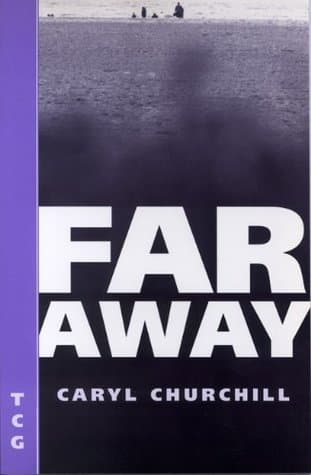
Sign in to track this book
In a world where the absurd escalates to the apocalyptic, a young woman navigates a global war where even animals have taken sides, and the very air is thick with the scent of countless, bizarrely specific deaths.
The play opens with young Joan at her Aunt Harper's house late at night. Joan has seen her Uncle Todd hitting people with an iron bar in the shed. She describes seeing 'blood' and 'a lot of people' and asks Harper about what happened. Harper tries to calm Joan with cocoa and avoid her questions, at first saying Todd was just moving things or that the people were 'not well.' As Joan keeps asking, Harper eventually admits to the violence but calls it a necessary act of 'justice' against 'bad people' who were 'plotting' against them, hinting at a larger, unseen conflict. Joan is disturbed but seems to accept her aunt's explanation, or at least stops asking questions, as Harper puts her to bed.
Years pass, and Joan is now an adult working in a hat factory. She talks with her colleague, Todd, about the increasing global conflict. The war has become everything, with nations, animals, and even inanimate objects taking sides. Joan finds meaning and creativity in her work, designing increasingly elaborate and strange hats for a parade, which she sees as a protest or a statement against the war's absurdity. She discusses the materials and ideas for her hats, which range from 'the dead' to 'fear' to 'hope,' all while the news reports detail the bizarre and horrific nature of the ongoing conflict, where even coffee and pins cause death.
Joan and Todd continue their conversation about the war, showing how absurd it is and how all natural order has broken down. They speak of animals and even parts of nature joining the conflict: 'the elephants are on our side' but 'the cats are fighting the dogs.' Even inanimate objects and ideas are fighters, with 'the French' allied with 'the river' and 'the English' with 'the coffee.' This discussion shows the complete collapse of logic and morality, where every entity has been forced to choose a side, and the reasons for allegiance are random and nonsensical. The parade, for which Joan designs hats, becomes a symbolic act of defiance and a grim celebration in the face of universal destruction.
Joan and Todd focus on the upcoming parade, where her fantastical hats will be shown. The designs mix beauty and horror, reflecting the state of the world: hats made of 'feathers of all the birds that have died,' 'bones of the animals,' or 'the hair of the mad.' The parade is not just a fashion show but a cultural event, a ritual in a society dealing with constant war. While they discuss the parade, the impending doom of the outside world is always present. Todd worries about the safety of the parade-goers and the increasing violence, suggesting that even their temporary artistic escape is fragile and threatened.
Joan returns to Harper's house, looking for safety from the worsening war. She tells of her difficult journey, describing piles of bodies killed by everyday objects like 'coffee' or 'pins,' and the burning of 'grass that wouldn't serve.' Harper, now older and more resigned, confirms how widespread the conflict is. She describes how the war has taken over everything, that 'everyone' is involved, and that trust has disappeared. Harper reveals that the 'traitors' and 'enemies' are everywhere, even within their own communities. She admits her own involvement and the need for extreme measures, implying that the violence Joan saw as a child was just the start of a total societal collapse into paranoia and brutality.
Harper gives Joan devastating news: all the hat designers, including Todd, have been executed. The reason given is that their hats were called 'subversive' or 'too beautiful,' suggesting that any independent thought or aesthetic expression is now a threat in the conformist and paranoid war-torn society. Harper explains that authorities are now executing people for increasingly small or abstract reasons, such as 'looking too sad' or 'walking too fast.' This news shatters Joan's last connection to a sense of normalcy and creative purpose, showing the arbitrary and all-consuming nature of the regime's brutality.
Harper, with a chilling calm, begins to prepare Joan for her own execution. She explains that Joan's turn has come, not for any specific crime, but because the system demands more and more victims. Harper reveals the ultimate distortion of justice: people are now being executed not for what they did, but for what they 'might have thought' or for simply existing. The 'traitors' are no longer a specific group but anyone chosen by the authorities. Harper details the process, including the specific time and location of Joan's execution, and even suggests how Joan should dress. This scene ends with the complete removal of individual freedom and the horrifying victory of a random, self-perpetuating cycle of violence and death.
The Protagonist
From a child questioning violence to an adult seeking meaning through art, only to be consumed by the very violence she once questioned.
The Supporting/Antagonist
Transforms from a protective but complicit aunt to an agent of the state's arbitrary violence.
The Supporting
From a creative partner to an arbitrary victim of the war's purges.
The Mentioned
His specific acts of violence transition into the generalized, faceless violence of the state.
The play shows how violence, initially shocking, becomes an accepted, almost normal part of life. From Uncle Todd's beatings justified as 'justice' to the adult world where 'coffee' and 'pins' cause death, the horrific becomes common. The war itself is absurd, with animals and inanimate objects taking sides, yet characters like Harper and Joan discuss it in a chillingly factual way. This theme shows humanity's ability to adapt to, and even join in, the most irrational and brutal situations.
“There were piles of bodies and if you stopped to find out there was one killed by coffee or one killed by pins, they were killed by heroin, petrol, chainsaws, hairspray, bleach, foxgloves, the smell of smoke was where we were burning the grass that wouldn't serve...”
As the war continues, traditional moral rules break down. Harper's justification of violence, first for 'bad people' and later for anyone called 'subversive,' shows this. Empathy slowly disappears, replaced by paranoia and a ruthless focus on survival or compliance. The execution of the hat designers for making 'beautiful' hats and Joan's eventual execution for no clear reason show a world where human life has lost all value, and arbitrary power rules. The characters' detached descriptions of atrocities highlight this moral decay.
“They were too beautiful. They were too sad. They were too slow. They were too fast. They thought too much. They didn't think enough.”
Joan's hat designs are an attempt to create beauty and meaning in a destructive world. Her elaborate, symbolic hats for the parade can be seen as artistic resistance, a way to process the horror and assert a flicker of humanity. However, this resistance ultimately fails. The execution of the hat designers, including Todd, for making 'subversive' or 'too beautiful' hats, shows that even art cannot escape the war's random brutality, highlighting how vulnerable creative expression is in a totalitarian environment.
“I like making hats. I like the way they look. I like the way they make people feel.”
From the initial secrecy around Uncle Todd's actions to the widespread belief that 'everyone' is plotting and 'traitors' are everywhere, paranoia drives events. The state has complete control, not just over actions but over thoughts and emotions. People are executed for 'looking too sad' or 'thinking too much.' This theme explores how fear and suspicion are used as weapons to maintain power, leading to a society where individual freedom does not exist, and self-preservation means conformity.
“It's all decided. You're decided. You're one of the ones who's decided.”
Three distinct acts spanning Joan's life, illustrating the progression of societal decay.
The play is structured in three acts, each separated by significant time jumps. Act One features young Joan, Act Two features adult Joan as a hat designer, and Act Three features Joan returning to Harper. This structure allows the audience to witness the gradual, yet accelerating, descent of society into total war and absurdity. It highlights the normalization of violence over time and shows Joan's personal journey from innocent witness to creative participant, and finally, to victim, mirroring the world's trajectory.
Characters discuss horrific events with a detached, matter-of-fact tone, emphasizing the surreal nature of the war.
Churchill employs absurdist dialogue where characters describe bizarre and horrifying events (animals fighting, objects as weapons, people killed by coffee) with a calm, almost mundane tone. This disjunction between content and delivery creates a sense of the surreal and underscores the complete breakdown of logic and morality. The imagery, such as hats made from 'bones of the animals' or 'hair of the mad,' further enhances the play's unsettling, dreamlike quality, reflecting the characters' internal and external landscapes.
A central symbol of futile resistance, creativity, and the arbitrary nature of beauty and subversion.
Joan's elaborate hats serve as a multifaceted symbol. Initially, they represent a creative outlet and a form of artistic expression in a world devoid of beauty. They symbolize a fragile attempt at resistance or a statement against the war's absurdity. However, their eventual condemnation and the execution of their designers for being 'too beautiful' or 'subversive' transform them into a symbol of the futility of such resistance and the arbitrary nature of what is deemed a threat in a totalitarian regime. They embody the tragic irony of art in a world that has lost all value for it.
The conflict is pervasive and ill-defined, making it impossible to fight or understand.
The war in 'Far Away' is never clearly defined or localized. It involves 'everyone,' including animals, objects, and concepts, blurring the lines between combatants and non-combatants, and between friend and foe. This ambiguity creates a pervasive sense of paranoia and makes the conflict impossible to comprehend or resist. The 'enemy' is a fluid concept, shifting from 'bad people' to 'traitors' to anyone arbitrarily chosen for execution, highlighting the ultimate powerlessness of individuals against an omnipresent, illogical force.
“I'm not going to be a person who's afraid.”
— Joan, a young girl, declares her determination to face the world's horrors.
“They're killing children. That's all. It's a fact.”
— A character matter-of-factly describes the brutal reality of the world.
“We have to be careful what we say. Even in here.”
— A warning about the pervasive surveillance and danger in society.
“It's not what you think. It's not what anyone thinks.”
— A cryptic line hinting at the distorted, surreal nature of the play's world.
“I can't remember when it started. I think it was always like this.”
— Reflecting on the normalization of violence and chaos.
“We'll be safe if we just keep quiet.”
— Advice given to avoid drawing attention in a dangerous environment.
“They're not people like us. They don't feel things.”
— Dehumanizing the enemy or oppressors to cope with the violence.
“I saw a bird today. It was red.”
— A simple, almost poetic observation amidst the bleakness.
“Everything's broken. Even the things that aren't broken.”
— A philosophical comment on the pervasive sense of decay and dysfunction.
“We have to pretend it's normal. That's how we get through.”
— A strategy for coping with an unbearable reality.
“The sky is the same. That's something.”
— Finding solace in the constancy of nature despite human turmoil.
“I don't know what's true anymore. Do you?”
— Expressing confusion and doubt in a world of propaganda and lies.
“We're all far away from something. Or someone.”
— A reflective line on loss, distance, and separation.
Ready to see how well you understood this book? Take our interactive quiz with 10 questions.
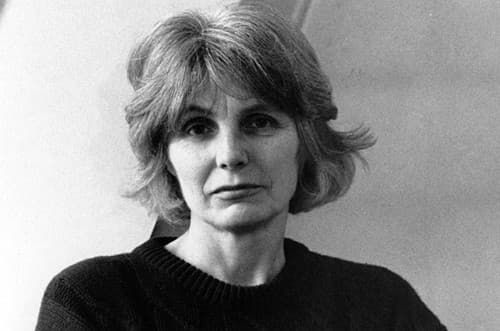
Caryl Churchill is a highly acclaimed contemporary playwright known for her innovative and often politically charged works. Her plays, such as "Far Away," "Top Girls," and "Cloud Nine," explore themes of power, gender, and societal structures with a distinct experimental style. Churchill has received numerous awards, including a Tony Award for Best Play, solidifying her reputation as a leading figure in modern drama.







