“Every cop has a dark place, you learn to live with it, but you never get used to it.”
— Eve considers the psychological toll of police work.

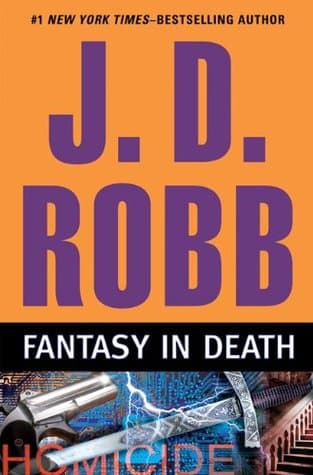
J.D. Robb (2010)
Genre
Thriller / Mystery / Science Fiction / Romance
Reading Time
356 min
Key Themes
See below
Sign in to track this book
When a gaming mogul is found decapitated in his locked playroom, Eve Dallas must navigate the cutthroat world where virtual fantasy meets real murder.
Bart Minnock, the founder of U-Play, a successful computer gaming company, is found decapitated in his locked, soundproofed private playroom. His body is slumped over a desk, his head placed beside him. The scene is clean, with no signs of forced entry or struggle, baffling Lieutenant Eve Dallas and Detective Delia Peabody. The victim, known for his enthusiastic personality, had no apparent enemies, and his death seems illogical. Eve's initial assessment points to a professional killer, possibly someone with close knowledge of Bart's habits and the secure environment of his penthouse apartment.
Eve begins her investigation by interviewing Bart's live-in girlfriend, Lara, who seems distraught but offers little useful information about potential enemies. She then speaks with his business partners at U-Play: Julian Cross, the COO, and Marlo, the creative director. While they express shock, Eve senses underlying tensions within the company. Meanwhile, Eve's husband, Roarke, a rival in the gaming industry, provides insight into the competitive nature of the business, confirming that while Bart was a competitor, he was generally respected. The lack of clear motives or suspects deepens the mystery, pushing Eve to look closer into Bart's personal and professional life.
Eve and Peabody, with help from Roarke and his tech team, begin to explore the virtual world of U-Play's main game, 'Fantasy in Death'. They find that Bart was deeply involved in the game, often playing as an avatar named 'The Architect'. The game features a complex, user-driven economy and social structure, and Eve wonders if the murder could be linked to an in-game dispute that spilled into reality. The large number of players and the anonymity of the virtual world pose a significant challenge, but Eve suspects the key to the murder is hidden within the game's layers, blurring the lines between fantasy and reality.
Eve investigates a rival gaming company, 'Specter Gaming,' led by Damon Blake, known for his aggressive business tactics and past conflicts with U-Play. While Blake had reason for professional sabotage, Eve doubts he is capable of such a meticulous and brutal murder. At the same time, Roarke discovers that a large part of Bart's personal game data, specifically related to his 'Architect' avatar and its interactions, has been carefully deleted from U-Play's servers. This suggests a deliberate attempt to hide tracks within the virtual world, reinforcing Eve's belief that the game itself holds vital clues to the killer's identity and motive.
Dr. Charlotte Mira, the police psychologist, provides a profile of the killer, suggesting a highly intelligent person with a strong need for control and a fascination with precision. She theorizes the killer might see the murder as a 'game' or a 'puzzle.' Meanwhile, forensic analysis of the unique, clean cut of Bart's decapitation shows an unusual weapon was used—not a traditional blade, but something with extreme sharpness and a specific design, possibly custom-made. This finding further narrows down the possibilities and points to a killer with specialized knowledge or access to advanced technology, making the investigation more complex.
Roarke, using his knowledge of gaming lore, connects the forensic description of the murder weapon to a legendary, impossibly sharp artifact within the 'Fantasy in Death' game known as the 'Dragon's Tooth.' This artifact is said to grant its wielder ultimate power and is highly sought after by players. This discovery suggests the killer might be someone deeply involved in the game, perhaps even obsessed with its mythology, and who has found a way to turn a virtual weapon into a real-world murder. This revelation strengthens the link between the game and the murder, pushing Eve further into the virtual realm.
Through careful analysis of game logs and server data, Roarke and his team uncover a sophisticated imposter who had been carefully mimicking Bart's 'The Architect' avatar within 'Fantasy in Death.' This imposter, known only by a cryptic username, had been secretly interacting with players, manipulating in-game events, and even engaging in private communications. This discovery suggests a deeper, more personal motive than first believed, hinting at a killer who sought to take over Bart's identity and influence, both in the virtual and potentially the real world, adding psychological depth to the case.
Eve, following digital clues and psychological profiling, confronts Julian Cross, Bart's seemingly loyal COO. Cross, driven by deep resentment and a desire to control U-Play, had carefully planned Bart's murder. He felt Bart's playful nature and lack of 'serious' business sense were holding the company back. Cross had secretly developed a real-world replica of the 'Dragon's Tooth' and used his knowledge of Bart's habits and the penthouse's security to commit the crime, seeing the murder as the ultimate game where he would win and take over U-Play.
Cornered by Eve's evidence, Julian Cross confesses to Bart Minnock's murder. He explains his motive came from a strong belief that Bart, despite his genius, was a 'child' who lacked the ruthlessness to make U-Play reach its full potential. Cross saw himself as the true architect of the company's future and viewed Bart as an obstacle. He carefully crafted the murder to be an unsolvable puzzle, a sign of his superior intellect and control. His confession reveals a chilling detachment and an almost artistic pride in his perfect crime, showing the dark side of ambition and the blurring of lines between virtual power and real-world violence.
With Julian Cross arrested and the case closed, Eve considers the disturbing implications of a murder rooted in the virtual world. The case shows how fantasy, when unchecked, can blur into a dangerous reality, and how ambition can corrupt individuals. She acknowledges Roarke's important role in navigating the complexities of the gaming world, strengthening their partnership. Despite the grim nature of her work, Eve finds comfort in her relationship with Roarke, who grounds her in the real world while understanding the dark parts of human nature she constantly faces. The experience reinforces her commitment to justice, no matter how unusual the crime scene.
The Protagonist
Eve navigates a complex murder case that challenges her understanding of reality and fantasy, reinforcing her reliance on her team and Roarke.
The Supporting
Roarke uses his extensive knowledge of the gaming industry to help Eve solve the case, further cementing their partnership.
The Supporting
Peabody continues to develop her investigative skills and professional confidence under Eve's mentorship.
The Victim
His death serves as the central mystery, revealing the dark underbelly of the gaming industry and human ambition.
The Antagonist
His carefully constructed facade unravels as Eve uncovers his meticulously planned crime, revealing his megalomaniacal ambition.
The Supporting
Mira's psychological analysis helps Eve understand the killer's unique mindset, guiding the investigation.
The Supporting
She serves primarily as an initial witness, her grief underscoring the victim's generally positive public image.
The Supporting
Marlo's perspective helps Eve understand the company's internal dynamics and Bart's creative vision.
The novel explores how the lines between the virtual world of online gaming and real-life can become dangerously blurred. Bart Minnock's murder, committed with a weapon inspired by an in-game item ('Dragon's Tooth') and motivated by a desire for control within a virtual empire, shows this theme. The killer, Julian Cross, sees the murder itself as a 'game' to be won, demonstrating how immersion in fantasy can distort one's view of reality and morality. Eve's investigation requires her to look into the virtual world, acknowledging its deep impact on the real one.
““Sometimes, Dallas, the lines between what’s real and what’s not get a little… fluid. Especially when you’re dealing with genius, and obsession.””
The destructive power of unchecked ambition and obsession is a main theme. Julian Cross's motive for murdering Bart Minnock comes from his obsessive desire to control U-Play and his belief that Bart's 'playful' approach was slowing its progress. His ambition leads him to carefully plan and execute a 'perfect' crime, seeing Bart as merely an obstacle in his 'game' for power. This theme highlights how even in industries like gaming, the drive for control and success can lead to extreme, violent acts, consuming individuals and distorting their moral compass.
““He didn’t just want the company, Dallas. He wanted to be the *architect*.””
The novel looks at how identity is built and seen, both in the real world and in virtual spaces. Bart Minnock's public persona as 'The Architect' in 'Fantasy in Death' was an extension of his real self, but it also allowed an imposter to mimic and manipulate his virtual presence. Julian Cross's motive includes not just taking over the company, but also erasing Bart's legacy and replacing his identity with his own vision. Eve struggles to understand the true identity of the killer, who hides behind layers of professional conduct and virtual avatars, making the investigation a search to uncover the real self behind the deception.
““In a world where you can be anything, some people choose to be something they’re not, for reasons that are anything but fantasy.””
As in many J.D. Robb novels, Eve Dallas constantly deals with the pursuit of justice within the law. Bart Minnock's murder is so carefully planned and seemingly impossible that it challenges normal police work. Eve's determination to bring the killer to justice often pushes her to the edges of protocol, especially when dealing with the complexities of the virtual world and the sophisticated cover-up. The theme explores her strong commitment to ensuring that even the most cunning criminals are held accountable, regardless of how cleverly they try to evade the system, strengthening her role as a moral arbiter.
““The law might have holes, but justice, Dallas, justice finds a way.””
The victim is found in an impossibly secured room with no signs of entry or struggle.
The murder of Bart Minnock occurs in a locked, soundproofed private playroom, with no forced entry, no struggle, and the victim's head neatly severed. This classic plot device immediately establishes a seemingly impossible crime, creating a high level of intrigue and challenging Eve's investigative skills. It forces her to look beyond conventional explanations and delve into the more obscure details of the victim's life and the environment, ultimately leading to the discovery of a highly sophisticated and precise killer who exploited the security measures rather than circumventing them.
A rival gaming company is initially presented as a plausible suspect.
Damon Blake, the aggressive CEO of Specter Gaming, is introduced as a strong competitor with a history of professional disputes with U-Play and Bart Minnock. This initially points the investigation in a direction of corporate rivalry and sabotage, providing a seemingly clear motive. However, Eve quickly dismisses Blake as the murderer due to his lack of precision and a different psychological profile, redirecting the focus back to Bart's inner circle and the more intricate details of the crime. This device serves to complicate the initial investigation and highlight the true killer's cunning.
The online game 'Fantasy in Death' holds crucial clues to the murder.
The intricate online game 'Fantasy in Death' is not just a backdrop but an active repository of clues. Bart's avatar, 'The Architect,' and the legend of the 'Dragon's Tooth' within the game directly link to the murder weapon and the killer's motives. The deletion of Bart's game data and the existence of an imposter avatar within the game necessitate a deep dive into the virtual realm, making it an essential investigative tool. This device blurs the lines between fiction and reality, highlighting how digital footprints can be as revealing as physical ones.
Analysis of digital communications and game data provides critical insights.
Given the nature of the crime, digital forensics plays a crucial role. Roarke's team meticulously analyzes game logs, server data, and encrypted communications to uncover the imposter avatar and the killer's digital trail. This includes tracking IP addresses, parsing complex data sets, and understanding the nuances of online interactions. This device highlights the evolution of police work into the digital age, where virtual evidence can be as vital as physical evidence, requiring specialized skills and technology to uncover the truth hidden within cyberspace.
“Every cop has a dark place, you learn to live with it, but you never get used to it.”
— Eve considers the psychological toll of police work.
“It was impossible to be a cop and not believe in evil. It was just as impossible to be a cop and not believe in good.”
— Eve reflects on the duality of humanity she encounters in her job.
“He was her rock, her steady, her anchor in the storm. And sometimes, just sometimes, he was her storm too.”
— Eve thinks about her complex relationship with Roarke.
“A good lie, well-placed, was often more effective than the truth.”
— Eve considers the manipulative tactics sometimes necessary in investigations.
“There were some wounds time couldn't heal, only scar over.”
— Eve reflects on lingering emotional pain from past traumas.
“The dead don't care about your feelings, Dallas. They just want justice.”
— Eve reminds herself of her primary duty to the victims.
“Sometimes the monsters were real, and sometimes they wore human faces.”
— Eve confronts the reality of human cruelty.
“She had a job to do. That was her mantra, her shield, her weapon against the chaos.”
— Eve focuses on her work to maintain control amidst disturbing cases.
“Love didn't make you weak. It made you dangerous, if you had something to protect.”
— Eve considers the protective instincts ignited by love.
“The city never slept, and neither did its demons.”
— Eve reflects on the relentless nature of crime in New York City.
“It wasn't about being fearless, it was about doing what needed to be done even when you were scared to death.”
— Eve's internal monologue about courage and duty.
“He was the chaos she craved, the calm she needed, and the passion that fueled her.”
— Eve's multifaceted feelings for Roarke.
“Every case left a mark. Some were just deeper than others.”
— Eve acknowledges the cumulative impact of her investigations.
“You didn't have to be perfect to be good at your job. You just had to be willing to bleed for it.”
— Eve considers the dedication required for her profession.
Ready to see how well you understood this book? Take our interactive quiz with 10 questions.

Biography coming soon.







