“The greatest breakthroughs in science are often the result of thinking what was previously unthinkable.”
— A general reflection on the nature of scientific progress.

Isaac Asimov (1966)
Genre
Fantasy / Mystery / Science Fiction
Reading Time
270 min
Key Themes
See below
Sign in to track this book
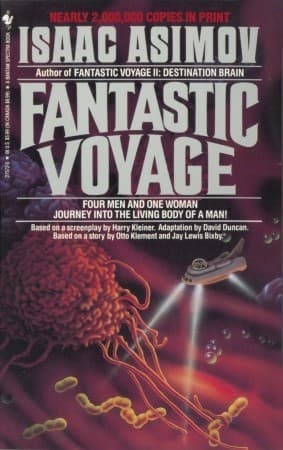
A miniaturized submarine crew navigates the perilous, microscopic world of a dying man's brain to destroy a blood clot, holding the fate of the world in their impossibly small hands.
Dr. Jan Benes, a brilliant scientist from behind the Iron Curtain, defects to the West, bringing vital knowledge about indefinite miniaturization. Immediately after his defection, he is critically injured in an assassination attempt, leaving him in a coma with an inoperable blood clot in his brain. The U.S. government, desperate to save him and acquire his knowledge, decides on a radical, experimental plan: miniaturize a submarine and a medical team, inject them into Benes's bloodstream, and destroy the clot from within. This mission, shrouded in secrecy, is the world's only hope for Benes and his scientific breakthrough.
The crew for the submarine, named the Proteus, is assembled. It consists of Dr. Michaels, a veteran surgeon; Cora Peterson, Benes's assistant and a biological specialist; Dr. Duval, a brain surgeon; and his assistant, Dr. LeRoy. Charles Grant, a CIA agent, is also assigned to the mission, tasked with ensuring Benes's survival and investigating potential sabotage, as the assassination attempt suggests a leak. The Proteus itself is a marvel of miniaturization technology, equipped with various tools for the journey. The team undergoes rigorous preparation, knowing their mission is a race against time and the limits of miniaturization, which is only stable for sixty minutes before the crew and sub begin to revert to normal size.
The Proteus and its crew are miniaturized to sub-cellular size and injected into Dr. Benes's carotid artery. The journey begins with immediate difficulties. The team experiences the turbulent flow of blood, navigating through the arterial network. Grant, initially skeptical, quickly adapts to the bizarre reality of their situation. The microscopic environment presents unforeseen dangers, from the force of the blood flow to the complex biological nature of the human body. They must carefully guide the Proteus, using its manipulators and internal systems, to avoid being swept away or encountering damaging obstacles as they make their way towards the brain.
The Proteus is shunted into the pulmonary circulation, ending up in Benes's lungs. This diversion is a major setback, as it wastes precious time and causes a rapid depletion of the submarine's internal oxygen supply. The crew faces an immediate crisis, risking suffocation. They are forced to perform an emergency procedure, using the submarine's laser to cut through a section of lung tissue to allow external oxygen to diffuse into their vessel. This risky maneuver is successful, but it further emphasizes the unpredictable and perilous nature of their journey, pushing the crew's resourcefulness to its limits.
While navigating through the lymphatic system, the Proteus encounters an attack from Benes's immune system. A white blood cell, perceiving the submarine as a foreign invader, attempts to engulf it. The crew is forced to use the laser to destroy the cell, a morally difficult decision as it means killing a part of Benes's own body. During the chaos, a crucial component of the laser system, a focusing crystal, is damaged. This incident, with other 'accidents' and navigational mishaps, intensifies Grant's suspicions of sabotage within the crew. He begins to observe his teammates more closely, wondering if one of them is an enemy agent working to ensure Benes's demise.
Continuing their journey, the Proteus is caught in a powerful nerve impulse within the auditory nerve, causing significant damage to the submarine's outer hull. During the struggle, Cora Peterson is swept out of the Proteus and becomes entangled in the delicate nerve fibers. The crew, particularly Grant, risks everything to retrieve her, navigating through the incredibly complex and sensitive neural pathways. They manage to rescue her, but the incident further reduces their already limited time and resources. The close call with Cora shows the extreme fragility of their situation and the constant threat of the human body itself becoming an insurmountable obstacle, adding to the psychological strain on the team.
After numerous perils and a harrowing journey, the Proteus finally reaches the brain and locates the massive blood clot obstructing Dr. Benes's vital functions. The sight of the clot, a formidable and alien mass within the delicate brain tissue, is both a relief and a daunting challenge. The team prepares for the delicate operation, knowing that any mistake could cause irreparable brain damage or even Benes's death. Dr. Duval, the brain surgeon, takes the lead, outlining the precise method for using the laser to break down the clot without harming the surrounding neural matter. The tension inside the Proteus is palpable as they position themselves for the critical procedure.
The crew successfully uses the laser to break apart the blood clot, carefully disintegrating it into harmless particles. Just as the mission seems accomplished, a shocking revelation occurs. Dr. Duval, driven by fanatical loyalty to his home country, reveals himself as the saboteur. He attempts to destroy the Proteus and kill Benes, having been tasked to prevent Benes's knowledge from reaching the West. In a desperate struggle, Grant and Michaels confront Duval. Duval is ultimately trapped and killed by a white blood cell, consumed by Benes's immune system, a poetic end to his treachery within the very body he sought to harm. The crew is horrified but relieved by his elimination.
With the clot destroyed and the saboteur neutralized, the Proteus must now make a rapid exit from Benes's body. The sixty-minute miniaturization window is rapidly closing, and the crew is aware that they are beginning to revert to their normal size. They navigate through the cerebral fluid and then into the venous system, aiming for a point where they can be extracted. The race against time is intense, as even microscopic increases in size could lead to fatal consequences within Benes's delicate tissues. Every second counts as they push the Proteus to its limits, desperate to reach the extraction point before their temporary state of existence expires.
The Proteus, with its surviving crew, reaches the designated extraction point in Benes's body, just as they are on the verge of reverting to full size. The external medical team successfully extracts the submarine. Miraculously, Dr. Benes begins to recover, his brain functions returning to normal. The mission is a success, saving Benes and securing his invaluable scientific knowledge. The surviving crew members, battered but triumphant, are debriefed. The psychological impact of their journey and the trauma of the sabotage will forever remain with them, a record of their fantastic voyage.
The Protagonist
From a skeptical outsider, Grant evolves into a key protector and active participant, crucial for the mission's success and the exposure of the saboteur.
The Supporting
Cora proves her scientific mettle and resilience, actively contributing to the mission's success and surviving extreme physical and psychological challenges.
The Supporting
Michaels demonstrates unwavering professional competence and leadership, successfully piloting the Proteus through unimaginable dangers.
The Antagonist
Duval maintains a facade of professionalism until his true antagonistic nature is revealed, leading to his demise by Benes's own immune system.
The Supporting
LeRoy remains largely static, a loyal assistant to Duval, until the shocking revelation of Duval's treachery.
The Mentioned
Benes remains unconscious throughout the story, his arc defined by his initial injury and eventual recovery.
The Supporting
Carter manages the mission from the outside, his arc defined by the successful execution of the complex operation.
The Supporting
Reid expertly manages the external medical and technical support, ensuring the Proteus has the best chance for success.
The novel explores the human body as a complex, dangerous, and resilient environment. From turbulent blood flow in arteries to delicate neural pathways and the aggressive immune system, Benes's body is both the mission's destination and its greatest antagonist. The crew's constant struggle against biological processes – oxygen depletion in the lungs, attacks by white blood cells, and the force of nerve impulses – shows how vulnerable and yet how robust our internal systems are. The success of the mission depends on both the crew's ingenuity and the body's capacity to heal once the obstruction is removed.
“For the first time they were seeing the human body, not as a collection of organs, but as a living, breathing, hostile universe.”
The story centers on groundbreaking miniaturization technology, pushing scientific possibility. The mission itself shows human ingenuity, yet it constantly raises ethical questions. The crew must kill Benes's white blood cells, damage lung tissue, and navigate delicate brain matter, making life-or-death decisions that blur the lines between healing and harming. The potential misuse of such powerful technology, shown by Duval's sabotage, also emphasizes the moral responsibility that comes with scientific advancement. The novel questions how far humanity should go in manipulating life for its own ends.
“We're inside a man, killing part of him to save the rest. It's a strange kind of medicine.”
Beyond the scientific adventure, the novel incorporates a Cold War espionage element. Charles Grant's primary mission is to uncover a saboteur, reflecting the pervasive paranoia and distrust of the era. The assassination attempt on Benes, followed by a series of 'accidents' within the Proteus, creates suspicion among the crew. The revelation of Dr. Duval as the enemy agent shows that threats can come from within, even from those trusted with critical responsibilities. This theme adds human drama and psychological tension to the already perilous physical journey.
“It isn't just a clot we're fighting. There's a human element here, a very dangerous one.”
The miniaturization process alters the characters' perception of reality. The familiar world of human anatomy becomes an alien place, where microscopic organisms are monstrous threats and nerve impulses are powerful currents. The crew must constantly adjust their understanding of scale, time, and danger. This theme explores how our perception shapes our reality and how a change in perspective can reveal an entirely new, complex, and frightening world within the seemingly mundane. It forces both the characters and the reader to reconsider the vastness of the universe, even within the confines of a single human body.
“They were no longer men, but sub-microscopic voyagers in a universe whose every atom was a star.”
The core scientific premise enabling the entire plot.
This fictional technology allows the Proteus and its crew to be shrunk to sub-cellular size, making the entire mission possible. It serves as the primary catalyst for the plot, creating the unique setting and challenges. The 'sixty-minute limit' of miniaturization, before objects revert to normal size, acts as a ticking clock, adding immense tension and urgency to the entire mission. The technology itself is both a marvel and a danger, pushing the boundaries of what is scientifically conceivable and creating ethical dilemmas.
The vessel that transports the crew through Benes's body.
The Proteus is more than just a vehicle; it's a character in itself, embodying the advanced technology and the crew's precarious existence. Equipped with manipulators, lasers, and life support, it is their only protection against the hostile internal environment of Benes's body. Damage to the Proteus, such as the hull breach or laser malfunction, directly impacts the crew's survival and the mission's progress, making its integrity crucial to the narrative.
The sixty-minute limit for miniaturization.
The sixty-minute window during which the miniaturization is stable serves as a relentless ticking clock throughout the narrative. This device creates constant tension and urgency, as every delay, every setback, and every moment wasted brings the crew closer to their inevitable and fatal reversion to normal size within Benes's body. It forces rapid decision-making and underscores the high stakes of the mission, amplifying the dramatic impact of every challenge they face.
An enemy agent hidden among the crew.
The presence of an internal saboteur, Dr. Duval, adds a layer of mystery and psychological thriller to the science fiction adventure. This device creates suspicion and distrust among the crew, particularly for Charles Grant, who is tasked with identifying the traitor. The sabotage attempts not only create plot obstacles but also highlight the Cold War espionage context, turning a medical mission into a high-stakes battle against both biological threats and human treachery.
Portraying the human body as a vast, alien landscape.
Asimov transforms the familiar human anatomy into an alien, hostile, and awe-inspiring environment. Arteries become raging rivers, white blood cells become monstrous predators, and nerve impulses are powerful electrical storms. This device allows for exploration of both scientific wonder and existential dread, making the internal journey as epic and dangerous as any space voyage. It highlights the incredible complexity and hidden dangers within something we take for granted, providing a unique and compelling setting for the adventure.
“The greatest breakthroughs in science are often the result of thinking what was previously unthinkable.”
— A general reflection on the nature of scientific progress.
“There are no insoluble problems, only problems for which we have not yet found the solution.”
— A statement reflecting optimism in the face of scientific challenges.
“The human body is an incredibly complex machine, and like any machine, it can break down.”
— Introducing the premise of medical intervention at a microscopic level.
“Time, like a river, flows relentlessly forward, carrying all before it.”
— A metaphorical reflection on the passage of time, especially relevant given the shrinking process.
“Sometimes the greatest dangers lie not in the unknown, but in the familiar.”
— Hinting at potential sabotage or internal threats during the mission.
“The miniaturization process was a triumph of technology, but it also introduced unforeseen complications.”
— Discussing the double-edged nature of advanced scientific breakthroughs.
“To navigate the microscopic world, one must think on a microscopic scale.”
— Emphasizing the mental shift required for the unique mission.
“Fear can be a powerful motivator, but it can also blind us to the truth.”
— Reflecting on the psychological pressures faced by the crew.
“Every cell is a universe unto itself, with its own intricate mechanisms and delicate balance.”
— Describing the wonder and complexity of the cellular world.
“The human brain, for all its power, remains largely a mystery.”
— Touching upon the ultimate frontier of human understanding, even as they operate within the body.
“In the realm of the minute, the smallest error can have the most catastrophic consequences.”
— Highlighting the high stakes and precision required for the mission.
“Even the most advanced technology is only as good as the minds that wield it.”
— Underscoring the importance of human skill and intellect over mere tools.
“Life, in all its forms, possesses an incredible resilience.”
— Observing the body's natural defenses and ability to heal.
“The boundary between science fiction and scientific fact often blurs with time.”
— A meta-commentary on the nature of the genre and potential future realities.
Ready to see how well you understood this book? Take our interactive quiz with 10 questions.

Isaac Asimov was an American writer and professor of biochemistry at Boston University. During his lifetime, Asimov was considered one of the "Big Three" science fiction writers, along with Robert A. Heinlein and Arthur C. Clarke. A prolific writer, he wrote or edited more than 500 books. He also wrote an estimated 90,000 letters and postcards. Best known for his hard science fiction, Asimov also wrote mysteries and fantasy, as well as much non-fiction.







