“There are some things in the world that are not for us to know. And there are some things that, once we know them, we can never unknow.”
— Focusing on the nature of forbidden knowledge and its irreversible impact.

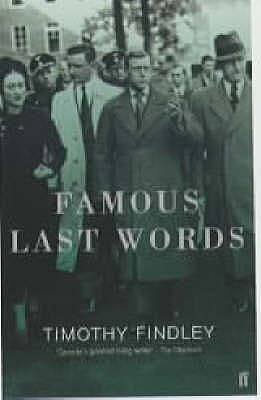
Timothy Findley (1981)
Genre
Literary Fiction / Historical Fiction
Reading Time
560 min
Key Themes
See below
Sign in to track this book
Trapped in an Alpine prison during WWII, a disgraced socialite's final, desperate confessions scrawled on the walls expose a chilling web of aristocratic scandal and political corruption that only his frozen corpse can now reveal.
In the final days of World War II, Major Quinn and Captain Frey of the American forces discover the frozen, disfigured body of Hugh Selwyn Mauberley in the remote, abandoned Schloss Seeblick in the Austrian Alps. The Schloss, once a lavish retreat, is now a desolate tomb. Mauberley, an American writer, has scrawled his final testament across the walls and ceilings of his makeshift prison using a mixture of blood, soot, and his own excrement. Quinn and Frey must decipher this bizarre and extensive manuscript, which promises to reveal shocking truths about a secret society, political intrigue, and the lives of powerful figures during the interwar period, all through the eyes of a man who was both a witness and a participant.
Mauberley's narrative begins with his personal history, detailing his early life as a disillusioned American writer who left his home country after the First World War. He describes his move to Europe, drawn by the appeal of a more sophisticated culture. He soon becomes involved in the glamorous, often decadent, expatriate circles of the 1920s and 30s, frequenting salons and parties where he meets many famous and infamous figures. His initial idealism slowly fades as he sees the moral decay and political blindness beneath the glittering surface of European society, hinting at the coming global conflict.
A turning point in Mauberley's account is his introduction to Wallis Simpson, the American socialite who would become the Duchess of Windsor. He describes her as a woman of great ambition and charm, navigating the difficult world of European high society. Mauberley becomes a close observer, and at times a confidant, of Wallis, gaining access to her inner circle. Through his eyes, the reader sees the relationships, the pursuit of power, and the social climbing that defined the lives of figures like Wallis and her husband, Edward VIII. Mauberley's narrative portrays her not just as a romantic figure, but as a shrewd operator in a world on the brink.
Mauberley's manuscript examines the events leading up to Edward VIII's abdication from the British throne. He provides an insider's view of the scandal and political maneuvering, highlighting the intense pressure placed upon the King and Wallis Simpson. Mauberley suggests that the abdication was not simply a love story but a complex interaction of political forces, class prejudices, and strategic manipulations by those who feared Edward's perceived pro-German sympathies. Following the abdication, Mauberley observes the Windsors' exile and their continued association with figures who held troubling political views, further deepening his suspicions about their true allegiances.
As Mauberley's narrative continues, he gradually uncovers the existence of a secret society he calls the 'White Mice.' This clandestine group includes influential individuals, such as aristocrats, industrialists, and politicians, who are actively working towards a fascist future for Europe, even collaborating with Nazi Germany. Mauberley's closeness to figures like the Windsors and their circle allows him to witness their discreet meetings and overhear their dangerous discussions. He realizes that many of the seemingly harmless social gatherings he attends are in fact places for political intrigue and the planning of a world order that aligns with authoritarian ideals, making him an unwitting, then unwilling, witness.
A key figure in Mauberley's revelations is Robert de Montesquiou, a charismatic and manipulative individual who seems to be at the heart of the 'White Mice' conspiracy. Montesquiou, a fictional character with echoes of real-life figures, is portrayed as a charming aesthete with a dark, calculating mind. He uses his influence and social connections to further the group's agenda, subtly orchestrating events and manipulating those around him. Mauberley finds himself both repulsed and fascinated by Montesquiou, recognizing his dangerous power and the insidious nature of his ambitions. Montesquiou's presence highlights the seductive appeal of fascism for some members of the European elite.
Mauberley's account details the Duke and Duchess of Windsor's controversial visit to Nazi Germany in 1937, where they met with Hitler and other high-ranking Nazi officials. Mauberley, often present or privy to the discussions, interprets these interactions not as innocent diplomatic gestures, but as evidence of deeper sympathies and potential collaboration. He portrays the Windsors as being deeply involved with the 'White Mice' agenda, or at least, as naive participants whose actions provided significant propaganda value to the Nazi regime. This section of the manuscript is particularly damning, suggesting a betrayal of their country and a dangerous flirtation with fascism.
As Europe moves towards war, Mauberley's initial fascination with the glamorous expatriate life turns into profound disillusionment and fear. He realizes the horrifying extent of the 'White Mice' conspiracy and the complicity of many he once admired. His position as an observer becomes increasingly dangerous, as he possesses knowledge that powerful people would prefer to keep hidden. He begins to feel hunted, his every movement potentially watched. The glittering parties and intellectual discussions are replaced by a pervasive sense of dread, forcing him to confront the moral bankruptcy of the world he has inhabited and his own precarious existence within it.
Mauberley's narrative shifts to his forced retreat and eventual imprisonment at Schloss Seeblick. He recounts how he was brought to the remote Austrian castle, ostensibly for his own safety, but soon realizes it is a gilded cage. He details the isolation, the psychological torment, and the gradual loss of his freedom, confined to the very room where his body is eventually discovered. He suspects he was brought there to be silenced, his knowledge of the 'White Mice' and their activities deemed too dangerous. The castle, initially a place of refuge, becomes his final, desolate prison, where he desperately begins to record his testimony.
In his final days, Mauberley describes the arduous and desperate act of creating his testament on the walls and ceilings of his prison. He uses whatever materials he can find—blood, soot, even his own excrement—to record his story, driven by an urgent need to expose the truth. He recounts his physical and mental deterioration, the extreme cold, the hunger, and the constant fear. This section is a raw and visceral account of his struggle for survival and his determination to leave behind a record, a final act of defiance against those who sought to silence him. His writing becomes his last, most powerful weapon.
As Quinn and Frey continue to decipher Mauberley's sprawling manuscript, they are alternately fascinated, horrified, and skeptical. The scope of his claims, implicating some of the most powerful figures of the era, is almost unbelievable. However, the meticulous detail and the desperation evident in the writing compel them to take it seriously. They begin to cross-reference his accounts with their own wartime intelligence and the limited information available to them. The officers are drawn into a chilling investigation, realizing that Mauberley's 'famous last words' might hold the key to understanding a much larger, darker conspiracy that reaches the highest levels of power.
Armed with Mauberley's detailed descriptions, Quinn and Frey begin the dangerous task of identifying and locating the surviving members of the 'White Mice'. They understand that many of these individuals are still powerful and well-connected, potentially embedded within the very structures of the post-war world. Their investigation is fraught with peril, as they realize that the conspiracy might extend far beyond what Mauberley could fully comprehend. The officers become detectives in a complex historical mystery, trying to bring to light the hidden architects of a fascist agenda that nearly consumed Europe, and perhaps still poses a threat.
The Protagonist
From a detached, aesthetic observer, Mauberley transforms into a desperate, morally driven witness, sacrificing his life to expose a dangerous truth.
The Supporting
From a detached investigator, Quinn becomes deeply invested in Mauberley's story, driven to expose the conspiracy.
The Supporting
Frey's idealism is tested and matured by the dark truths revealed in Mauberley's story, solidifying his commitment to justice.
The Supporting
Remains largely consistent in her ambition, but her role shifts from socialite to a figure caught in and manipulated by political machinations.
The Supporting
His arc is largely historical, but Mauberley's narrative reframes his choices as potentially complicit in larger political schemes.
The Antagonist
His arc is one of consistent, insidious manipulation, serving as the primary orchestrator of the 'White Mice' conspiracy.
The Supporting
Remains a static character, serving as a conduit for information and a representation of a fading social order.
The Mentioned
She exists primarily in Mauberley's past recollections, a static representation of a life he abandoned.
The novel explores how wealth, social standing, and political influence can be used for nefarious purposes, leading to moral decay and involvement in larger schemes of evil. Mauberley's narrative exposes a hidden network of European aristocrats and industrialists, the 'White Mice,' who use their positions to align with fascist ideologies and undermine democratic principles. The Windsors' actions, particularly their visit to Nazi Germany, show how perceived privilege can blind individuals to the consequences of their associations, or worse, be actively used to further dangerous political agendas. The glittering facade of high society, as Mauberley observes, often conceals a moral emptiness and a willingness to betray for personal gain or ideological conviction, as seen in the manipulative orchestrations of Robert de Montesquiou.
“He who sees the world through the eyes of the powerful sees a different world, one where the rules are made to be bent, and history, a story to be rewritten.”
Findley challenges official historical narratives by presenting Mauberley's 'secret' account, suggesting that much of what we accept as truth is often curated or concealed by those in power. Mauberley's desperate act of writing on the walls is an attempt to reclaim and record a truth that has been suppressed. The discovery of his manuscript by Quinn and Frey highlights the fragile, often fragmented nature of historical evidence and the ongoing struggle to piece together what 'really' happened. The novel questions who gets to write history and whose voices are silenced, implying that personal testimonies, even from a seemingly unreliable narrator, can reveal truths that official records overlook. The 'famous last words' are an act of radical truth-telling against a world built on lies.
“History is not what happened. History is what is told. And what is told is not always what is true.”
Mauberley's journey is an exploration of the moral burden placed upon those who witness atrocities or conspiracies. Initially, he is a detached observer, but as he uncovers the extent of the 'White Mice' plot and the complicity of powerful figures like the Windsors, he realizes he cannot remain silent. His act of writing his testament, even in the face of death, becomes his ultimate fulfillment of this responsibility. The novel suggests that silence in the face of evil is a form of complicity. Quinn and Frey, in their turn, inherit this responsibility by deciphering and investigating Mauberley's claims, recognizing the ethical need to act upon the knowledge he has left behind, even if it implicates powerful individuals and challenges comfortable truths.
“To know is to be burdened. To know and to be silent is to be damned.”
The novel portrays the atmosphere of decadence that permeated European high society between the World Wars, serving as a backdrop to its impending political and moral collapse. The lavish parties, the pursuit of pleasure, and the aestheticism of figures like Robert de Montesquiou mask a deeper societal rot. Mauberley initially enjoys this world, but gradually sees its hollowness and the moral bankruptcy it conceals. The superficial glamour of the expatriate scene, the casual antisemitism, and the flirtation with fascism are all symptoms of a society in decline, unaware or unwilling to confront the horrors it is incubating. This theme shows how a culture's aesthetic beauty can coexist with, and even facilitate, its moral unraveling, leading to cataclysmic events like World War II.
“The perfume of decay was always present, even in the most exquisite rooms, a faint, sweet warning of what lay beneath the polish.”
A desperate, sprawling testament scrawled by the protagonist in his final days.
Hugh Selwyn Mauberley's manuscript, scrawled across the walls and ceiling of his prison at Schloss Seeblick, serves as the central plot device. It is a frame narrative, providing the entire backstory and revelations. The physical act of writing—with blood, soot, and excrement—underscores Mauberley's desperation, his moral urgency, and the raw, unvarnished nature of his truth. Its fragmented, almost stream-of-consciousness style reflects his deteriorating mental and physical state, while its detailed content provides a comprehensive, albeit subjective, account of the political conspiracy. The deciphering of this unusual 'book' by Quinn and Frey drives the present-day narrative, creating a sense of archaeological discovery.
The story of Mauberley's past is framed by the present-day discovery and interpretation of his writings.
The novel employs a classic frame narrative structure. The 'present' story involves Major Quinn and Captain Frey discovering Mauberley's frozen body and his extraordinary manuscript in the abandoned Schloss Seeblick. Their efforts to decipher and verify his account form the outer frame. The 'inner' story is Mauberley's extensive first-person narrative, detailing his life, observations, and the conspiracy he uncovered. This structure allows for a dual perspective: Mauberley's subjective, immediate experience of events, and Quinn and Frey's more objective, investigative interpretation, creating tension and allowing the reader to experience the unfolding revelations alongside the officers.
Mauberley's testimony is presented through his subjective, often feverish, perspective, raising questions of veracity.
Mauberley acts as an unreliable narrator. While his account is meticulously detailed and passionately delivered, his physical and mental deterioration, coupled with his isolated circumstances, suggest that his perception might be skewed. The reader, along with Quinn and Frey, must constantly question the absolute truth of his claims, even as their sheer volume and consistency compel belief. This device adds a layer of suspense and intellectual engagement, forcing the reader to interpret and synthesize information, and highlighting the subjective nature of memory and historical interpretation, especially when dealing with hidden truths and powerful figures.
The novel blends real historical figures and events with fictional characters and speculative plot lines.
Findley masterfully uses historical allusions and fictionalized versions of real people (like Wallis Simpson and Edward VIII) alongside entirely fictional characters (like Robert de Montesquiou and Mauberley himself). This blend creates a powerful sense of verisimilitude while allowing the author creative license to explore a 'secret' history. The familiar names lend weight and credibility to the fictional conspiracy, making the revelations more shocking and plausible. This device blurs the lines between fact and fiction, inviting readers to reconsider official historical narratives and ponder what hidden truths might lie beneath the surface of well-known events like the abdication crisis and the lead-up to World War II.
“There are some things in the world that are not for us to know. And there are some things that, once we know them, we can never unknow.”
— Focusing on the nature of forbidden knowledge and its irreversible impact.
“The past is never dead. It's not even past.”
— A reflection on how historical events and personal histories continue to influence the present.
“War is not a game. It is a horror. And it changes everything.”
— A poignant observation on the devastating and transformative power of conflict.
“We invent our own monsters, and then we are surprised when they devour us.”
— A commentary on self-deception and the consequences of creating one's own illusions or problems.
“Silence can be a terrible weapon, more deadly than any bullet.”
— Highlighting the destructive potential of unspoken truths or withheld information.
“Love is not a choice. It is a necessity.”
— Emphasizing love's fundamental and indispensable role in human existence.
“Every man carries his own hell within him.”
— A deep insight into internal struggles and personal torment.
“The truth is a dangerous thing, especially when it is whispered.”
— Exploring the potent and often disruptive nature of hidden or suppressed truths.
“Memory is a traitor. It shows you what it wants to show you, not what actually happened.”
— Reflecting on the unreliability and subjective nature of memory.
“To live is to suffer, to survive is to find some meaning in the suffering.”
— A philosophical take on resilience and the search for purpose amidst hardship.
“We are all prisoners of our own making.”
— A statement on how individuals often confine themselves through their choices and beliefs.
“Sometimes the greatest courage is simply to endure.”
— Highlighting the quiet strength found in perseverance.
“The world is full of ghosts. Some are dead, and some are still living.”
— A metaphorical reflection on the lingering presence of past events and people, both literally and figuratively.
“Every secret has a life of its own, and it grows with every lie that feeds it.”
— Discussing the insidious nature of secrets and how they fester over time.
Ready to see how well you understood this book? Take our interactive quiz with 10 questions.

Timothy Irving Frederick Findley was a Canadian novelist and playwright. He was also informally known by the nickname Tiff or Tiffy, an acronym of his initials.







