“The world is not run by the people who are right, but by the people who have power.”
— Reflection on political realities during World War I.

Ken Follett (2010)
Genre
Historical Fiction
Reading Time
16-20 hours (approx. 985 pages at 50 pages/hour)
Key Themes
See below
Sign in to track this book
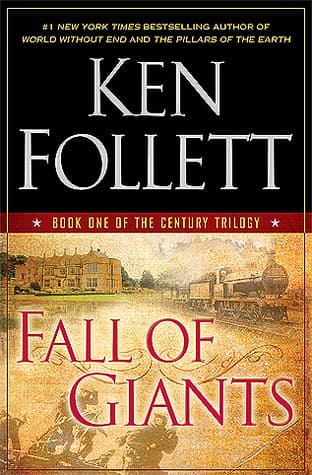
As World War I begins, the lives of a Welsh coal miner, an English aristocrat, a German spy, an American politician, and two Russian orphans intertwine in a story of love, betrayal, and revolution that changes the 20th century.
The year is 1911 in Aberowen, Wales. Thirteen-year-old Billy Williams goes into the coal mine for his first day of work, a dangerous tradition for boys there. His father, David Williams, a strong union man, worries about his son's safety. At the nearby Fitzherbert estate, 'The Place,' Lady Maud Fitzherbert, a suffragette, gets ready for her brother Fitz's twenty-first birthday party. She finds Fitz in bed with Clara von Ulrich, sister of Walter von Ulrich, a German diplomat. Maud is upset by her brother's casual meanness and Clara's vulnerability, showing the complicated relationships between these families and nations.
Lady Maud Fitzherbert, despite not liking German aristocrats at first, feels attracted to Walter von Ulrich, a cultured and smart attaché at the German Embassy in London. Their secret romance grows, going against the social rules of their time. At the same time, Ethel Williams, the housekeeper at 'The Place' and Billy's sister, has a secret affair with Earl Fitzherbert. She gets pregnant, but Fitz, afraid of scandal, refuses to admit the child or marry her. This betrayal deeply affects Ethel, making her want social justice and independence.
In Russia, the orphaned brothers Grigori and Lev Peshkov struggle in pre-revolutionary society. Grigori, older and more hopeful, gets involved in revolutionary activities, including a strike at a St. Petersburg factory. Lev, more practical, wants to move to America for a better life. Their paths separate as Grigori joins the socialist cause. Across the Atlantic, Gus Dewar, a bright and ambitious young graduate, starts working as an aide to Senator Joe Thawley in President Woodrow Wilson's administration. He quickly shows he is good at politics, setting the stage for his involvement in international matters.
The killing of Archduke Franz Ferdinand in Sarajevo in June 1914 breaks the peace in Europe. The alliances quickly pull nations into conflict. Walter von Ulrich, despite loving Maud, is called back to Germany to serve his country, leaving Maud sad. Billy Williams, feeling patriotic and dutiful, joins the British army, despite his father's peaceful views and the dangers of the trenches. Grigori Peshkov is drafted into the Russian army, separating him from his revolutionary friends and sending him to the front lines against Germany.
Billy Williams sees the horrors of trench warfare on the Western Front, witnessing the loss of life and the brutal conditions. His experiences make him tough but also strengthen his will to fight for a better world. Meanwhile, Ethel Williams, after giving birth to her son, Georgie, and being cast out by Fitz, finds her voice in the women's suffrage movement. She becomes a strong organizer, rising in the ranks and pushing for political and social change, often clashing with the established order and even Fitz.
Grigori Peshkov, fighting on the Eastern Front, endures the hardships of war, seeing the Tsarist regime's incompetence and the Russian people's suffering. He becomes more and more unhappy with the current system and more open to revolutionary ideas. When the February Revolution starts in 1917, he gets caught up in the change, eventually joining the Bolsheviks. He takes part in the October Revolution, helping to overthrow the Provisional Government and establish Soviet power, believing it will lead to a better future for Russia.
Gus Dewar, now a key advisor to President Woodrow Wilson, helps shape American foreign policy. He goes with Wilson to Europe, seeing the destruction. The United States eventually enters World War I, changing the balance of power. Gus deals with the difficulties of international diplomacy and the moral problems of war. Lady Maud, despite her personal sadness, becomes a pacifist, working to promote peace and understanding between nations, often using her social status to influence political discussions, even as her own family is divided by the conflict.
As World War I ends, the characters deal with the big changes it brought. Billy Williams returns home, scarred by his experiences but determined to fight for workers' rights in the coal mines. Ethel Williams, now a Labour activist, continues her fight for social equality and women's rights. Walter von Ulrich, having survived the war, faces a Germany in chaos and struggles to rebuild his life amid the economic and political instability of the Weimar Republic. Their personal lives and political goals connect with the larger forces shaping the post-war world.
Ethel Williams, using her growing political influence, becomes a leader in the Labour Party, strongly advocating for women's voting rights and better conditions for the working class. Her son, Georgie, eventually forms a bond with Fitz, his biological father, though their relationship stays complicated. Lady Maud, now married to Walter von Ulrich, continues her work for social justice, using her position to support progressive causes. Both women, from different social classes, work for a more fair society, showing the spirit of change that swept through the early 20th century.
The novel ends with the characters navigating the new political world of the 1920s. Gus Dewar continues his career in American politics, seeing new global powers rise. Grigori Peshkov, now a Bolshevik, becomes a figure in the Soviet government; his ideals are both met and compromised by the realities of power. Lev Peshkov, having made his way to America, finds success through less honest means, showing the darker side of the American Dream. The families, changed forever by the war and revolutions, look towards an uncertain future, with the beginnings of future conflicts already present.
The Protagonist
From a privileged but rebellious aristocrat, Maud evolves into a committed pacifist and advocate for social change, finding love and purpose across national divides.
The Protagonist
Walter transitions from a hopeful diplomat to a disillusioned war veteran, committed to rebuilding Germany and his life with Maud.
The Protagonist
From a wronged housekeeper, Ethel transforms into a powerful political voice, fighting for equality and social reform.
The Protagonist
Billy's innocence is shattered by war, leading him to become a dedicated advocate for workers' rights and social justice.
The Protagonist
Grigori's journey from a factory worker to a dedicated Bolshevik leader reflects the tumultuous changes in Russia.
The Protagonist
Lev transforms from a desperate orphan into a successful but morally ambiguous American entrepreneur.
The Protagonist
Gus rises through American politics, shaping foreign policy and witnessing the U.S.'s emergence as a global power.
The Supporting
Fitz reluctantly adapts to a changing world, seeing his power slowly erode while maintaining his aristocratic facade.
The Supporting
David remains a steadfast figure of working-class solidarity and a moral compass for his family.
The Supporting
Clara matures through personal experiences, finding a new path despite early romantic missteps.
The novel shows the old aristocratic order, like the Fitzherberts, losing power as the working class, like the Williams family and the Peshkov brothers, gains influence. Scenes in the coal mines show the hard lives of laborers, a contrast to the rich lives of landowners. The suffrage movement, supported by Ethel and Maud, also challenges old power structures, showing a shift from inherited privilege to earned rights and group action.
“The world was changing. It was changing fast, and the old order was dying.”
World War I is the central event of the novel, affecting every character regardless of their country or social class. Billy Williams's experiences show the brutal realities of trench warfare, including the loss of life, the mental trauma, and the disappointment it caused. The war also forces hard choices on characters like Walter von Ulrich, caught between love and duty, and fuels revolutionary feelings in Russia, showing its wide effects beyond the battlefield.
“He had seen enough men die to know that God was not on the side of the British, or the Germans, or anyone else.”
A main theme is the fight for social justice, which includes women's voting rights, workers' rights, and the struggle against class oppression. Ethel Williams's journey from a wronged housekeeper to a leading suffragette and Labour activist shows this, as does David and Billy Williams's dedication to trade unions. Lady Maud, despite being an aristocrat, also supports these causes, showing how different social groups can unite for change. The Russian Revolution, led by Grigori Peshkov, represents a more radical pursuit of social and economic equality.
“We want the vote because we are human beings, not because we are women.”
The novel explores how love and loyalty can go beyond national and social boundaries, often conflicting with political loyalties. The secret romance between Lady Maud Fitzherbert (British) and Walter von Ulrich (German) is an example, challenging the strong nationalism and hatred during WWI. Their personal commitment to each other lasts despite the war that divides their nations, showing the shared humanity that can exist even during global conflict. This theme questions the random nature of national identity when faced with deep personal connections.
“Love was a country in itself, and it had no borders.”
The story looks at different kinds of power: the inherited power of the aristocracy, the political power of figures like President Wilson, and the revolutionary power of the people. The Russian Revolution, seen through Grigori Peshkov's eyes, shows how brutal and transformative it is to overthrow an existing government. The novel examines how power is gained, kept, and challenged, and the often unplanned results of revolutionary change, suggesting that while old orders fall, new kinds of oppression or idealism can appear.
“The revolution was a storm, and he was caught in its eye, a tiny speck in a whirlwind of change.”
Tells the story through the eyes of five interconnected families across different nations.
Ken Follett employs a multiple perspective narrative, following the lives of characters from five distinct families (Welsh, English, German, Russian, American). This allows the reader to experience the same historical events from various social, economic, and national viewpoints. For example, the build-up to WWI is seen from a German diplomat's perspective (Walter), a British aristocrat's (Maud), and an American politician's (Gus), providing a panoramic view of the conflict and its causes, rather than a singular, biased account.
Integrates fictional characters seamlessly into actual historical events and periods.
The novel is meticulously researched, grounding its fictional characters and their personal dramas within the accurate historical context of the early 20th century. Key events like the Coronation of King George V, the assassination of Archduke Franz Ferdinand, trench warfare on the Western Front, the Russian Revolutions, and the women's suffrage movement are not just backdrops but integral to the plot. Characters interact with real historical figures (e.g., Woodrow Wilson, Lenin), making the narrative feel authentic and immersive.
Hints at future events and character developments to build suspense.
Follett frequently uses foreshadowing to build tension and hint at future calamities or triumphs. For instance, the early discussions about alliances and military build-up among the diplomats subtly hint at the impending global conflict. Similarly, the dangerous conditions in the coal mines foreshadow the struggles for workers' rights and the potential for accidents. Ethel's early experiences of betrayal and injustice foreshadow her later emergence as a powerful advocate for social change, creating a sense of inevitability and dramatic irony.
Explores how social strata both separate and connect characters' destinies.
Social class is a fundamental plot device, dictating opportunities, relationships, and conflicts. The stark contrast between the lives of the Welsh coal miners (Williams family) and the English aristocracy (Fitzherberts) drives much of the early conflict. However, the novel also shows how class lines can be crossed through love (Maud and Walter), shared political ideals (Maud and Ethel), or the unifying experience of war. This dynamic highlights the rigid social structures of the era while also demonstrating their eventual erosion.
“The world is not run by the people who are right, but by the people who have power.”
— Reflection on political realities during World War I.
“War is a crime against humanity.”
— Character expressing anti-war sentiment amidst the conflict.
“In politics, the middle ground is where you get shot from both sides.”
— Observation on political compromise during turbulent times.
“The rich will always find a way to protect their wealth, even in a revolution.”
— Commentary on class dynamics during the Russian Revolution.
“Love is not a calculation; it is a surrender.”
— Personal reflection on romantic relationships amid societal upheaval.
“History is written by the victors, but it is lived by the people.”
— Musing on the gap between historical narratives and lived experiences.
“A man's character is not judged by his wealth, but by his actions in times of crisis.”
— Moral assessment of characters during wartime.
“The old order is dying, and the new order struggles to be born.”
— Description of the transitional period after World War I.
“In war, there are no unwounded soldiers.”
— Observation on the psychological toll of combat.
“Freedom is not given; it is taken.”
— Assertion during discussions of suffrage and independence movements.
“The greatest tragedy is not the loss of life, but the loss of humanity.”
— Reflection on the dehumanizing effects of war.
“Hope is the last thing to die in the human heart.”
— Character finding resilience amidst despair.
“Power corrupts, but absolute power corrupts absolutely, and quickly.”
— Warning about the dangers of unchecked authority in revolutions.
“The bonds of family can withstand even the collapse of empires.”
— Highlighting personal connections during historical upheavals.
Ready to see how well you understood this book? Take our interactive quiz with 10 questions.

Kenneth Martin Follett, is a British author of thrillers and historical novels who has sold more than 160 million copies of his works.







