“Before you could say, 'What in the name of all that is holy is that fake mustache doing on that baby's face?' the baby was gone.”
— Describing the sudden appearance and disappearance of a baby with a mustache.

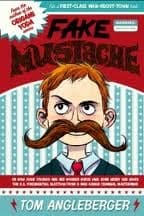
Tom Angleberger (2012)
Genre
Fantasy / Children's / Mystery
Reading Time
120 min
Key Themes
See below
Sign in to track this book
Lenny Flem Jr. must stop his best friend, Casper, a master of disguise and hypnosis, from taking over the world, all because of a convincing fake mustache.
Lenny Flem Jr., an ordinary boy, is at the mall with his best friend, Casper, who is smart and observant. Casper uses money from his granny to buy a very realistic fake mustache: the Heidelberg Handlebar #7. This mustache is convincing, changing Casper's look and, more importantly, how old and important he seems. Lenny is amused, but he feels uneasy as he sees the immediate, strong effect the mustache has on how adults see Casper. This purchase changes their usual childhood fun into something serious.
With the Heidelberg Handlebar #7, Casper starts robbing banks. The fake mustache, his cleverness, and his ability to act like an adult allow him to pose as a businessman. He enters banks, convinces tellers to give him large amounts of money, and leaves without being caught. Lenny, at first just confused, soon realizes how big Casper's criminal plan is. Casper quickly gets rich, storing his money in a secret underground place beneath his house. This sudden wealth gives Casper great power and resources, which he plans to use for world domination.
Lenny discovers that the Heidelberg Handlebar #7 has a hidden, more sinister power: it hypnotizes adults. When Casper wears the mustache and speaks, adults believe whatever he says and obey his commands, often against their better judgment. This explains how Casper easily convinced bank tellers and others to do what he wanted. Lenny, as a child, is not affected by this hypnosis, making him the only one who sees Casper for who he is—a child in a fake mustache. This immunity gives Lenny a big responsibility.
With his stolen money and the mustache's hypnotic power, Casper decides to run for President of the United States. He starts a very effective, though unusual, political campaign. His simple, direct messages, boosted by the mustache's influence, appeal to the public. He quickly becomes popular, even without experience or clear policies. Lenny watches in horror as his best friend, disguised as a charismatic adult, manipulates the whole nation. The election becomes a race against time for Lenny to expose Casper before he takes the most powerful office.
As Casper's presidential campaign grows, Lenny tries to expose him. He tells adults the truth, but they are all under the mustache's spell and think he is a child with a wild imagination. Lenny tries to grab the mustache, but Casper is always one step ahead. He even tries to make his own fake mustache to fight Casper's, but it fails comically. Each of Lenny's attempts ends in frustration, showing the great power of the Heidelberg Handlebar #7 and the huge challenge he faces.
Casper's granny, an eccentric and somewhat unaware character, helps his plans without knowing it. She gives him the money for the mustache and often makes comments about 'adult rules' and behavior. While she never fully understands how bad Casper is, her presence often grounds the story and offers a moral contrast, even if by accident. Her love for Casper is clear, but her inability to see past the mustache's disguise shows how widespread its power is. Lenny sometimes asks her for help, hoping she might see the truth, but she remains under its influence.
The peak of Casper's political rise is the final presidential debate, shown on TV. This is Lenny's last chance to stop Casper. Lenny, with a desperate plan, gets into the debate hall. He knows he needs to get close enough to Casper to remove the mustache, or at least disrupt its hypnotic effect. The tension is high as Casper, looking like a confident, charismatic candidate, gives his final speech. Lenny gets past security and the hypnotized crowd, determined to act before the election is decided.
In a dramatic moment during the debate, Lenny lunges at Casper and pulls off the Heidelberg Handlebar #7. The effect is instant and strong: the entire audience, and likely the nation watching, wakes from their trance. They suddenly see Casper as he truly is—a young boy in a suit. The situation's absurdity is overwhelming. Casper is immediately disqualified, and his political hopes fall apart. The stolen money is recovered, and the world slowly returns to normal, with adults remembering the strange, unexplainable time under Casper's influence.
After being unmasked, Casper is humiliated and leaves public life. He faces the results of his actions, in a way that fits a child, not a criminal mastermind. Lenny, having saved the world, thinks about his friendship with Casper. Despite Casper's bad deeds, they still have a bond. Lenny understands that Casper's genius, though misused, is still part of him. The experience has matured Lenny, making him more aware of the world's complexities and the power of perception. Their friendship, though changed, continues.
The Heidelberg Handlebar #7, the cause of all the chaos, is taken away, and its unique properties are recognized. It is decided that such a powerful and dangerous item cannot be allowed to fall into the wrong hands again. The mustache's specific fate is handled with a touch of the absurd, making sure its potential for trouble is neutralized without being overly dramatic. The story ends with the understanding that while the mustache was powerful, Casper's ambition and Lenny's courage drove the narrative, not the mustache acting on its own.
The Protagonist
Lenny transforms from a passive observer to a determined hero, learning to trust his instincts and stand up against a seemingly unstoppable force.
The Antagonist
Casper starts as a mischievous genius, rises to near-absolute power, and ultimately falls, learning a lesson about the limits of manipulation and the importance of genuine connection.
The Supporting
Granny remains largely unchanged, serving as a constant, if oblivious, presence throughout Casper's rise and fall.
The Mentioned
The mustache's 'arc' is from an innocuous purchase to an instrument of near-world domination, before being neutralized at the story's end.
The Supporting
These characters go from normal, functional citizens to hypnotized followers, and then back to normal after the mustache is removed.
The novel explores how easily people are fooled by appearances, especially when those appearances match what society expects. The Heidelberg Handlebar #7 is the main symbol of this; it completely changes how adults see Casper, making him seem like an authority figure instead of a child. This theme appears whenever Casper talks to adults, from robbing banks to running for president. They see a mustache and an adult, ignoring the child underneath. Lenny, as a child, is not fooled, so he is the only one who sees the truth.
““The mustache was like a magic spell, making everyone see what wasn't there.””
At its core, the story looks at the bond between best friends, even when one becomes a villain. Lenny struggles with the moral problem of stopping his best friend, Casper, from trying to take over the world. Despite Casper's actions, Lenny's loyalty and concern for him are clear. The story asks if friendship can last through such extreme events and shows the pain of having to betray a friend for the greater good. Lenny's actions are driven by a desire to save the world and a hope to bring his friend back from his wrong path.
““How do you stop your best friend from taking over the world when he’s the smartest kid you know?””
The novel humorously contrasts the worlds of children and adults. Children, like Lenny, are shown to have a clearer, more honest view of reality, free from the social rules and expectations that blind adults. Adults, on the other hand, are easily manipulated and too reliant on surface cues (like a fake mustache) to decide who is in charge and trustworthy. This theme explains why Lenny is the only one who can save the day, as he is the only one who truly sees Casper as a child. It comments on the often-absurd rules and perceptions that control the adult world.
““Adults are so easy to fool, if you just look like an adult.””
Casper's journey from buying a fake mustache to trying to take over the world shows how unchecked power corrupts. At first, the mustache is a novelty, but as Casper realizes its power to manipulate, his ambition grows fast. He uses his new 'adult' authority to get rich, gain political influence, and ultimately seek total control. This theme warns about the dangers of power without a moral compass, showing how even a child can be consumed by the desire for dominance once they have the means.
““With great power comes great responsibility, and Casper had all the power, but none of the responsibility.””
The Heidelberg Handlebar #7 is the central object of desire and conflict.
The Heidelberg Handlebar #7 functions as a MacGuffin, driving the plot forward and being the primary object of Casper's ambition and Lenny's efforts to thwart him. However, it's a MacGuffin with a twist: it's not just a desired object, but an active agent in the story due to its hypnotic powers. Its existence creates the central conflict, allowing Casper to achieve his goals and forcing Lenny into action. The mustache's unique abilities make it more than just a simple plot device; it's almost a character in itself, dictating much of the action.
The audience and Lenny know the truth, while other characters are oblivious.
Dramatic irony is a pervasive element throughout the story. The audience, along with Lenny, is privy to the truth about Casper and the fake mustache, while all the adult characters remain completely unaware and under its hypnotic spell. This creates a constant tension and often provides comedic moments, as Lenny's desperate attempts to warn adults are dismissed. This device effectively highlights the theme of perception versus reality and emphasizes Lenny's isolation as the sole truth-teller.
Adult characters' perceptions are warped by the mustache.
While Lenny is a reliable narrator in the traditional sense, the story uses the concept of an 'unreliable narrator' to describe the collective perception of the adult characters. Due to the hypnotic power of the Heidelberg Handlebar #7, all adults perceive Casper as a charismatic, trustworthy adult, despite overwhelming evidence to the contrary. Their perception is fundamentally flawed and manipulated, making their understanding of events unreliable and creating the central conflict Lenny must overcome.
“Before you could say, 'What in the name of all that is holy is that fake mustache doing on that baby's face?' the baby was gone.”
— Describing the sudden appearance and disappearance of a baby with a mustache.
“You can never trust a baby with a mustache. Never.”
— The narrator's immediate conclusion about the suspicious baby.
“The mustache was a disguise, of course. A very, very bad disguise, but a disguise nonetheless.”
— Realization about the purpose of the fake mustache.
“It was the kind of silence that meant someone was about to do something very, very stupid.”
— Anticipating a foolish action from the characters.
“Being a hero isn't always about punching bad guys. Sometimes it's about knowing when to run away.”
— A moment of pragmatic wisdom from one of the characters.
“The world was full of mysteries, but this one had a fake mustache and a very strong smell of baby powder.”
— Highlighting the unique and humorous nature of their current predicament.
“Sometimes the most obvious answer is the right one, even if it's completely ridiculous.”
— Reflecting on the strange truths they uncover.
“It’s hard to be scared when you’re also trying not to laugh.”
— Describing the conflicting emotions during a tense but silly situation.
“The best plans are always the ones that involve snacks.”
— A lighthearted take on planning and strategy.
“You never know what you're capable of until you're being chased by a mustachioed baby.”
— Realizing one's own hidden strengths under pressure.
“The truth, like a good fake mustache, often takes a bit of effort to apply.”
— A metaphorical comparison of truth and disguise.
“Even the most ordinary day can turn extraordinary with the right amount of weirdness.”
— Reflecting on how their lives changed with the arrival of the mystery.
“Some secrets are meant to stay hidden, especially if they involve a talking squirrel.”
— Hinting at other fantastical elements in the story.
“Logic is overrated when you're dealing with a world that makes no sense.”
— Acknowledging the nonsensical nature of their adventure.
Ready to see how well you understood this book? Take our interactive quiz with 10 questions.

Biography coming soon.







