“He knew he was going to die. He had known it for a long time. It was just a question of when.”
— Reflecting on the dangerous life of the spy, 'The Needle'.

Ken Follett (2015)
Genre
Thriller / Historical Fiction / Mystery
Reading Time
10-12 hours
Key Themes
See below
Sign in to track this book
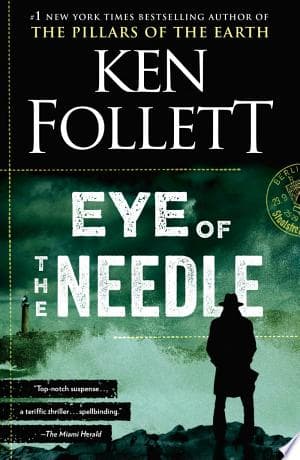
A Nazi master spy races against time to deliver critical D-Day intelligence, only to find his escape and the fate of the war resting with a lonely Englishwoman on a remote island.
In 1944, as D-Day nears, Henry Faber, a skilled German spy known as 'The Needle' for his preferred weapon, a stiletto, parachutes into England. His mission is to gather intelligence on Allied invasion plans. Posing as an English officer, Faber carefully avoids detection, using his cunning and efficiency. He quickly establishes his cover, traveling through the British countryside, always aware of the constant threat of discovery. His first goal is to find and photograph top-secret information about the phantom army in East Anglia, meant to trick the Germans about the real landing site.
Faber's spy skills lead him to an airfield in East Anglia, where he finds the deception of 'Operation Fortitude.' He sees inflatable tanks, fake airfields, and other convincing fakes designed to make Germans believe the main invasion would happen at Pas-de-Calais, not Normandy. Realizing how important this information is, Faber photographs the evidence. This discovery is critical for the German war effort, possibly changing the course of the war if he can send it back to Berlin. The pressure grows as he knows the Allies will soon realize their deception has been compromised.
With the vital photographs, Faber boards a train to reach a U-boat pickup point. However, a chance meeting with Mrs. Garden, his former landlady from a previous mission, threatens to expose him. Mrs. Garden, recognizing his scar, alerts authorities. Faber, realizing he's been caught, kills her without hesitation and makes a daring escape from the moving train. This act confirms his reputation as a cold-blooded killer, but also intensifies the British manhunt, now led by intelligence officer Percival Godliman and his assistant, David Rose.
Fleeing across the country, Faber tries to reach a U-boat waiting off the coast of Scotland. During a dangerous storm, his small boat wrecks on the isolated Storm Island, a desolate outpost in the Hebrides. Lucy Rose finds him; she is a young woman with an injured husband, David, and their young son, Jo. Lucy, at first believing him to be a stranded airman, offers him shelter and care. She doesn't know she has brought a deadly enemy into her home, one who holds the fate of the war in his hands and will use her kindness to achieve his mission.
As Faber recovers, he gains Lucy's trust and her family's. He acts as a charming and helpful guest, slowly winning her over. Lucy, feeling isolated and neglected by her disabled husband, finds herself drawn to Faber's strength and attention. A fragile, unspoken connection starts between them, built on shared vulnerability and loneliness. Faber, always looking for opportunities, recognizes Lucy's emotional state and subtly manipulates it to ensure his continued safety and access to the island's only important radio transmitter.
David Rose, Lucy's husband, a former RAF pilot injured in the war, grows more suspicious of Faber. David, despite his physical limits, has a sharp mind and a strong sense of duty. He notices inconsistencies in Faber's stories and his unusual interest in the island's weather and radio. His suspicions increase because of Faber's unusual arrival and his seemingly perfect English, which is a bit too perfect. David begins to investigate Faber's past, setting the stage for a dangerous confrontation as he gets closer to the truth.
David's persistent investigation eventually uncovers clear proof of Faber's true identity as a German spy. He finds a German-made stiletto and a hidden radio. Confronting Faber, David tries to alert the mainland, but Faber, realizing he's caught, brutally attacks him. A desperate struggle follows, ending with Faber murdering David to protect his secret and his mission. Lucy is left devastated and horrified, understanding the true nature of the man she had taken into her home and the terrible cost of her misplaced trust.
After David's murder, a grief-stricken and angry Lucy understands the full horror of Faber's mission and the devastating results if he succeeds. Driven by revenge and a desire to protect her country, she realizes she is the only one who can stop him. She knows Faber needs the island's radio to send the vital intelligence to Germany. Lucy, finding an inner strength she never knew she had, decides to stop his efforts, starting a tense pursuit across the isolated island as she tries to prevent him from reaching his U-boat pickup.
With British intelligence, led by Godliman, closing in on Storm Island, Lucy and Faber engage in a harrowing chase. Lucy uses her knowledge of the island's dangerous terrain to her advantage, trying to evade Faber and stop him from reaching the radio or the U-boat. Faber, desperate to finish his mission, is ruthless in his pursuit, determined to eliminate Lucy as a threat. The island's isolation increases the tension, turning it into a confined battleground where survival and the fate of nations are at stake. Lucy's strength is tested to its limits.
The chase ends in a tense standoff at the island's radio transmitter. Lucy, having anticipated Faber's move, confronts him, determined to stop him from sending the message. A final, desperate struggle happens between the two. Lucy, fueled by her grief and patriotism, fights with surprising ferocity. Faber, wounded and cornered, still tries to transmit the information. The arrival of British forces, alerted by Godliman, adds to the urgency. The fate of D-Day and the lives of countless soldiers depend on whether Faber can send his message, or if Lucy can stop him in time.
In the final moments, Faber manages to transmit a partial message to Germany, but Lucy's brave action and the timely arrival of British forces stop him from sending the full, decisive intelligence. Faber is eventually cornered and killed by Lucy, who uses David's rifle. Though the Germans receive a garbled, incomplete message, it is not enough to compromise Operation Fortitude. The Allied invasion proceeds as planned, secure that their deception remains largely intact. Lucy, a reluctant hero, has helped ensure D-Day's success, though at great personal cost.
The Antagonist
Faber remains steadfast in his mission, his ruthlessness intensifying as obstacles arise, ultimately leading to his demise.
The Protagonist
Lucy evolves from a lonely, somewhat naive woman into a strong, courageous avenger, finding her inner strength through tragedy.
The Supporting
David moves from a state of quiet resignation to active suspicion and heroic action, culminating in his sacrifice.
The Supporting
Godliman consistently pursues Faber, demonstrating his growing effectiveness as an intelligence operative.
The Supporting
He remains a loyal and diligent assistant, growing in experience throughout the chase.
The Supporting
Jo remains a child, his innocence a stark contrast to the adult world of war and espionage.
The Mentioned
Her brief appearance triggers a major turning point in the plot.
The novel shows the harsh and dehumanizing nature of war, especially through espionage. Faber, a seemingly cultured man, commits murder without hesitation, seeing human lives as expendable for his mission. The constant threat of discovery and the need for violence to survive highlight the moral compromises inherent in wartime intelligence. Scenes like Faber killing Mrs. Garden on the train and later David Rose on Storm Island show how war strips away humanity and forces individuals into desperate acts.
“He knew it was a dirty game, and he was good at it.”
Deception is central to the plot, from the large strategic scale of Operation Fortitude to Faber's personal lies and disguises. The entire Allied D-Day strategy depends on a massive deception campaign, and Faber's mission is to uncover this truth. Conversely, Faber himself is a master of disguise and manipulation, constantly presenting a false persona. The conflict between revealing the truth (Faber's goal) and maintaining the deception (Allied goal, and later Lucy's) drives the story. Lucy's journey involves uncovering the truth about Faber, shattering her illusions.
“The whole invasion was built on a lie, a magnificent, terrifying lie.”
Isolation is a prominent theme, especially through Lucy's character. Living on a remote island with an injured husband, she feels emotionally cut off. This vulnerability makes her open to Faber's charm and apparent connection. Faber, despite his mission, also experiences a type of professional isolation, unable to trust anyone. The brief, intense connection between Lucy and Faber, born of loneliness, turns out to be a dangerous illusion. The island itself acts as a symbol for their emotional and physical isolation, which is eventually broken by the intrusion of war.
“She was isolated, and he knew it. A perfect target.”
The novel shows the unexpected strength and heroism of ordinary people caught in extraordinary situations. Lucy Rose, a seemingly vulnerable and ordinary woman, becomes a strong opponent, driven by grief and patriotism. Her courage in confronting Faber, a highly trained killer, shows that heroism is not limited to soldiers or spies. Similarly, David Rose, despite his disability, shows great courage in uncovering Faber's identity. This theme highlights that even against great odds, ordinary people can rise to protect what they believe in.
“She was no soldier, no spy, but she had a cause now.”
The vital intelligence Faber obtains about the Allied deception.
The photographs Faber takes of the dummy army in East Anglia serve as the primary MacGuffin. This intelligence is the driving force behind Faber's mission and the subsequent manhunt. Its significance is immense: if successfully transmitted, it could expose the Allied deception and potentially alter the outcome of D-Day. The physical presence of the undeveloped film in Faber's possession creates tangible stakes and urgency, as both sides are desperate to either secure or destroy it.
A remote island that serves as both refuge and trap.
Storm Island functions as a crucial plot device, heightening the tension and sense of isolation. Its remoteness makes it an ideal, albeit accidental, sanctuary for Faber, allowing him to recover and attempt his transmission without immediate detection. However, this very isolation also traps Lucy with him, turning her home into a deadly arena. The island's harsh environment and limited escape routes create a claustrophobic atmosphere, intensifying the cat-and-mouse game between Lucy and Faber, and contributing to the feeling of being cut off from the outside world.
Faber's signature weapon, symbolizing his ruthless efficiency.
Faber's stiletto is more than just a weapon; it is a symbol of his identity and his chilling efficiency. It's the source of his codename, 'The Needle,' and its use in his brutal murders underscores his cold, precise, and ruthless nature. The discovery of the stiletto by David is a key moment in exposing Faber's true identity, making it a crucial piece of evidence. Its presence constantly reminds the reader of Faber's dangerous capabilities and the ever-present threat he poses.
The audience knows Faber's true identity while Lucy does not.
Dramatic irony is heavily employed, particularly in the initial scenes on Storm Island. The audience is fully aware that 'The Needle' is a dangerous German spy, while Lucy, out of compassion and her own loneliness, believes him to be a stranded airman. This creates profound tension and dread as Lucy unwittingly harbors her enemy, making her vulnerable and heightening the suspense of David's growing suspicions and eventual discovery. It allows the reader to anticipate the inevitable betrayal and confrontation.
“He knew he was going to die. He had known it for a long time. It was just a question of when.”
— Reflecting on the dangerous life of the spy, 'The Needle'.
“Love, he thought, was the most dangerous weapon of all.”
— Ferguson contemplates Lucy's influence and his own feelings.
“The truth was a weapon, and like all weapons, it could be used for good or ill.”
— Discussing the power of information and deception.
“A good spy was an invisible man, and the invisible man was a lonely man.”
— Ferguson's internal monologue about the nature of his profession.
“He had never felt so utterly alone, so completely cut off from the rest of the world.”
— After being stranded on the island with Lucy.
“Desperate times called for desperate measures, and these were desperate times indeed.”
— The urgency of the war effort and the spy's mission.
“The greatest trick the devil ever pulled was convincing the world he didn't exist.”
— While not original to the book, it's used to describe the subtlety of the spy's methods.
“He was a ghost, a shadow, a whisper in the wind. And he was deadly.”
— Describing the elusive and dangerous nature of 'The Needle'.
“It was amazing how quickly one could adapt to the unthinkable.”
— Lucy's resilience in the face of extreme circumstances.
“The war had a way of bringing out the best and the worst in people.”
— Observation on the impact of conflict on human nature.
“Fear was a cold, hard knot in his stomach, but it was also a stimulant.”
— Ferguson experiencing fear during a high-stakes moment.
“He was a professional, and professionals did not allow personal feelings to cloud their judgment.”
— Ferguson reminding himself of his duty amidst growing emotional entanglement.
“The past was a relentless hunter, and it always caught up with you in the end.”
— Reflecting on the unavoidable consequences of past actions.
“Sometimes, the biggest lies were the ones you told yourself.”
— Lucy's realization about her own self-deception.
Ready to see how well you understood this book? Take our interactive quiz with 10 questions.

Kenneth Martin Follett, is a British author of thrillers and historical novels who has sold more than 160 million copies of his works.







