“I like to talk. I am a talker. I like to talk about everything.”
— Alex describing his personality to Jonathan upon their first meeting.

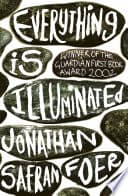
Jonathan Safran Foer (2003)
Genre
Literary Fiction / Historical Fiction
Reading Time
6-8 hours
Key Themes
See below
Sign in to track this book
A young American Jew goes on a funny, difficult journey through post-Soviet Ukraine with a translator who misuses words, a blind, haunted elder, and an 'undersexed' dog. He wants to find out about his grandfather's past and the woman who saved him from the Nazis.
Jonathan Safran Foer, a young American writer, arrives in Lviv, Ukraine, with a photograph and a goal: to find Augustine, the woman who saved his grandfather, Safrans, from the Nazis during World War II. He meets Alex Perchov, a young Ukrainian translator whose English is creatively broken, and Alex's 'blind' grandfather, who will drive them. With them is Sammy Davis, Jr., Jr., the grandfather's 'seeing eye bitch.' Jonathan carries a wrinkled photograph of his grandfather with a mysterious woman, a detail that drives his sincere but somewhat naive search for his family's past in the village of Trachimbrod.
As they begin their journey in an old car, Alex starts writing his own story, mixing Jonathan's real-time experiences with a made-up, detailed history of Jonathan's ancestors and the Jewish village of Trachimbrod. This parallel story, written in Alex's unique English, describes Trachimbrod's founding by a man named Brod, and the later generations of Foers, including their quirks and bad luck. Alex's grandfather, despite being supposedly blind, drives surprisingly well, often making unclear comments that suggest he knows more than he says.
Alex's ongoing story introduces readers to many interesting Foer ancestors in Trachimbrod. He tells the love story of Brod and the Gypsy girl, the sad story of the Foer who fell in love with a pig, and the touching tale of Yankel and the girl who swallowed a wedding ring. These stories, while often funny and absurd, also have a sadness that hints at the destruction Trachimbrod will eventually face. Jonathan, meanwhile, tries to make sense of Alex's exaggerated tales with his own earnest search for historical truth.
Jonathan's interactions with Alex's grandfather are marked by the old man's quietness and avoidance. When Jonathan tries to ask direct questions about the war or Augustine, the grandfather often changes the subject, pretends not to know, or responds with seemingly unrelated stories. This frustrates Jonathan, who wants to put together the factual account of his grandfather's survival. The grandfather's behavior suggests a deep trauma and an unwillingness to face painful memories, creating a barrier to Jonathan's quest for clarity.
After a long and difficult journey, the three, along with Sammy Davis, Jr., Jr., finally arrive at what they believe is Trachimbrod. Instead of a village, they find only an overgrown field, with a few crumbling ruins and forgotten gravestones. The once lively Jewish village, carefully described in Alex's imaginative stories, is now just a ghost of what it was, showing how efficiently the Nazis destroyed it. This desolate scene deeply affects Jonathan, making the reality of the historical tragedy clear.
Among the ruins of Trachimbrod, a key part of the puzzle becomes clear. The grandfather, prompted by the surroundings and Jonathan's persistent questions, reveals that the woman in Jonathan's photograph is not Augustine, but his grandfather's first wife, a woman named Brod. This discovery shatters Jonathan's previous ideas and changes his search, adding another layer of complexity to his understanding of his family's past. The grandfather's admission marks a significant change in his willingness to face the past.
In a powerful confession, Alex's grandfather reveals his true identity: he is not just a driver but a survivor of Trachimbrod and, more importantly, the person who betrayed Jonathan's grandfather, Safrans, to the Nazis. He explains that he was forced to choose between his own life and Safrans's, a decision that has haunted him for decades. This confession is a moment of deep emotional impact, showing the complex moral compromises made during wartime and the lasting psychological scars carried by survivors. It drastically changes Jonathan's view of his family history.
The grandfather further explains Augustine's story, revealing that she was a young Ukrainian woman who, despite the dangers, helped Jewish survivors, including himself. He recounts how, after the war, he looked for Augustine and lived with her for a time, trying to make up for his past actions and find some peace. This revelation highlights the nuanced bravery of individuals during wartime and the grandfather's ongoing struggle with his conscience. It offers a glimmer of hope and human connection amidst the tragedy.
With most of his family's past uncovered, Jonathan gets ready to return to America. He has found not the simple truth he sought, but a complex mix of betrayal, survival, and unexpected connections. Alex, deeply affected by the journey and the discoveries, continues to write his story, now including the painful truths he has learned about his own grandfather and Trachimbrod's destruction. His writing changes, becoming more thoughtful and deep, even as his unique English remains.
After Jonathan leaves, Alex's grandfather, unable to live with the burden of his past actions and the trauma of his memories, commits suicide. This tragic event deeply affects Alex, who must now face not only the historical horrors but also his personal grief and the complex legacy of his own family. The grandfather's death shows the lasting psychological toll of war and how hard it is to find true peace and forgiveness, even decades later. Alex's final letters to Jonathan show his deep sadness and changing understanding.
In a series of touching final letters, Alex shares his grief over his grandfather's death and his continued efforts to process the events of their journey. He struggles with the idea of truth, recognizing that history is often subjective and shaped by individual views and the need for meaning. Alex's writing, while still uniquely his own, shows a deeper understanding of human suffering and the complexities of memory. He continues to combine fact and fiction, creating a story that honors both the brutal realities and the enduring human spirit.
The Protagonist
Jonathan transforms from an innocent seeker of factual truth to someone who understands the nuanced, often painful, nature of memory and storytelling.
The Supporting
Alex evolves from a comically naive and language-mangling translator to a more introspective and empathetic writer, deeply affected by the historical truths he uncovers.
The Supporting/Antagonist
The grandfather gradually sheds his facade of ignorance, confessing his role in the Holocaust and ultimately succumbing to the weight of his past through suicide.
The Supporting
Remains largely static, serving as a symbolic presence and occasional comic relief.
The Mentioned
Her role is redefined from Jonathan's initial misconception to her true, significant, but different, act of kindness.
The Mentioned
His story is slowly revealed through the combined narratives, transforming from a simple survivor to a figure whose past is intertwined with betrayal and complex moral choices.
The novel constantly questions how reliable memory is and how subjective truth can be. Jonathan looks for a factual, historical account, but Alex's imaginative stories and his grandfather's avoidance show that truth is often exaggerated, forgotten, or too painful to face directly. The parallel stories highlight how personal stories and historical facts mix, creating a more complex reality. For example, Alex's detailed fictional history of Trachimbrod, though not true in detail, conveys a deeper emotional truth about the Jewish village's lost vibrancy. The grandfather's eventual confession shows how traumatic memories can be hidden or changed for decades, only appearing under great pressure.
“History is not a story for us. It is a memory. And if you do not know your memory, then you do not know yourself.”
The Holocaust is not just a historical event but a continuing trauma that affects generations. Jonathan's journey is a direct result of this past, as he tries to understand his grandfather's survival. Trachimbrod's destruction, shown as an overgrown field with scattered remains, strongly symbolizes the wiping out of a lively culture. More deeply, Alex's grandfather embodies the lasting psychological scars of the Holocaust, not only as a victim but also as someone forced to make an impossible, morally difficult choice to survive. His suicide at the end emphasizes the unshakeable burden of such memories.
“I will never forget the faces of the Jews who were not saved. Their eyes will always be with me.”
Language is a main theme, especially through Alex's 'unique' English. His wrong words and grammar mistakes create humor but also highlight the barriers to real understanding, both linguistic and cultural. Jonathan often struggles to communicate his earnest questions, while Alex struggles to translate accurately. This language barrier mirrors the deeper difficulty of communicating unspeakable historical truths and emotional pain. As Alex's story changes, his English, while still unusual, becomes deeper, showing his growing understanding and emotional maturity. The novel suggests that even imperfect language can convey deep meaning.
“My legal name is Alexander Perchov. But all of my friends, they call me Alex. And it is a pleasure to meet you, as a new friend.”
The novel itself shows how powerful storytelling is. Alex's imaginative stories about Trachimbrod and the Foer ancestors, while first presented as made-up, become a vital way to deal with history and create meaning. Jonathan's own writing, and his search for a story, drives the plot. Telling stories, even exaggerated ones, allows characters to face their pasts, understand who they are, and connect with others. The book suggests that stories are not just records of events, but essential tools for survival, remembrance, and building who we are, especially when facing overwhelming trauma.
“Sometimes I am wanting to be like you, a writer, because I can make everything to be as I want it to be.”
Two distinct narratives, one historical and one fantastical, running concurrently.
The novel employs two distinct narrative threads: Jonathan's real-time journey to find Augustine and Alex's fictionalized, embellished history of Trachimbrod and Jonathan's ancestors. These narratives are presented side-by-side, often commenting on and contrasting with each other. Jonathan's sections are more straightforward and factual, while Alex's are whimsical, tragic, and written in his unique English. This device allows the author to explore different facets of truth, memory, and history, showing how personal experience and imaginative storytelling both contribute to understanding the past.
Alex's narrative voice, characterized by malapropisms and embellishments, shapes the reader's perception.
Alex Perchov serves as an unreliable narrator, particularly in his historical accounts. His fractured English, combined with his tendency to romanticize and invent details, means that the reader must constantly question the veracity of his statements. This unreliability is not a flaw but a deliberate artistic choice, highlighting the subjective nature of memory and the way stories are constructed. It also allows for moments of profound humor and pathos, as Alex's earnest attempts to communicate often lead to unexpected and poignant turns of phrase, ultimately enriching the emotional depth of the narrative.
An initial objective that drives the plot but ultimately proves to be less important than the journey itself.
Jonathan's quest to find Augustine, the woman in the photograph who he believes saved his grandfather, acts as a classic MacGuffin. It is the initial driving force of the plot, setting Jonathan's journey in motion. However, as the story progresses, the identity of the woman and the exact details of the rescue become less important than the deeper revelations about Alex's grandfather's past, the destruction of Trachimbrod, and the complex nature of survival and guilt. The MacGuffin serves to propel the characters into a much more profound and unexpected exploration of history and identity.
“I like to talk. I am a talker. I like to talk about everything.”
— Alex describing his personality to Jonathan upon their first meeting.
“Many things are, for us, illuminated.”
— Alex's recurring phrase, often at the end of a chapter or letter, signifying a new understanding.
“My life has been many things, but it has not been short. It has also not been long. It has been a medium life.”
— Brod, a character from the past, reflecting on his existence.
“Memory is not a xerox. It is a creative art.”
— Alex's grandfather's perspective on the nature of memory and storytelling.
“For many years I have been hoping for a girl. I have a girl's name. I am a girl. I am a girl who is a boy.”
— Alex's internal conflict and identity struggles, hinted at through his name and feelings.
“Sometimes I can feel the weight of all the things I don't know pressing down on me.”
— Jonathan reflecting on the vastness of history and his personal ignorance.
“It is not a good idea to be a Jew in Ukraine.”
— A stark historical reality conveyed by Alex's grandfather, reflecting the anti-Semitism of the time.
“I am a very bad liar. I am very bad at many things. But I am not bad at being me.”
— Alex's self-assessment, highlighting his acceptance of his own quirks and honesty.
“If I am to be a good translator, I must not only translate words, but also feelings.”
— Alex's ambition and understanding of the deeper aspects of communication.
“The past is a foreign country; they do things differently there.”
— A subtle echo of L.P. Hartley, used by the narrator to frame the historical journey.
“I am not a Jew. I am a human being.”
— Alex's grandfather asserting his universal humanity beyond religious or ethnic labels.
“It is not a problem to be sad. It is a problem to be unable to feel sad.”
— A profound observation on the importance of emotional capacity and vulnerability.
“Sometimes I think that I am just a translator of myself.”
— Jonathan's meta-reflection on his own role as a writer and interpreter of his experiences.
“The memory of the future is a terrible thing.”
— A poignant reflection on the burden of anticipating future suffering or loss.
Ready to see how well you understood this book? Take our interactive quiz with 10 questions.

Jonathan Safran Foer is an American novelist. He is known for his novels Everything Is Illuminated (2002), Extremely Loud & Incredibly Close (2005), Here I Am (2016), and for his non-fiction works Eating Animals (2009) and We Are the Weather: Saving the Planet Begins at Breakfast (2019). He teaches creative writing at New York University.







