“Every man dies alone. And every man is alone in his life.”
— The novel's central theme, reflecting the isolation of individuals under totalitarianism.

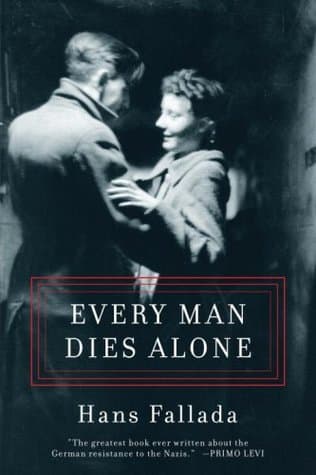
Hans Fallada (2010)
Genre
Historical Fiction
Reading Time
12-15 hours
Key Themes
See below
Sign in to track this book
In Nazi Berlin, an ordinary couple, broken by their son's death, starts a dangerous, silent rebellion against the regime, leading to a deadly pursuit by the Gestapo.
In Berlin, 1940, Otto and Anna Quangel live a quiet life at 55 Jablonski Strasse, trying to navigate the Nazi regime without attracting attention. Otto works as a factory foreman, and Anna is a homemaker. Their world shatters when they receive a letter from the German army saying their only son, Baldur, died in France. This news brings deep grief and moral outrage. Anna, at first more emotional, struggles with the injustice. Otto, a quiet man, internalizes his sorrow and begins planning a quiet but powerful resistance against the regime he blames for his son's death.
Driven to avenge his son and expose Nazi lies, Otto Quangel starts a solitary resistance. He writes anti-Nazi messages on postcards, detailing the regime's cruelties, the war's pointlessness, and urging people to resist. His first message reads, "Mother! The Führer has murdered my son." He places these postcards in public places around Berlin, carefully choosing spots and times to avoid being seen. Anna, initially shocked and afraid of the danger, eventually supports her husband's mission, though she remains terrified of the consequences. This act of defiance, small in scale but huge in courage, becomes their shared secret and purpose.
The anti-Nazi postcards appearing in Berlin cause a stir within the Gestapo. This seemingly small act is a significant threat to morale and the image of an invincible regime. Inspector Escherich, an ambitious Gestapo officer, takes charge of the case. He sees it as a chance to advance his career and becomes obsessed with finding the 'postcard writer.' Escherich uses all available resources, including informants, surveillance, and psychological profiling, to find clues. But the Quangels' carefulness makes them hard to trace, frustrating Escherich and increasing pressure from his superiors.
The apartment building at 55 Jablonski Strasse shows a cross-section of wartime Berlin society. Besides the Quangels, there is the fiercely loyal Nazi Persicke family, who report on their neighbors. They embody the regime's brutality. There is also the kind but fearful retired Jewish judge, Fromm, who slowly loses his dignity and rights. Other characters, like the elderly Frau Rosenthal, show the silent suffering of many. Interactions between these residents highlight the widespread fear, suspicion, and moral compromises the Nazi regime demanded. The Quangels' secret acts of defiance happen amidst watchful eyes and ideological divisions, adding to the immense pressure they face.
As Escherich's investigation intensifies, the Gestapo uses various methods to catch the postcard writer. They set traps, like leaving 'planted' postcards to see who picks them up, and rely heavily on informants. The Persicke family, especially their son Baldur (not the Quangels' son), are zealous Nazi youth who actively inform on perceived dissidents. The Quangels have several terrifying close calls, where their careful planning and Otto's calm manner barely save them from discovery. These incidents show the constant, crushing threat of the Gestapo and the immense courage needed for their continued resistance.
Two petty criminals, Karl Kluge and Emil Borkhausen, accidentally get involved in the postcard case. Kluge, who was in prison with a man who found one of Otto's postcards, starts using the idea for his own petty crimes, planting fake postcards to cause confusion and distract the police. Borkhausen, his accomplice, is more cautious but goes along with Kluge's plans. Their involvement complicates Escherich's investigation, initially misleading him and making him doubt his methods. However, their clumsy attempts eventually bring the Gestapo closer to the truth, as their actions draw more attention to the postcard phenomenon.
Despite their carefulness, the Quangels are eventually betrayed. A combination of factors — increased Gestapo pressure, Kluge and Borkhausen's involvement, and a moment of carelessness — leads to their downfall. A woman who finds one of Otto's postcards, fearing for her safety, turns it in and gives a description. This, combined with other information, leads the Gestapo to Jablonski Strasse. The Quangels are arrested in their home, their quiet defiance brutally exposed. The arrest ends their silent protest and begins their terrible experience within the Nazi justice system.
After their arrest, Otto and Anna Quangel endure intense, brutal interrogations by the Gestapo, mainly by Inspector Escherich and his superior, Commissioner Gobel. Otto, despite severe torture and psychological pressure, refuses to name accomplices or reveal information beyond his own involvement. Anna, though physically weaker, also shows remarkable resilience, protecting her husband and their shared secret. The interrogations aim to break their spirit and extract confessions, showing the cruel methods of the Nazi regime. Their steadfastness in the face of such torment shows their unwavering moral conviction.
Inspector Escherich, initially praised for solving the postcard case and catching the Quangels, soon finds himself in a risky position. His superiors, especially Commissioner Gobel, are ruthless. When it becomes clear the Quangels acted alone and there is no larger 'resistance network,' Escherich is seen as having exaggerated the case and caused unnecessary panic. His earlier ambition and perceived success turn against him. Eventually, in a swift and brutal turn of events, the Gestapo arrests and executes Escherich for perceived failures and insubordination. This shows the regime's readiness to destroy its own.
Otto and Anna Quangel are brought before the Volksgerichtshof (People's Court), a Nazi kangaroo court designed to approve the regime's will. The trial is a sham, with the verdict already decided. Despite their quiet dignity and Otto's calm explanation of his motives, they are quickly condemned for 'undermining military morale' and 'treason.' The judge, a zealous Nazi, gives a harsh sentence, reflecting the regime's zero-tolerance for dissent. The trial illustrates the complete lack of justice and the arbitrary power the Nazi state held over its citizens.
Separated and imprisoned, Otto and Anna Quangel spend their final days in different facilities, awaiting execution. Despite the grim situation, they both keep a remarkable sense of dignity and inner peace, knowing they acted according to their conscience. Otto reflects on his life and choice, feeling a quiet satisfaction in his resistance. Anna, though heartbroken, finds comfort in her love for Otto and the memory of their son. They communicate through smuggled notes, reaffirming their love. Their final moments show a deep resolve and a quiet defiance against the regime that will take their lives.
Otto Quangel is executed first, then Anna. Their deaths are carried out brutally, as per Nazi protocol for dissidents. While their individual acts of resistance are silenced, the novel suggests their postcards, though often destroyed, had a subtle, cumulative effect. They planted seeds of doubt and resistance in some who found them. Their story, based on real events, shows the human spirit's ability to defy tyranny, even when such acts seem pointless and lead to tragedy. Their legacy is one of quiet courage and moral integrity.
The Protagonist
From a compliant, silent citizen, Otto transforms into a determined, solitary resistor, finding his voice and moral purpose through his acts of defiance, ultimately accepting his fate with dignity.
The Protagonist
Anna evolves from a fearful, compliant wife to a courageous partner in resistance, demonstrating unwavering loyalty and strength in the face of extreme adversity.
The Antagonist
Escherich rises through the Gestapo ranks through his ruthless efficiency but is ultimately consumed and destroyed by the very system he serves.
The Supporting
Fromm endures the systematic dehumanization of Jews under the Nazi regime, maintaining his quiet dignity until his tragic end.
The Supporting
They remain steadfast in their Nazi loyalty, benefiting from the regime's power and contributing to the oppressive atmosphere.
The Supporting
Gobel remains a consistently cruel and powerful figure, demonstrating the unchanging brutality of the Nazi hierarchy.
The Supporting
Kluge's selfish acts of imitation initially complicate the investigation but eventually lead to his own capture and contribute to the Quangels' downfall.
The Supporting
Borkhausen is a reluctant participant in Kluge's schemes, ultimately facing the consequences of their actions.
The main theme is the various forms of resistance against totalitarianism. Otto and Anna Quangel's silent postcard campaign, though small, is a profound act of moral courage against an oppressive regime. Their resistance is not violent or organized, but a personal, principled stand against lies and injustice. The novel explores the high personal cost of such defiance, the psychological impact, and the quiet dignity found in following one's conscience, even to death. It shows how one person's refusal to conform can be a powerful, if tragic, statement.
“Mother! The Führer has murdered my son!”
Fallada shows how evil spreads through everyday life under Nazism, not just through major atrocities but through ordinary people. Characters like the Persickes, who eagerly inform on neighbors, and the Gestapo's efficient bureaucracy, especially Inspector Escherich, show how individuals become parts of a monstrous machine. This theme highlights how fear, ambition, and conformity enable the regime's power, making people complicit or indifferent to suffering. The novel shows that evil is often common, woven into daily life, making it more insidious.
“He knew that he was a small man, and that what he was doing was small. But he also knew that smallness, when it was multiplied by many, could become something great.”
The novel is deeply rooted in grief and loss, particularly the death of the Quangels' son, Baldur. His death starts their entire resistance. Otto and Anna's deep sorrow turns their passive lives into active defiance. The novel explores how grief can motivate moral action, pushing individuals beyond their comfort zones. It also touches on the widespread loss families experienced during wartime, and how such tragedies can lead to re-evaluating societal values and political loyalties.
“Her son was dead. And if she had to die too, she wanted to die for him.”
The stark difference between true justice and twisted justice under totalitarianism is a key theme. The Gestapo's arbitrary arrests, brutal interrogations, and the sham trials of the People's Court show a complete lack of a real legal system. Characters like Judge Fromm, once a pillar of justice, become victims of this perversion. The state calls the Quangels' acts 'treasonous,' while the story portrays their moral stand as inherently just. The novel questions what true justice means in a society where the state itself is criminal, and where moral uprightness is punished as a crime.
“Justice? There is no justice here. Only the will of the Führer.”
Despite the Nazi state's overwhelming power, the novel emphasizes the lasting power of individual conscience and action. Otto and Anna Quangel, two ordinary people, choose to act on their beliefs, even if it means certain death. Their story suggests that even seemingly insignificant acts of defiance can hold deep moral weight and subtly inspire others. It shows that human dignity and moral agency can persist even in the most dehumanizing situations, proving that true strength is not physical power but an unyielding spirit.
“What he did, he did alone. And what he suffered, he suffered alone. But he was not alone in his conscience.”
The physical manifestation of the Quangels' silent resistance.
The anti-Nazi postcards are the central plot device. They serve as the catalyst for the entire Gestapo investigation and the Quangels' tragic journey. Each postcard, with its brief, defiant message, is a physical act of rebellion, a small stone thrown against a giant wall. They symbolize the power of words and truth against propaganda, and the immense courage required for even a minor act of dissent under a totalitarian regime. The postcards also become a source of fear for the public, a puzzle for the Gestapo, and a symbol of hope for a few, driving the narrative forward.
A microcosm of wartime German society.
The apartment building at 55 Jablonski Strasse functions as a powerful symbolic setting and a microcosm of German society under Nazi rule. Its diverse residents – the Quangels, the Persickes, Judge Fromm, and others – represent different facets of the population: the resistors, the fanatics, the victims, and the indifferent. The close proximity and forced interactions within the building highlight the pervasive fear, suspicion, and ideological divisions of the time. It allows Fallada to explore the 'banality of evil' and the personal dramas unfolding against the backdrop of national tragedy within a confined, relatable space.
The historical document that inspired the novel, lending authenticity.
The novel is explicitly based on a true Gestapo file concerning Otto and Elise Hampel, the real-life couple who inspired the Quangels. This plot device, though external to the narrative itself, lends immense historical authenticity and weight to the story. It grounds the fiction in verifiable fact, emphasizing that such acts of quiet courage and the brutal state response were real. The existence of the file highlights the meticulous record-keeping of the Nazi regime and paradoxically preserves the memory of those it sought to erase, making the Quangels' story a testament to historical truth.
The suspenseful pursuit between the Quangels and Inspector Escherich.
The dynamic between the Quangels' meticulous, clandestine postcard distribution and Inspector Escherich's relentless, increasingly desperate hunt creates a gripping 'cat and mouse' suspense. This device drives much of the immediate plot tension. Each side employs cunning and strategy, with the stakes being life and death. The back-and-forth between the Quangels' near-misses and Escherich's close calls keeps the reader on edge, illustrating the immense pressure on both the resistors and the state's enforcers, and highlighting the inherent dangers of any act of defiance.
“Every man dies alone. And every man is alone in his life.”
— The novel's central theme, reflecting the isolation of individuals under totalitarianism.
“The great thing about the Nazis was that they took away all your freedom, and then you had nothing to lose.”
— Otto Quangel's cynical reflection on the regime's oppressive nature.
“You can't change the world, but you can change yourself.”
— Anna Quangel's quiet philosophy amidst the despair, emphasizing personal integrity.
“He hated them, not with a screaming, raging hatred, but with a cold, quiet, enduring hatred that was more dangerous.”
— Describing Otto Quangel's deep-seated resentment towards the Nazi regime.
“Fear is a bad counsellor. But it is always there, and you have to live with it.”
— Characters grappling with the pervasive fear instilled by the Gestapo.
“In times like these, even a small act of kindness is a revolution.”
— Highlighting the significance of human compassion amidst widespread cruelty.
“The truth is a dangerous thing, but lies are even more dangerous.”
— A reflection on the propaganda and deceit prevalent in Nazi Germany.
“It's not about winning or losing, it's about not giving up.”
— The spirit of quiet, persistent resistance embodied by the Quangels.
“The world needs people who are brave enough to be kind.”
— Emphasizing the moral courage required to show empathy in a brutal regime.
“He felt like a small fly caught in a giant spiderweb, knowing that escape was impossible.”
— Otto's feeling of helplessness against the overwhelming power of the state.
“Even in the darkest night, there is always a glimmer of light.”
— A recurring sentiment of enduring hope, however faint, in dire circumstances.
“Silence can be a weapon, and it can be a shield.”
— Characters using silence to protect themselves or to express dissent.
“The greatest prison is not made of walls, but of fear.”
— Exploring the psychological impact of living under a totalitarian regime.
“He had done his duty, not to the state, but to his conscience.”
— Otto's ultimate justification for his acts of resistance.
Ready to see how well you understood this book? Take our interactive quiz with 10 questions.

Biography coming soon.







