“Every heart a doorway, and every doorway a story. Some doors lead to sunshine, and some to shadow. Some to worlds of wonder, and some to worlds of fear.”
— A general observation on the nature of other worlds and the individuals who find them.

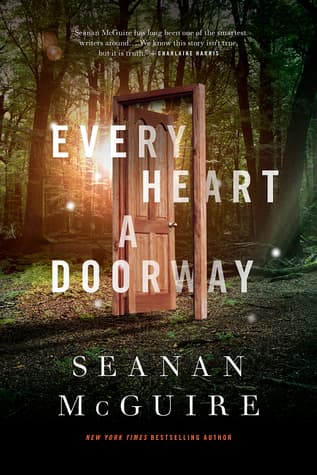
Seanan McGuire (2016)
Genre
Fantasy / Mystery / Young Adult
Reading Time
90 min
Key Themes
See below
Sign in to track this book
At a peculiar boarding school for children who've returned from fantastical worlds, a new arrival and a string of mysterious deaths force the students to confront whether the darkness they escaped has followed them home.
Nancy, a quiet and asexual girl who spent time in a world of the dead, arrives at Eleanor West's Home for Wayward Children. This unique boarding school helps children who have found their way to other worlds and, for various reasons, have been returned. Each student wants to go back to their fantasy land, and Miss West, who herself once visited a world of logic, understands their yearning. Nancy is assigned a room and begins to navigate the school's social dynamics, observing the different 'types' of worlds the children came from – Nonsense, Wicked, Logic, and Fairytale. She quickly learns the unwritten rules and social hierarchies among the students, each shaped by their unique experiences and the trauma of being returned.
Soon after Nancy's arrival, a horrific event shatters the fragile peace of the Home. Lorna, a girl who had returned from a world of sentient dolls, is found dead in her bed, her throat slit and her body horribly dismembered. The gruesome discovery sends fear and suspicion through the school. Miss West immediately contacts the authorities, but the police are baffled by the nature of the crime and the strange inhabitants of the school. The students, many of whom have experienced violence and strangeness in their other worlds, are deeply affected, and the collective hope of returning to their worlds feels more distant than ever. Nancy, despite her quiet nature, is drawn into the mystery.
The police investigation yields little, as the students are reluctant to share details about their 'other worlds' with outsiders. Miss West tries to protect her charges, but tensions rise among the students. Suspicion falls on various individuals, including Kade, a transgender boy who returned from a goblin market, and Jack and Jill, twins with a dark history in a world of mad scientists. Nancy starts to form connections, particularly with Sumi, a cheerful girl from a world of candy, and begins to observe the subtle hostilities and alliances within the student body. The unique trauma of being 'returned' makes everyone a potential suspect, as their moral compasses are often skewed by their experiences.
Before the students can fully process Lorna's death, another tragedy strikes. Sumi, Nancy's new friend, is found dead, also brutally murdered. Her death is particularly shocking, not only because she was well-liked, but also because it confirms there's a serial killer among them. The second murder intensifies the fear and paranoia, driving a wedge between the students. Miss West struggles to maintain order and ensure the safety of the remaining children. The police are no closer to finding the culprit, and the students realize they might have to solve the mystery themselves, using their unique, often disturbing, understanding of the world.
Driven by the loss of Sumi and the desire to protect others, Nancy, along with Kade and Christopher, a boy whose world was populated by the dead, decide to conduct their own investigation. They start by interviewing other students, piecing together clues and trying to understand the motives behind the murders. Nancy's quiet observational skills and Kade's practical nature are useful. They learn more about the dark histories and emotional wounds of their peers, realizing that everyone at the Home carries a burden that could lead to violence, or make them a target. The investigation is dangerous, as the killer is still among them.
As Nancy and her allies look deeper, they focus their attention on Jack and Jill, the twins who returned from a gothic horror world of mad scientists and reanimated corpses. Christopher reveals that his world of the dead helps him understand the undead, and he can sense a lingering strangeness around Jill. They learn that Jill was once a loyal assistant to a mad scientist, while Jack was his unwilling subject. Their world was one of scientific pursuit and ethical depravity, where life and death held different meanings. The twins' shared past is deeply intertwined with their present behavior, and Nancy suspects their world's influence is more apparent than it appears.
Through careful deduction and observation, Nancy, Kade, and Christopher eventually uncover the horrifying truth: Jill is the murderer. Her motive stems from her desperate desire to return to her world, where she was valued and had a clear purpose. She believed that by collecting enough 'pieces' – body parts from the other students – she could reanimate a creature that would open a doorway back to her gothic horror world. Her time in the mad scientist's laboratory had warped her understanding of life and death, turning her into a cold, calculating killer with a perverse sense of scientific experimentation. The revelation is devastating, especially for Jack, who had always protected his sister.
Nancy confronts Jill, who has already begun her macabre ritual with the collected body parts. A violent struggle ensues, with Jill proving to be a formidable and ruthless opponent, devoid of empathy. Jack, torn between his love for his sister and his horror at her actions, ultimately sides with Nancy and the others, trying to stop Jill. Christopher's unique abilities also play a crucial role in the confrontation. In the end, Jill is defeated, but not without further tragedy and sacrifice. The confrontation leaves a lasting impact on all involved, forcing them to confront the darker aspects of their own experiences and the price of their longing for 'home'.
In the aftermath of the murders and Jill's defeat, the school community is shattered but ultimately begins to heal. The police are finally able to close the case, albeit with a heavily censored version of events. Miss West works to restore a sense of normalcy, though the innocence of the Home has been irrevocably lost. Christopher, having played a key role in stopping Jill and having found a renewed purpose, finds a way back to his world of the dead, fulfilling his deepest desire. Kade also accepts his past and finds a new direction for his future, deciding to stay at the Home and help Miss West.
Nancy, having survived the ordeal and helped solve the murders, is left to contemplate her own future. She realizes that her world of the dead, while peaceful and beautiful in its own way, is not a place for the living. She makes a conscious decision to remain in her original world, accepting that her time in the land of the dead was a chapter, not her entire story. She finds a sense of belonging and purpose at Eleanor West's Home, understanding that while she may never return to her fantastical world, she can still find meaning and connection among others who share her unique experiences. She becomes an integral part of the school's new dynamic, offering quiet strength and understanding.
The Protagonist
Nancy evolves from a withdrawn newcomer to a courageous investigator, ultimately accepting her place in the 'real' world while finding purpose in helping others at the Home.
The Supporting
Eleanor struggles to maintain control and protect her students amidst the murders, ultimately accepting the dark realities of their worlds and her role in helping them heal.
The Supporting
Kade grapples with his longing for his world and his identity, finding a new sense of purpose and belonging at the Home by helping others.
The Supporting
Christopher finds a renewed purpose and understanding of his abilities, ultimately achieving his desire to return to his world.
The Antagonist
Jill's arc is one of escalating villainy, culminating in her exposure and defeat, revealing the destructive power of a warped longing for 'home'.
The Supporting
Jack grapples with loyalty and morality, eventually making the difficult choice to confront his sister's evil actions.
The Supporting/Victim
Sumi's arc is tragically cut short by her murder, serving as a catalyst for the main plot.
The Mentioned/Victim
Lorna's arc is brief, as she is the initial victim, serving to kickstart the mystery and establish the stakes.
Every child at Eleanor West's Home shares a deep and often painful longing to return to their magical worlds, which they consider their true homes. This theme appears in their conversations, their carefully curated 'world rooms,' and their deep dissatisfaction with the ordinary reality of the 'real' world. Jill's murderous rampage is the most extreme expression of this longing, showing how the desire for belonging, when warped, can lead to horrific acts. Nancy, too, grapples with this, ultimately finding a new form of belonging at the Home itself.
“For us, the only way to be home again is to find a door. Or to make one.”
The children's experiences in their other worlds have shaped their identities, often making them feel like outsiders in their original world. Kade, as a transgender boy, felt truly seen and accepted in his goblin market world, highlighting the struggle for identity. Nancy's asexuality is also a part of her identity that is understood and accepted at the Home, in contrast to the expectations of the 'real' world. The Home provides a space where these unique identities, forged in fantastical lands, can be acknowledged and, to some extent, healed.
“We are all mad here, you know. But we're also all ourselves.”
Each child at the Home carries significant trauma from their experiences in magical worlds and, perhaps more acutely, from being returned. This trauma appears in various ways: Kade's dysphoria, Christopher's quiet detachment, and Jill's complete moral corruption. The school is a form of therapy, a place where children can process their experiences without judgment. The murders force the students to confront their trauma directly, as they must use their unique, often dark, worldviews to understand and stop the killer.
“It is a dangerous thing to be a child who has been to a magical land. They are always half-gone, always looking for the door that will take them home.”
The novel explores how experiences in different worlds can blur the lines between good and evil, changing individuals' moral compasses. Jill, molded by her gothic horror world, commits heinous acts without remorse, viewing them as scientific endeavors rather than murders. The students, having lived in worlds with different ethical frameworks, struggle to apply conventional morality to their situation. The story suggests that 'evil' can arise from a twisted sense of purpose or a desperate longing, rather than inherent malice, challenging simple notions of morality.
“Some worlds are all logic, some are all nonsense, and some are all wicked.”
A boarding school for children who have returned from magical worlds.
This unique setting acts as a safe haven and a crucible for the story. It brings together diverse characters, each with their own fantastical backstory, creating a microcosm of 'returned' children. The school's rules and Miss West's understanding provide a fragile sense of order, which is then disrupted by the murders. It functions as both a sanctuary and a prison, as the children are trapped between their longing for other worlds and their inability to return.
Categorization of magical realms into Logic, Nonsense, Wicked, and Fairytale.
This classification system helps the reader understand the diverse backgrounds and psychological impacts on the characters. It provides a framework for understanding their motivations, coping mechanisms, and even their moral compasses. For example, Jill's 'Wicked' world explains her detached cruelty, while Sumi's 'Nonsense' world explains her initial cheerfulness. It's a shorthand that enriches character development and foreshadows potential conflicts.
The driving motivation for most characters to return to their magical worlds.
The constant longing to find a 'door' back to their respective worlds serves as a powerful symbol of hope, despair, and ultimately, the core motivation for many characters. It fuels their existence at the Home and, in Jill's case, drives her to murder. The 'door' represents not just a physical passage but a return to a place where they felt whole, understood, and truly themselves. Its absence is the central tragedy of their lives.
Character traits that highlight themes of identity and acceptance.
Nancy's asexuality and Kade's transgender identity are not merely incidental details but crucial aspects of their characters that underscore the novel's themes of identity and belonging. These traits highlight how the 'real' world often fails to understand or accept them, making their magical worlds places where they felt truly seen. Their experiences contribute to the Home being a place of refuge and understanding for those who don't fit societal norms.
“Every heart a doorway, and every doorway a story. Some doors lead to sunshine, and some to shadow. Some to worlds of wonder, and some to worlds of fear.”
— A general observation on the nature of other worlds and the individuals who find them.
“For some of us, there is no going home. And for some of us, home isn’t a place at all, but a feeling. Or a person. Or a story.”
— Nancy reflects on the difficulty of returning to the 'real world' after experiencing a portal fantasy.
“We are all of us broken things. We are all of us searching for the pieces that will make us whole.”
— Eleanor Vance's philosophy about the students at the school, who are all trying to cope with their pasts.
“Children who fall into other worlds tend to be a specific type: curious, clever, and just a little bit out of place.”
— The narrator describes the common characteristics of children who find portal worlds.
“Fairytales are true. Not because they tell us that dragons exist, but because they tell us that dragons can be beaten.”
— A perspective on the enduring power and meaning of fairytales.
“There are things that are worse than death. Being forgotten is one of them.”
— Summoned by Christopher reflecting on the fate of those who are lost to their worlds.
“Some roads are not meant to be walked alone.”
— Lundy's advice to students, emphasizing the importance of community and support.
“We all have our monsters. Some of us just keep them in better cages.”
— A character's observation about the internal struggles everyone faces.
“The world doesn't care if you're a hero or a villain. It just keeps turning.”
— A cynical view on the indifference of the universe to individual actions.
“Sometimes, the only way to find yourself is to get lost.”
— A common theme among the students who found their true selves in other worlds.
“Reality is a crutch for people who can't cope with drugs and alcohol.”
— Kade's dismissive view of the mundane world he was forced to return to.
“There are no monsters, only people who are afraid.”
— A compassionate perspective on the source of cruelty and fear.
“Hope is a dangerous thing. It can drive a man to madness, or make him do the impossible.”
— A reflection on the dual nature of hope, both destructive and motivating.
Ready to see how well you understood this book? Take our interactive quiz with 10 questions.
Biography coming soon.







