“I am a drifter, and as lonely as that can be, it is also remarkably freeing.”
— A reflects on the nature of their existence, moving into a new body each day.

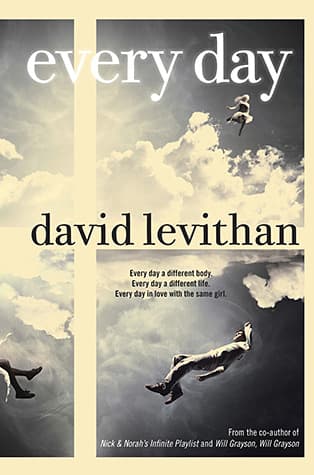
David Levithan (2012)
Genre
Fantasy / Science Fiction / Young Adult / Romance
Reading Time
360 min
Key Themes
See below
Sign in to track this book
A nomadic soul, shifting bodies daily, risks a lifetime of solitude to pursue a singular, impossible love with a girl who can only know them anew with each sunrise.
A, a mysterious entity that wakes up in a different body every day, begins a new day in the body of Justin, a high school student. A navigates Justin's morning routine and attends school, where A meets Justin's girlfriend, Rhiannon. Despite A's strict personal rules about not interfering with lives and avoiding attachment, A is captivated by Rhiannon. A spends the day connecting with Rhiannon, something Justin rarely does, leading Rhiannon to comment on Justin's unusual attentiveness. As the day ends, A feels a longing, realizing A has fallen in love with Rhiannon and dreading the inevitable departure from Justin's body.
The next morning, A wakes up in the body of a girl named Amy. Driven by the desire to see Rhiannon again, A uses Amy's computer to find Rhiannon's school and then drives Amy's car there, fabricating an excuse for Amy's absence. A finds Rhiannon and explains the truth: A is the same person who was in Justin's body yesterday, now in Amy's. Rhiannon is disbelieving and disturbed, dismissing A as a prank or a deluded stranger. A's attempts to convince her are met with fear and confusion, showing the challenge of maintaining a relationship under such extraordinary circumstances.
Over the following days, A inhabits various bodies – a boy, a girl, an overweight student, a popular jock – and each day, A finds a way to reach out to Rhiannon. Sometimes A manages to spend time with her, sometimes just to send a message. Rhiannon, initially resistant and frightened, slowly begins to recognize A's consistent personality and affection, despite the ever-changing physical form. She starts to feel a connection, but the constant change, the secrecy, and the ethical implications of A inhabiting different people's lives cause her emotional turmoil and confusion. She questions the nature of love and identity.
While inhabiting the body of a boy named Nathan Daldry, A attends a party. The next day, A wakes up in a new body, only to discover that Nathan Daldry is publicly claiming to have been possessed by the devil. Nathan, now back in his own body, recounts the exact details of A's time in him, including private thoughts and conversations, leading to a media frenzy and attracting the attention of religious zealots and scientists. This exposure of A's existence poses a threat to A's anonymity and to the lives of the people A inhabits, as Nathan's story gains traction and credibility.
Despite the public spectacle surrounding Nathan, Rhiannon's bond with A strengthens. She finally accepts A's daily transformations and commits to trying to make their relationship work. They establish a system: A will try to find a way to contact Rhiannon each day, and Rhiannon will try to meet A, regardless of the body. They share intimate moments and attempt to define their love beyond physical appearance. Rhiannon introduces A to her parents, albeit with a different 'date' each time, creating awkward but often humorous situations that only they understand.
The constant transitions, the need for secrecy, and the emotional toll of never being able to truly build a shared life begin to wear on both A and Rhiannon. Rhiannon struggles with the lack of a consistent physical partner, while A feels the burden of inadvertently disrupting lives and the pain of leaving Rhiannon every night. This strain motivates A to consider breaking one of the most fundamental rules: to find a way to stay in one body permanently. A begins to research and contemplate drastic measures, driven by the desire for a normal, stable relationship with Rhiannon.
A learns about Kelsea, a girl in a coma whose family is considering taking her off life support. Seeing an opportunity for a permanent body, A visits Kelsea in the hospital, contemplating the ethical implications of inhabiting Kelsea's body indefinitely. A believes this could be the only way to have a lasting relationship with Rhiannon. A discusses this possibility with Rhiannon, who is hesitant and disturbed by the idea, recognizing the moral dilemma of essentially taking over someone else's life, even if that life is fading.
Nathan Daldry, still obsessed with the 'possession' he experienced, tracks A down while A is in another body. Believing A to be a demonic entity, Nathan attempts an exorcism. During this confrontation, A realizes that Nathan, in his own distorted way, is another being like A – a soul that also inhabits different bodies. Nathan's experience, however, has led him to fanaticism and self-loathing, believing himself to be evil. This encounter shatters A's belief of being unique, opening up the possibility of a shared existence with others like A, but also showing the dangers.
After the encounter with Nathan, A has a realization. A understands that trying to force a permanent life with Rhiannon would ultimately be unfair to her, limiting her to a life of secrecy and constant adaptation, and would involve taking another person's life (Kelsea's) for A's own gain. A recognizes that true love means wanting what is best for the other person, even if it means personal sacrifice. A decides that Rhiannon deserves a normal life and a partner who can be physically present and stable. This leads to a painful but necessary decision to end their romantic relationship.
In a final act, A inhabits Justin's body once more. Instead of pursuing Rhiannon, A uses this day to connect with Rhiannon as Justin, giving her a sense of closure and a positive memory of her actual boyfriend. A encourages Justin to be a better boyfriend, to truly see and appreciate Rhiannon, and to make amends for his past neglect. A gives Rhiannon a heartfelt farewell, explaining the decision to step aside for her happiness. A then leaves Justin's body, knowing that Rhiannon now has the opportunity for a stable, conventional relationship, while A continues the nomadic existence, forever carrying the memory of Rhiannon.
The Protagonist
A moves from a detached observer to someone deeply committed to love, ultimately learning that true love sometimes requires self-sacrifice for the other's happiness.
The Love Interest
Rhiannon evolves from a confused, skeptical girl to someone who understands and accepts a love beyond physical form, ultimately learning to prioritize her own needs for a stable future.
The Supporting
Justin remains largely static but is given a chance for redemption by A, subtly nudged towards being a better partner.
The Antagonist/Supporting
Nathan becomes increasingly fanatical and public about his 'possession,' serving as a warning of what A could become if not careful.
The Mentioned/Supporting
A temporary vessel for A's initial pursuit of Rhiannon, her life is briefly altered.
The Mentioned
Her comatose state presents a moral crossroad for A, influencing A's ultimate decision.
The Supporting
Remains static, representing a dogmatic interpretation of the supernatural.
The Supporting
A stable source of support for Rhiannon throughout her emotional turmoil.
The novel explores the nature of identity, questioning whether it is tied to physical form, personality, or something more intrinsic. A, lacking a consistent body, defines self through memories, experiences, and moral principles. Rhiannon's journey involves learning to see beyond the physical and connect with A's true essence. The story suggests that true identity resides not in appearance or social roles, but in one's core character and capacity for connection. This is evident as Rhiannon falls in love with 'A' despite A's ever-changing physical manifestation.
“What does it mean to love someone? It means to see them. To see all of them. To see past the body and the person and the life they’re living, and to see into their soul.”
The central theme is whether love can transcend physical form, gender, and social status. A's love for Rhiannon challenges conventional notions of romance, as their relationship is built purely on emotional and intellectual connection, unhindered by outward appearance. The book examines the sacrifices and difficulties in such a love, including the longing for physical intimacy and shared experiences. Ultimately, it suggests that true love is selfless, prioritizing the well-being and happiness of the beloved above one's own desires, as shown by A's final decision.
“It is not a question of whether I want to be with you, Rhiannon. It is a question of whether I can be with you.”
A's daily existence creates a sense of empathy, as A literally walks in the shoes of countless individuals from diverse backgrounds. This allows A to understand the human condition from many perspectives, from the popular jock to the depressed introvert, the wealthy to the struggling. This constant exposure to different lives shapes A's compassionate worldview and enhances A's ability to connect deeply with Rhiannon. The novel encourages readers to consider the lives of others and practice understanding beyond superficial judgment.
“I learn something new every day. I learn it with my heart, my brain, my body. I learn it with all of me.”
A's unique existence presents ethical challenges. A constantly grapples with the responsibility of inhabiting someone else's life, trying to minimize disruption and avoid permanent alteration. The moral questions intensify when A considers taking over Kelsea's comatose body or when A's presence in Nathan Daldry's body leads to public hysteria. The novel explores the line between observation and interference, and the impact one's choices can have on others, even when those choices are made with good intentions.
“I have to leave them as I find them. That is the rule. That is the only way I can live.”
A's entire existence is defined by transience, a constant state of flux. This instability clashes with the human desire for permanence, particularly in relationships and personal identity. A's love for Rhiannon shows this conflict, as A longs for a stable, continuous life with her, something that seems impossible. The struggle to reconcile transience with the yearning for lasting connection is a core emotional engine of the narrative, leading A to contemplate drastic measures before accepting the reality of the situation.
“Every day is a new body. Every day is a new life. Every day I am in love with the same girl.”
Narrative told from A's perspective, experiencing different lives.
The story is told entirely from A's internal perspective, but because A inhabits a different body each day, the narration offers a unique form of limited omniscience. A has access to the host's memories and some thoughts, providing glimpses into many different lives and backgrounds. This allows the reader to experience the world through a vast array of identities, fostering empathy and illustrating the diversity of human experience, while maintaining a consistent emotional core through A's unchanging personality.
A's supernatural ability to wake in a new body each day.
This is the core fantastical element of the novel. The daily transformation serves as the primary engine of the plot, creating both the central conflict (A's inability to stay with Rhiannon) and the unique opportunities for A to learn and grow. It forces A to constantly adapt, observe, and understand different facets of human existence. It also acts as a powerful metaphor for the transient nature of life, identity, and the challenges of maintaining connection in a constantly changing world.
Self-imposed guidelines for A's daily life.
A has established strict rules for navigating the daily body changes: 'Never get too attached. Avoid being noticed. Do not interfere.' These rules function as a moral compass for A and create internal conflict when A falls in love with Rhiannon. The breaking of these rules drives much of the narrative, showing A's personal growth and the sacrifices A is willing to make for love. They also highlight the ethical dilemmas inherent in A's existence.
The protagonist's lack of a specific name or gender.
The protagonist is simply referred to as 'A,' emphasizing A's lack of a fixed identity. This anonymity reinforces the theme of identity being separate from physical form or social labels. It allows readers of any gender to connect with A's experiences and makes A a universal figure. The absence of a name highlights A's transient nature and the idea that A's true self is an internal, consistent consciousness rather than an external persona.
“I am a drifter, and as lonely as that can be, it is also remarkably freeing.”
— A reflects on the nature of their existence, moving into a new body each day.
“I wake up thinking of yesterday's memories. They are the only possessions I have that I keep with me from life to life.”
— A describes how memories are their sole constant in a life of constant change.
“I have never had a choice. I am who I am, regardless. I am who I am, regardless of the body I'm in.”
— A asserts their core identity despite inhabiting different bodies daily.
“The greatest gift you can give someone is your time, because you're giving them something you can never get back.”
— A reflects on the value of time and connection in their transient life.
“I am not a boy or a girl. I am not a straight or gay. I am not a anything. I am just me.”
— A explains their genderless and fluid identity to Rhiannon.
“You notice the emptiness only if you are looking for fullness.”
— A muses on perception and the human tendency to seek what is missing.
“I fall in love a little bit with anyone who shows me their soul. This world is full of souls.”
— A expresses their capacity for love and connection despite their circumstances.
“The only way to get through life is to laugh your way through it. You either have to laugh or cry. I prefer to laugh. Crying gives me a headache.”
— A shares a perspective on coping with life's challenges, often in difficult bodies.
“I am a collection of oddities, a circus of neurons and electrons, my heart a brain, my brain a heart.”
— A poetically describes their complex inner self beyond physical form.
“There is never a time for the truth. There is only the truth, and the time you take to face it.”
— A reflects on honesty and the inevitability of confronting reality.
“I have learned that the world is not a wish-granting factory.”
— A acknowledges the harsh realities of life, influenced by their experiences.
“Love is the most powerful thing there is. It's the only thing that can make a life worth living.”
— A emphasizes the central role of love in finding meaning, especially with Rhiannon.
“I am not a ghost. I am not a dream. I am a person, and I am here.”
— A asserts their existence and humanity to Rhiannon, seeking validation.
“The hardest part is knowing that I will never be able to give someone a lifetime. I can only give them a day.”
— A laments the limitations of their existence in forming lasting relationships.
Ready to see how well you understood this book? Take our interactive quiz with 10 questions.

David Levithan is a celebrated author of young adult fiction, known for his lyrical prose and exploration of complex emotional themes. His notable works include the bestselling novel "Every Day," which was adapted into a film, and "Love Is the Higher Law." Levithan also co-authored "Will Grayson, Will Grayson" with John Green.







