“There are two kinds of people in this world: those who believe there are two kinds of people in this world, and those who don't.”
— A philosophical observation on human categorization.

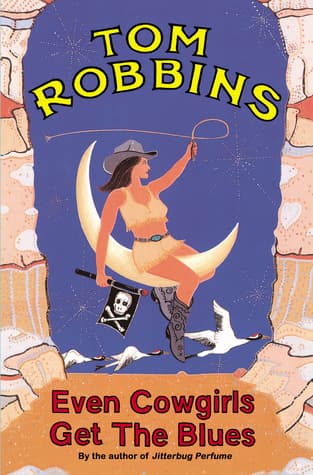
Tom Robbins (1976)
Genre
Literary Fiction
Reading Time
9-12 hours
Key Themes
See below
Sign in to track this book
Sissy Hankshaw, with thumbs as unusual as her desire to travel, hitchhikes across America, a free spirit looking for identity, love, and the real story behind the 'cowgirl' image.
Sissy Hankshaw is introduced as a girl born in Richmond, Virginia, with unusually large thumbs. This genetic trait makes her an object of curiosity and causes her to feel slightly different from a young age. Her thumbs are not just big; they are also very strong and flexible, becoming the main feature of her life. While her family, especially her mother, tries to treat her normally, Sissy knows her hands are special. This physical difference leads her to a strong connection with the open road and hitchhiking, a habit she starts early. She finds freedom and self-expression by catching rides across America. Her thumbs, at first a source of difference, become her greatest tool.
Sissy Hankshaw becomes famous in the hitchhiking world, known across the country for her unmatched ability to get rides. Her reputation as the 'Queen of Hitchhikers' eventually gets the attention of Julian Gitche, a rich and unusual guru who runs 'The Countess,' an empire of high-end feminine hygiene products. Julian, interested in Sissy's unique spirit and body, proposes marriage, not for typical romance, but as a symbolic union. Sissy, looking for a different kind of stability and perhaps a deeper understanding of herself, agrees. Their marriage is unusual, marked by Julian's philosophical thoughts and Sissy's continued desire to travel, even as she tries to settle into a more domestic life in New York City.
Julian Gitche, always a showman and business owner, decides to feature Sissy in a big advertising campaign for 'The Countess' products. The commercial aims to use Sissy's well-known image and her natural, uninhibited spirit. While Sissy takes part, her heart is not fully in it. The artificiality of the commercial world and the limits of her new life with Julian start to clash with her natural desire for freedom and real experiences. She feels more and more disconnected from her structured, city life, longing for the open road and the spontaneous meetings that defined her earlier life. This time shows her inner conflict between what society expects and her own wild nature.
Feeling uneasy and given a vague task by Julian to look into a strange situation, Sissy Hankshaw travels to the Chink, a remote ranch in the Pacific Northwest. Julian has heard rumors of a group of cowgirls living an unconventional life there, and he believes Sissy, with her unique view and connection to nature, is the best person to observe them. Sissy, eager to escape her marriage and return to the road, quickly accepts the job. Her journey is a return to her hitchhiking roots, a trip back to the freedom and unpredictability she loves, leading her to an encounter that will deeply change her understanding of identity and community.
When Sissy Hankshaw arrives at the Chink, she finds a lively and unusual community of cowgirls, living independently and defiantly in the wilderness. These women, including figures like Bonanza Jellybean, are strong, independent, and fiercely protective of their way of life, which challenges traditional gender roles and social norms. They are involved in many activities, from ranching to philosophical discussions, all guided by self-determination. Sissy is immediately drawn to their spirit and the sense of belonging she finds among them, a feeling that contrasts sharply with the isolation she often felt in her more conventional life. This meeting marks a big turning point in her journey of self-discovery.
Sissy quickly learns that the cowgirls at the Chink are involved in a secret operation: protecting a flock of rare whooping cranes. These cranes, thought to be the last of their kind, are central to the cowgirls' beliefs and their connection to nature. The women are not just watching the birds; they are actively working to ensure their survival, even going to great lengths to protect their habitat from outside threats. This mission gives their lives a strong sense of purpose and rebellion, as they act outside the law to protect what they consider sacred. Sissy finds herself drawn into this cause, recognizing the deep spiritual and ecological importance of their actions.
The unconventional lifestyle and mysterious activities at the Chink eventually get the attention of the FBI, specifically Agent Jabob Wall. Wall, a strict and somewhat confused representative of authority, is assigned to investigate the cowgirls, whom he sees as a threat to social order. His investigation grows, leading to a direct conflict with the cowgirls. The women, however, are not easily scared. They use various tactics, from clever dodges to more direct acts of defiance, to protect their community and their secret mission with the whooping cranes. This conflict shows the clash between individual freedom and institutional control, a main idea of the book.
As the FBI investigation becomes more intense, Sissy Hankshaw finds herself more and more involved in the cowgirls' world. She becomes more than just an observer; she actively takes part in their daily lives and their efforts to protect the whooping cranes. Her unique perspective, developed over years of hitchhiking and watching people, allows her to deeply understand and connect with their unconventional spirit. This period marks a big change in Sissy's identity, as she leaves behind her urban life and embraces the raw freedom of the wilderness. She forms strong bonds with the other cowgirls, especially Bonanza Jellybean, finding a sense of belonging and purpose she had long sought.
Amidst the drama at the Chink, Sissy Hankshaw finds herself in a complex web of relationships. Her marriage to Julian Gitche, though unusual, still occupies her thoughts, representing a different kind of commitment. However, her deep connection with Bonanza Jellybean at the Chink brings a new dimension of emotional and physical closeness. This love triangle, along with her interactions with other characters like Dr. Bustard, forces Sissy to confront her desires, her understanding of love, and her true identity. She questions social rules about relationships and seeks a real connection that goes beyond traditional boundaries, ultimately aiming for a life defined by her own terms.
The tension at the Chink reaches its peak as the FBI, led by Agent Jabob Wall, prepares for a final attack on the cowgirls' ranch. The cowgirls, however, are ready. They have prepared for this confrontation, determined to defend their way of life and the whooping cranes they protect. The showdown is not a simple battle but a chaotic and surreal clash of ideas, involving various eccentric characters and unexpected turns. It shows the cowgirls' strength and their firm commitment to freedom. Sissy Hankshaw plays an important part in this climax, using her unique abilities and new courage to stand with her new community against pressure to conform.
After the chaotic confrontation at the Chink, things settle, leaving a changed landscape and uncertain futures. The cowgirls, though they faced big challenges, manage to keep their core community and their mission to protect the whooping cranes, with some changes to how they operate. The FBI's efforts are largely stopped, leaving Agent Wall confused and defeated. Sissy Hankshaw, having fully embraced who she is and found a deep sense of belonging, decides to stay with the cowgirls, committing to their unconventional life. This time marks a new chapter for Sissy, one where she is fully aligned with her true self and her chosen family, free from the social pressures she once faced.
The novel ends with Sissy Hankshaw continuing her journey, both physically and spiritually. Having found her true home and purpose among the cowgirls at the Chink, she embraces a life of freedom, connection to nature, and unconventional love. Her experiences have changed her from a girl known for her unique thumbs into a woman who understands the deeper meaning of individuality and community. The whooping cranes remain a central symbol of hope and the wild spirit. Sissy's story ultimately celebrates embracing one's true self, defying social norms, and finding beauty and meaning in unexpected places, solidifying her status as a legendary figure.
The Protagonist
Sissy evolves from a celebrated but somewhat unrooted hitchhiker into a woman deeply connected to a community and a cause, finding her true home and identity.
The Supporting
Julian remains largely static, a philosophical anchor for Sissy's initial journey, his influence waning as she finds her own path.
The Supporting
Bonanza remains a steadfast and strong leader, her core values unchanged, serving as a catalyst for Sissy's transformation.
The Supporting
Dr. Bustard's perspective broadens through his interactions with Sissy, moving from a detached observer to someone more engaged with her unique worldview.
The Antagonist
Agent Wall's arc is one of increasing frustration and eventual defeat, unable to impose order on the chaos he encounters.
The Mentioned
The Countess remains a static symbol of consumer culture and Julian's influence.
The Supporting
The cranes' survival becomes a central goal for the cowgirls, their fate intertwined with the community's struggle.
This theme is central to the novel, shown through Sissy Hankshaw's journey. Her large thumbs give her extraordinary freedom as a hitchhiker, allowing her to escape social expectations and geographic limits. Her marriage to Julian Gitche and her brief time in the commercial world represent a flirtation with conformity, which she ultimately rejects. The cowgirls at the Chink show radical freedom, living outside established norms and defying government authority (Agent Wall) to protect their way of life and the whooping cranes. The novel consistently supports the individual's right to create their own path, even if it means clashing with the mainstream.
“There are two kinds of people in this world: those who like to be in control and those who like to be free. The world is a cage, and some of us are trying to climb out of it.”
Sissy's search for identity is a main part of the story. Her unique thumbs first define her, but her journey is about discovering who she is beyond this physical trait. From her early life as a famous hitchhiker to her experimental marriage and finally to her deep connection with the cowgirls, Sissy constantly redefines herself. The Chink gives her a place to shed imposed identities and embrace her true self, including her sexuality and her spiritual connection to nature. The novel suggests that true identity is not fixed but is an ongoing process of exploration and self-acceptance, often found in unconventional places.
“Our lives are not our own. We are bound to others, past and present, and by each crime and every kindness, we birth our future.”
The novel explores various forms of love and relationships, challenging traditional definitions. Sissy's marriage to Julian Gitche is intellectual and symbolic rather than romantic, showing the complexities of commitment. Her passionate and life-changing relationship with Bonanza Jellybean at the Chink questions social norms around sexuality and gender, celebrating love in its fluid and real forms. The friendship among the cowgirls represents a strong form of communal love and chosen family. The novel proposes that love is complex and can appear in surprising ways, often going beyond conventional boundaries and expectations.
“Love is the only game in town where you don't have to win to be a winner.”
The strong link between people and the natural world is a repeated theme. Sissy's love for the open road and her intuitive connection to her surroundings show this. The cowgirls at the Chink live in harmony with nature, their lives deeply connected to the wilderness and the protection of the whooping cranes. These endangered birds symbolize the delicate balance of the ecosystem and serve as a strong metaphor for the wild spirit that the characters want to preserve, both outside and within themselves. The novel criticizes modern society's separation from nature and argues for a more balanced relationship.
“God is a woman, and she is black, and she is nature.”
Tom Robbins uses satire and absurdism to criticize various parts of modern society. Julian Gitche's feminine hygiene empire, 'The Countess,' and his mix of spirituality with consumerism, are main targets. Agent Jabob Wall and the FBI represent the absurdities of bureaucratic authority struggling to understand anything outside its rigid framework. The very idea of a hitchhiking queen with huge thumbs and a ranch of cowgirls protecting whooping cranes adds to the novel's surreal and funny tone. This theme allows Robbins to comment on social norms, politics, and consumer culture with a unique blend of wit and thoughtful depth.
“The greatest gift you can give anybody is the gift of your honest self.”
A physical anomaly that serves as both a literal tool and a powerful symbol.
Sissy Hankshaw's unusually large and strong thumbs are the primary plot device. Literally, they enable her extraordinary hitchhiking abilities, propelling the plot forward by facilitating her travels and encounters. Symbolically, her thumbs represent her uniqueness, her difference from the norm, and her inherent connection to freedom and the open road. They are a physical manifestation of her spirit, a 'ticket' to a life less ordinary, and a constant reminder of her individuality in a world that often demands conformity. Their exaggerated nature also contributes to the novel's whimsical and surreal tone.
A remote, unconventional setting that serves as a sanctuary and catalyst for change.
The Chink, a remote ranch in the Pacific Northwest, functions as a crucial setting and a plot device. It is a sanctuary for the cowgirls and the endangered whooping cranes, representing an alternative society built on freedom, community, and defiance of convention. Its isolation allows for the development of an entirely different social structure and belief system, away from the prying eyes of mainstream society. For Sissy, the Chink is a catalyst for her profound self-discovery and the place where she finally finds belonging and authentic love, providing the dramatic backdrop for the novel's climax and resolution.
An endangered species symbolizing freedom, nature, and the cowgirls' cause.
The whooping cranes serve as a significant symbolic plot device. Their endangered status drives much of the cowgirls' actions and their conflict with the authorities, giving their unconventional lifestyle a concrete, noble purpose. Symbolically, the cranes represent the wild, untamed spirit that Sissy and the cowgirls embody and strive to protect. They are a metaphor for the fragility of freedom and the importance of preserving natural beauty against the encroachment of civilization. Their fate is intertwined with the fate of the cowgirls, making them a central focus of the narrative's tension and resolution.
A blend of spiritualism and consumerism that frames Sissy's early journey.
Julian Gitche's eccentric and often contradictory philosophy, blending Eastern mysticism with Western consumerism (epitomized by 'The Countess' brand), acts as a plot device by providing an intellectual and spiritual framework against which Sissy measures her own beliefs. His pronouncements and the environment he creates initially draw Sissy in, but ultimately highlight her yearning for something more authentic. His philosophical musings offer a satirical commentary on modern spirituality and the search for meaning, while also serving to contrast with the more grounded, visceral philosophy of the cowgirls at the Chink.
“There are two kinds of people in this world: those who believe there are two kinds of people in this world, and those who don't.”
— A philosophical observation on human categorization.
“It's never too late to have a happy childhood.”
— Sissy Hankshaw's Aunt Olive reflecting on life and personal growth.
“The only difference between a madman and a mystic is that the mystic has the sense to keep quiet about it.”
— A reflection on the fine line between madness and spiritual insight.
“Behind every beautiful thing, there's some kind of pain.”
— A realization about the inherent struggles in creation and beauty.
“The world is a looking glass, and gives back to every man the reflection of his own face.”
— A discussion about perception and how reality reflects one's inner state.
“When you're happy, you don't notice the years passing. You don't even notice that you're happy.”
— A comment on the nature of happiness and the passage of time.
“Humor is the only way to get through life alive.”
— A character's belief in the necessity of humor for survival.
“What we call reality is in fact nothing more than a culturally sanctioned and linguistically reinforced hallucination.”
— A radical perspective on the construct of reality.
“There are four basic human needs: food, sleep, sex and revenge.”
— A cynical yet humorous take on fundamental human desires.
“To be truly free, you must be free of the need to be free.”
— A paradox concerning the ultimate nature of freedom.
“The only way to escape the prison of the mind is to realize that the prison doesn't exist.”
— A statement about mental liberation and the power of perception.
“Never underestimate the power of a good story.”
— A general observation on the impact and importance of narratives.
“The purpose of life is to be defeated by greater and greater things.”
— A unique perspective on growth and facing challenges.
“If you don't know where you're going, any road will take you there.”
— A famous adage used to illustrate the importance of direction.
Ready to see how well you understood this book? Take our interactive quiz with 10 questions.

Biography coming soon.







