“Everyone has a story, and it is important to hear them all.”
— Eva's philosophy as a storyteller, emphasizing the value of every individual's narrative.

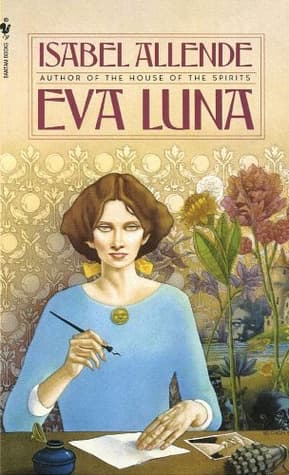
Isabel Allende (1987)
Genre
Literary Fiction / Historical Fiction / Romance
Reading Time
600 min
Key Themes
See below
Sign in to track this book
Orphaned and poor, Eva Luna tells her remarkable life story through vivid tales, changing her South American world with imagination and the diverse people she meets.
Eva Luna is born in an unnamed South American country. Her mother, Consuelo, is a beautiful, clairvoyant indigenous woman. Her father, an Austrian gardener, dies from a snakebite shortly after Eva's conception. Consuelo, who used to work for a German professor, raises Eva in modest conditions, often moving from one employer to another. Consuelo has a mystical link to the spirit world, talking to ghosts and predicting events, which greatly influences how Eva sees reality. Eva's earliest memories include her mother's fantastic stories and the unique people who entered their lives, setting the stage for Eva's own storytelling talent. Consuelo eventually dies from a bite from a rabid dog, leaving young Eva an orphan.
After Consuelo's death, Eva goes to an orphanage run by the strict Sister Inés, where she experiences hunger and rigid rules. Her strong imagination and gift for making up tales become a way to cope and find comfort. She is later hired as a domestic servant by several employers. Many of these experiences are unfair; she is treated badly by the cruel Señora Caridad and later by the harsh Colonel Molina. During these difficult years, Eva learns to observe people closely. She begins to understand that her stories can be useful, entertaining, calming, or even subtly influencing those around her to get small favors or moments of peace.
Eva works for Matias, a tailor, and his wife, La Señora, a former prostitute. La Señora, despite her past, is kind and teaches Eva to read and write, opening new worlds for her. Eva's time with Matias is fairly stable, but she eventually runs away after Matias tries to molest her. She finds herself in a busy town and, by chance, meets a group of transvestite performers. Among them is Mimí, a famous and wise transsexual entertainer, who takes Eva under her wing. Mimí introduces Eva to the lively, complex world of the local brothel, where Eva lives and works as a maid, learning the many stories and experiences of the women there.
While at the brothel, Eva meets Rolf Carlé, a young Austrian filmmaker and photojournalist who is documenting the women's lives. Rolf is troubled by his difficult past as a child refugee in post-World War II Europe, having escaped Nazi persecution with his abusive father. He is fascinated by Eva's storytelling ability and her unique view of life. Their first meetings show a mutual curiosity and a growing attraction. Rolf's artistic sensitivity and his wish to capture truth through his camera connect with Eva's own drive to create stories, forming an early bond that will deepen later in the story.
Eva leaves the brothel and, through a series of lucky events, becomes a housekeeper for Riad Halabí, a kind and mysterious Lebanese immigrant who runs a general store. Riad is a very generous and wise man, with a cleft palate that makes his speech difficult, but he is open-hearted. He treats Eva with respect and affection, giving her the first real sense of family and stability she has ever known. Riad encourages Eva's storytelling, listening patiently to her tales and even giving her a quiet room where she can write. His home becomes a safe place, and Eva thrives under his kind support, learning about his culture and the complexities of his life.
While living with Riad, Eva sees the growing political tensions and social unrest in her country. She becomes aware of the developing guerrilla movement fighting the corrupt government. Her childhood friend, Huberto Naranjo, with whom she shared a brief, innocent closeness as children, has become a strong and determined guerrilla leader. Eva's connection to Huberto, along with her sympathy for the oppressed, draws her into the edges of the revolutionary cause. She begins to use her storytelling not just for entertainment, but as a subtle form of resistance, sharing tales that inspire hope and challenge authority among the common people she meets.
Eva's talent for storytelling eventually leads her to a job writing scripts for a popular telenovela. Her stories, full of drama, passion, and complex plots, captivate the nation. She includes parts of her own life and the stories she has gathered from the many people she has met, including the struggles of the poor and the political trouble. Her success as a writer gives her a platform and financial independence she has never known. While her stories entertain, they also subtly reflect the social and political realities of her country, often touching on themes of justice, love, and resilience, connecting deeply with the audience.
Rolf Carlé, now a well-known filmmaker and journalist, returns to the country to document the growing civil conflict. He and Eva meet again, and their earlier attraction turns into a deep love. Rolf, still troubled by his childhood trauma, finds comfort and understanding in Eva's presence and her capacity for empathy. Eva, in turn, is drawn to Rolf's intensity and his dedication to truth. Their relationship becomes a central support for both of them amid the revolution's chaos. They discover shared experiences of loss and resilience, forming a bond that goes beyond their different backgrounds and life paths.
As the country falls further into civil war, Eva and Rolf become more involved. Huberto Naranjo, now a powerful guerrilla commander, asks for Eva's help, relying on her ability to connect with people and her understanding of the local population. Rolf uses his filmmaking skills to document the terrible acts committed by both sides, risking his life to show the truth. Eva's storytelling becomes more directly political, as she creates narratives that inspire and mobilize. Their love story unfolds against a background of violence and political upheaval, testing their commitment and forcing them to face their deepest fears.
The novel ends with Eva Luna, now an accomplished writer, thinking about her life and the journey that brought her to Rolf Carlé. She has accepted her identity as a storyteller, understanding that her narratives are not just entertainment but a way to preserve memory, create meaning, and shape reality. Her relationship with Rolf is one of deep mutual respect and love, showing their shared resilience and their ability to find connection amid hardship. Eva's final act is to finish the story of her own life, bringing together her past, her current love, and the rich history of the country she calls home, confirming the lasting power of imagination and human connection.
The Protagonist
From a vulnerable orphan relying on stories for survival, Eva evolves into an accomplished writer who uses her narratives to shape reality, inspire change, and find profound love.
The Love Interest / Supporting
Rolf gradually moves from a solitary individual haunted by trauma to finding love, acceptance, and a shared purpose with Eva, allowing him to begin healing from his past.
The Supporting
Riad remains a consistently benevolent and stable figure, offering Eva a sanctuary and embodying the theme of unconditional love and acceptance.
The Supporting / Antagonist
Huberto transforms from a vulnerable street boy into a hardened revolutionary, his ideals clashing with his methods, representing the moral complexities of armed struggle.
The Supporting
Mimí remains a steadfast mentor and friend to Eva, consistently offering wisdom, protection, and a model of living authentically.
The Supporting / Mentioned
Consuelo's life and death serve as the catalyst for Eva's journey, her spirit continuing to influence Eva's perception of the world.
The Mentioned / Minor Antagonist
Señora Caridad serves as a static representation of the harsh realities Eva faces, without significant personal development.
The Mentioned / Minor Antagonist
Colonel Molina is a static character, serving as a symbol of state-sponsored brutality and the dangers Eva must overcome.
Storytelling is a basic human need and a strong force for survival, connection, and change. Eva Luna uses her stories not just to entertain, but to understand her world, cope with trauma, build relationships, and even subtly influence events. Her stories become a form of value, a defense, and eventually, a tool for social commentary and revolution. The novel itself is Eva's big story, showing how personal narratives can shape identity and history. For example, her tales to Riad Halabí strengthen their bond, and her telenovela scripts subtly reflect the country's political trouble, showing how stories can shape perception and inspire.
“I tell stories to console myself, to give order to the world, to keep my memory from fading, to invent a future, to escape from reality, to put my life in order, to give it meaning.”
The novel explores the many sides of identity, especially how it is shaped by personal history, relationships, and self-narration. Eva Luna, an orphan who constantly moves, builds her identity through the stories she tells and the experiences she gathers from the diverse people she meets. Characters like Mimí, who embraces her transsexual identity, and Rolf Carlé, who deals with his traumatic past, further show the changing and often difficult journey of self-discovery. Eva's journey is about continuously defining who she is through her voice and her ability to weave her own life into a meaningful story.
“Everyone has a story, and if you know it, you know the person.”
Despite widespread poverty, violence, and political unrest, the novel highlights the lasting human ability for love, compassion, and deep connection. Eva finds love and family in unexpected places—from the brothel with Mimí, to Riad Halabí's home, and finally with Rolf Carlé. These relationships provide comfort, stability, and emotional support, proving that even in the toughest situations, human bonds can thrive. The love between Eva and Rolf shows how to find a soulmate who understands and accepts one's deepest self, offering a strong contrast to the surrounding chaos.
“Love is a dangerous thing, but it is also the only true thing.”
The novel takes place in a volatile South American country dealing with social inequality, political corruption, and armed rebellion. It clearly shows the lives of marginalized people—the poor, the indigenous, the sexually diverse—and their struggles against oppressive governments. Characters like Huberto Naranjo embody the revolutionary spirit, while Rolf Carlé documents the injustices with his camera. Eva's own experiences with exploitation fuel her empathy and subtly influence her storytelling, making her narratives a form of resistance. The novel examines the complex reasons and often brutal realities of seeking social change through revolution.
“The poor have only one weapon: their numbers. And one dream: justice.”
Eva Luna narrates her own life story.
The entire novel is framed as Eva Luna's autobiography, told in her own voice. This device allows for a deeply personal and subjective account, emphasizing Eva's role as the ultimate storyteller. It enables her to weave together diverse narratives, jump between past and present, and offer reflective commentary on her experiences. This structure reinforces the theme of storytelling as a means of constructing identity and meaning, as the reader experiences the world directly through Eva's imaginative and empathetic perspective.
Integration of fantastical elements into a realistic setting.
Magical realism is a prominent device, blending the mundane with the miraculous. Eva's mother, Consuelo, communicates with spirits and foresees events. Animals exhibit human-like understanding, and coincidences often feel like destiny. This device enriches the narrative by suggesting a deeper, more mystical layer to reality, reflecting Eva's own imaginative perception of the world. It allows for the exploration of spiritual and cultural beliefs that transcend Western rationality, making the extraordinary feel ordinary and enhancing the novel's lyrical quality.
A series of interconnected stories within the main plot.
The novel employs an interwoven narrative structure, where Eva's main life story is punctuated by the detailed tales of the various characters she encounters. Each character's backstory—such as Rolf Carlé's traumatic childhood, Riad Halabí's journey from Lebanon, or Mimí's transformation—forms a complete, compelling mini-narrative within the larger framework. This episodic approach not only enriches the world-building but also highlights Eva's role as a collector and weaver of stories, demonstrating how individual lives contribute to the grand tapestry of human experience and the collective history of a nation.
Character names carry deeper meanings.
Many character names carry symbolic weight, subtly revealing aspects of their identity or fate. 'Eva Luna' itself, combining 'life' with 'moon,' suggests cycles, mystery, and a feminine, intuitive nature. 'Consuelo' means 'consolation,' reflecting her role in Eva's early life. 'Riad' means 'garden' in Arabic, hinting at his nurturing and settled nature. This device adds a layer of depth and literary richness, inviting readers to consider the inherent qualities and destinies suggested by the characters' appellations, often reinforcing their thematic roles within the narrative.
“Everyone has a story, and it is important to hear them all.”
— Eva's philosophy as a storyteller, emphasizing the value of every individual's narrative.
“Memory is a monster; you can't control it. It has a mind of its own.”
— A reflection on the unpredictable and powerful nature of memory, often beyond one's will.
“She had learned that when you can't control what's happening, you can challenge yourself to control the way you respond to what's happening. That's where your power is.”
— Eva's realization about agency and resilience in the face of uncontrollable circumstances.
“Happiness is not a station you arrive at, but a manner of traveling.”
— A philosophical insight into the nature of happiness, suggesting it's a journey, not a destination.
“The past is a place of reference, not a place of residence.”
— A reminder to learn from the past but not dwell there, focusing on the present and future.
“Love is like a war; easy to begin, but very hard to stop.”
— A poignant comparison highlighting the intensity and difficulty of ending a romantic relationship.
“There are no innocent bystanders. All of us are involved.”
— A statement on collective responsibility and the interconnectedness of human actions and their consequences.
“Writing is like making love. Don't worry about the orgasm, just worry about the foreplay. Work up to it, feel it, enjoy it.”
— An analogy comparing the creative process of writing to the intimacy of lovemaking, emphasizing process over outcome.
“A person needs a purpose, a dream, a passion, to survive.”
— Eva's understanding of the essential elements for a fulfilling and resilient life.
“We don't know who we are until we are tested.”
— A reflection on how challenges and adversity reveal one's true character and capabilities.
“The greatest power is the power to choose.”
— Highlighting the fundamental human freedom and agency in making decisions.
“Nothing is ever lost, only transformed.”
— A concept suggesting continuity and change, rather than absolute loss, in life's cycles.
“The poor have only one weapon: their numbers.”
— A comment on the collective strength and potential power of the marginalized.
“Silence is not empty. It's full of answers.”
— An observation on the profound insights that can be found in quiet contemplation.
Ready to see how well you understood this book? Take our interactive quiz with 10 questions.
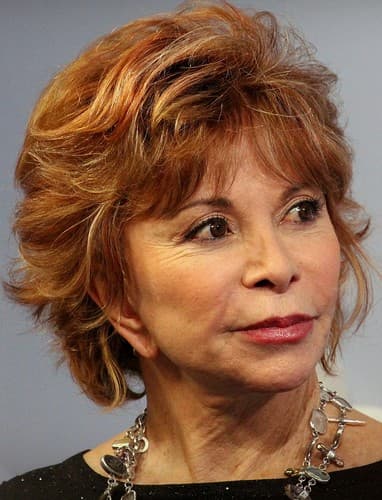
Isabel Angélica Allende Llona is a Chilean writer. Allende, whose works sometimes contain aspects of the genre magical realism, is known for novels such as The House of the Spirits and City of the Beasts, which have been commercially successful. Allende has been called "the world's most widely read Spanish-language author." In 2004, Allende was inducted into the American Academy of Arts and Letters, and in 2010, she received Chile's National Literature Prize. President Barack Obama awarded her the 2014 Presidential Medal of Freedom.







