“It’s funny how you can forget the things that no one else knew.”
— Etta reflecting on her memories and what she shares with others.

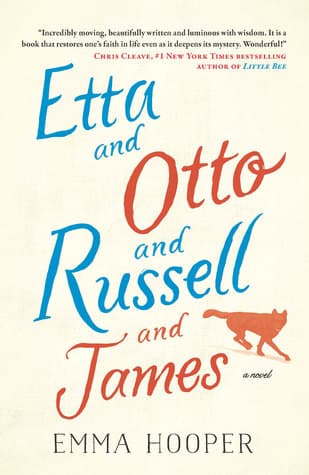
Emma Hooper (2015)
Genre
Literary Fiction / Historical Fiction
Reading Time
240 min
Key Themes
See below
Sign in to track this book
An eighty-two-year-old woman walks across Canada to see the ocean, leaving her husband and a lifelong admirer to deal with her absence and their shared, complicated past, all while she travels with a talking coyote.
Eighty-two-year-old Etta leaves her farm in Saskatchewan, planning to walk the 3,232 kilometers to the Atlantic Ocean, a dream she's had her whole life. She leaves a simple note for Otto, her husband: 'I will try to remember to come back.' She takes only a rifle, some chocolate, and her best boots. She starts early, before Otto wakes, showing an unexpected act of independence in her old age. This first act sets up the main quest and introduces the ideas of memory and achieving dreams.
Otto wakes to Etta's note and understands her desire for the ocean. Instead of following her, he deals with her absence by cooking and baking, which keeps him busy. Her leaving brings back many memories from their early life, the hard times of the Depression, and his difficult experiences in a war. His kitchen becomes a place where past and present mix, as he remembers important times with Etta and his childhood friend, Russell.
Russell, who lives on a nearby farm and has loved Etta for sixty years, hears she's gone. Despite his quiet nature and a life of following rules, Etta's journey sparks something in him. He decides to follow her, believing she needs him. This is the first truly rebellious act of his life. His decision adds a third viewpoint to the story and sends him on his own trip, driven by worry, longing, and unfulfilled love for Etta.
As Etta continues her difficult walk, her memories become clearer and more broken, blurring the lines between past and present, real and imagined. She starts talking to a coyote she calls James. James becomes her constant friend, giving her mysterious advice and company. His presence shows Etta's weakening mind but also adds a magical part to her journey, symbolizing her connection to nature and her inner world as she crosses Canada.
While Etta walks and Russell follows, Otto's memories grow stronger, especially those about his time in World War II. He clearly remembers the horrors of battle, the friendship with other soldiers, and the deep impact of seeing death. His war memories mix with his longing for Etta and his attempts to understand his life. These flashbacks show the deep emotional scars he carries and the historical background of his generation.
Russell's chase after Etta takes an artistic turn. As he travels, he carefully makes hundreds of papier-mâché animals, leaving them at different spots along Etta's likely path. These animals, from small birds to larger creatures, become a quiet, heartfelt message to Etta, showing his love and presence. This act turns his journey into a unique artistic trip, different from Etta's physical endurance and Otto's home life.
As Etta walks further east, the physical strain of her journey combines with her worsening dementia. She often loses track of where she is, who she's with, and what time period it is. Talks with James become more central, and her memories of Otto, Russell, and their shared history mix with the current scenery. The reader sees her slow decline, highlighting the sadness of her quest and the fragile nature of memory.
Alone in the farmhouse, Otto thinks about Etta and Russell. He remembers their childhood together, their shared upbringing, and the unspoken understanding between them. Otto subtly acknowledges Russell's lasting love for Etta, a love he's known about for decades. These thoughts show the deep, complex bonds that have held the three of them together throughout their lives, marked by unspoken feelings, loyalty, and sacrifices, especially in their rural Canadian lives.
After months of walking, Etta finally reaches the Atlantic Ocean. But her arrival isn't a clear win. Because of her advanced dementia, the experience is very personal and internal. The real ocean blends with her broken memories and James's presence. She sees not just the water but a mix of her past, present, and imagination. Achieving her dream is less about the physical act and more about the end of her inner journey and the stories she has lived.
The book ends without saying exactly if Etta returns or what happens to her after reaching the ocean. Instead, it focuses on how her journey affects Otto and Russell. Otto continues his home routines, changed by Etta's absence and the return of his memories. Russell, having finished his own quiet trip, finds a new sense of purpose and self-awareness. Etta's walk becomes a strong, almost mythical event that changes the lives of those she left behind, showing themes of memory, love, and the lasting human spirit.
The Protagonist
Etta begins as a woman with a clear goal, but her journey transforms into a symbolic pilgrimage of memory and self-discovery, culminating in a deeply personal experience of her lifelong dream.
The Protagonist
Otto's arc is one of internal processing, as Etta's departure forces him to confront and integrate his fragmented memories, leading to a deeper understanding of his life and love.
The Protagonist
Russell begins as a passive, unfulfilled man but undergoes a transformative journey of self-discovery and artistic expression, finally acting on his deep-seated emotions.
The Supporting
James's arc is tied to Etta's; he is a constant presence, evolving as her mental state shifts, reflecting her inner world.
The Mentioned
Not applicable, as she is a memory.
The Mentioned
Not applicable, as they are collective memories.
The book mixes past and present, often blurring them, especially through Etta's fading mind. Otto's memories of the war and his early life with Etta are clear, while Etta's journey shows her internal struggle with dementia, where childhood, marriage, and the present exist together. The broken story structure reflects how memory isn't linear, suggesting our past is always with us, shaping how we see things and act. The story implies that memory is not just recalling facts but a changing, often unreliable, force that defines who we are.
““I will try to remember to come back,””
At its core, the book looks deeply at different kinds of love: the lasting, quiet devotion between Etta and Otto, Russell's unreturned but loyal love for Etta, and Etta's love for a lifelong dream. Etta's walk is an act of love for herself and her unfulfilled wish. Otto's home routines are acts of love and remembrance. Russell's papier-mâché animals are a quiet, artistic expression of his deep longing. The story shows how love, spoken or not, forms the basis of human connection and drives amazing actions.
““He had loved Etta for sixty years. He would find her.””
Each main character goes on a kind of pilgrimage. Etta's physical walk across Canada is a literal journey toward a lifelong dream, symbolizing a search for purpose in old age. Otto's journey is internal, a trip through his memories to understand his past and his relationship with Etta. Russell's journey is both physical and spiritual, as he follows Etta, finding his own purpose and showing his hidden feelings through art. These journeys suggest that finding purpose, even late in life, can be a life-changing experience.
““She had never seen the ocean. So she would walk.””
The book itself shows the power of storytelling, both in its structure and the characters' inner lives. Etta's journey becomes a story she tells herself, a way to understand her broken reality. Otto puts his life together through his memories, creating his own story of love and survival. Russell's papier-mâché animals are a form of silent storytelling, leaving a trail of his devotion. The book shows how stories—personal, shared, and imagined—give shape to our experiences and help us deal with the complexities of life and memory.
““The stories we tell ourselves, they matter.””
The challenges of aging, especially dementia, are central to Etta's journey. Her physical decline and mental worsening are shown with care and realism. The book explores the fear of forgetting, losing oneself, and trying to keep dignity in old age. It also touches on how relationships end and the bittersweet feeling of looking back on a long life, reminding readers that time is precious and it's important to fulfill dreams before it's too late.
““The mind is a tricky thing. It remembers what it wants to remember, and forgets what it doesn't.””
The story jumps back and forth in time, interweaving past and present.
The novel frequently shifts between different time periods, often within the same chapter or even paragraph, reflecting the fragmented nature of memory, particularly Etta's experience with dementia and Otto's vivid recollections of the past. This device allows for a deeper exploration of character backstories and thematic resonance, showing how past events continuously inform the present. It creates a dreamlike quality, blurring the boundaries of reality and emphasizing the subjective experience of time.
The presence of a talking coyote introduces a fantastical element into an otherwise realistic narrative.
The character of James, Etta's talking coyote companion, is a key element of magical realism. He is presented as a real presence to Etta, offering advice and dialogue, yet his existence is ambiguous to the reader, suggesting he might be a manifestation of Etta's mind or a symbolic guide. This device allows the author to explore Etta's internal world and the effects of her dementia in a unique way, while also adding a layer of wonder and folklore to her epic journey.
Russell creates and leaves hundreds of papier-mâché animals along Etta's route.
Russell's act of creating and leaving papier-mâché animals serves as a powerful symbol of his unspoken love and devotion to Etta. Each animal represents a silent message, a tangible trace of his presence and care. They also symbolize the fragility and beauty of life, and the creative expression of deep emotion. This device transforms Russell's pursuit into an artistic pilgrimage, creating a poignant and unique testament to unrequited love and the desire to connect across vast distances.
The story is told through the alternating viewpoints of Etta, Otto, and Russell.
The novel employs a shifting narrative perspective, primarily focusing on Etta's journey, Otto's domestic life and memories, and Russell's pursuit. This allows the reader to gain a comprehensive understanding of the central events and their emotional impact on each character. It highlights the different ways individuals cope with loss, longing, and the passage of time, and reveals the complex interconnections between their lives, even when physically separated. The differing perspectives enrich the thematic exploration of love, memory, and purpose.
“It’s funny how you can forget the things that no one else knew.”
— Etta reflecting on her memories and what she shares with others.
“The world is full of things that can’t be explained, and some things are better left that way.”
— Otto's philosophical musings about life's mysteries.
“You can carry a lot of things on your back, but you can’t carry time.”
— Etta contemplating the passage of time during her journey.
“Sometimes the things you leave behind are the things that define you.”
— Russell reflecting on his past and his relationship with Etta and Otto.
“It’s not the distance that matters, it’s the walking.”
— Etta's mantra as she embarks on her long walk.
“Silence can be a very loud thing.”
— Otto experiencing the quiet solitude of his life after Etta leaves.
“There are some things you just have to do, even if you don't know why.”
— Etta explaining her impulsive decision to walk to the ocean.
“Love is not a straight line, it’s a winding road.”
— A reflection on the complexities and detours in relationships.
“Every step is a new story, and every story is a new step.”
— The narrative style often blending Etta's physical journey with her memories.
“The greatest adventures are often the ones you don't plan.”
— Etta's spontaneous journey across Canada.
“You can’t erase what’s written, but you can choose how you read it.”
— A thought about interpreting past events and memories.
“Sometimes the smallest things hold the biggest weight.”
— Otto considering the significance of seemingly minor details in his life.
“We are all just trying to get to the ocean, one way or another.”
— A metaphorical statement about life's ultimate goals and destinations.
“Memory is a funny thing, it changes every time you look at it.”
— Various characters reflecting on their personal histories and how they evolve.
Ready to see how well you understood this book? Take our interactive quiz with 10 questions.







