“The past is like a string. You can tie knots in it, but you can never really cut it.”
— Kira reflects on the difficulty of escaping one's past.

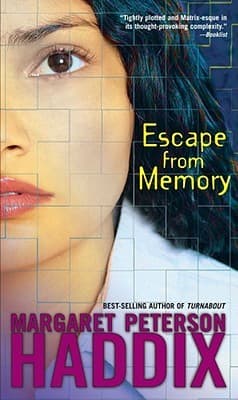
Margaret Peterson Haddix (2003)
Genre
Fantasy / Children's / Mystery / Science Fiction / Young Adult
Reading Time
240 min
Key Themes
See below
Sign in to track this book
After a party hypnotism unlocks fragmented memories of a forgotten past and a vanished mother, Kira must journey to the clandestine country of Crythe with a mysterious 'aunt' to unearth the dangerous truths hidden within her own mind before those same memories become a death sentence.
Thirteen-year-old Kira Moore attends a party with her friend, Ian, where they experiment with hypnotism. When Ian hypnotizes Kira, she unexpectedly recalls a vivid, terrifying memory: fleeing a war-torn country with her mother, speaking a language she does not recognize. The memory is so real it shakes her, leaving her disoriented and disturbed. She tries to dismiss it as a trick of her imagination, but the intensity of the experience lingers. The next morning, the memory continues to trouble her, making her question her own past and the life she believes she knows, setting a tone of unease for what is to come.
A few days after the hypnotism incident, Kira's mother mysteriously disappears, leaving only a cryptic note. Before Kira can fully process her mother's absence, a woman named Memory appears at their door, claiming to be Kira's long-lost aunt. Aunt Memory insists that Kira's mother is in grave danger and that they must go to a place called Crythe, a country that does not officially exist, to rescue her. Kira is skeptical but feels she has no other choice. Aunt Memory's demeanor is unsettling, and her explanations are vague, increasing Kira's apprehension about the true nature of her mother's disappearance and her 'aunt's' intentions.
Aunt Memory takes Kira to Crythe through a hidden portal, revealing a technologically advanced but strangely isolated society. Crythe is a place where memories are meticulously managed and often suppressed. Kira quickly notices that Aunt Memory's behavior is increasingly controlling and secretive. Aunt Memory constantly questions Kira about her past and the memory she recalled during hypnotism, hinting that these memories are crucial and dangerous. Kira also observes the strange, almost robotic obedience of some of Crythe's inhabitants, further fueling her unease and making her question the true purpose of their journey and Aunt Memory's real agenda.
Kira learns about the Institute, a central facility in Crythe dedicated to memory manipulation and preservation. It becomes clear that Crythe's authorities control its citizens through altering and implanting memories. Kira overhears conversations and sees glimpses of the Institute's operations, realizing that her own 'forgotten' memories are not just random recollections but highly sought-after information. She understands that her mother's disappearance and her own presence in Crythe are directly linked to these memories. The realization dawns on her that she is not there to rescue her mother, but that she herself is the target, and her memories hold a dangerous secret.
To her shock, Kira encounters Ian, the boy who hypnotized her, in Crythe. Ian reveals that he too was brought to Crythe under false pretenses. He explains that Crythe is a secret haven for children rescued from war-torn regions, their memories of their past lives erased and replaced with new, fabricated ones to protect them from trauma and to create a compliant society. Ian confirms that Kira's mother, a former 'memory-wiped' refugee herself, was trying to help her remember her true past. This revelation shatters Kira's understanding of her identity and her entire life, making her question everything she thought she knew about her family and her origins.
Kira learns that she is a 'Memory Suppressor,' a person with an unusual natural resistance to Crythe's memory-altering technology. This explains why the hypnotism worked and why her forgotten memory resurfaced. Her mother, it turns out, is also a Suppressor and had been working to help other children, including Kira, regain their original memories, believing it was their right to know their true pasts. The 'aunt' Memory is an agent of Crythe's governing body, tasked with capturing Kira and ensuring her memories remain suppressed. Kira realizes the immense danger she and her mother are in, as their ability to recall original memories threatens Crythe's entire system of control.
Armed with the truth, Kira and Ian decide they must escape Crythe and find Kira's mother. They understand that Kira's mother is likely being held or pursued for her efforts to restore memories. They begin to plan their escape, navigating Crythe's surveillance systems and avoiding Aunt Memory's watchful eye. Their plan involves utilizing Kira's unique memory abilities to bypass some of Crythe's controls. The urgency of their situation intensifies as they realize that the longer they stay, the greater the risk of Kira's memories being permanently altered or suppressed, making her mother's efforts futile.
Kira finally confronts Aunt Memory, who attempts to force her to undergo a complete memory wipe. During this intense confrontation, Kira manages to access a crucial, deeply suppressed memory. This memory reveals that her original name was Elara, and her mother's name was Anya. They were refugees from a war-torn country, and her mother had entrusted her with vital information—a code or a location—that could expose Crythe's operations or lead to a safe haven for others. This memory is not just personal; it is a dangerous secret that Crythe's leaders are desperate to keep buried, explaining their relentless pursuit of Kira and her mother.
Following the clues from Kira's recovered memories, she and Ian infiltrate the deepest levels of the Institute, the heart of Crythe's memory manipulation. They find Kira's mother, Anya, who is being held captive and subjected to memory-erasing procedures. Anya, weakened but still defiant, recognizes Kira and confirms the importance of the memories Kira has regained. Together, they initiate their escape plan, facing down Crythe's security forces. The trio must work together, combining Anya's knowledge of Crythe's weaknesses with Kira's unique abilities and Ian's resourcefulness, to navigate the labyrinthine facility and reach the outside world.
Kira, Anya, and Ian manage a harrowing escape from Crythe, using a combination of wit, courage, and a bit of luck. They pass through the hidden portal, returning to the 'outside' world, forever changed by their experiences. Kira now fully understands her true identity as Elara and the implications of her past. While they are safe, the future remains uncertain. They carry the burden of their regained memories and the knowledge of Crythe's existence. The ending suggests that their fight is not over, as they now face the challenge of living with their true histories and potentially exposing Crythe's secrets to protect others from a similar fate, embracing their identities as survivors and truth-tellers.
The Protagonist
Kira transforms from a naive, memory-wiped girl into a self-aware 'Memory Suppressor' who reclaims her true identity and past.
The Supporting / Catalyst
Anya's arc is one of sustained resistance and sacrifice, culminating in her reunion with Kira and continued fight for truth.
The Supporting / Ally
Ian evolves from a curious friend to a courageous and resourceful ally, helping Kira navigate the dangers of Crythe and reclaim her past.
The Antagonist
Aunt Memory remains steadfast in her loyalty to Crythe, failing in her mission to control Kira's memories.
The Mentioned / Antagonistic Force
Their arc is one of continued control, challenged but not fully overthrown by the end of the story.
The central theme is about how memories shape identity. Crythe's entire society is built on the premise that erasing painful pasts and implanting new memories creates a better, more compliant populace. However, Kira's journey demonstrates that true identity is linked to one's authentic memories, both good and bad. Her struggle to reclaim her past as Elara, despite the dangers, highlights the human need to know one's origins and experiences. This is evident when Kira's suppressed memories resurface, creating a crisis of identity and propelling her quest for truth, as seen in her initial disorientation after the hypnotism and her later determination to find her mother.
“What if the memories that made you who you were weren't your own?”
The narrative constantly pits the pursuit of truth against pervasive deception. Crythe is a society built on lies, fabricating entire life stories for its citizens and presenting a benevolent facade. Aunt Memory embodies this deception, appearing as a caring relative while actively working against Kira's true interests. Kira's journey is one of peeling back layers of lies to uncover the uncomfortable truth about her past, her mother, and Crythe itself. The story suggests that while truth can be painful and dangerous, it is ultimately liberating and necessary for genuine self-awareness and freedom. The slow unveiling of Crythe's true purpose and Aunt Memory's real identity are prime examples of this theme.
“Sometimes the truth was a dangerous thing to know.”
The conflict between individual freedom and societal control is a driving force in the book. Crythe is an extreme form of control, where a governing body dictates not only actions but also thoughts and memories, believing it fosters peace and order. However, characters like Kira and Anya fight for the freedom to remember, to choose their own narratives, and to live authentically. Their resistance highlights the human desire for autonomy and the dangers of a society that sacrifices individual liberty for perceived stability. The entire system of Crythe, with its memory-altering technology and surveillance, is a manifestation of this theme, contrasting sharply with Kira's desperate desire to escape and live freely.
“They thought they could erase us, but they couldn't erase who we really were.”
The book explores the complex nature of family, particularly in the context of adoption, hidden pasts, and genetic bonds. Kira's initial understanding of her family is shattered when she discovers her mother's true identity and her own origins. The 'family' presented by Aunt Memory is a deceptive construct, contrasting sharply with the deep, protective bond Kira shares with her biological mother, Anya. The story suggests that true family ties transcend fabricated memories and are rooted in genuine connection, love, and a shared history, even if that history is difficult. Anya's unwavering efforts to reach Kira and help her remember underscore the enduring power of familial love.
“Family wasn't just blood. It was memories. It was knowing. It was loving.”
A casual party game that accidentally unlocks Kira's suppressed memories, serving as the inciting incident.
The act of hypnotism is the crucial plot device that kicks off the entire story. It is presented as an innocent game at a party, but its unexpected effect on Kira reveals her unique 'Memory Suppressor' ability and bypasses Crythe's memory-altering technology. This device serves as the initial disruption to Kira's seemingly normal life, introducing the core mystery and setting her on a path to uncover her true past. Without the hypnotism, Kira's memories would likely have remained buried, and the central conflict would never have emerged.
A secret, technologically advanced society that manipulates memories to control its citizens.
Crythe functions as both a setting and a major antagonist. Its existence as a hidden, non-existent country allows for the creation of a unique dystopian society where memory manipulation is commonplace. The advanced technology within Crythe, particularly the Institute, is integral to the plot, as it explains how memories are suppressed and how Kira's mother's efforts to reverse this process are so dangerous. Crythe's secretive nature and its authoritarian control over its inhabitants drive much of the suspense and conflict, making it a formidable obstacle for Kira and her allies.
Individuals with a natural resistance to memory alteration, crucial to the story's conflict and resolution.
The concept of 'Memory Suppressors,' like Kira and her mother, is a key plot device that provides the protagonists with a unique ability to combat Crythe's system. This genetic anomaly explains why Kira's memories could be triggered by hypnotism and why Anya's efforts to restore memories are possible. It creates a specific type of hero who possesses the very thing Crythe seeks to eradicate – an authentic, resistant memory. This device not only defines the protagonists' abilities but also creates the central tension: the hunt for those who can remember their true pasts.
A short, mysterious message left by Kira's mother, serving as a clue and a call to action.
Kira's mother's cryptic note, left before her disappearance, is a classic plot device used to propel the protagonist into action and introduce an element of mystery. Its vague but urgent message hints at danger and a hidden truth, compelling Kira to follow 'Aunt Memory' even when she has doubts. The note acts as a breadcrumb, guiding Kira forward while keeping her in suspense about her mother's true fate and the meaning behind the unfolding events. It symbolizes the hidden truths that Kira must uncover.
“The past is like a string. You can tie knots in it, but you can never really cut it.”
— Kira reflects on the difficulty of escaping one's past.
“Sometimes, the only way to find out who you are is to find out who you aren't.”
— Kira grapples with her fragmented memories and uncertain identity.
“A memory is just a story we tell ourselves about the past.”
— A character discusses the subjective nature of memory.
“The hardest part about not knowing who you are is not knowing who you can trust.”
— Kira's internal struggle with her amnesia and suspicious surroundings.
“Even if you can erase the memory, you can't erase the person it made you.”
— A character ponders the lasting impact of experiences, even forgotten ones.
“Secrets are like shadows. They follow you, even when you try to run.”
— Kira feels pursued by the unknown truths of her past.
“What if the truth is something you don't want to remember?”
— Kira considers the potential pain of recovering her lost memories.
“You can't build a future on a foundation of lies.”
— A character emphasizes the importance of honesty and truth.
“The scariest monsters are the ones you can't see, the ones inside your own head.”
— Kira's internal battle with her fragmented memories and fears.
“Home isn't a place, it's a feeling. It's where you belong.”
— Kira searches for a sense of belonging amidst her confusion.
“Sometimes, the people who are trying to help you are the ones you need to be most afraid of.”
— Kira's growing suspicion of those around her.
“Memory is a fragile thing. Easy to break, hard to put back together.”
— A description of the delicate nature of human memory.
“The greatest prison is not being able to know who you truly are.”
— Kira's feeling of being trapped by her amnesia.
“Even shattered pieces can still tell a story.”
— Kira begins to piece together fragments of her past.
Ready to see how well you understood this book? Take our interactive quiz with 10 questions.

Biography coming soon.







