“There was no justice in the world, and very little of the other thing.”
— Granny Weatherwax's cynical view of the world.

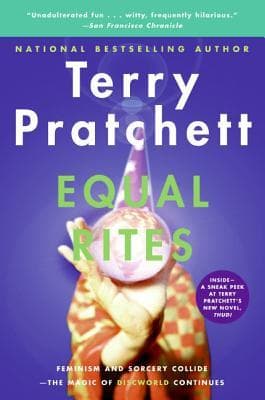
Terry Pratchett (1987)
Genre
Fantasy / Science Fiction
Reading Time
228 min
Key Themes
See below
Sign in to track this book
A young girl with wizarding powers defies ancient traditions to enter an all-male university and save Discworld from a magical cataclysm.
On the Ramtop Mountains, the eighth son of an eighth son is about to be born in Bad Ass village. This child is meant to be a powerful wizard. Unseen University wizard Drum Billet, sensing his death and the birth, teleports to the village to pass on his staff and magic. In his rush, he fails to notice that the baby is a girl, Eskarina Smith. Billet dies, leaving his staff in Esk's hand, confusing her parents and the village. The magical inheritance takes hold, setting up a challenge to the gendered nature of magic.
Granny Weatherwax, the powerful witch of Bad Ass, hears about the magical infant. She recognizes the imbalance caused by a girl inheriting a wizard's power. Granny takes Eskarina in, planning to train her in witchcraft, the traditional magic for women. Granny believes a wizard's staff in a girl's hands goes against the natural order and that Esk must avoid wizardry. Esk, however, shows an innate talent for the staff's magic, often doing things beyond typical witchery, much to Granny's frustration and occasional admiration.
As Esk grows, her wizardly power becomes clear and harder for Granny to manage. The staff, with its own magic, often acts on its own, causing magical disruptions. Realizing that traditional witch training is not enough, Granny decides they must go to Ankh-Morpork and face the male-dominated Unseen University. She hopes to find a way for Esk to either get rid of the wizard's magic or be allowed to learn at the University, an unheard-of idea for the reclusive wizards.
In Ankh-Morpork, Esk and Granny find a busy, chaotic city. Granny tries to get Esk into Unseen University, but they are firmly refused. The Archchancellor and senior wizards are horrified by the idea of a female wizard, citing old traditions and the belief that women simply cannot wield wizardry. They argue that female magic is different and not compatible with the University's structured, theoretical approach. Esk, frustrated and hurt, feels the weight of centuries of patriarchal magical tradition.
While exploring the city, Esk meets Simon, a young, very talented, but socially awkward boy who recently joined Unseen University. Simon has an extraordinary natural talent for magic, able to change reality in deep ways. He also has strange, unsettling dreams of a place beyond the universe, a void that calls to him. Esk finds a connection with Simon, and they discover a shared link to the fabric of magic, hinting at a deeper, universal magic that goes beyond gender and traditional boundaries.
Granny, always clever, arranges for Esk to work as a scullery maid at Unseen University. This gives Esk an unofficial way in, letting her watch and learn from the wizards from the shadows. She attends lectures hidden in the rafters, practices spells in secret, and learns wherever she can. Her presence, though mostly unnoticed, sometimes causes subtle magical disruptions as her wizardly power connects with the University's old magical currents, further unsettling the established order.
Simon's magical abilities continue to grow quickly, far surpassing his peers and even many senior wizards. His obsession with the 'beyond' increases, fueled by his unique connection to magic. He starts to neglect his physical health, becoming thin and withdrawn, his mind increasingly taken over by the cosmic void he sees. His magic, powerful as it is, becomes erratic and dangerous, accidentally creating small tears in reality and drawing the attention of the senior wizards, who are both amazed and scared by his potential.
Simon's powerful, unfocused magic eventually tears a hole in reality, allowing 'Things' – formless, evil entities – from the 'beyond' to seep into Discworld. These entities are drawn to raw magic and threaten to consume all reality. The wizards, at first dismissing Simon's talk, slowly realize the growing danger as magical problems increase and the world itself seems to unravel. The Archchancellor and senior faculty understand the immense threat Simon's uncontrolled power poses.
As the 'Things' from beyond grow stronger, Simon becomes more connected to their dimension, his body slowly dissolving into pure magical energy. The wizards are paralyzed by fear and tradition, unable to fight the threat effectively. It falls to Esk and Granny Weatherwax to deal with the crisis. Granny, despite her initial dislike of wizardry, recognizes the unique nature of Esk's power and the need to break tradition. Esk, using both her wizardly talent and the practical wisdom from Granny, prepares for a confrontation.
In the final confrontation, Esk and Granny enter the chaotic, merging realities where Simon is being consumed by the 'Things.' Granny Weatherwax uses her powerful, intuitive witchcraft, while Esk uses her raw, wizardly power, enhanced by her unique perspective. They realize that the 'Things' are not evil, but simply a different form of existence that cannot coexist with Discworld's reality. Together, they use their combined, complementary magic to create a strong, focused spell that seals the breach in reality and pulls Simon back, restoring him to his physical form.
With Discworld saved and Simon restored, the senior wizards of Unseen University must rethink their strict traditions. Eskarina, having shown that a woman can wield wizardry and save the world with it, challenges the basic gender divide in magic. While she does not formally enroll as a wizard, she finds her own path, combining aspects of both wizardry and witchcraft. Her presence starts a quiet revolution, suggesting a future where magic is not limited by gender but by talent and purpose, hinting at a more inclusive understanding of power.
The Protagonist
Esk transforms from a bewildered child with inherited power into a confident young woman who forges her own unique path in magic, bridging the gap between wizardry and witchcraft.
The Supporting
Granny's rigid adherence to tradition is challenged and softened by Esk's unique situation, leading her to accept a more fluid understanding of magic.
The Supporting
Simon's journey takes him to the brink of dissolution into pure magic, only to be pulled back to a more grounded, though still extraordinary, existence by Esk and Granny.
The Mentioned
N/A (dies at the beginning)
The Supporting
Cutangle's rigid adherence to tradition is shaken by the events, forcing him to grudgingly acknowledge the possibility of female magic.
The Supporting
The Senior Wizards collectively move from staunch opposition to grudging, fearful acceptance of Esk's existence and the need for new magical perspectives.
The main theme of 'Equal Rites' is the strict and unfair nature of gender roles, especially in magic. The novel shows how society, and in this case, the magical establishment, dictates what men and women can and cannot do, often based on old traditions rather than actual ability. Esk's journey is a fight against the deep-seated sexism of Unseen University, which believes women cannot be wizards. Her existence and success prove that power and talent do not belong to one gender, challenging the foundations of Discworld's magical patriarchy. The wizards' refusal to admit Esk, despite her clear talent, exemplifies this.
“A man's magic is in the head. A woman's magic is in the heart. Or the other way around. Or something. It was all very complicated.”
The conflict between sticking to tradition and the need for new ideas drives the story. Unseen University holds onto old, often outdated, traditions, where 'things are done this way because they've always been done this way.' Granny Weatherwax, though traditional herself, is also practical and can adapt when needed. Esk, by her very existence, forces both the University and Granny to question their long-held beliefs. The crisis with the 'Things' from beyond shows the danger of being too rigid, as the wizards' traditional spells prove useless, requiring a new approach.
“The problem with having spent your entire life in an ancient university, learning about things that were, on the whole, dead, was that you were never, on the whole, ready for things that were not.”
The novel explores the many sides of magic, contrasting the structured, theoretical wizardry of Unseen University with the practical, intuitive, and community-focused witchcraft of the Ramtops. Wizardry is shown as intellectual and abstract, dealing with big, cosmic forces. Witchcraft is grounded, focused on everyday problems, and often involves empathy and psychology. Esk's unique position, having both types of magic, suggests that true power is a mix of both – a balanced approach that includes the theoretical and the practical, the cosmic and the personal. Simon's magic also represents a raw, untamed form that blurs conventional understanding.
“Witches were not like wizards. They were not great, they were small. They were not clever, they were wise. They were not powerful, they were strong.”
A repeated theme is the need for balance, both in magic and in the world. The magical imbalance created by a girl inheriting wizardly power starts the plot. The 'Things' from beyond represent an imbalance where a different reality threatens to overwhelm Discworld. The solution comes not from one form of magic winning over the other, but from Esk and Granny combining their distinct approaches – the 'big' magic of wizardry with the 'small' magic of witchcraft – to restore equilibrium. This suggests that harmony and effective problem-solving often come from combining seemingly opposite forces, rather than one force winning.
“Magic was too important to be left to just one half of the world.”
A magical conduit that becomes the symbol of Esk's destiny.
The staff is the physical manifestation of Drum Billet's wizardly power, passed on to Esk. It acts as a conduit for her magic, but also seems to possess a will of its own, often acting independently and leading Esk into situations that challenge the gendered magical order. It is a symbol of the power that was never meant for a girl, and its presence in Esk's hands highlights the absurdity of the gender divide in magic, forcing the narrative forward by constantly reminding characters of Esk's unique, rule-breaking status.
The wizarding institution reflects societal prejudice and stagnation.
Unseen University functions as a microcosm of patriarchal society, with its rigid traditions, bureaucratic inefficiencies, and staunch resistance to anything that challenges its established order, particularly the idea of a female wizard. Its dusty halls and complacent faculty embody the stagnation that comes from unchecked tradition. By setting much of the story within its walls, Pratchett uses the University to satirize not just academic institutions, but any system that prioritizes outdated rules and prejudice over talent and progress.
An extra-dimensional threat that forces characters to transcend their limitations.
The 'beyond' is a cosmic void from which 'Things' begin to seep into Discworld, primarily through Simon's uncontrolled magical abilities. This extra-dimensional threat serves as a catalyst, forcing the wizards, Granny, and Esk to confront a danger that traditional magic cannot easily handle. It represents the unknown and the consequences of wielding immense power without understanding or balance. Crucially, it forces the characters to set aside their prejudices and work together, as the survival of reality depends on it.
“There was no justice in the world, and very little of the other thing.”
— Granny Weatherwax's cynical view of the world.
“You can't go around telling people their world's a dream. It's just not kind.”
— Granny Weatherwax reflecting on the nature of reality and illusion.
“She was learning that in life, you could be a lady and a wizard, or a lady and a warrior, or even a lady and a dragon if you were lucky. But you couldn't be a lady and a wizard and a warrior and a dragon, all at once.”
— Esk trying to reconcile different aspects of her identity and potential.
“The librarian was a very old orangutan with a very bad temper. He didn't like being called a monkey. He was an ape.”
— A description of the Unseen University Librarian.
“There was a lot of magic in the world, but not all of it was good. Some of it was very bad indeed. And some of it just wasn't very bright.”
— A general observation on the nature of magic.
“A wizard's staff is a symbol of power. It's not actually for hitting people with. Although it can be used for that, in a pinch.”
— Granny Weatherwax explaining the practicalities of a wizard's staff.
“It was a truth universally acknowledged that a man in possession of a good fortune must be in want of a wife, unless he was a wizard, in which case he was in want of a good cup of tea.”
— A humorous twist on a famous literary opening, applied to wizards.
“She had the air of someone who has just seen something she didn't like and was considering whether to be annoyed or merely disgusted.”
— Describing Granny Weatherwax's reaction to a situation.
“People were always trying to make the world a better place, and it never worked. It just made it a different place.”
— Granny Weatherwax's view on attempts at societal improvement.
“You could always tell a witch by the way she dressed. She dressed the way she liked, and not the way other people liked.”
— Highlighting the independence and non-conformity of witches.
“The trouble with magic was that it didn't always do what you wanted. Sometimes it did what it wanted.”
— Reflecting on the unpredictable nature of magic.
“Witches are not like other people. They don't have to be. They are witches.”
— A statement on the unique identity and role of witches.
“There are some things that cannot be changed, and some things that must be changed. And sometimes, it's very hard to tell the difference.”
— A philosophical observation on fate and free will.
“Books are not about facts, they're about ideas.”
— A statement on the deeper value and purpose of books.
Ready to see how well you understood this book? Take our interactive quiz with 10 questions.
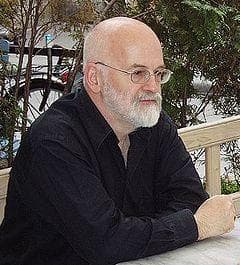
Sir Terence David John Pratchett was an English humorist, satirist, and author of fantasy novels, especially comical works. He is best known for his Discworld series of 41 novels.







