“The greatest freedom is the freedom to choose your own chains.”
— Erik reflecting on his limited choices within the game's structure.

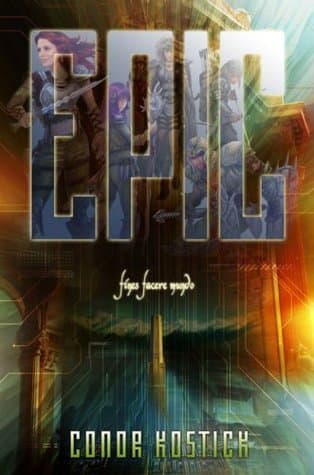
Conor Kostick (2004)
Genre
Fantasy / Science Fiction / Young Adult
Reading Time
7-8 hours
Key Themes
See below
Sign in to track this book
In a future where all conflict is resolved within a ubiquitous fantasy MMORPG, a young man seeking revenge for his parents' mistreatment dares to break the game's rules, potentially unraveling society's entire digital tyranny.
On New Earth, where physical violence is against the law, all disputes and social advancement are decided through the massively multiplayer online role-playing game, 'Epic.' Citizens spend their lives playing. Their real-world status, resources, and even food rations are directly linked to their in-game performance. Erik, a fourteen-year-old boy, lives in 'Old Home,' a farming community known for its poor yields and low status. His parents, once high-ranking players, lost their privileges and were sent to Old Home after a major loss in Epic. This unfairness makes Erik deeply resentful of the game and the Committee that runs it. It leads him to question the very basis of their society.
During a normal Epic session, Erik, frustrated by the game's unfairness and his community's constant struggle, makes a big decision. Instead of fighting as expected, he uses an obscure game mechanic to avoid a direct fight with a powerful player. This disrupts the usual way of playing. This act, while not technically against the written rules, breaks an unwritten rule of Epic: players must always fight when given the chance. His unusual strategy earns him a surprising win and quickly gets the attention of several high-ranking players and even Committee members, who are both interested and bothered by his defiance.
Erik's rebellious act sparks curiosity among other players, especially those who also feel marginalized or used by Epic's system. He starts to form alliances, beginning with his close friends, including the smart and practical Kilda, and the resourceful Pil. They share his growing belief that Epic is not a fair system but a tool of control used by the Committee. As they discuss strategies and the possibility of more subversion, the risks grow. Their unusual tactics and increasing influence in the game anger more traditional, powerful players and, more importantly, draw the direct attention of the all-seeing Committee, who see Erik's actions as a threat to their established order.
Alarmed by Erik's growing popularity and his ability to gather unhappy players, the Committee decides to act. Instead of punishing him directly, which might make him a martyr, they issue a public challenge: a grand tournament within Epic. This tournament is meant to pit Erik and his growing group against the Committee's most loyal and skilled players, including the strong 'Red Knight,' a champion of the established order. The Committee believes a public defeat will discredit Erik and confirm their authority. However, Erik and his allies see this as an opportunity, a chance to expose the game's flaws on a grand stage and potentially start a wider rebellion.
As the grand tournament goes on, Erik and his allies stand out by using very unusual strategies. Unlike other players who usually focus on individual glory and fighting skill, Erik's group emphasizes cooperation, sharing resources, and creative problem-solving. They use overlooked game mechanics, work as a team to overcome seemingly impossible challenges, and even engage in in-game diplomacy with other players not in their immediate group, subtly spreading their message of unity. Their fresh approach confuses and frustrates their opponents, including the Committee's champions, who are used to more predictable, combat-focused playstyles.
During a particularly difficult part of the tournament, Erik and his team notice odd behavior and abilities in some of their opponents. Through careful observation and analysis, they figure out that certain high-ranking players, especially those close to the Committee, have abilities and knowledge impossible for regular players to get. They realize these individuals are not just skilled players, but 'Game Masters' — people with direct, hidden access to Epic's backend, allowing them to manipulate the game. This confirms Erik's suspicions about the game's unfairness and the Committee's deliberate deception.
Knowing about the Game Masters, Erik and his team plan a bold move for the tournament's final stages. Their goal is no longer just to win, but to publicly expose the Committee's cheating and the true nature of Epic to all players on New Earth. They strategically move to force the Game Masters into situations where their illegal abilities become clear to the wider player base. The final confrontation is not just a battle of skill, but a battle for truth and openness, played out on Epic's most public stage, with the future of New Earth at stake.
As Erik's team exposes the Game Masters' manipulations during the tournament's climax, the truth quickly spreads across New Earth. The realization that Epic, the foundation of their society, has been rigged for generations, sparks anger and a widespread uprising among players. The illusion of fairness shatters, and the Committee's authority crumbles. Players, once passive, unite in their demand for change. The system that once controlled every part of their lives begins to fall apart, as the collective will of the people overwhelms the Committee's weakening power, marking the end of Epic's oppressive rule.
With the Committee overthrown and Epic's power gone, New Earth faces a big challenge: how to build a new society free from the game's control. Erik and his friends, now seen as heroes, find themselves leading this huge task. They understand that simply destroying the old system is not enough; they must work to create a truly fair and just society where resources are shared equally, and individual worth is not decided by a game. The future is uncertain, but the promise of true freedom and self-determination for all citizens of New Earth is now possible, requiring new ways of governance and cooperation.
After the revolution, Erik, Kilda, Pil, and their allies take on leadership roles, guiding New Earth through the complex change. They focus on creating transparent governance, ensuring fair resource distribution, and building a society where individual talents and contributions are valued outside of a game. The challenges are huge, from re-educating a population used to Epic's rules to designing new economic and social structures. Erik's journey from a frustrated youth to a revolutionary leader ends with his dedication to building a lasting legacy of freedom and real self-governance for all citizens of New Earth, ensuring that the lessons from Epic's tyranny are never forgotten.
The Protagonist
Erik transforms from a rebellious individual seeking personal justice into a charismatic leader who spearheads a revolution to dismantle the oppressive Epic system and build a new society.
The Supporting
Kilda develops from a supportive friend to a key strategic leader in the revolution, playing a vital role in planning and implementing the new societal structures.
The Supporting
Pil remains a steadfast and resourceful supporter, growing in confidence and contributing significantly to the practical aspects of the revolution and rebuilding.
The Antagonist
The Committee, initially an unassailable authority, is ultimately exposed and overthrown by the combined efforts of Erik and the awakened populace.
The Antagonist/Supporting
The Red Knight serves as a powerful adversary, initially a symbol of the oppressive system, whose ultimate fate or realization of the truth is left open to interpretation, representing the potential for even loyalists to question the system.
The Antagonist
The Game Masters are exposed as the instruments of the Committee's deception, leading to the public's outrage and the collapse of the system they upheld.
The Mentioned/Supporting
Their story serves as a tragic backstory that directly motivates Erik's rebellion, leading to their eventual vindication through his actions.
The novel shows how an authoritarian regime, the Committee, controls its people by manipulating a seemingly harmless system, the game Epic. By linking all societal value, resources, and food to in-game performance, the Committee creates a highly competitive and individualistic society where disagreement is impossible without risking survival. The revelation that Epic is rigged through 'Game Masters' highlights the sneaky nature of this control, as citizens are not only oppressed but actively lied to. Erik's struggle directly challenges this manipulation, showing the importance of questioning authority and seeking truth.
““The game was a mirror, reflecting what they wanted us to see. But the true game was played by the Committee, and we were merely their pawns.””
Epic's design encourages extreme individualism and competition, as players are rewarded for personal wins and penalized for losses. However, Erik and his allies succeed precisely because they reject this idea, embracing cooperation, teamwork, and sharing resources. Their unusual strategies, which prioritize group success over individual glory, allow them to overcome challenges that traditional, individualistic players cannot. This theme suggests that true strength and societal progress come from unity and mutual support, rather than fierce competition, directly opposing the values promoted by the oppressive system.
““We had always been taught to fight alone, to triumph alone. But the real victory lay in fighting together.””
At its heart, 'Epic' is a story about finding truth and justice in a world built on lies. Erik's initial resentment comes from the unfairness his parents faced, but his quest grows into exposing the fundamental unfairness of Epic itself. The discovery of the 'Game Masters' and the Committee's manipulation fuels this quest. The characters realize that true justice cannot exist until the truth about the system is revealed to everyone. The story's climax is not just about winning a game, but about publicly revealing the deception, showing that truth can powerfully drive a revolution.
““They built their world on a lie, and the only way to tear it down was to show everyone the truth.””
The novel blurs the lines between Epic's virtual world and New Earth's physical reality. For generations, the game has controlled every part of life, making the virtual world effectively more 'real' in terms of consequences than physical existence. Food, status, and freedom are all decided by in-game performance. This theme explores how virtual constructs can become so widespread that they define and control reality, raising questions about identity, purpose, and how technology can become a tool of oppression. The characters' struggle is to take back their physical reality from the virtual prison.
““Our lives were lived in the game, our worth decided by pixels. But the hunger was real, the fear was real.””
The story carefully tracks Erik's progress from individual acts of defiance against Epic's 'unwritten rules' to a full societal revolution. It shows how small acts of rebellion, when strengthened by shared complaints and smart leadership, can combine into a powerful movement capable of overthrowing a deeply rooted, oppressive system. The story emphasizes the courage needed to challenge the status quo, the importance of gathering others for a cause, and the collective power of a population awakened to injustice. The revolution is fought not just in the game, but in the hearts and minds of the people.
““One spark can ignite a forest, if the wood is dry enough.””
Epic is not just a game, but the literal framework for New Earth's entire society.
This central plot device establishes the high stakes and unique conflict of the novel. By making Epic the sole arbiter of social status, resource allocation, education, and even survival, the author creates a world where the virtual directly dictates the physical. This device ensures that every action within the game has profound real-world consequences, elevating gameplay to a matter of life and death. It also allows for a clear antagonist (the Committee controlling the game) and provides a tangible, albeit virtual, battlefield for the revolution.
Implicit societal norms within Epic that Erik defies.
While Epic has explicit rules, the 'unwritten rules' represent the ingrained social conditioning and expected behavior of players. Erik's defiance of these unwritten rules (e.g., avoiding direct combat, cooperating unexpectedly) is his initial act of rebellion. This device highlights the insidious nature of control; even without explicit laws, societal expectations can be just as binding. By breaking these unspoken norms, Erik challenges the very fabric of the system and signals his willingness to subvert the Committee's authority, paving the way for more overt acts of resistance.
Secret players with hidden advantages who manipulate Epic for the Committee.
The Game Masters serve as the ultimate reveal of the Committee's corruption and the rigged nature of Epic. This plot device functions as the physical manifestation of the system's unfairness, confirming Erik's suspicions that the game is not a meritocracy but a tool of control. Their existence raises the stakes significantly, transforming the conflict from a game of skill into a battle against deliberate deception. Exposing the Game Masters becomes the crucial turning point, catalyzing the widespread rebellion by proving to the populace that they have been systematically cheated.
A public, high-stakes event used by the Committee to neutralize dissent.
The Grand Tournament is a classic plot device, providing a structured arena for the central conflict. For the Committee, it's a strategic move to publicly defeat and discredit Erik. For Erik, it's an opportunity to expose the truth on the largest possible stage. This device creates escalating tension, allows for dramatic confrontations, and provides a clear narrative arc for the characters' journey. Its public nature is crucial for the eventual uprising, as the exposure of the Game Masters during such a prominent event ensures maximum impact and widespread awareness.
“The greatest freedom is the freedom to choose your own chains.”
— Erik reflecting on his limited choices within the game's structure.
“Sometimes, the only way to win is to change the rules of the game.”
— Erik contemplating how to overcome the oppressive system.
“A hero is not someone who never falls, but someone who gets up every time they fall.”
— A general lesson Erik learns about resilience.
“The game was designed to divide us, but it only showed us how to unite.”
— Erik realizing the unintended consequence of the game's design.
“What good is a perfect world if you're not free to make it imperfect?”
— Erik questioning the nature of the seemingly utopian society.
“Ignorance is not bliss when it's forced upon you.”
— Erik thinking about the censored history and information.
“The strongest weapon is not a sword, but an idea.”
— Erik considering how he can truly challenge the system.
“Every choice you make, no matter how small, defines who you are.”
— A mentor's advice to Erik about personal responsibility.
“Fear is a cage, but courage is the key.”
— Erik overcoming his initial trepidation to take action.
“They gave us a game to keep us distracted, but we found a revolution instead.”
— A summary of the central conflict and outcome.
“The real world isn't just outside the game; it's within us.”
— Erik's realization about the internal struggle and personal growth.
“Even in a world of rules, there's always room for a little chaos.”
— Erik's playful defiance against the rigid system.
“History is written by the victors, but it can be rewritten by the brave.”
— Erik contemplating the possibility of changing the established narrative.
“The greatest adventure isn't in escaping reality, but in changing it.”
— Erik's ultimate understanding of his purpose.
Ready to see how well you understood this book? Take our interactive quiz with 10 questions.

Conor Kostick is a writer known for his "Epic" series of interactive fantasy novels. His work allows readers to make choices that shape the narrative, a hallmark of his engaging storytelling style. Kostick has established himself as a notable voice in the interactive fiction genre.







