Biography coming soon.

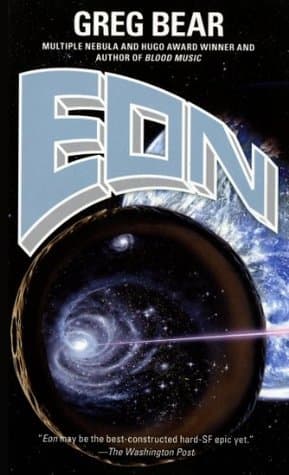
Greg Bear (1985)
Genre
Fantasy / Science Fiction
Reading Time
12 Minutes
Key Themes
See below
Sign in to track this book
A mysterious, mile-long asteroid from the future appears in Earth's orbit, offering humanity a glimpse of its own annihilation and a civilization's ultimate secret.
In 2005, with the United States and the Soviet Union on the verge of nuclear war, a massive, 300-kilometer-long asteroid appears in Earth's orbit. This sudden event stops hostilities as both superpowers and the United Nations investigate. Probes show the asteroid, named 'the Stone,' is artificial, hollow, and has an internal atmosphere. An international team of scientists, military personnel, and linguists is sent to explore it, hoping to learn its origins and purpose, and perhaps find a solution to their earthly conflicts.
Exploration teams enter the Stone and find seven huge, connected chambers, called 'Thistledown.' These chambers contain developed ecosystems: forests, lakes, rivers, and even hanging cities. To their surprise, they find evidence of an advanced human civilization, with complex architecture and technology, but it seems abandoned. The air is breathable, and the environment is well-maintained. This discovery immediately raises questions: if it's from space, how can it contain human civilization? And why does it seem to be from Earth's future?
Among Thistledown's many features, explorers find museums chronicling its inhabitants' history. These museums detail a future Earth devastated by a global conflict called 'the Death,' similar to the 21st-century nuclear standoff. Exhibits show the war's consequences, including a long 'winter' and the subsequent rebuilding by survivors who built Thistledown. This news shocks Earth's governments, as the Stone appears to be a warning from their future, detailing the war they are about to fight.
Further exploration reveals living inhabitants in Thistledown. These are descendants of future Earth-dwellers who survived the Death and built the Stone as a refuge and a way to travel through space and time. They speak English, Russian, and Chinese, reflecting 21st-century languages. The Thistledown people are technologically advanced and organized into a multi-generational society. Their interaction with 21st-century Earthlings creates diplomatic and ethical problems, as the future humans are hesitant to interfere with Earth's timeline but worry about the impending Death.
A key discovery is that the Stone is not just an asteroid, but a small part of an infinitely long, extra-dimensional structure called 'the Way.' The Way is a vast, ancient conduit that goes beyond normal space-time, allowing instant travel across immense distances and through different temporal realities. The Thistledown civilization has traveled the Way for generations, meeting various alien species. A significant alien entity, known as the Jovian (from near Jupiter in an alternate reality), also travels the Way and has a complex, often hostile, relationship with the Thistledown people. This changes the understanding of the Stone's purpose and the universe itself.
Despite shared humanity, tensions quickly grow between 21st-century Earth forces and Thistledown inhabitants. Earth's military and political leaders demand access to Thistledown's technology and history to prevent the Death, while the Thistledown people, especially Olmy's faction, are reluctant to alter Earth's past. Factions within both groups seek control. Earthlings, particularly the Soviets, try to seize parts of Thistledown, leading to skirmishes and mistrust that threatens to erupt into full conflict within the Stone, even as the global nuclear threat on Earth continues.
Patricia Vasquez, a mathematician from the 21st-century Earth expedition, finds she has an intuitive understanding of the Way's complex geometry and physics. The Thistledown people recognize this as a rare ability. Her insights become important for understanding the Way's mechanisms and navigating it. She forms a close bond with Olmy, a Thistledown leader, and through her experiences, she begins to change her 21st-century perspective, adapting to the multi-dimensional realities of the Way and its inhabitants.
The Jovian, an enigmatic, non-human intelligence that also travels the Way, is a significant threat. Its motives are unclear, but it conflicts with the Thistledown people, often manipulating the Way's structure. The Way itself is not stable; it has unpredictable shifts and instabilities that can cause catastrophic events for travelers. These 'perturbations' can sever connections, strand travelers, or destroy parts of the Way. The Thistledown people, and now the Earthlings, must deal with both the Jovian threat and the Way's volatile nature.
Divisions appear within Thistledown society about interacting with 21st-century Earth. A radical group, led by Chang, believes they must intervene directly to prevent the Death on Earth, even if it changes their own history. This group clashes with more conservative elements, like Olmy, who advocate for non-interference, fearing unforeseen consequences of tampering with causality. Chang's group ultimately tries to use Thistledown's technology to send information and personnel back to Earth more directly, hoping to avert the coming disaster.
Under pressure from both internal and external forces, the Thistledown people decide to fully activate the Stone's capabilities, opening a direct portal to the Way. This turns the Stone from a refuge into an active gateway to infinite parallel realities and timelines. The 21st-century Earthlings face the overwhelming reality of the multi-verse, as the Way offers both immense possibilities and dangers. This event is a point of no return, linking the destinies of Earth and Thistledown with the vast, incomprehensible expanse of the Way.
Internal conflicts, combined with the Way's instability and possibly the Jovian's actions, cause a catastrophe within the Stone. The asteroid, or at least the section with Thistledown and the Earth expedition, is destroyed or detached from the Way. Many die, but survivors, including Patricia Vasquez and Olmy, must abandon the Stone and fully enter the Way, becoming travelers in its infinite expanse. Patricia, using her unique abilities, transforms, evolving beyond her human form and becoming more attuned to the Way's nature, embracing her role as a navigator and explorer of its realities.
With the Stone destroyed and Earth's fate unknown, the remaining Thistledown civilization and surviving Earthlings are adrift in the Way. Guided by Patricia's evolving consciousness and Olmy's leadership, they journey through the Way's infinite corridors, seeking new realities, potential refuges, and perhaps a way to understand or influence their original timeline. 'Home' becomes a flexible concept as they adapt to constant movement and discovery, encountering new life and phenomena within the Way's boundless dimensions. Their quest is for survival and meaning in a vast universe.
The Protagonist
Patricia evolves from a skeptical scientist into a transcendent being intimately connected to the Way, ultimately becoming a navigator and explorer of its infinite realities.
The Supporting
Olmy maintains his commitment to his people and the Way's principles, adapting to new challenges while guiding Patricia's development.
The Antagonist
Chang's unwavering conviction to alter Earth's past drives him to increasingly desperate measures, ultimately leading to significant consequences for Thistledown.
The Supporting
Amerine's perspective gradually broadens from nationalistic concerns to a grudging acceptance of the Way's reality, though he remains grounded in his military training.
The Supporting
Kirov remains largely entrenched in his nationalistic mindset, becoming a significant obstacle to cooperation, though he eventually faces the overwhelming reality of the Way.
The Antagonist
The Jovian remains an enigmatic, powerful force throughout the narrative, serving as a primary external threat and a catalyst for many events within the Way.
The Supporting
Gorokhov's scientific curiosity leads him to a deeper understanding of the Way, pushing him beyond nationalistic concerns towards a broader view of existence.
The Supporting
Petya serves as a symbol of the future and the continuing journey of the Thistledown people, adapting to the Way's realities as she grows.
The novel explores the philosophical aspects of time travel and whether destiny is fixed or changeable. Thistledown, a civilization from Earth's future, provides 21st-century characters with a detailed account of their impending doom, 'the Death.' This raises the question of whether history is predetermined or can be altered. Characters deal with the ethics of knowing the future and the potential results of intervention. The Way, as a path through various timelines, further complicates this, suggesting a multi-verse where different futures might exist simultaneously.
“The past is an illusion, the future a dream, and the present... a doorway.”
A main theme is humanity's paradox: its capacity for both great destruction and remarkable resilience. 21st-century Earth is near nuclear war, showing destructive potential. In contrast, Thistledown shows humanity's ability to survive, adapt, and rebuild after catastrophe, building a civilization within an asteroid to escape a dying Earth. The story highlights the cycle of conflict and the human spirit to overcome adversity, even against overwhelming odds. It asks if humanity can learn from its past (or future) mistakes.
“We are a species that builds monuments to our own folly, then wonders why they crumble.”
The novel introduces 'the Way,' an infinite, extra-dimensional tunnel connecting countless realities and times. This concept pushes the limits of human understanding, forcing characters and readers to confront the universe's vastness and complexity beyond conventional perception. It challenges human-centered views and suggests reality is far more expansive and mysterious than usually thought. The encounter with the Jovian and the Way's instability further emphasize the limits of human knowledge and control in the face of truly alien and cosmic phenomena, creating a sense of awe and existential wonder.
“The Way is not merely a path, but a living, breathing entity, a universe unto itself, and we are but specks upon its skin.”
The interaction between 21st-century Earthlings and Thistledown inhabitants is a core theme. Though genetically the same, their vastly different experiences, technology, and societies lead to cultural misunderstandings and conflicts. The novel explores the challenges of communication, trust, and cooperation when facing such differences, especially under high-stakes conditions. It examines how ingrained biases, nationalistic interests (from Earth), and long-held traditions (from Thistledown) can hinder or help mutual understanding and the potential for a shared future.
“We were their ancestors, yet they were utterly alien to us, and we, perhaps, barbarians to them.”
Through Patricia Vasquez, the novel explores human consciousness's evolution. As Patricia interacts with the Way, her mind expands beyond conventional three-dimensional thinking, allowing her to perceive and interact with multi-dimensional realities. This transformation suggests a potential future for human awareness, where the mind can adapt to and understand increasingly complex cosmic structures. Her journey implies that true understanding of the universe might require a fundamental shift in perception and a transcendence of the physical self, leading to a new form of existence tied to the very fabric of space-time.
“To truly see the Way, one must cease to be merely human.”
A future human civilization contained within an asteroid from an alternate future.
The Stone, later revealed to contain Thistledown, is the central inciting incident and a multi-purpose plot device. Initially, it acts as a 'Deus ex machina' by appearing and halting global nuclear war. It then serves as a 'MacGuffin' for Earth forces, who seek its technology and historical data. More importantly, it is a 'setting' that is also a 'character,' a self-contained world and a time-traveling vessel. Its internal structure, with museums detailing 'the Death,' functions as a 'prophetic vision' and a 'warning' from the future, driving much of the conflict and ethical debate. It also acts as a 'cultural bridge' and 'barrier' between two versions of humanity.
An infinite, extra-dimensional tunnel that connects different universes and timelines.
The Way is the ultimate plot device, expanding the narrative scope exponentially. It functions as a 'portal' and a 'transport system,' allowing travel across vast distances and through various realities. It is also a 'source of conflict' due to its instability and the presence of other entities like the Jovian. The Way serves as a 'metaphysical concept' that challenges the characters' understanding of reality, time, and existence. Its infinite nature provides a boundless landscape for future exploration and allows for the 'escape' and 'evolution' of the Thistledown survivors, fundamentally shifting the genre from hard sci-fi to a more cosmic and philosophical exploration.
Knowledge of Earth's future, as depicted in Thistledown's museums.
The detailed historical accounts and artifacts within Thistledown's museums, particularly those describing 'the Death' (Earth's future nuclear war), serve as a powerful form of 'precognition' or 'future history.' This device creates immediate dramatic tension for the 21st-century characters, as they are confronted with their own impending doom. It acts as a 'moral dilemma,' forcing them to decide whether to accept their fate or attempt to alter it. This knowledge also fuels the internal conflicts within both the Earth and Thistledown factions, as different groups interpret and react to this future history in varied ways, leading to clashes over intervention and destiny.
An alien intelligence representing the unknown dangers of the Way.
The Jovian serves as a 'mystery' and a 'source of external conflict' within the Way. Its enigmatic nature, advanced capabilities, and often hostile interactions with the Thistledown people provide an ongoing threat that is not directly related to Earth's internal squabbles. As an 'alien intelligence,' it highlights the vastness and diversity of life within the Way, challenging human-centric perspectives. The Jovian acts as a 'catalyst' for certain events, forcing the Thistledown people and eventually the Earthlings to adapt and make difficult choices in their journey, pushing them further into the unknown and away from their origins.
Ready to see how well you understood this book? Take our interactive quiz with 10 questions.
Biography coming soon.







