“Books are not just words on a page; they are doors to other worlds, and some doors should never be opened.”
— Blake Winters reflects on the mysterious nature of the book Endymion Spring.

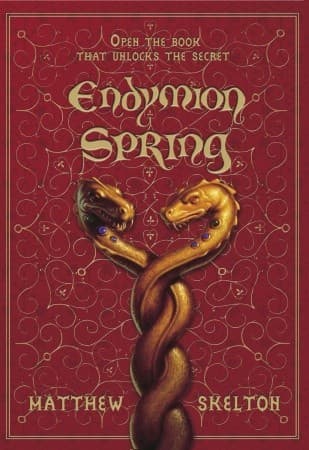
Matthew Skelton (2006)
Genre
Fantasy / Children's / Historical Fiction / Mystery / Young Adult
Reading Time
500 min
Key Themes
See below
Sign in to track this book
An ancient, blood-bound book found in an Oxford library pulls a young boy into a centuries-old mystery, where hidden words on living pages reveal a secret far more dangerous and magical than he could ever imagine.
The story begins in 1452 Mainz, Germany, with Endymion Spring, a timid apprentice in Johannes Gutenberg's printing workshop. Endymion does menial labor and is mocked by other apprentices, especially Otto. One day, while cleaning, Endymion finds a strange, blank book hidden in a heavy, serpent-clasped chest. The book is made of unique, vellum-like paper that seems almost alive. When Endymion pricks his finger on the serpent clasp, a drop of blood falls onto the blank page, causing faint, shimmering words to appear. He quickly realizes that the book, which he calls the 'Liber Noctis' (Book of Night), shows text only to him and responds to his thoughts and proximity to certain inks. Endymion begins to secretly study the book, unaware of its true power and the dangers it brings, including Gutenberg's watchful eyes and a mysterious, cloaked figure.
Centuries later, in modern-day Oxford, England, eleven-year-old Maia and her younger brother, Alex, are spending their summer vacation with their academic mother, Mary, who is researching at the Bodleian Library. Maia feels out of place and isolated, often reading books. During one of her explorations, she finds the restricted 'Duke Humfrey's Library' and is drawn to an old, heavily bound book on a dusty shelf. When she touches it, she feels a prick and sees a faint shimmer on the blank pages. This book is the same 'Liber Noctis' Endymion found centuries earlier. Maia is captivated, but her mother dismisses it as an ordinary blank book. Alex, meanwhile, finds a peculiar, empty box that seems to hum with strange energy, unknowingly connected to the book's history.
Maia's interest in the blank book grows. She notices that the pages are not truly blank; faint, shimmering words appear and disappear, visible only to her. The book seems to communicate with her, showing snippets of text that hint at an ancient, powerful secret related to printing and making books. She learns that the book is alive, a creation designed to record and reveal truths. Maia keeps her discovery a secret from her mother and Alex, feeling a deep, personal connection to the artifact. At the same time, the mysterious 'cloaked figure' from Endymion's timeline, later revealed as the enigmatic printer, starts to appear in the modern era, subtly observing Maia and the book, showing a long pursuit of its power.
While Maia learns more from the Liber Noctis, Alex discovers more about the 'empty' box he found. It is, in fact, the serpent-clasped chest that once held the Liber Noctis in Gutenberg's workshop. Alex, with his innocent curiosity, finds that the box is not truly empty but contains hidden compartments and mechanisms. He realizes it is more than just an old container; it is a key to understanding the book. The chest, like the book, seems to respond to him, revealing faint impressions and clues. This discovery links Alex directly to the historical narrative, showing that the power of the Liber Noctis and its related artifacts is not limited to Maia alone, and that the ancient secrets are starting to resurface in their present.
In the 15th-century storyline, Endymion continues to secretly study the Liber Noctis. He learns that Gutenberg is not just a craftsman but an ambitious man obsessed with the book's power to create perfect, living text. Endymion also meets the mysterious 'printer' – an ancient, shadowy figure who has pursued the Liber Noctis for centuries, believing it holds the key to immortality or ultimate knowledge. This printer, who uses various names throughout history (including Mr. Rouncewell in the modern era), is a master of manipulation and dark arts, always trying to get the book. Endymion realizes he is caught in a dangerous game between Gutenberg's possessiveness and the printer's relentless, malevolent quest.
Driven by the book's cryptic messages, Maia begins to research its origins. She looks for information about ancient printing, alchemy, and the history of the Bodleian. Her inquiries attract the attention of Mr. Rouncewell, a seemingly kind but subtly sinister old man who works at the library. Rouncewell, who is the modern version of the 'printer,' pretends to be helpful, offering Maia obscure texts and seemingly innocent advice. However, his true goal is to get closer to Maia and the Liber Noctis. Maia, still naive, senses something uneasy about him but is too focused on her quest to fully recognize the danger he poses, slowly falling into his trap.
As Maia interacts more with the Liber Noctis, the book gradually reveals its full history through shimmering images and text. She learns about Endymion Spring, his life in Gutenberg's workshop, his discovery of the book, and his growing understanding of its power. The book shows her how Endymion, guided by its magic, tried to protect it from Gutenberg and the 'printer.' Maia sees Endymion's fear, his courage, and his fate. She understands that the book itself is a living creation, with a consciousness, and that Endymion's essence, or a part of it, is tied to its pages, making his story a central part of its existence.
Mr. Rouncewell's true nature appears as he tries to take the Liber Noctis from Maia. He reveals his ancient identity as the relentless 'printer' who has pursued the book for centuries. He explains his belief that the book, combined with the serpent chest, holds the secret to eternal life and control over knowledge. Rouncewell tries to manipulate Maia, using her mother as leverage. During this confrontation, Alex, who has been reading clues from the serpent chest, realizes its connection to the book and Rouncewell's sinister plans. Alex's innocence and his ability to interact with the chest are important, as he holds a piece of the puzzle Rouncewell needs to fully activate the book's power.
The climax happens as Maia and Alex, guided by the Liber Noctis, confront the printer, Mr. Rouncewell, in a hidden chamber under the Bodleian Library. The serpent chest and the book are brought together, creating a powerful, mystical energy. Rouncewell tries to force the children to activate the book's ultimate power, believing it will grant him immortality. However, the book, through Maia, reveals that its true power is in spreading knowledge and the beauty of creation. Maia, understanding Endymion's sacrifice and the book's true purpose, makes a final, selfless choice about the Liber Noctis's fate, choosing to protect its magic from falling into the wrong hands forever.
After the confrontation, the Liber Noctis, having found a protector in Maia, changes. Its pages become truly blank, its magic diffused, or hidden, waiting for another guardian. The printer is defeated, his ancient quest finally stopped. Maia and Alex return to a normal life, but they are changed by their summer. Maia has found her voice and purpose, no longer feeling isolated but empowered by her connection to a timeless mystery. Alex has matured, his curiosity leading him to a deeper understanding of the world. The experience leaves them with a strong bond and a secret knowledge of the magic in books and the power of stories.
The Protagonist
Maia evolves from a shy, isolated girl into a brave and confident protector of the Liber Noctis, finding her voice and purpose.
The Supporting
Alex matures from a typical energetic younger brother into a courageous and insightful partner in solving the ancient mystery.
The Protagonist (historical)
Endymion transforms from a fearful and bullied apprentice into a brave guardian of the Liber Noctis, making a selfless sacrifice.
The Antagonist
His character remains static in his relentless pursuit, ultimately leading to his defeat.
The Supporting (historical)
Gutenberg's ambition for the book leads to his eventual downfall and loss of the Liber Noctis.
The Supporting
She remains largely unaware of the magical events, but her presence in Oxford sets the stage for the story.
The Mentioned (historical)
Remains a static character, representing early adversity for Endymion.
The Supporting (object/entity)
The book's purpose is to find a worthy guardian to protect its true nature and knowledge, eventually finding its resting place.
The main theme is the power of books, not just as information sources, but as living things that affect destiny. The Liber Noctis itself is a sentient book, showing that knowledge can be alive, magical, and dangerous. The story explores the responsibility that comes with such power, contrasting Gutenberg's desire to control it and the 'printer's' desire to exploit it with Endymion's and Maia's more respectful, protective relationship with the book. It suggests that true knowledge is not just about facts but about understanding, connection, and creation.
“''Words are living things,' he whispered. 'They breathe. They have blood.'”
Maia and Endymion both go through journeys of self-discovery because of their connection to the Liber Noctis. Maia, initially shy and lonely, finds her voice, courage, and purpose as she solves the book's mystery. Endymion, a timid apprentice, finds his bravery and makes a sacrifice to protect the book. The book acts as a mirror, showing their inner strengths and challenging them to grow beyond their initial situations. Their individual searches for understanding the book match their personal growth and the formation of their true identities.
“'She felt a sense of belonging she hadn't known she was missing, a quiet understanding that this book, this mystery, was hers.'”
The novel explores creation and destruction, especially in printing and knowledge. Gutenberg, a revolutionary creator, is also driven by destructive ambition. The Liber Noctis, a creation of great power, can be used for good (spreading knowledge) or evil (immortality and control). The 'printer' represents the destructive pursuit of knowledge for selfish gain. The story suggests that every act of creation can have both positive and negative results, and the intention and character of the user determine its final impact.
“'The greatest creations hold the greatest dangers.'”
The narrative connects two distinct timelines—15th-century Mainz and modern-day Oxford—to show how the past directly affects the present. The Liber Noctis is the bridge, carrying its history and Endymion's essence to Maia. The 'printer's' long life further emphasizes this theme, as his ancient quest continues across centuries. This intertwining shows the lasting nature of secrets, the echoes of historical events, and how old mysteries can resurface and need resolution in contemporary times, blurring the lines between different eras.
“'Some stories are never finished; they simply wait for a new reader.'”
The 'printer's' pursuit of the Liber Noctis is driven by his desire for immortality, believing the book holds the secret to eternal life. However, the novel redefines what true immortality means. While the printer seeks a physical, unending existence, the book itself, and Endymion's spirit within it, suggests a different kind of immortality: the lasting life of knowledge, stories, and the legacy left behind. Endymion's sacrifice and Maia's protection of the book imply that true lasting impact comes from selfless acts and the preservation of truth, rather than selfish eternal existence.
“'He did not want to live forever. He wanted the book to live forever.'”
Alternating chapters between 15th-century Mainz and modern-day Oxford.
The novel employs a dual timeline narrative, alternating between Endymion Spring's story in 15th-century Mainz and Maia's story in contemporary Oxford. This structure slowly reveals the interconnectedness of the two plots, building suspense as the reader pieces together how the past events directly influence the present. It allows for a gradual unveiling of the Liber Noctis's history and the 'printer's' ancient pursuit, creating a rich tapestry that emphasizes the timeless nature of the book's magic and the enduring echoes of historical secrets.
A magical, living book that reveals its secrets to specific individuals.
The Liber Noctis itself is the central plot device. It's not just an artifact but a sentient, magical entity that actively participates in the story. Its ability to reveal words only to Maia (and Endymion), to show its own history through shimmering text and images, and to seemingly guide its protectors, drives the entire plot. It acts as a bridge between the timelines, a source of mystery, and a character in its own right, forcing the protagonists to interact with it and understand its profound power and purpose.
A mystical chest that acts as a key to the Liber Noctis's power.
The serpent-clasped chest serves as a crucial plot device, initially appearing as a simple, ancient container. Its intricate design, particularly the serpent clasp that requires blood to open, and its hidden compartments, act as a physical key and a source of clues. Alex's discovery and interaction with the chest parallel Maia's with the book, revealing that the chest is integral to fully unlocking the Liber Noctis's power. It represents the binding and protection of ancient magic, and its reunification with the book is essential for the climax of the story.
A character who transcends time, linking the two narrative timelines.
The 'printer' is a pivotal plot device as an ageless antagonist. His presence in both the 15th century (as the cloaked figure) and the modern era (as Mr. Rouncewell) directly connects the two timelines and provides continuity to the overarching conflict. His relentless, centuries-long pursuit of the Liber Noctis creates a sense of urgency and deep-rooted danger, demonstrating the enduring power of ambition and obsession. He serves as the primary external conflict for both Endymion and Maia, embodying the threat to the book's true purpose.
A historical setting that acts as both a sanctuary and a battleground.
The Bodleian Library in Oxford is more than just a setting; it's a significant plot device. As a repository of ancient knowledge, it provides the perfect backdrop for the discovery of a magical book and serves as a symbolic sanctuary for books and learning. Its labyrinthine passages, restricted sections, and hidden chambers become a metaphorical battleground for the conflict between preserving knowledge and exploiting it. The library's historical weight and atmosphere amplify the sense of mystery and danger surrounding the Liber Noctis.
“Books are not just words on a page; they are doors to other worlds, and some doors should never be opened.”
— Blake Winters reflects on the mysterious nature of the book Endymion Spring.
“The book chooses its reader, not the other way around.”
— Blake discovers the magical book Endymion Spring in the library.
“Words have power, and some words have more power than others.”
— Blake learns about the magical properties of the book from his sister, Duck.
“In every library, there is a book that holds a secret waiting to be discovered.”
— Narrator describing the allure of libraries in the story.
“The past is not dead; it is just waiting to be read.”
— Blake contemplates the historical mysteries tied to the book.
“Fear is the lock, and courage is the key.”
— Blake musters bravery to face the dangers of the magical book.
“Some stories are meant to be hidden, and some are meant to be told.”
— Duck discusses the secretive nature of the book with Blake.
“A book without a reader is like a soul without a body.”
— Reflection on the importance of readers in bringing books to life.
“The ink of scholars is more precious than the blood of martyrs.”
— Historical reference to the value of knowledge in the book's backstory.
“Magic is not in the wand, but in the words.”
— Blake realizes the true source of the book's power.
“Every page turned is a step into the unknown.”
— Blake experiences the thrill and risk of reading Endymion Spring.
“The greatest treasures are not gold, but stories.”
— Duck reminds Blake of the value of their magical discovery.
“In the silence of a library, the loudest stories are told.”
— Narrator describes the atmosphere of the Oxford library setting.
“To unlock a mystery, you must first unlock yourself.”
— Blake learns that solving the book's puzzle requires personal growth.
Ready to see how well you understood this book? Take our interactive quiz with 10 questions.

Biography coming soon.







